Thailand Low Voltage Electric Motor Market (2026-2032) | Outlook, Revenue, Share, Value, Industry, Growth, Trends, Forecast, Analysis, Size & Companies
Market Forecast By Type (AC (Upto 60V, 60.1V - 200V and 200.1V - 1000V), DC (Upto 60V, 60.1V - 200V and 200.1V - 1000V)), By Products (Fans, Compressors, Pumps, Conveyors and Others including Centrifuges, Extruders and Winches), By Applications (Residential, Commercial, Industrial, Automotive, Power Utility and Water Treatment and Others including Defense, Agriculture, Transportation and Infrastructure) and Competitive Landscape
| Product Code: ETC000631 | Publication Date: Feb 2025 | Updated Date: Apr 2026 | Product Type: Report | |
| Publisher: 6Wresearch | Author: Ravi Bhandari | No. of Pages: 70 | No. of Figures: 35 | No. of Tables: 4 |
Thailand Low Voltage Electric Motor Market Growth Rate
According to 6Wresearch internal database and industry insights, the Thailand Low Voltage Electric Motor Market is projected to grow at a compound annual growth rate (CAGR) of 6.7% during the forecast period (2026-2032).
Five-Year Growth Trajectory of the Thailand Low Voltage Electric Motor Market with Core Drivers
Below mentioned is the evaluation of year-wise growth rate along with key growth drivers:
|
Year |
Est. Annual Growth (%) |
Growth Drivers |
|
2021 |
3.3% |
Rising industrial automation and manufacturing expansion |
|
2022 |
3.9% |
Increased adoption of energy-efficient motor systems |
|
2023 |
4.6% |
Growth in HVAC and infrastructure development projects |
|
2024 |
5.3% |
Expansion of automotive and electronics manufacturing sectors |
|
2025 |
5.9% |
Government initiatives promoting energy efficiency and smart industries |
Topics Covered in the Thailand Low Voltage Electric Motor Market Report
The Thailand Low Voltage Electric Motor Market report thoroughly covers the market by type, products, and applications. The market report provides an unbiased and detailed analysis of ongoing market trends, opportunities/high growth areas, and market drivers, which help stakeholders devise and align their market strategies according to the current and future market dynamics.
Thailand Low Voltage Electric Motor Market Highlights
| Report Name | Thailand Low Voltage Electric Motor Market |
| Forecast period | 2026 - 2032 |
| CAGR | 5.8% |
| Growing Sector | Industrial |
Thailand Low Voltage Electric Motor Market Synopsis
Thailand Low Voltage Electric Motor Market is anticipated to witness steady growth driven by factors such as increasing industrialization, growing demand for energy-efficient products, and increasing infrastructure development. In addition, the growing trend of adopting automation technologies in the manufacturing and processing industry is positively influencing the demand for low voltage motors. Government initiatives to encourage energy saving and smart industrialization are other factors that are positively influencing the low voltage motors market. Growing investments in industries such as automotive, utilities, and water treatment are also positively influencing the demand for motor products.
Evaluation of Growth Drivers in the Thailand Low Voltage Electric Motor Market
Below mentioned are some prominent drivers and their influence on the market dynamics:
| Drivers | Primary Segments Affected | Why it Matters (Evidence) |
| Rising Industrial Automation | AC Motors; Industrial | Automation increases demand for efficient motor-driven systems. |
| Growth in HVAC Systems | Fans & Compressors; Commercial | Expanding infrastructure boosts need for ventilation and cooling systems. |
| Energy Efficiency Regulations | AC & DC Motors; All Applications | Policies encourage adoption of energy-saving motor technologies. |
| Expansion of Manufacturing Sector | Pumps & Conveyors; Industrial | Industrial growth drives demand for motorized equipment. |
| Infrastructure Development Projects | All Products; Commercial & Industrial | Construction activities increase usage of electric motors. |
Thailand Low Voltage Electric Motor Market is expected to grow at the CAGR of 6.7% during the forecast period of 2026-2032. The growth in the market is attributed to the rising levels of industrial automation, the rising demand for energy-efficient motor systems, and the growth in infrastructure projects in the country. Government regulations to conserve energy and implement the latest technologies in the manufacturing industry also provide a boost to the market. Rising investments in the automotive industry, power plants, and water treatment plants also contribute to the growth in the deployment of low voltage electric motors.
Evaluation of Restraints in the Thailand Low Voltage Electric Motor Market
Below mentioned are some major restraints and their influence on the market dynamics:
| Restraints | Primary Segments Affected | What This Means (Evidence) |
| High Initial Cost of Efficient Motors | AC Motors; Industrial | Advanced motors require higher upfront investment. |
| Dependence on Imported Components | All Types; Industrial | Import reliance affects pricing and availability. |
| Maintenance and Operational Challenges | Pumps & Compressors; Industrial | Regular servicing increases operational costs. |
| Limited Awareness Among Small Enterprises | All Types; Commercial | Slower adoption of advanced motor technologies. |
| Fluctuating Raw Material Prices | All Products; Industrial | Cost instability impacts manufacturing margins. |
Thailand Low Voltage Electric Motor Industry Challenges
Despite strong growth potential, the Thailand Low Voltage Electric Motor Industry faces several practical challenges that impact its expansion. The high initial investment costs of energy-efficient motors act as a barrier for small and medium enterprises. Moreover, the use of imported technology in motors is another factor which affects the industries. Maintenance costs are another factor that increases the cost of operations for industries. Furthermore, lack of awareness about the long-term benefits of efficient motor systems is another factor which affects the adoption of motor systems by small businesses.
Thailand Low Voltage Electric Motor Market Trends
Emerging trends shaping the Thailand Low Voltage Electric Motor Market Growth are:
- Adoption of Energy-Efficient Motors: Industries are increasingly adopting high-efficiency motors for operations. This is a positive trend for sustainability.
- Integration of Smart Motor Technologies: Smart motors are becoming popular due to IoT integration for efficient operations. This is a positive trend for efficient operations.
- Growth in Electric Vehicle Manufacturing: There is a significant increase in electric vehicle manufacturing. This is a positive trend for long-term market growth as electric vehicles will require low voltage motors for operations.
- Expansion of Industrial Automation: Automation technologies are increasing reliance on motor-driven systems. This trend is improving productivity and efficiency across industries.
Investment Opportunities in the Thailand Low Voltage Electric Motor Market
Key investment areas in the Thailand Low Voltage Electric Motor Market are:
- Energy Efficient Motor Manufacturing – Investing in the production of energy-efficient motors is beneficial for sustainability. This segment has high demand from industries.
- Automation Solutions Development – Providing motor-driven automation solutions presents an opportunity. Industries are adopting smart technologies for motor-driven automation systems.
- HVAC System Expansion – Investment in motor-driven HVAC systems is growing with the development of infrastructure. This segment presents steady demand for motor applications in industries.
Top 5 Leading Players in the Thailand Low Voltage Electric Motor Market
Some leading players operating in the Thailand Low Voltage Electric Motor Market include:
1. ABB Ltd.
| Company Name | ABB Ltd. |
| Established Year | 1988 |
| Headquarters | Zurich, Switzerland |
| Official Website | Click Here |
ABB provides advanced low voltage electric motors and automation solutions widely used in industrial applications. The company focuses on energy efficiency, digitalization, and smart technologies, offering reliable products that enhance productivity and sustainability across global markets.
2. Siemens AG
| Company Name | Siemens AG |
| Established Year | 1847 |
| Headquarters | Munich, Germany |
| Official Website | Click Here |
Siemens offers a broad portfolio of electric motors and automation systems designed for industrial efficiency. The company emphasizes innovation and digital integration, supporting smart manufacturing and energy-efficient operations across various sectors.
3. WEG S.A.
| Company Name | WEG S.A. |
| Established Year | 1961 |
| Headquarters | Jaraguá do Sul, Brazil |
| Official Website | Click Here |
WEG specializes in electric motors and industrial automation solutions. The company focuses on sustainability and innovation, delivering high-performance motor systems for diverse applications including manufacturing, energy, and infrastructure.
4. Nidec Corporation
| Company Name | Nidec Corporation |
| Established Year | 1973 |
| Headquarters | Kyoto, Japan |
| Official Website | Click Here |
Nidec is a leading manufacturer of electric motors, offering advanced solutions for industrial and automotive applications. The company prioritizes efficiency and precision, supporting global demand for reliable motor technologies.
5. Toshiba Corporation
| Company Name | Toshiba Corporation |
| Established Year | 1875 |
| Headquarters | Tokyo, Japan |
| Official Website | Click Here |
Toshiba provides a wide range of electric motors and industrial equipment. The company focuses on technological innovation and energy efficiency, delivering solutions that support infrastructure development and industrial growth worldwide.
Government Regulations Introduced in the Thailand Low Voltage Electric Motor Market
The Thailand government has introduced several initiatives to promote energy efficiency and industrial modernization, directly benefiting the low voltage electric motor market. Programs such as the Thailand Energy Efficiency Development Plan promote the use of energy-saving devices in industries. These include efficient motor systems. The government has introduced several incentives for the adoption of smart manufacturing and Industry 4.0 technologies. These technologies use advanced motor technologies. The government has invested in infrastructure, water management systems, and renewable energy projects. These projects use electric motors. These not only help in the growth of industries but also help in the sustainable use of energy.
Future Insights of the Thailand Low Voltage Electric Motor Market
Thailand Low Voltage Electric Motor Market Share is expected to witness steady expansion as industries continue to adopt automation and energy-efficient technologies. People are expected to want more energy-efficient motors due to the focus on sustainability and cutting down on energy use. Moreover, the emergence of EV manufacturers and projects related to their infrastructural development will create fresh opportunities for the stakeholders. Improvements in smart motor technology are expected to improve efficiency. Strong support from the government and increased investments in industries will create opportunities for long-term growth in the market.
Market Segmentation Analysis
The report offers a comprehensive study of the subsequent market segments and their leading categories.
AC Motors to Dominate the Market – By Type
According to Mohit, Senior Research Analyst, 6Wresearch, the AC motor segment is expected to dominate the Thailand Low Voltage Electric Motor Market due to its widespread use in industrial and commercial applications. This segment benefits from higher efficiency, durability, and lower maintenance requirements. The Thailand Low Voltage Electric Motor Market is growing due to more people are using automation systems and energy-efficient technologies. Additionally, the versatility of AC motors across multiple industries such as manufacturing, HVAC, and infrastructure strengthens their leading position in the market.
Pumps to Dominate the Market – By Products
Pumps lead the market due to high demand in water treatment and industrial applications. Increasing infrastructure and utility projects support this segment’s dominance.
Key Attractiveness of the Report
- 10 Years of Market Numbers.
- Historical Data Starting from 2022 to 2025.
- Base Year: 2025.
- Forecast Data until 2032.
- Key Performance Indicators Impacting the Market.
- Major Upcoming Developments and Projects.
Key Highlights of the Report:
- Thailand Low Voltage Electric Motor Market Outlook
- Market Size of Thailand Low Voltage Electric Motor Market, 2025
- Forecast of Thailand Low Voltage Electric Motor Market, 2032
- Historical Data and Forecast of Thailand Low Voltage Electric Motor Market Revenues & Volume for the Period 2022 - 2032
- Thailand Low Voltage Electric Motor Market Trend Evolution
- Thailand Low Voltage Electric Motor Market Drivers and Challenges
- Thailand Low Voltage Electric Motor Market Price Trends
- Thailand Low Voltage Electric Motor Market Porter's Five Forces
- Thailand Low Voltage Electric Motor Market Industry Life Cycle
- Historical Data and Forecast of Thailand Low Voltage Electric Motor Market Revenues and volume byTypefor the Period 2022-2032
- Historical Data and Forecast of Thailand Low Voltage Electric Motor Market Revenues and volume byAC Motorsfor the Period 2022-2032
- Historical Data and Forecast of Thailand Low Voltage Electric Motor Market Revenues and volume byUp to 60Vfor the Period 2022-2032
- Historical Data and Forecast of Thailand Low Voltage Electric Motor Market Revenues and volume by60.1V - 200Vfor the Period 2022-2032
- Historical Data and Forecast of Thailand Low Voltage Electric Motor Market Revenues and volume by200.1V - 1000Vfor the Period 2022-2032
- Historical Data and Forecast of Thailand Low Voltage Electric Motor Market Revenues and volume byDC Motorsfor the Period 2022-2032
- Historical Data and Forecast of Thailand Low Voltage Electric Motor Market Revenues and volume byUp to 60Vfor the Period 2022-2032
- Historical Data and Forecast of Thailand Low Voltage Electric Motor Market Revenues and volume by60.1V - 200Vfor the Period 2022-2032
- Historical Data and Forecast of Thailand Low Voltage Electric Motor Market Revenues and volume by200.1V - 1000Vfor the Period 2022-2032
- Historical Data and Forecast of Thailand Low Voltage Electric Motor Market Revenues and volume byProductsfor the Period 2022-2032
- Historical Data and Forecast of Thailand Low Voltage Electric Motor Market Revenues and volume byFansfor the Period 2022-2032
- Historical Data and Forecast of Thailand Low Voltage Electric Motor Market Revenues and volume byCompressorsfor the Period 2022-2032
- Historical Data and Forecast of Thailand Low Voltage Electric Motor Market Revenues and volume byPumpsfor the Period 2022-2032
- Historical Data and Forecast of Thailand Low Voltage Electric Motor Market Revenues and volume byConveyorsfor the Period 2022-2032
- Historical Data and Forecast of Thailand Low Voltage Electric Motor Market Revenues and volume byOthersfor the Period 2022-2032
- Historical Data and Forecast of Thailand Low Voltage Electric Motor Market Revenues and volume byCentrifugesfor the Period 2022-2032
- Historical Data and Forecast of Thailand Low Voltage Electric Motor Market Revenues and volume byExtrudersfor the Period 2022-2032
- Historical Data and Forecast of Thailand Low Voltage Electric Motor Market Revenues and volume byWinchesfor the Period 2022-2032
- Historical Data and Forecast of Thailand Low Voltage Electric Motor Market Revenues and volume byApplicationsfor the Period 2022-2032
- Historical Data and Forecast of Thailand Low Voltage Electric Motor Market Revenues and volume byResidentialfor the Period 2022-2032
- Historical Data and Forecast of Thailand Low Voltage Electric Motor Market Revenues and volume byCommercialfor the Period 2022-2032
- Historical Data and Forecast of Thailand Low Voltage Electric Motor Market Revenues and volume byIndustrialfor the Period 2022-2032
- Historical Data and Forecast of Thailand Low Voltage Electric Motor Market Revenues and volume byAutomotivefor the Period 2022-2032
- Historical Data and Forecast of Thailand Low Voltage Electric Motor Market Revenues and volume byPower Utility and Water Treatmentfor the Period 2022-2032
- Historical Data and Forecast of Thailand Low Voltage Electric Motor Market Revenues and volume byOthersfor the Period 2022-2032
- Historical Data and Forecast of Thailand Low Voltage Electric Motor Market Revenues and volume byDefensefor the Period 2022-2032
- Historical Data and Forecast of Thailand Low Voltage Electric Motor Market Revenues and volume byAgriculturefor the Period 2022-2032
- Historical Data and Forecast of Thailand Low Voltage Electric Motor Market Revenues and volume byTransportationfor the Period 2022-2032
- Historical Data and Forecast of Thailand Low Voltage Electric Motor Market Revenues and volume byInfrastructurefor the Period 2022-2032
- Thailand Low Voltage Electric Motor Market Import Export Trade Statistics
- Market Opportunity Assessment by KVA ratings
- Market Opportunity Assessment by Application
- Thailand Low Voltage Electric Motor Market Top Companies Market Share
- Thailand Low Voltage Electric Motor Market Competitive Benchmarking by Technical and Operational Parameters
- Thailand Low Voltage Electric Motor Market Company Profiles
- Thailand Low Voltage Electric Motor Market Key Strategic Recommendation
Markets Covered
The report offers a comprehensive analysis of the following market segments
By Type:
- AC Motors
- Up to 60V
- 60.1V - 200V
- 200.1V - 1000V
- DC Motors
- Up to 60V
- 60.1V - 200V
- 200.1V - 1000V
By Products:
- Fans
- Compressors
- Pumps
- Conveyors
- Others
- Centrifuges
- Extruders
- Winches
By Applications:
- Residential
- Commercial
- Industrial
- Automotive
- Power Utility and Water Treatment
- Others
- Defense
- Agriculture
- Transportation
- Infrastructure
Thailand Low Voltage Electric Motor Market (2026-2032): FAQs
The Thailand Low Voltage Electric Motor Market is projected to grow at a CAGR of 6.7% during the forecast period 2026-2032.
Key challenges faced by the Thailand Low Voltage Electric Motor Market include cost, import-dependent nature, maintenance difficulties, and fluctuations in the prices of raw materials.
Government initiatives in the form of energy efficiency drives, Industry 4.0 adoption, and infrastructure development contribute to the growth of the market.
End users of the product in the market include manufacturing industries, commercial establishments, the automotive industry, and infrastructure projects.
6Wresearch actively monitors the Thailand Low Voltage Electric Motor Market and publishes its comprehensive annual report, highlighting emerging trends, growth drivers, revenue analysis, and forecast outlook. Our insights help businesses to make data-backed strategic decisions with ongoing market dynamics. Our analysts track relevent industries related to the Thailand Low Voltage Electric Motor Market, allowing our clients with actionable intelligence and reliable forecasts tailored to emerging regional needs.
Yes, we provide customisation as per your requirements. To learn more, feel free to contact us on sales@6wresearch.com
| 1. Executive Summary |
| 2. Introduction |
| 2.1 Report Description |
| 2.2 Key Highlights of The Report |
| 2.3 Market Scope & Segmentation |
| 2.4 Research Methodology |
| 2.5 Assumptions |
| 3. Thailand Low Voltage Electric Motor Market Overview |
| 3.1 Thailand Country Indicators |
| 3.2 Thailand Low Voltage Electric Motor Market Revenues 2022-2032F |
| 3.3 Thailand Low Voltage Electric Motor Market Revenue Share, By Types, 2022-2032F |
| 3.4 Thailand Low Voltage Electric Motor Market Revenue Share, By Voltage, 2022-2032F |
| 3.5 Thailand Low Voltage Electric Motor Market Revenue Share, By Products, 2022-2032F |
| 3.6 Thailand Low Voltage Electric Motor Market Revenue Share, By Applications, 2022-2032F |
| 3.7 Thailand Low Voltage Electric Motor Market - Industry Life Cycle |
| 3.8 Thailand Low Voltage Electric Motor Market - Porter’s Five Forces |
| 4. Thailand Low Voltage Electric Motor Market Dynamics |
| 4.1 Impact Analysis |
| 4.2 Market Drivers |
| 4.2.1 Increasing industrialization in Thailand leading to higher demand for low voltage electric motors. |
| 4.2.2 Government initiatives promoting energy efficiency and use of electric motors in various sectors. |
| 4.2.3 Growing awareness about the benefits of using low voltage electric motors in terms of cost savings and environmental impact. |
| 4.3 Market Restraints |
| 4.3.1 Fluctuating raw material prices affecting manufacturing costs of low voltage electric motors. |
| 4.3.2 Competition from alternative technologies such as high-efficiency motors or renewable energy sources. |
| 5. Thailand Low Voltage Electric Motor Market Trends |
| 6. Thailand Low Voltage Electric Motor Market Overview, By Types |
| 6.1 Thailand AC Low Voltage Electric Motor Market Overview, 2022-2032F |
| 6.1.1 Thailand AC Low Voltage Electric Motor Market Revenues, 2022-2032F |
| 6.1.2 Thailand AC Low Voltage Electric Motor Market Revenue Share, By Voltage, 2022 & 2032F |
| 6.1.3 Thailand AC Low Voltage Electric Motor Market Revenues, By Voltage, 2022-2032F |
| 6.2 Thailand DC Low Voltage Electric Motor Market Overview, 2022-2032F |
| 6.2.1 Thailand DC Low Voltage Electric Motor Market Revenues, 2022-2032F |
| 6.2.2 Thailand DC Low Voltage Electric Motor Market Revenue Share, By Voltage, 2022 & 2032F |
| 6.2.3 Thailand DC Low Voltage Electric Motor Market Revenues, By Voltage, 2022-2032F |
| 7 Thailand Low Voltage Electric Motor Market Overview, By Voltage |
| 7.1 Thailand Upto 60 V Electric Motor Market Revenues, 2022-2032F |
| 7.2 Thailand 60.1 V-200 V Electric Motor Market Revenues, 2022-2032F |
| 7.3 Thailand 200.1V-1000 V Electric Motor Market Revenues, 2022-2032F |
| 8 Thailand Low Voltage Electric Motor Market Overview, By Products |
| 8.1 Thailand Electric Motor Market Revenues, By Fans, 2022-2032F |
| 8.2 Thailand Electric Motor Market Revenues, By Compressor, 2022-2032F |
| 8.3 Thailand Electric Motor Market Revenues, By Pumps, 2022-2032F |
| 8.4 Thailand Electric Motor Market Revenues, By Conveyors, 2022-2032F |
| 8.5 Thailand Electric Motor Market Revenues, By Other Components, 2022-2032F |
| 9 Thailand Low Voltage Electric Motor Market Overview, By Applications |
| 9.1 Thailand Low Voltage Electric Motor Market Revenues, By Residential Application, 2022-2032F |
| 9.2 Thailand Low Voltage Electric Motor Market Revenues, By Commercial Application, 2022-2032F |
| 9.3 Thailand Low Voltage Electric Motor Market Revenues, By Industrial Application, 2022-2032F |
| 9.4 Thailand Low Voltage Electric Motor Market Revenues, By Automotive Application, 2022-2032F |
| 9.5 Thailand Low Voltage Electric Motor Market Revenues, By Power Utility & WaterTreatment Application,2022-2032F |
| 9.6 Thailand Low Voltage Electric Motor Market Revenues, By Other Applications, 2022-2032F |
| 10 Thailand Low Voltage Electric Motor Market Key Performance Indicators |
| 10.1 Energy efficiency ratings of low voltage electric motors used in industrial applications. |
| 10.2 Number of government projects or incentives promoting the adoption of low voltage electric motors. |
| 10.3 Growth in the number of industrial units or manufacturing facilities in Thailand that are using low voltage electric motors. |
| 10.1 Thailand Government Spending Outlook |
| 10.2 Thailand Residential Sector Overview |
| 10.3 Thailand Commercial Applications Overview |
| 10.4 Thailand Industrial Applications Market Overview |
| 10.5 Thailand Infrastructure & Transportation Sector Outlook |
| 11 Thailand Low Voltage Electric Motor Market Opportunity Assessment |
| 11.1 Thailand Low Voltage Electric Motor Market Opportunity Assessment, By Applications, 2032F |
| 12 Thailand Low Voltage Electric Motor Market Competitive Landscape |
| 12.1 Thailand Low Voltage Electric Motor Market Competitive Benchmarking, By Types |
| 12.2 Thailand Low Voltage Electric Motor Market Revenue Share, By Company, 2025 |
| 13 Company Profiles |
| 13.1 Siemens AG |
| 13.2 ABB ltd |
| 13.3 TECO Electric & Machinery Co., Ltd. |
| 13.4 WEG S.A. |
| 13.5 Regal Beloit Corporation |
| 13.6 Fuji Electric Co. Ltd. |
| 13.7 Mitsubishi Electric Corporation |
| 13.8 Toshiba Corporation |
| 13.9 Wolong Electric Group |
| 13.9 Nidec Corporation |
| 14 Key Strategic Recommendations |
| 15 Disclaimer |
Market Forecast By Type (AC (Upto 60V, 60.1V - 200V and 200.1V - 1000V), DC (Upto 60V, 60.1V - 200V and 200.1V - 1000V)), By Products (Fans, Compressors, Pumps, Conveyors and Others including Centrifuges, Extruders and Winches), By Applications (Residential, Commercial, Industrial, Automotive, Power Utility and Water Treatment and Others including Defense, Agriculture, Transportation and Infrastructure) and Competitive Landscape
| Product Code: ETC000631 | Publication Date: Jan 2022 | Product Type: Report | |
| Publisher: 6Wresearch | No. of Pages: 90 | No. of Figures: 26 | No. of Tables: 10 |
Thailand low voltage electric motor market is expected to project growth on account of the surging commercial sector. Growing investment and rising transformation in industries such as automotive, electronics, petrochemical, and agriculture segments would be the leading drivers for the growth of the low voltage electric motors market in Thailand. Additionally, initiatives such as “Thailand 4.0”, and “Eastern Economic Corridor (EEC)”, would further fuel the Thailand Low voltage electric motor Market Growth...
According to 6Wresearch, Thailand low voltage electric motor market size is projected to grow at a CAGR of 6.2% during 2019-25. The industrial segment is expected to acquire the highest revenue share in the future due to favorable government initiatives to strengthen the manufacturing sector and diversify the economy by building new industries in the regions of Chonburi, Rayong, and Chachoengsao under the Eastern Economic Corridor (EEC) initiative. Moreover, Thailand stands as one of the major automobile producers in the APAC region which is further adding to the Thailand Low Voltage Electric Motor Market Revenue. Additionally, government inclination towards increasing production of vehicles in passenger and commercial segments would result in a surge in the number of automobile industries, which would, in turn, spur the demand for low voltage electric motors across the region during the forecast period.
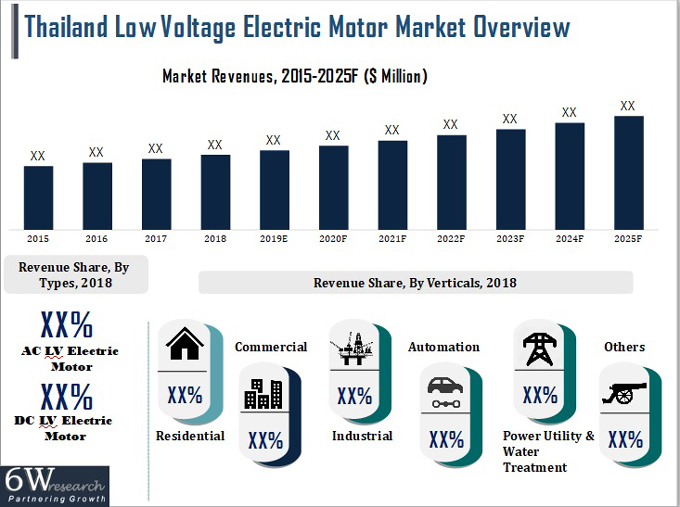
Considering the product type, pumps accounted for the highest Thailand low voltage electric motor market share during the past years in terms of market revenues; however, compressors are considered as the key growing product segment through the forecast period.
The Thailand low voltage electric motor market report thoroughly covers the market by types, voltage, products, and applications. The Thailand low voltage electric motor market outlook report provides an unbiased and detailed analysis of the ongoing Thailand low voltage electric motor market trends, opportunities/high growth areas, and market drivers which would help the stakeholders to devise and align their market strategies according to the current and future market dynamics.
Key Highlights of the Report:
• Thailand Low Voltage Electric Motor Market Overview
• Thailand Low Voltage Electric Motor Market Outlook
• Thailand Low Voltage Electric Motor Market Forecast
• Historical data of Thailand Low Voltage Electric Motor Market Revenues for the Period 2015-2018.
• Thailand Low Voltage Electric Motor Market Size & Thailand Low Voltage Electric Motor Market Forecast of Revenues until 2025.
• Historical Data of Thailand Low Voltage Electric Motor Market Revenues, by Types, for the Period 2015-2018.
• Market Size & Forecast of Thailand Low Voltage Electric Motor Market Revenues, by Types, until 2025.
• Historical Data of Thailand Low Voltage Electric Motor Market Revenues, by Voltage, for the Period 2015-2018.
• Market Size & Forecast of Thailand Low Voltage Electric Motor Market Revenues, by Voltage, until 2025.
• Historical Data of Thailand Low Voltage Electric Motor Market Revenues, by Products, for the Period 2015-2018.
• Market Size & Forecast of Thailand Low Voltage Electric Motor Market Revenues, by Products, until 2025.
• Historical Data of Thailand Low Voltage Electric Motor Market Revenues, by Applications, for the Period 2015-2018.
• Market Size & Forecast of Thailand Low Voltage Electric Motor Market Revenues, by Applications, until 2025.
• Thailand Low Voltage Electric Motor Market Trends
• Thailand Low Voltage Electric Motor Market Share, By players
• Thailand Low Voltage Electric Motor Market Overview on Competitive Benchmarking
• Market Drivers and Restraints
• Recent Market Trends
• Players Market Share
• Company Profiles
• Strategic Recommendations
Markets Covered:
The Thailand Low Voltage Electric Motor market report provides a detailed analysis of the following market segments:
• By Type
o AC
? Upto 60V
? 60.1V - 200V
? 200.1V - 1000V
o DC
? Upto 60V
? 60.1V - 200V
? 200.1V - 1000V
• By-Products
o Fans
o Compressors
o Pumps
o Conveyors
o Others (Centrifuges, Extruders, Winches, etc.)
• By Applications
o Residential
o Commercial
o Industrial
o Automotive
o Power Utility and Water Treatment
o Others (Defense, Agriculture, Transportation Infrastructure, etc.)
Global Go To Market Strategy - 2030
Export potential enables firms to identify high-growth global markets with greater confidence by combining advanced trade intelligence with a structured quantitative methodology. The framework analyzes emerging demand trends and country-level import patterns while integrating macroeconomic and trade datasets such as GDP and population forecasts, bilateral import–export flows, tariff structures, elasticity differentials between developed and developing economies, geographic distance, and import demand projections. Using weighted trade values from 2020–2024 as the base period to project country-to-country export potential for 2030, these inputs are operationalized through calculated drivers such as gravity model parameters, tariff impact factors, and projected GDP per-capita growth. Through an analysis of hidden potentials, demand hotspots, and market conditions that are most favorable to success, this method enables firms to focus on target countries, maximize returns, and global expansion with data, backed by accuracy.
By factoring in the projected importer demand gap that is currently unmet and could be potential opportunity, it identifies the potential for the Exporter (Country) among 190 countries, against the general trade analysis, which identifies the biggest importer or exporter.
To discover high-growth global markets and optimize your business strategy:
Click Here
Pricing
- Single User License$ 1,995
- Department License$ 2,400
- Site License$ 3,120
- Global License$ 3,795

Leadership Perspectives from Industry Events
Search
Thought Leadership and Analyst Meet





Our Clients








6WResearch In News
- India Export Attractiveness Tracker 2026
- India Air Conditioner Market Set for Strong Rebound in 2026 After Weather-Led Correction and GST-Driven Recovery: 6Wresearch
- ADAS in India: How Automatic Emergency Braking, Blind Spot Detection & Driver Monitoring are Transforming Road Safety
- Doha a strategic location for EV manufacturing hub: IPA Qatar
- Demand for luxury TVs surging in the GCC, says Samsung
- Empowering Growth: The Thriving Journey of Bangladesh’s Cable Industry
Latest Reports
- Qatar Access and Home Network Market (2026-2032)
- Nicaragua RPG Gaming Market (2026-2032)
- New Zealand RPG Gaming Market (2026-2032)
- Netherlands RPG Gaming Market (2026-2032)
- Nauru RPG Gaming Market (2026-2032)
- Namibia RPG Gaming Market (2026-2032)
- Mozambique RPG Gaming Market (2026-2032)
- Montenegro RPG Gaming Market (2026-2032)
- Mongolia RPG Gaming Market (2026-2032)
- Monaco RPG Gaming Market (2026-2032)
Industry Events and Analyst Meet

EV India Expo 2026

HIMTEX 2026

India Refining Summit 2026

India EV Show 2026

EV tech India Expo 2026
Whitepaper
- Middle East & Africa Commercial Security Market Click here to view more.
- Middle East & Africa Fire Safety Systems & Equipment Market Click here to view more.
- GCC Drone Market Click here to view more.
- Middle East Lighting Fixture Market Click here to view more.
- GCC Physical & Perimeter Security Market Click here to view more.


