Algeria Cellulose Acetate Fiber Market Size, Share & Growth Rate
The Algeria Cellulose Acetate Fiber Market was estimated at USD 274 Million in 2025 and is projected to reach USD 373 Million by 2032, growing at a CAGR of 4.5% from 2026 to 2032. This growth trajectory is primarily driven by the increasing adoption of cellulose acetate fibers within the textile and apparel industries, as consumers actively seek sustainable and eco-friendly alternatives to traditional synthetic materials. The rising awareness of environmental issues and a shift in consumer preferences towards high-quality, biodegradable fabrics further accentuate this market's positive outlook.
Algeria Cellulose Acetate Fiber Market Year-wise Growth Rate and Key Drivers
This graph highlights how the Algeria Cellulose Acetate Fiber Market has steadily grown over the years, supported by major growth factors.
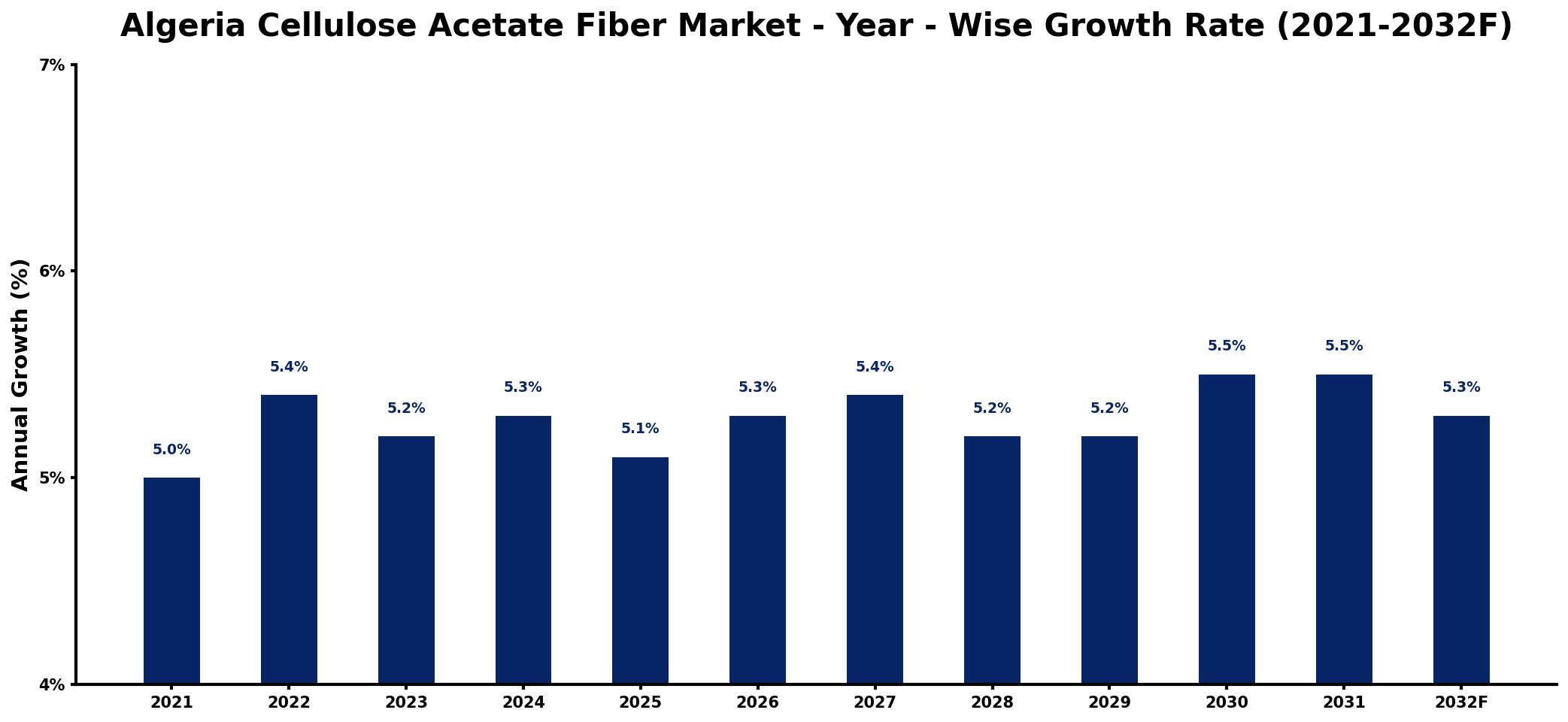
The table below presents the year‑wise growth rates along with the key drivers influencing the market
| Year | Growth Rate | Major Drivers |
| 2021 | 5.0% | Rising demand from textile industry |
| 2022 | 5.4% | Growth in sustainable packaging solutions |
| 2023 | 5.2% | Increased applications in automotive sector |
| 2024 | 5.3% | Expansion of nonwoven material usage |
| 2025 | 5.1% | Investment in renewable resource technologies |
| 2026 | 5.3% | Surge in fashion industry innovations |
| 2027 | 5.4% | Growing market for eco-friendly products |
| 2028 | 5.2% | Rising consumer interest in sustainability |
| 2029 | 5.2% | Development of advanced manufacturing processes |
| 2030 | 5.5% | Increased focus on circular economy |
| 2031 | 5.5% | improved raw material availability |
| 2032 | 5.3% | rising end-use demand growth |
Note: Market size estimations and growth projections presented in this report are based on 6Wresearch's proprietary forecasting methodology, utilizing the latest available industry data, government publications, and primary research inputs.
Algeria Cellulose Acetate Fiber Market Synopsis
The strongest force shaping the Algeria Cellulose Acetate Fiber Market right now is the escalating demand for sustainable textile materials. As consumers become increasingly cognizant of the environmental ramifications of their choices, the shift towards cellulose acetate fibers—renowned for their renewability and biodegradability—has gained momentum. This trend is further complemented by the growing popularity of athleisure and activewear, which increasingly incorporates these fibers due to their desirable characteristics.
Moreover, ongoing research and development efforts are focused on enhancing the quality and functionality of cellulose acetate fibers, which is critical in meeting the evolving needs of consumers. This focus on innovation positions the market favorably for growth, aligning with global trends that prioritize sustainability in textiles while also catering to the domestic appetite for high-performance materials.
Algeria Cellulose Acetate Fiber Market Key Takeaways
- The market is driven by heightened consumer awareness regarding sustainable textile options.
- Key trends include the growth of athleisure and eco-friendly apparel sectors.
- Investment in R&D is crucial for improving the performance of cellulose acetate fibers.
- Government initiatives aim to bolster local production and reduce reliance on imports.
- Despite challenges from alternative synthetic fibers, the market holds considerable growth potential.
Evaluation of Restraints in Algeria Cellulose Acetate Fiber Market
The Algeria Cellulose Acetate Fiber Market faces several restraints that could hinder its growth trajectory. Chief among them is the stiff competition from established synthetic fibers like polyester and nylon, which often offer lower production costs and enhanced durability. Furthermore, fluctuations in raw material prices can significantly impact production costs, thus squeezing profit margins for manufacturers. The relative lack of technological advancement in production processes means that cellulose acetate fibers may not yet fully leverage the efficiencies achieved by other materials. Additionally, consumer awareness regarding the specific benefits of cellulose acetate over traditional fibers remains limited, posing a challenge for deeper market penetration.
Algeria Cellulose Acetate Fiber Market Trends
The market is currently witnessing a substantial trend toward eco-friendly materials, with cellulose acetate fibers gaining traction as an alternative to non-biodegradable synthetics. The textile industry's increasing inclination towards sustainability is driving innovations in fiber production, leading to improved properties such as strength, softness, and dyeing efficiency. The popularity of activewear and athleisure continues to rise, with cellulose acetate fibers increasingly incorporated into these applications due to their breathability and comfort. Furthermore, collaborations between textile producers and environmental organizations are emerging, aimed at fostering greater consumer awareness about sustainable fiber choices.
Algeria Cellulose Acetate Fiber Market Opportunities
Several investment opportunities exist in the Algeria Cellulose Acetate Fiber Market that could yield significant returns. The increasing demand for sustainable fibers presents a lucrative prospect for companies involved in the production and distribution of cellulose acetate. Innovating the manufacturing process to enhance fiber characteristics and exploring new applications can set businesses apart in a competitive landscape. Collaborations with local textile manufacturers to integrate cellulose acetate fibers into their offerings can create niche markets with robust growth potential. Additionally, ongoing investments in research and development aimed at improving the functionality and versatility of cellulose acetate fibers can provide a competitive edge in the rapidly evolving textile sector.
Government Initiatives in the Algeria Cellulose Acetate Fiber Market
Government policies in Algeria are increasingly supporting the cellulose acetate fiber market through various initiatives aimed at promoting domestic production. Efforts to enhance local manufacturing capabilities are pivotal, as they aim to decrease reliance on imports while stimulating the domestic economy. Policies include subsidies and incentives for local producers and protective tariffs designed to favor national manufacturers over foreign competition. Additionally, the government is investing in research and development initiatives, which are crucial for improving the competitiveness and technological capabilities of Algeria's cellulose acetate fiber sector, thereby enhancing its long-term sustainability.
Future Insights of the Algeria Cellulose Acetate Fiber Market
Looking ahead to 2026-2032, the Algeria Cellulose Acetate Fiber Market is poised for steady growth driven by increasing consumer demand for sustainable textile materials. The market's future will largely be shaped by a growing consciousness of environmental issues and a collective pivot toward high-quality, biodegradable fabric options. As disposable incomes rise and preferences shift toward comfort and sustainability, cellulose acetate fibers are likely to see expanding applications in various sectors. However, manufacturers will need to navigate challenges such as raw material price volatility and competition from more established synthetic options to harness these growth opportunities fully.
Algeria Cellulose Acetate Fiber Market Latest Developments (2025 - 2026)
In recent months, the Algeria Cellulose Acetate Fiber Market has seen a notable uptick in collaboration between textile manufacturers and environmental organizations focused on promoting sustainable practices. There's a growing emphasis on incorporating cellulose acetate fibers into new product lines, particularly within the expanding athleisure segment. Additionally, various research initiatives have been launched to explore technological advancements in production processes, aiming to improve fiber quality and reduce costs. These efforts are not only responding to consumer demand but also aligning with broader sustainability goals within the textile industry.
Algeria Cellulose Acetate Fiber Market - Key Attractiveness of the Report
- 10 Years of Market Numbers
- Historical Data Starting from 2022 to 2025
- Base Year: 2025
- Forecast Data until 2032
- Key Performance Indicators Impacting the Market
- Major Upcoming Developments and Projects
Key Highlights of the Report:
- Algeria Cellulose Acetate Fiber Market Outlook
- Market Size of Algeria Cellulose Acetate Fiber Market, 2025
- Forecast of Algeria Cellulose Acetate Fiber Market, 2032
- Historical Data and Forecast of Algeria Cellulose Acetate Fiber Revenues & Volume for the Period 2022-2032F
- Algeria Cellulose Acetate Fiber Market Trend Evolution
- Algeria Cellulose Acetate Fiber Market Drivers and Challenges
- Algeria Cellulose Acetate Fiber Price Trends
- Algeria Cellulose Acetate Fiber Porter's Five Forces
- Algeria Cellulose Acetate Fiber Industry Life Cycle
- Historical Data and Forecast of Algeria Cellulose Acetate Fiber Market Revenues & Volume By Type for the Period 2022-2032F
- Historical Data and Forecast of Algeria Cellulose Acetate Fiber Market Revenues & Volume By Plastic for the Period 2022-2032F
- Historical Data and Forecast of Algeria Cellulose Acetate Fiber Market Revenues & Volume By Fiber for the Period 2022-2032F
- Historical Data and Forecast of Algeria Cellulose Acetate Fiber Market Revenues & Volume By Application for the Period 2022-2032F
- Historical Data and Forecast of Algeria Cellulose Acetate Fiber Market Revenues & Volume By Photographic Films for the Period 2022-2032F
- Historical Data and Forecast of Algeria Cellulose Acetate Fiber Market Revenues & Volume By Cigarette Filters for the Period 2022-2032F
- Historical Data and Forecast of Algeria Cellulose Acetate Fiber Market Revenues & Volume By Tapes & Labels for the Period 2022-2032F
- Historical Data and Forecast of Algeria Cellulose Acetate Fiber Market Revenues & Volume By Textiles & Apparel for the Period 2022-2032F
- Algeria Cellulose Acetate Fiber Import Export Trade Statistics
- Market Opportunity Assessment By Type
- Market Opportunity Assessment By Application
- Algeria Cellulose Acetate Fiber Top Companies Market Share
- Algeria Cellulose Acetate Fiber Competitive Benchmarking By Technical and Operational Parameters
- Algeria Cellulose Acetate Fiber Company Profiles
- Algeria Cellulose Acetate Fiber Key Strategic Recommendations






































