Kenya Cellulose Acetate Fiber Market Size, Share & Growth Rate
The Kenya Cellulose Acetate Fiber Market was estimated at USD 1265 Million in 2025 and is projected to reach USD 1813 Million by 2032, growing at a CAGR of 5.3% from 2026 to 2032. This growth trajectory is fueled by an increasing demand for sustainable and eco-friendly fibers within the textile and apparel industries. The rising consumer awareness regarding environmental sustainability and the shift towards biodegradable materials are pivotal in shaping the landscape of this market.
Kenya Cellulose Acetate Fiber Market Year-wise Growth Rate and Key Drivers
This graph highlights how the Kenya Cellulose Acetate Fiber Market has steadily grown over the years, supported by major growth factors.
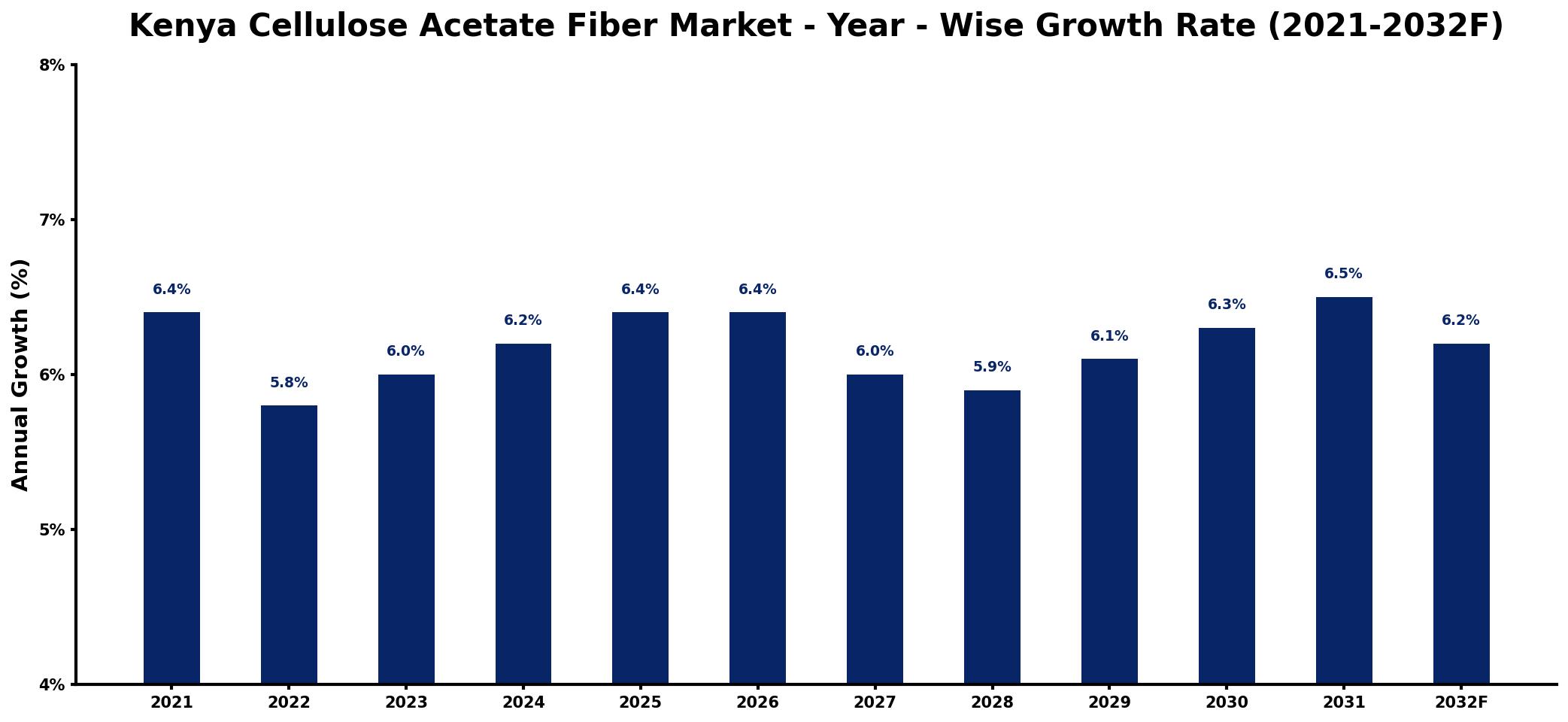
The table below presents the year‑wise growth rates along with the key drivers influencing the market
| Year | Growth Rate | Major Drivers |
| 2021 | 6.4% | Rising demand in textile industry |
| 2022 | 5.8% | Increased investment in manufacturing |
| 2023 | 6.0% | Growth in sustainable fashion trends |
| 2024 | 6.2% | Expansion of global trade agreements |
| 2025 | 6.4% | Higher consumer awareness on sustainability |
| 2026 | 6.4% | Technological advancements in production |
| 2027 | 6.0% | Emergence of eco-friendly alternatives |
| 2028 | 5.9% | Growing popularity of biodegradable materials |
| 2029 | 6.1% | Increased production capacity initiatives |
| 2030 | 6.3% | strengthening underlying market demand |
| 2031 | 6.5% | Rising consumer preference for innovation |
| 2032 | 6.2% | Strengthened partnerships in supply chain |
Note: Market size estimations and growth projections presented in this report are based on 6Wresearch's proprietary forecasting methodology, utilizing the latest available industry data, government publications, and primary research inputs.
Kenya Cellulose Acetate Fiber Market Synopsis
The Kenya Cellulose Acetate Fiber Market is currently on an upward trend, characterized by robust demand from various sectors that prioritize sustainability. This fiber is increasingly favored for its natural properties, such as softness and absorbency, which resonate well with eco-conscious consumers.
Manufacturers are actively innovating and developing new products to meet evolving consumer preferences. As the textile industry gears up to embrace greener solutions, cellulose acetate fibers are becoming synonymous with quality and environmental responsibility.
Kenya Cellulose Acetate Fiber Market Key Takeaways
- The market is driven by increasing consumer demand for sustainable textile options.
- Government initiatives supporting sustainable practices are expected to enhance market growth.
- High absorbency and biodegradability of cellulose acetate fibers make them attractive for manufacturers.
- Innovation in production processes is crucial for improving product quality and competitiveness.
- Economic growth in Kenya is positively impacting disposable income, driving demand for high-quality fibers.
Evaluation of Restraints in Kenya Cellulose Acetate Fiber Market
While the Kenya Cellulose Acetate Fiber Market shows promising growth, several restraints hinder its full potential. A notable challenge is the limited domestic production capacity, resulting in reliance on imports for raw materials. This reliance exposes the market to fluctuating global prices, which can compress profit margins. Additionally, inadequate infrastructure, such as inconsistent power supply and insufficient transportation facilities, can stifle industry growth. These factors necessitate strategic initiatives to bolster local manufacturing capabilities and enhance overall market resilience.
Kenya Cellulose Acetate Fiber Market Trends
Emerging trends within the Kenya Cellulose Acetate Fiber Market are increasingly focused on sustainability and product innovation. The rise in consumer awareness regarding environmental impact is driving a shift towards natural and biodegradable fibers. Moreover, manufacturers are investing in advanced production technologies to improve the characteristics of cellulose acetate fibers, ensuring they meet high standards of quality, softness, and durability.
Kenya Cellulose Acetate Fiber Market Opportunities
The burgeoning demand for eco-friendly fibers presents lucrative investment opportunities in the Kenya Cellulose Acetate Fiber Market. With cellulose acetate emerging as a popular alternative to traditional synthetic materials, manufacturers and investors can benefit from this shift. Furthermore, the ongoing growth in Kenya's textile industry suggests a promising landscape for cellulose acetate fibers, especially as government policies increasingly favor sustainable practices.
Government Initiatives in the Kenya Cellulose Acetate Fiber Market
While there are no specific policies directly targeting the Cellulose Acetate Fiber market, the Kenyan government actively promotes local manufacturing and value addition across sectors. Programs implemented by the Ministry of Industrialization, Trade, and Enterprise Development aim to support the textile industry's growth, indirectly benefiting cellulose acetate fiber producers. Additionally, initiatives to attract foreign direct investment highlight the government's commitment to boosting sectors that align with sustainable development goals.
Future Insights of the Kenya Cellulose Acetate Fiber Market
Looking ahead to 2026-2032, the Kenya Cellulose Acetate Fiber Market is poised for steady expansion. Increased consumer focus on sustainability, combined with the government's push for eco-friendly materials, will likely drive growth. Moreover, as disposable incomes rise, the demand for premium textile products incorporating cellulose acetate fibers will continue to escalate. Manufacturers are anticipated to invest in research and development, further enhancing their product offerings and competitiveness in a global marketplace increasingly defined by sustainability.
Kenya Cellulose Acetate Fiber Market Latest Developments (2025 - 2026)
Recent developments in the Kenya Cellulose Acetate Fiber Market indicate a strong focus on innovation and sustainability. Companies are exploring new techniques for fiber production that enhance quality while reducing environmental impact. Furthermore, collaborative efforts between industry stakeholders and the government are becoming more prominent, aimed at fostering a competitive and sustainable market environment.
Kenya Cellulose Acetate Fiber Market - Key Attractiveness of the Report
- 10 Years of Market Numbers
- Historical Data Starting from 2022 to 2025
- Base Year: 2025
- Forecast Data until 2032
- Key Performance Indicators Impacting the Market
- Major Upcoming Developments and Projects
Key Highlights of the Report:
- Kenya Cellulose Acetate Fiber Market Outlook
- Market Size of Kenya Cellulose Acetate Fiber Market, 2025
- Forecast of Kenya Cellulose Acetate Fiber Market, 2032
- Historical Data and Forecast of Kenya Cellulose Acetate Fiber Revenues & Volume for the Period 2022-2032F
- Kenya Cellulose Acetate Fiber Market Trend Evolution
- Kenya Cellulose Acetate Fiber Market Drivers and Challenges
- Kenya Cellulose Acetate Fiber Price Trends
- Kenya Cellulose Acetate Fiber Porter's Five Forces
- Kenya Cellulose Acetate Fiber Industry Life Cycle
- Historical Data and Forecast of Kenya Cellulose Acetate Fiber Market Revenues & Volume By Type for the Period 2022-2032F
- Historical Data and Forecast of Kenya Cellulose Acetate Fiber Market Revenues & Volume By Plastic for the Period 2022-2032F
- Historical Data and Forecast of Kenya Cellulose Acetate Fiber Market Revenues & Volume By Fiber for the Period 2022-2032F
- Historical Data and Forecast of Kenya Cellulose Acetate Fiber Market Revenues & Volume By Application for the Period 2022-2032F
- Historical Data and Forecast of Kenya Cellulose Acetate Fiber Market Revenues & Volume By Photographic Films for the Period 2022-2032F
- Historical Data and Forecast of Kenya Cellulose Acetate Fiber Market Revenues & Volume By Cigarette Filters for the Period 2022-2032F
- Historical Data and Forecast of Kenya Cellulose Acetate Fiber Market Revenues & Volume By Tapes & Labels for the Period 2022-2032F
- Historical Data and Forecast of Kenya Cellulose Acetate Fiber Market Revenues & Volume By Textiles & Apparel for the Period 2022-2032F
- Kenya Cellulose Acetate Fiber Import Export Trade Statistics
- Market Opportunity Assessment By Type
- Market Opportunity Assessment By Application
- Kenya Cellulose Acetate Fiber Top Companies Market Share
- Kenya Cellulose Acetate Fiber Competitive Benchmarking By Technical and Operational Parameters
- Kenya Cellulose Acetate Fiber Company Profiles
- Kenya Cellulose Acetate Fiber Key Strategic Recommendations






































