Nigeria Cellulose Acetate Fiber Market Top 5 Importing Countries and Market Competition (HHI) Analysis
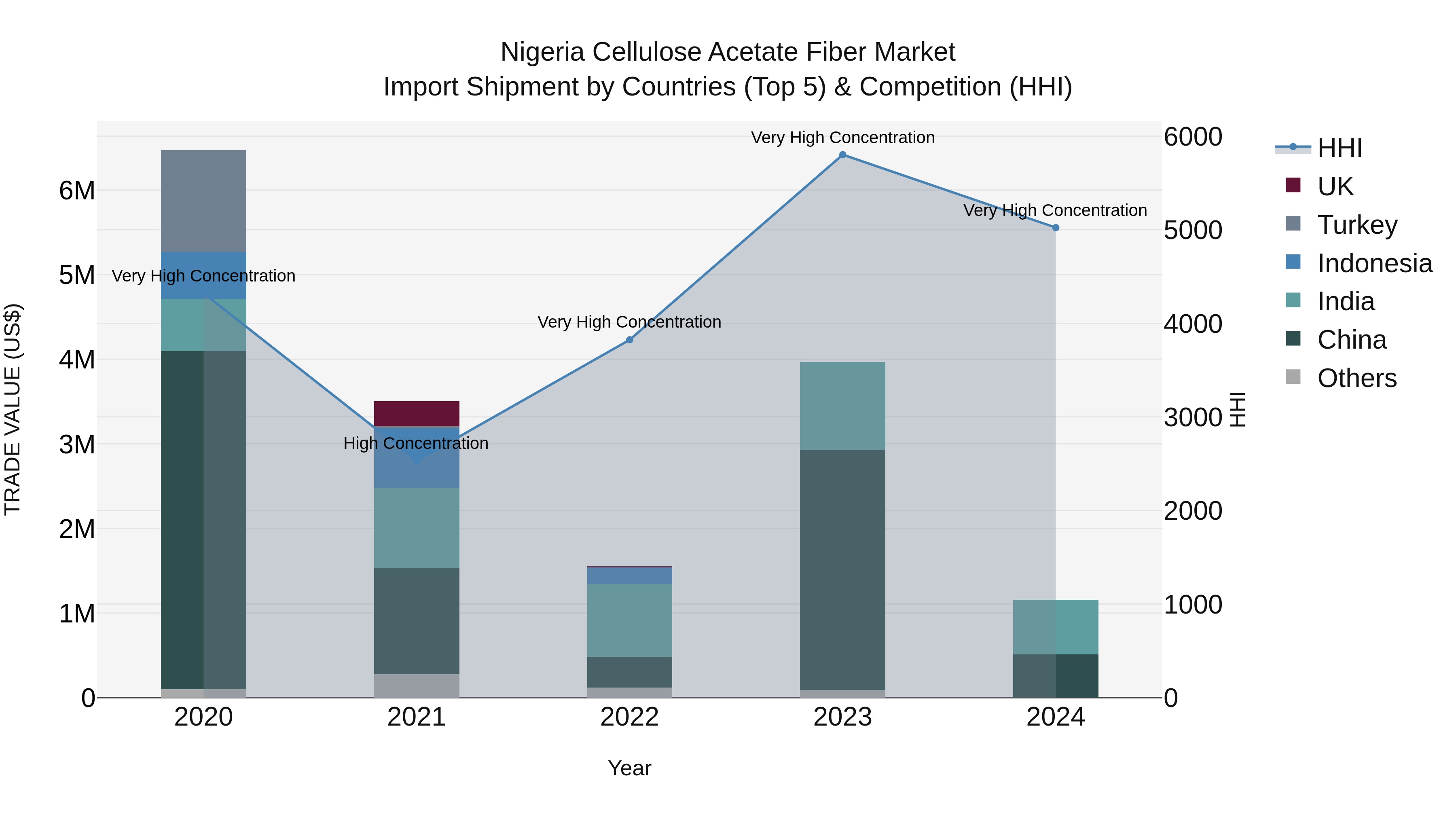
Nigeria`s cellulose acetate fiber import market in 2024 continued to be dominated by top exporters including India, China, Ethiopia, Belgium, and Egypt. The high Herfindahl-Hirschman Index (HHI) indicates a concentrated market structure. However, the market experienced a significant decline with a negative Compound Annual Growth Rate (CAGR) of -34.96% from 2020 to 2024. The growth rate in 2024 plummeted even further by -70.82% compared to the previous year, reflecting challenges and changes in the market dynamics. Stakeholders should closely monitor these trends for strategic decision-making.
Nigeria Cellulose Acetate Fiber Market Overview
The Nigeria Cellulose Acetate Fiber market is experiencing steady growth driven by increasing demand from various industries such as textiles, healthcare, and automotive. The market is expected to witness a significant rise in the production and consumption of cellulose acetate fiber due to its properties like breathability, softness, and biodegradability, making it a preferred choice for sustainable textiles and non-woven applications. The growing awareness regarding sustainable products and the shift towards eco-friendly materials are further fueling the market growth in Nigeria. Key players in the market are focusing on product innovation, strategic partnerships, and expanding their distribution networks to cater to the increasing demand. However, challenges related to raw material procurement and pricing fluctuations may impact the market dynamics in the coming years.
Nigeria Cellulose Acetate Fiber Market Trends
The Nigeria Cellulose Acetate Fiber Market is experiencing growth due to the increasing demand for sustainable and eco-friendly textiles. Consumers are becoming more conscious of the environmental impact of their purchases, leading to a shift towards natural and biodegradable fibers like cellulose acetate. Additionally, the textile industry in Nigeria is focusing on innovation and technological advancements in manufacturing processes to improve the quality and performance of cellulose acetate fibers. The market is also witnessing collaborations between local manufacturers and international companies to enhance product offerings and expand market reach. Overall, the Nigeria Cellulose Acetate Fiber Market is poised for steady growth driven by sustainability trends and technological advancements.
Nigeria Cellulose Acetate Fiber Market Challenges
In the Nigeria Cellulose Acetate Fiber market, some of the key challenges faced include high production costs due to the reliance on imported raw materials, inconsistent government policies impacting the industry`s growth and investment climate, limited technological advancements leading to lower product quality compared to international standards, and stiff competition from synthetic fibers. Additionally, inadequate infrastructure such as power supply and transportation further hinders the market`s efficiency and competitiveness. The lack of skilled workforce and limited access to financing options also pose obstacles to the expansion of the cellulose acetate fiber industry in Nigeria. Addressing these challenges will be crucial for the market to realize its full potential and compete effectively on a global scale.
Nigeria Cellulose Acetate Fiber Market Investment Opportunities
The Nigeria Cellulose Acetate Fiber Market presents promising investment opportunities due to the increasing demand for biodegradable and sustainable textiles in the country. With a growing focus on eco-friendly products and a shift towards renewable resources, investing in manufacturers of cellulose acetate fiber can be lucrative. This market offers growth potential as consumers become more conscious of their environmental impact and seek alternatives to traditional synthetic fibers. Additionally, the textile industry in Nigeria is expanding, providing a favorable environment for investment in innovative and sustainable materials like cellulose acetate fiber. Collaborating with local manufacturers or establishing partnerships with international suppliers can help investors capitalize on the rising demand for eco-friendly textiles in Nigeria.
Nigeria Cellulose Acetate Fiber Market Government Policy
The Nigerian government has implemented various policies to support the Cellulose Acetate Fiber Market. These include the National Industrial Revolution Plan (NIRP) aimed at boosting local production capacity and reducing import dependency, the Nigerian Sugar Master Plan to promote local sourcing of raw materials, and the National Cotton, Textile, and Garment Policy to enhance the competitiveness of the textile industry. Additionally, the government has offered incentives such as tax breaks and duty exemptions to attract investment in the sector. These policies demonstrate the government`s commitment to developing a sustainable and vibrant Cellulose Acetate Fiber Market in Nigeria by fostering local production, creating employment opportunities, and stimulating economic growth.
Nigeria Cellulose Acetate Fiber Market Future Outlook
The Nigeria Cellulose Acetate Fiber market is expected to witness steady growth in the coming years due to the increasing demand for eco-friendly and sustainable textile materials. The market is likely to be driven by factors such as the growing awareness about environmental conservation, the rise in disposable income levels, and the shift towards ethically produced clothing. Additionally, the versatility of cellulose acetate fiber in various applications, including textiles, packaging, and automotive industries, will further fuel its demand in the Nigerian market. However, challenges such as fluctuating raw material prices and competition from synthetic fibers may pose a threat to the market growth. Overall, with the increasing focus on sustainability and the adoption of green practices, the Nigeria Cellulose Acetate Fiber market is poised for promising growth prospects in the foreseeable future.
Key Highlights of the Report:
- Nigeria Cellulose Acetate Fiber Market Outlook
- Market Size of Nigeria Cellulose Acetate Fiber Market, 2024
- Forecast of Nigeria Cellulose Acetate Fiber Market, 2031
- Historical Data and Forecast of Nigeria Cellulose Acetate Fiber Revenues & Volume for the Period 2021 - 2031
- Nigeria Cellulose Acetate Fiber Market Trend Evolution
- Nigeria Cellulose Acetate Fiber Market Drivers and Challenges
- Nigeria Cellulose Acetate Fiber Price Trends
- Nigeria Cellulose Acetate Fiber Porter's Five Forces
- Nigeria Cellulose Acetate Fiber Industry Life Cycle
- Historical Data and Forecast of Nigeria Cellulose Acetate Fiber Market Revenues & Volume By Type for the Period 2021 - 2031
- Historical Data and Forecast of Nigeria Cellulose Acetate Fiber Market Revenues & Volume By Plastic for the Period 2021 - 2031
- Historical Data and Forecast of Nigeria Cellulose Acetate Fiber Market Revenues & Volume By Fiber for the Period 2021 - 2031
- Historical Data and Forecast of Nigeria Cellulose Acetate Fiber Market Revenues & Volume By Application for the Period 2021 - 2031
- Historical Data and Forecast of Nigeria Cellulose Acetate Fiber Market Revenues & Volume By Photographic Films for the Period 2021 - 2031
- Historical Data and Forecast of Nigeria Cellulose Acetate Fiber Market Revenues & Volume By Cigarette Filters for the Period 2021 - 2031
- Historical Data and Forecast of Nigeria Cellulose Acetate Fiber Market Revenues & Volume By Tapes & Labels for the Period 2021 - 2031
- Historical Data and Forecast of Nigeria Cellulose Acetate Fiber Market Revenues & Volume By Textiles & Apparel for the Period 2021 - 2031
- Nigeria Cellulose Acetate Fiber Import Export Trade Statistics
- Market Opportunity Assessment By Type
- Market Opportunity Assessment By Application
- Nigeria Cellulose Acetate Fiber Top Companies Market Share
- Nigeria Cellulose Acetate Fiber Competitive Benchmarking By Technical and Operational Parameters
- Nigeria Cellulose Acetate Fiber Company Profiles
- Nigeria Cellulose Acetate Fiber Key Strategic Recommendations






































