Algeria Curtains and Window Blinds Market Size, Share & Growth Rate
The Algeria Curtains and Window Blinds Market was estimated at USD 774 Million in 2025 and is projected to reach USD 1424 Million by 2032, growing at a CAGR of 9.1% from 2026 to 2032. This robust growth trajectory is primarily fueled by increasing urbanization, rising disposable incomes, and a heightened focus on home aesthetics. As more Algerians seek stylish and functional window treatments, the demand is further bolstered by an expanding residential and commercial construction landscape.
Algeria Curtains and Window Blinds Market Year-wise Growth Rate and Key Drivers
This graph highlights how the Algeria Curtains and Window Blinds Market has steadily grown over the years, supported by major growth factors.
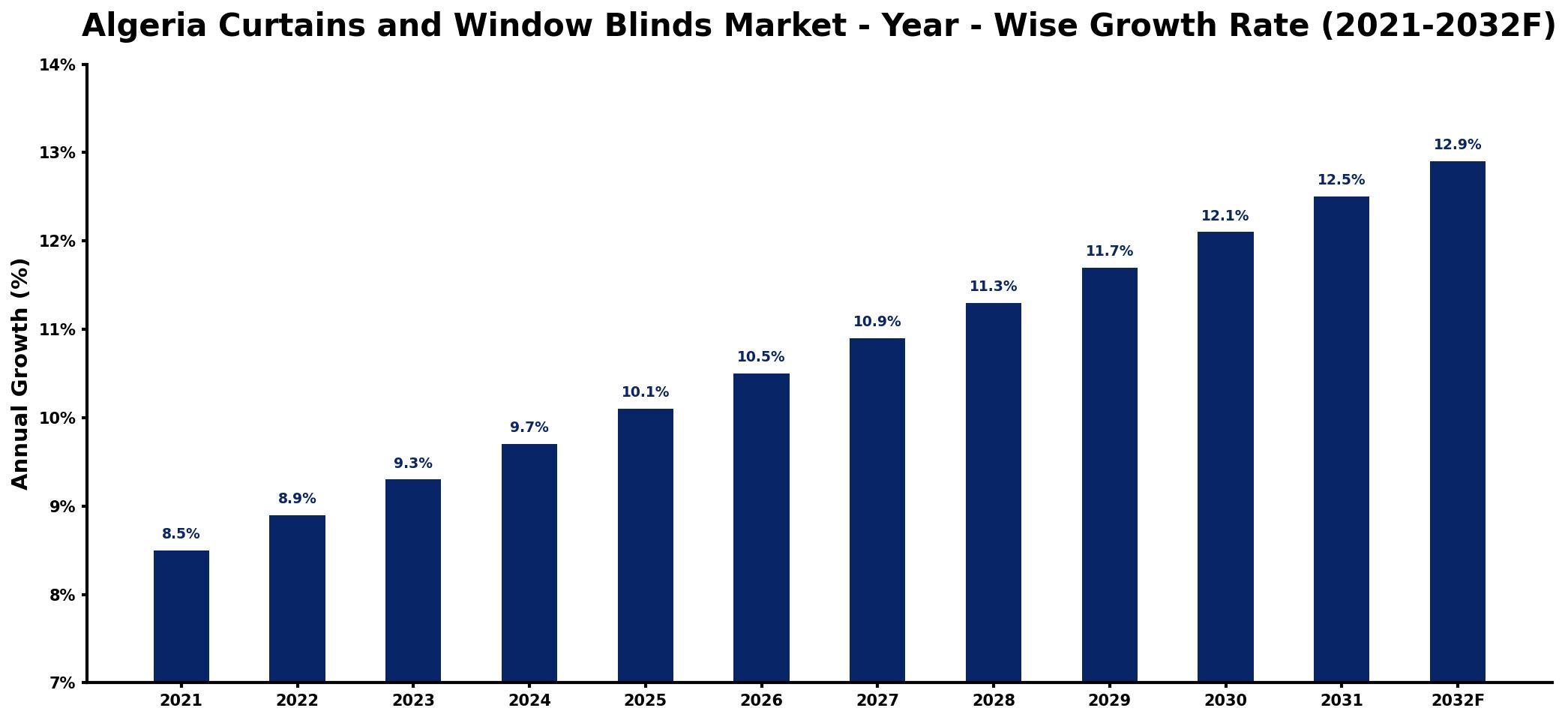
The table below presents the year‑wise growth rates along with the key drivers influencing the market
| Year | Growth Rate | Major Drivers |
| 2021 | 8.5% | Rising construction sector activity |
| 2022 | 8.9% | Increased disposable income levels |
| 2023 | 9.3% | Growing urbanization trends observed |
| 2024 | 9.7% | Expansion in interior design market |
| 2025 | 10.1% | Surge in home renovation projects |
| 2026 | 10.5% | Growing popularity of smart homes |
| 2027 | 10.9% | Investment in green building initiatives |
| 2028 | 11.3% | Rising demand for sustainable materials |
| 2029 | 11.7% | Increase in tourism and hospitality |
| 2030 | 12.1% | Growth in e-commerce platforms available |
| 2031 | 12.5% | Expansion of retail distribution channels |
| 2032 | 12.9% | Rising awareness of energy efficiency |
Note: Market size estimations and growth projections presented in this report are based on 6Wresearch's proprietary forecasting methodology, utilizing the latest available industry data, government publications, and primary research inputs.
Algeria Curtains and Window Blinds Market Synopsis
The Algeria curtains and window blinds market is currently witnessing a transformative phase, characterized by evolving consumer preferences and a shift towards more sophisticated home decor solutions. As urban areas continue to expand and modernize, an increasing number of residents are opting for premium window treatment options that offer both aesthetic appeal and functionality.
With a surge in demand for customized and innovative designs, consumers are seeking products that not only enhance the visual charm of their living spaces but also incorporate energy efficiency and smart technology. The market is increasingly embracing diverse materials and designs to cater to varying tastes and budgets, reflecting a broader trend toward personalization and environmental consciousness.
Algeria Curtains and Window Blinds Market Key Takeaways
- The market is driven by increased urbanization and rising disposable incomes in Algeria.
- There is a notable consumer shift towards stylish and functional window treatment solutions.
- Customization, including motorized and smart options, is gaining traction among consumers.
- Sustainability trends are pushing demand for eco-friendly materials in window treatments.
- Challenges remain, such as low consumer awareness and reliance on traditional styles.
Evaluation of Restraints in Algeria Curtains and Window Blinds Market
Despite its growth potential, the Algeria curtains and window blinds market faces several constraints. One primary issue is the limited consumer awareness regarding modern window treatment options, which hampers market penetration. Many consumers still lean towards traditional styles, which can restrict the adoption of innovative products. Additionally, the market grapples with the challenges of inconsistent product quality, competition from low-cost imports, and a fragmented landscape populated by smaller players. Regulatory hurdles can also complicate entry for new participants, highlighting the need for improved consumer education and digital engagement strategies.
Algeria Curtains and Window Blinds Market Trends
Emerging trends in the Algeria curtains and window blinds market indicate a strong preference for modern and stylish designs that balance aesthetics with practicality. More consumers are gravitating towards customized solutions, including motorized blinds and smart curtains that offer convenience and enhanced control over lighting. Sustainability is becoming increasingly relevant, with eco-friendly materials and energy-efficient designs capturing consumer interest. Furthermore, the popularity of light-filtering and blackout options reflects a growing awareness of the importance of privacy and natural light control in residential and commercial settings.
Algeria Curtains and Window Blinds Market Opportunities
The Algeria curtains and window blinds market presents lucrative investment opportunities, primarily due to the increasing demand for stylish and functional window treatments. With urbanization on the rise and disposable incomes growing, there is a clear niche for high-quality materials and innovative designs. Investors can benefit from expanding distribution channels, particularly through e-commerce and specialized home decor retail outlets. Emphasizing customization and sustainability could further enhance market appeal, positioning businesses to capitalize on evolving consumer trends in interior decoration.
Government Initiatives in the Algeria Curtains and Window Blinds Market
Government policies significantly influence the Algeria curtains and window blinds market, encompassing import regulations, quality standards, and taxation frameworks. These regulations ensure that products meet certain safety and quality criteria, which is essential for consumer trust. Furthermore, import tariffs can affect pricing and availability, thus impacting market dynamics. Compliance with these regulations is critical for businesses aiming to maintain competitive advantages while ensuring product quality and safety.
Future Insights of the Algeria Curtains and Window Blinds Market
Looking ahead to 2026-2032, the Algeria curtains and window blinds market is poised for steady growth, driven by the continuous urban expansion and rising consumer awareness regarding home decor. The trend towards innovative and customized window treatment solutions is expected to gain momentum, particularly as eco-friendly and energy-efficient options become more prevalent. While economic uncertainties and raw material price fluctuations may present challenges, the overall outlook remains positive as consumers increasingly prioritize aesthetics and functionality in their living and working spaces.
Algeria Curtains and Window Blinds Market Latest Developments (2025 - 2026)
In recent months, the Algeria curtains and window blinds market has witnessed a surge in the introduction of new product lines featuring innovative designs and materials. Companies are increasingly focusing on enhancing their digital presence, using e-commerce platforms to reach a broader customer base. Additionally, collaborations between local manufacturers and international suppliers are becoming more common, aimed at enhancing product quality and expanding market reach. There is also a noted emphasis on sustainable practices, with several firms launching collections made from eco-friendly materials.
Algeria Curtains and Window Blinds Market - Key Attractiveness of the Report
- 10 Years of Market Numbers
- Historical Data Starting from 2022 to 2025
- Base Year: 2025
- Forecast Data until 2032
- Key Performance Indicators Impacting the Market
- Major Upcoming Developments and Projects
Key Highlights of the Report:
- Algeria Curtains and Window Blinds Market Outlook
- Market Size of Algeria Curtains and Window Blinds Market, 2025
- Forecast of Algeria Curtains and Window Blinds Market, 2032
- Historical Data and Forecast of Algeria Curtains and Window Blinds Revenues & Volume for the Period 2022-2032F
- Algeria Curtains and Window Blinds Market Trend Evolution
- Algeria Curtains and Window Blinds Market Drivers and Challenges
- Algeria Curtains and Window Blinds Price Trends
- Algeria Curtains and Window Blinds Porter's Five Forces
- Algeria Curtains and Window Blinds Industry Life Cycle
- Historical Data and Forecast of Algeria Curtains and Window Blinds Market Revenues & Volume By Materials for the Period 2022-2032F
- Historical Data and Forecast of Algeria Curtains and Window Blinds Market Revenues & Volume By Curtains (Cotton, Linen, Polyester) for the Period 2022-2032F
- Historical Data and Forecast of Algeria Curtains and Window Blinds Market Revenues & Volume By Window Blinds (Cotton, Linen, Wood, PVC, Metal) for the Period 2022-2032F
- Historical Data and Forecast of Algeria Curtains and Window Blinds Market Revenues & Volume By Product for the Period 2022-2032F
- Historical Data and Forecast of Algeria Curtains and Window Blinds Market Revenues & Volume By Curtains (Box pleat curtains, Pinch pleat curtains & drapery, Goblet pleat curtains & drapery, Eyelet curtains & drapery) for the Period 2022-2032F
- Historical Data and Forecast of Algeria Curtains and Window Blinds Market Revenues & Volume By Window Blinds (Window Shades,, Window Screens, Connected) for the Period 2022-2032F
- Historical Data and Forecast of Algeria Curtains and Window Blinds Market Revenues & Volume By Distribution Channel for the Period 2022-2032F
- Historical Data and Forecast of Algeria Curtains and Window Blinds Market Revenues & Volume By B2B for the Period 2022-2032F
- Historical Data and Forecast of Algeria Curtains and Window Blinds Market Revenues & Volume By B2C for the Period 2022-2032F
- Historical Data and Forecast of Algeria Curtains and Window Blinds Market Revenues & Volume By E-commerce for the Period 2022-2032F
- Historical Data and Forecast of Algeria Curtains and Window Blinds Market Revenues & Volume By Price Range for the Period 2022-2032F
- Historical Data and Forecast of Algeria Curtains and Window Blinds Market Revenues & Volume By High for the Period 2022-2032F
- Historical Data and Forecast of Algeria Curtains and Window Blinds Market Revenues & Volume By Medium for the Period 2022-2032F
- Historical Data and Forecast of Algeria Curtains and Window Blinds Market Revenues & Volume By Low for the Period 2022-2032F
- Algeria Curtains and Window Blinds Import Export Trade Statistics
- Market Opportunity Assessment By Materials
- Market Opportunity Assessment By Product
- Market Opportunity Assessment By Distribution Channel
- Market Opportunity Assessment By Price Range
- Algeria Curtains and Window Blinds Top Companies Market Share
- Algeria Curtains and Window Blinds Competitive Benchmarking By Technical and Operational Parameters
- Algeria Curtains and Window Blinds Company Profiles
- Algeria Curtains and Window Blinds Key Strategic Recommendations






































