Algeria Metal Fabrication Market Size, Share & Growth Rate
The Algeria Metal Fabrication Market was estimated at USD 691 Million in 2025 and is projected to reach USD 1005 Million by 2032, growing at a CAGR of 5.5% from 2026 to 2032. This upward trajectory is primarily driven by significant investments in infrastructure and urban development initiatives across the nation. The automotive sectors expansion further enhances demand for precision metal components, while innovations in fabrication technologies bolster operational efficiency, creating a robust landscape for market participants.
Algeria Metal Fabrication Market Year-wise Growth Rate and Key Drivers
This graph highlights how the Algeria Metal Fabrication Market has steadily grown over the years, supported by major growth factors.
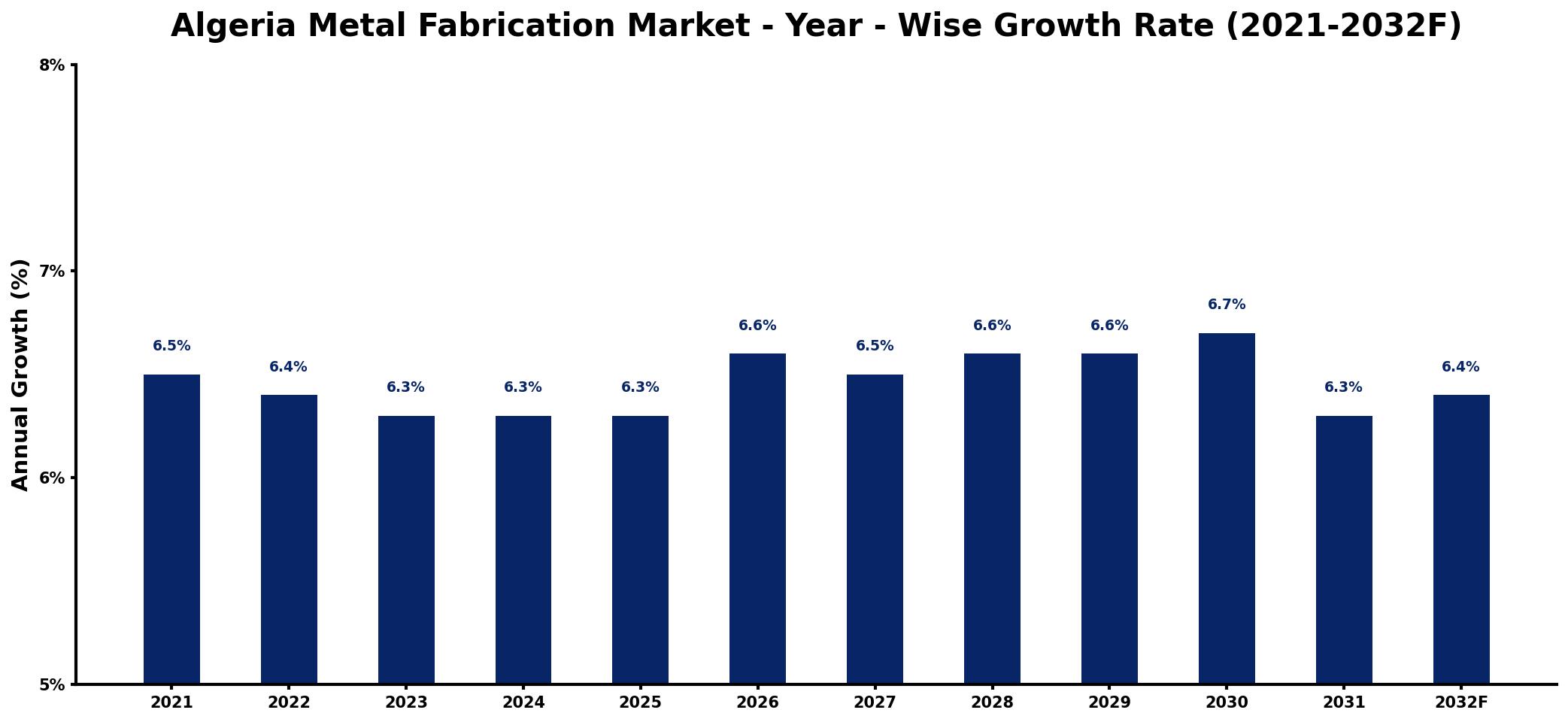
The table below presents the year‑wise growth rates along with the key drivers influencing the market
| Year | Growth Rate | Major Drivers |
| 2021 | 6.5% | increased infrastructure development projects |
| 2022 | 6.4% | rising demand from construction sector |
| 2023 | 6.3% | growing investments in renewable energy |
| 2024 | 6.3% | expansion of automotive manufacturing facilities |
| 2025 | 6.3% | boost in public transportation initiatives |
| 2026 | 6.6% | surge in industrial automation trends |
| 2027 | 6.5% | enhanced residential construction activities |
| 2028 | 6.6% | growing exports to neighboring countries |
| 2029 | 6.6% | increased government infrastructure spending |
| 2030 | 6.7% | rise in urbanization and population |
| 2031 | 6.3% | strengthened partnerships with global firms |
| 2032 | 6.4% | rising export shipment volumes |
Note: Market size estimations and growth projections presented in this report are based on 6Wresearch's proprietary forecasting methodology, utilizing the latest available industry data, government publications, and primary research inputs.
Algeria Metal Fabrication Market Synopsis
The metal fabrication market in Algeria is experiencing a dynamic transformation, characterized by increasing demand across various sectors such as construction, automotive, and manufacturing. As the country embarks on ambitious infrastructure projects, the necessity for high-quality fabricated metal products is more pronounced than ever.
Technological advancements, including the integration of CAD and CAM in fabrication processes, are reshaping the operational landscape. This shift not only enhances productivity but also ensures the production of precision components essential for industries ranging from energy to aerospace, solidifying the market's potential for future growth.
Algeria Metal Fabrication Market Key Takeaways
- The market's projected growth is supported by robust infrastructure investments and industrial expansion.
- Technological innovations, including automation, are driving improvements in efficiency and quality.
- The automotive and aerospace industries are significant contributors to the rising demand for precision fabrication.
- Government policies are expected to play a crucial role in facilitating market growth through support for local manufacturing.
- Challenges such as access to advanced machinery and skilled labor remain critical factors to address for sustained growth.
Evaluation of Restraints in Algeria Metal Fabrication Market
Despite its promising growth, the Algeria Metal Fabrication Market faces several constraints that can hinder its progress. Limited access to advanced machinery poses a significant barrier to enhancing production capabilities, often resulting in inefficiencies. Moreover, the shortage of skilled labor complicates the ability to meet the industry's increasing demands for precision and quality. Fluctuating raw material prices can disrupt operational stability, making it difficult for businesses to plan and execute projects consistently. Additionally, navigating regulatory complexities can challenge companies trying to adhere to evolving standards and practices.
Algeria Metal Fabrication Market Trends
The market is witnessing several transformative trends that are shaping its future trajectory. A notable trend is the increasing adoption of automation and robotics within fabrication processes, which enhances efficiency while reducing labor costs. Concurrently, the shift towards sustainable practices is prompting companies to explore eco-friendly materials and processes. The integration of digital technologies in fabrication, such as the Internet of Things (IoT), is also emerging as a critical focus area, enabling real-time monitoring and improved supply chain management.
Algeria Metal Fabrication Market Opportunities
There exists a wealth of growth and investment opportunities within the Algeria Metal Fabrication Market. The ongoing expansion of the construction sector presents a substantial demand for fabricated products, particularly structural components. Additionally, the governments focus on boosting local manufacturing capabilities opens avenues for investment in advanced fabrication technologies. As sectors like renewable energy gain momentum, the need for specialized metal components in this field is also set to rise, creating an attractive landscape for businesses seeking to expand their service offerings.
Government Initiatives in the Algeria Metal Fabrication Market
The Algerian government is actively promoting industrial growth through a variety of initiatives aimed at the metal fabrication sector. Policies are being implemented to encourage local manufacturing, including potential tax incentives and subsidies for companies investing in new fabrication facilities. Regulations regarding product quality and occupational safety are also evolving to ensure adherence to international standards, thereby enhancing the competitiveness of Algerian fabricated products in global markets. Public procurement policies, especially regarding infrastructure projects, further stimulate demand for locally manufactured metal products.
Future Insights of the Algeria Metal Fabrication Market
Looking ahead to the 2026-2032 period, the Algeria Metal Fabrication Market is poised for significant evolution. The combination of continued infrastructure investment and rising industrial demands is expected to sustain growth momentum. As the automotive and aerospace sectors further evolve, the demand for precision fabrication is likely to intensify. Furthermore, advancements in technology will facilitate new product development and manufacturing processes, positioning the market as a critical contributor to Algeria's economic landscape.
Algeria Metal Fabrication Market Latest Developments (2025 - 2026)
Recent developments in the Algeria Metal Fabrication Market indicate a growing trend towards digital transformation and automation in manufacturing processes. Companies are increasingly investing in state-of-the-art technologies to enhance productivity and efficiency. Additionally, collaborative efforts between industry stakeholders and government entities are expected to yield new initiatives aimed at skill development and capacity building within the workforce. These advancements signal a positive shift towards more sophisticated manufacturing capabilities in the region.
Algeria Metal Fabrication Market - Key Attractiveness of the Report
- 10 Years of Market Numbers
- Historical Data Starting from 2022 to 2025
- Base Year: 2025
- Forecast Data until 2032
- Key Performance Indicators Impacting the Market
- Major Upcoming Developments and Projects
Key Highlights of the Report:
- Algeria Metal Fabrication Market Outlook
- Market Size of Algeria Metal Fabrication Market, 2025
- Forecast of Algeria Metal Fabrication Market, 2032
- Historical Data and Forecast of Algeria Metal Fabrication Revenues & Volume for the Period 2022-2032F
- Algeria Metal Fabrication Market Trend Evolution
- Algeria Metal Fabrication Market Drivers and Challenges
- Algeria Metal Fabrication Price Trends
- Algeria Metal Fabrication Porter's Five Forces
- Algeria Metal Fabrication Industry Life Cycle
- Historical Data and Forecast of Algeria Metal Fabrication Market Revenues & Volume By End-user Industry for the Period 2022-2032F
- Historical Data and Forecast of Algeria Metal Fabrication Market Revenues & Volume By Manufacturing for the Period 2022-2032F
- Historical Data and Forecast of Algeria Metal Fabrication Market Revenues & Volume By Power and Utilities for the Period 2022-2032F
- Historical Data and Forecast of Algeria Metal Fabrication Market Revenues & Volume By Construction for the Period 2022-2032F
- Historical Data and Forecast of Algeria Metal Fabrication Market Revenues & Volume By Oil and Gas for the Period 2022-2032F
- Historical Data and Forecast of Algeria Metal Fabrication Market Revenues & Volume By Other End-user Industries for the Period 2022-2032F
- Historical Data and Forecast of Algeria Metal Fabrication Market Revenues & Volume By Metal Folding for the Period 2022-2032F
- Historical Data and Forecast of Algeria Metal Fabrication Market Revenues & Volume By Product category for the Period 2022-2032F
- Historical Data and Forecast of Algeria Metal Fabrication Market Revenues & Volume By Structural steel fabrication for the Period 2022-2032F
- Historical Data and Forecast of Algeria Metal Fabrication Market Revenues & Volume By Process Equipment Fabrication for the Period 2022-2032F
- Algeria Metal Fabrication Import Export Trade Statistics
- Market Opportunity Assessment By End-user Industry
- Market Opportunity Assessment By Product category
- Algeria Metal Fabrication Top Companies Market Share
- Algeria Metal Fabrication Competitive Benchmarking By Technical and Operational Parameters
- Algeria Metal Fabrication Company Profiles
- Algeria Metal Fabrication Key Strategic Recommendations






































