Morocco Metal Fabrication Market Size, Share & Growth Rate
The Morocco Metal Fabrication Market was estimated at USD 271 Million in 2025 and is projected to reach USD 382 Million by 2032, growing at a CAGR of 5.0% from 2026 to 2032. This growth trajectory is primarily driven by the burgeoning construction and automotive sectors, which are increasingly demanding tailored metal solutions. As projects scale in complexity, the reliance on advanced fabrication technologies and a skilled workforce is more crucial than ever to meet evolving industry needs.
Morocco Metal Fabrication Market Year-wise Growth Rate and Key Drivers
This graph highlights how the Morocco Metal Fabrication Market has steadily grown over the years, supported by major growth factors.
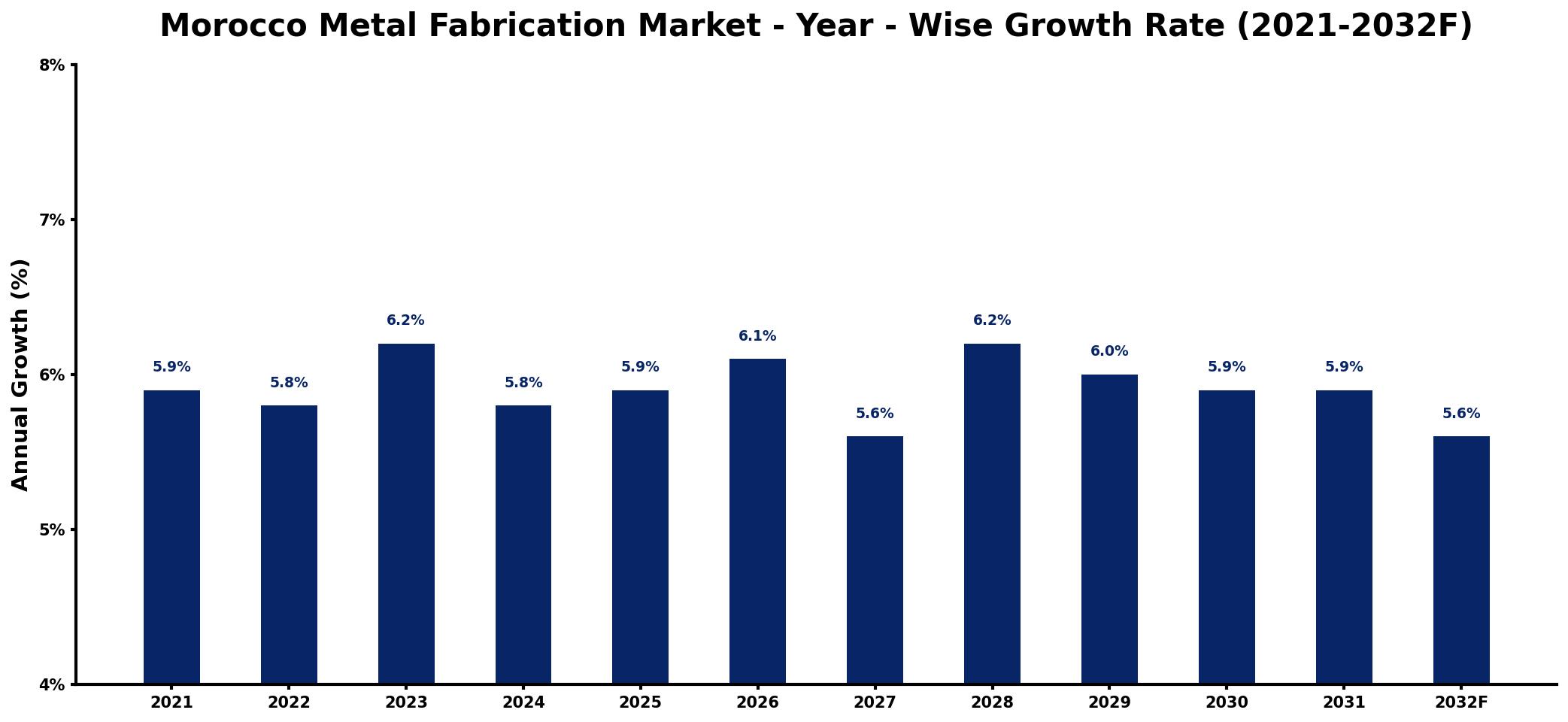
The table below presents the year‑wise growth rates along with the key drivers influencing the market
| Year | Growth Rate | Major Drivers |
| 2021 | 5.9% | Rising construction sector investments |
| 2022 | 5.8% | Increased demand for infrastructure projects |
| 2023 | 6.2% | Growth in renewable energy initiatives |
| 2024 | 5.8% | Expansion of automotive manufacturing facilities |
| 2025 | 5.9% | Surge in regional trade activities |
| 2026 | 6.1% | Boost in technological advancements adoption |
| 2027 | 5.6% | Development of new industrial parks |
| 2028 | 6.2% | Heightened focus on export markets |
| 2029 | 6.0% | Increased private sector partnerships |
| 2030 | 5.9% | Growing urbanization and population density |
| 2031 | 5.9% | increased overall sector activity |
| 2032 | 5.6% | Strengthened government investment programs |
Note: Market size estimations and growth projections presented in this report are based on 6Wresearch's proprietary forecasting methodology, utilizing the latest available industry data, government publications, and primary research inputs.
Morocco Metal Fabrication Market Synopsis
The demand for customized metal components in Morocco has surged, spurred by ongoing infrastructure projects and the expansion of the automotive industry. This trend necessitates innovative fabrication techniques and heightened efficiency, pushing local manufacturers to adopt advanced technologies to remain competitive.
Additionally, skilled labor shortages pose a challenge for many manufacturers. The need for training and development in modern fabrication technologies is critical to ensure that the market can meet the growing demands of sectors such as construction, which requires precision and adaptability in metalwork.
Morocco Metal Fabrication Market Key Takeaways
- The construction and automotive sectors are the primary drivers of market growth.
- Investment in advanced fabrication technologies is essential for local manufacturers to remain competitive.
- Government policies aim to support skills development in the fabrication workforce.
- Fluctuating raw material prices can impact the overall profitability of metal fabrication businesses.
- Customized metal solutions are becoming increasingly sought after in various industries.
Evaluation of Restraints in Morocco Metal Fabrication Market
While the Morocco Metal Fabrication Market exhibits a promising growth trajectory, several factors are inhibiting its full potential. Fluctuations in raw material prices present a significant challenge, often making it difficult for manufacturers to maintain consistent pricing structures and profit margins. Additionally, the competition from international suppliers who offer lower-cost alternatives can pressure local manufacturers to reduce their prices, potentially compromising quality. The need for continual investment in advanced fabrication technologies further strains resources, as companies must balance between upgrading equipment and managing operational costs.
Morocco Metal Fabrication Market Trends
Current trends in the Morocco Metal Fabrication Market indicate a significant shift toward digitalization and automation. Manufacturers are increasingly adopting technologies such as 3D printing and CNC machining to enhance precision and reduce turnaround times. Furthermore, sustainability is becoming a focal point, with companies exploring eco-friendly materials and practices to meet both regulatory requirements and consumer expectations. As industries evolve, the demand for sustainable and efficient production methods continues to shape the landscape of metal fabrication in Morocco.
Morocco Metal Fabrication Market Opportunities
There is a substantial opportunity for growth in Moroccos metal fabrication market, particularly within renewable energy sectors and advanced manufacturing. Investments in solar and wind energy infrastructure present a promising avenue for specialized metal components. Additionally, with a growing emphasis on export markets, local manufacturers have the chance to extend their reach beyond national borders, tapping into international demand for high-quality metal fabrication. Collaboration with technology firms could also facilitate the integration of cutting-edge practices and innovations, further bolstering market potential.
Government Initiatives in the Morocco Metal Fabrication Market
The Moroccan government actively supports the metal fabrication sector through various initiatives aimed at fostering investment in technology and skill development. Policies focus on enhancing the competitiveness of local manufacturers while promoting infrastructure improvements to facilitate industrial growth. Collaborative efforts between the Ministry of Industry, Trade, and Green and Digital Economy and the Ministry of Economy and Finance are pivotal in implementing these strategies, aiming to create employment opportunities and bolster the overall economy.
Future Insights of the Morocco Metal Fabrication Market
Looking ahead to 2026-2032, the Morocco Metal Fabrication Market is poised for transformation as it embraces advancements in automation and digital technologies. The integration of Industry 4.0 principles is expected to redefine manufacturing processes, increasing productivity and efficiency. Furthermore, as sustainability becomes a central theme across industries, the demand for eco-friendly fabrication practices will likely influence market dynamics. With strategic investments and government support, the market is expected to not only grow but also enhance its global competitiveness.
Morocco Metal Fabrication Market Latest Developments (2025 - 2026)
Recent developments in the Morocco Metal Fabrication Market highlight a trend toward technological adoption and collaboration within the industry. Manufacturers are increasingly engaging with tech firms to integrate advanced software solutions and automation technologies into their processes. There is also a notable increase in partnerships focusing on sustainability, where companies are exploring innovative methods to reduce waste and enhance material efficiency. These shifts reflect a broader commitment to modernization and responsiveness to market demands.
Morocco Metal Fabrication Market - Key Attractiveness of the Report
- 10 Years of Market Numbers
- Historical Data Starting from 2022 to 2025
- Base Year: 2025
- Forecast Data until 2032
- Key Performance Indicators Impacting the Market
- Major Upcoming Developments and Projects
Key Highlights of the Report:
- Morocco Metal Fabrication Market Outlook
- Market Size of Morocco Metal Fabrication Market, 2025
- Forecast of Morocco Metal Fabrication Market, 2032
- Historical Data and Forecast of Morocco Metal Fabrication Revenues & Volume for the Period 2022-2032F
- Morocco Metal Fabrication Market Trend Evolution
- Morocco Metal Fabrication Market Drivers and Challenges
- Morocco Metal Fabrication Price Trends
- Morocco Metal Fabrication Porter's Five Forces
- Morocco Metal Fabrication Industry Life Cycle
- Historical Data and Forecast of Morocco Metal Fabrication Market Revenues & Volume By End-user Industry for the Period 2022-2032F
- Historical Data and Forecast of Morocco Metal Fabrication Market Revenues & Volume By Manufacturing for the Period 2022-2032F
- Historical Data and Forecast of Morocco Metal Fabrication Market Revenues & Volume By Power and Utilities for the Period 2022-2032F
- Historical Data and Forecast of Morocco Metal Fabrication Market Revenues & Volume By Construction for the Period 2022-2032F
- Historical Data and Forecast of Morocco Metal Fabrication Market Revenues & Volume By Oil and Gas for the Period 2022-2032F
- Historical Data and Forecast of Morocco Metal Fabrication Market Revenues & Volume By Other End-user Industries for the Period 2022-2032F
- Historical Data and Forecast of Morocco Metal Fabrication Market Revenues & Volume By Metal Folding for the Period 2022-2032F
- Historical Data and Forecast of Morocco Metal Fabrication Market Revenues & Volume By Product category for the Period 2022-2032F
- Historical Data and Forecast of Morocco Metal Fabrication Market Revenues & Volume By Structural steel fabrication for the Period 2022-2032F
- Historical Data and Forecast of Morocco Metal Fabrication Market Revenues & Volume By Process Equipment Fabrication for the Period 2022-2032F
- Morocco Metal Fabrication Import Export Trade Statistics
- Market Opportunity Assessment By End-user Industry
- Market Opportunity Assessment By Product category
- Morocco Metal Fabrication Top Companies Market Share
- Morocco Metal Fabrication Competitive Benchmarking By Technical and Operational Parameters
- Morocco Metal Fabrication Company Profiles
- Morocco Metal Fabrication Key Strategic Recommendations






































