Algeria Mineral Oil Market Size, Share & Growth Rate
The Algeria Mineral Oil Market was estimated at USD 392 Million in 2025 and is projected to reach USD 542 Million by 2032, growing at a CAGR of 4.7% from 2026 to 2032. This growth trajectory is largely driven by the expanding automotive and industrial sectors, which are increasingly reliant on high-performance mineral oil products for lubrication and other functional applications. The increasing automotive fleet, coupled with industrialization efforts, will further propel the demand for quality mineral oil solutions.
Algeria Mineral Oil Market Year-wise Growth Rate and Key Drivers
This graph highlights how the Algeria Mineral Oil Market has steadily grown over the years, supported by major growth factors.
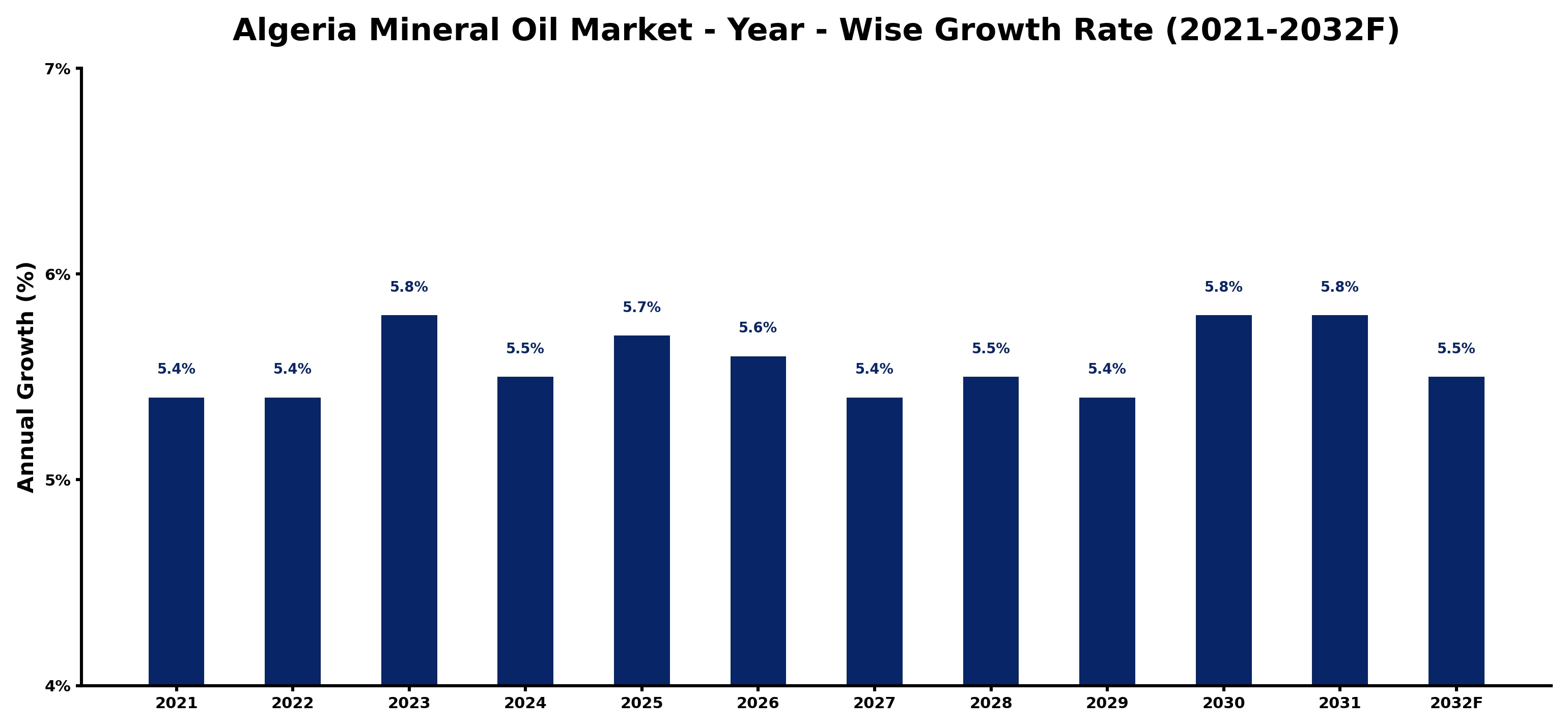
The table below presents the year‑wise growth rates along with the key drivers influencing the market
| Year | Growth Rate | Major Drivers |
| 2021 | 5.4% | Expansion of transportation and logistics networks |
| 2022 | 5.4% | Growing urbanization and commercial development |
| 2023 | 5.8% | Growing renewable energy integration projects |
| 2024 | 5.5% | Increasing industrial automation investments |
| 2025 | 5.7% | Increasing smart city development projects |
| 2026 | 5.6% | Increasing smart city development projects |
| 2027 | 5.4% | Increasing adoption of advanced technologies |
| 2028 | 5.5% | Rising electricity demand across industries |
| 2029 | 5.4% | Increasing smart city development projects |
| 2030 | 5.8% | Expansion of transportation and logistics networks |
| 2031 | 5.8% | Increasing adoption of advanced technologies |
| 2032 | 5.5% | Increasing adoption of advanced technologies |
Note - Market size estimations and growth projections presented in this report are based on 6Wresearch's advanced forecasting approach, validated with industry datasets as of June 2026.
Algeria Mineral Oil Market Synopsis
The mineral oil market in Algeria is currently marked by a surge in demand, particularly from the automotive and manufacturing industries. As the automotive sector evolves, the need for advanced lubricants and hydraulic fluids continues to rise, contributing significantly to the overall market growth.
Additionally, Algeria's strategic initiatives in industrial development are fostering an environment conducive to market expansion. The focus on high-quality mineral oil formulations meets the diverse needs of various industrial applications, ensuring that the market remains competitive and dynamic.
Algeria Mineral Oil Market Key Takeaways
- The market is supported by a growing automotive fleet and industrial activities in Algeria.
- High lubricity, thermal stability, and corrosion resistance of mineral oils drive their adoption.
- Government policies emphasize sustainable development and environmental protection in mineral oil production.
- Fluctuating global oil prices pose a significant risk to market stability.
- Awareness of environmental sustainability shapes the future direction of the mineral oil industry.
Evaluation of Restraints in Algeria Mineral Oil Market
Despite its growth potential, the Algeria mineral oil market faces notable restraints, particularly regarding dependency on oil revenues. Fluctuating global oil prices can lead to volatile market conditions that affect production and investment decisions. Geopolitical tensions further complicate the stability of the sector, influencing both supply chains and market confidence. Moreover, environmental concerns regarding the sustainability of mineral oil pose significant challenges, necessitating a shift towards more sustainable practices and products.
Algeria Mineral Oil Market Trends
Emerging trends in the Algeria mineral oil market are increasingly reflective of global shifts towards efficiency and sustainability. Companies are innovating with formulations that reduce environmental impact while maintaining performance, aligning with the broader push for cleaner industrial processes. Additionally, advancements in technology are leading to more efficient extraction, processing, and distribution methods, enhancing the overall performance of mineral oils.
Algeria Mineral Oil Market Opportunities
The current landscape presents substantial opportunities for growth and investment within the Algeria mineral oil market. A burgeoning automotive industry, coupled with infrastructural developments, creates a demand for specialized lubricants and fluids. Furthermore, ongoing research into alternative energy sources and blends may present avenues for innovation, fostering a competitive edge for companies willing to adapt. Engaging in public-private partnerships to enhance production capabilities can also yield long-term benefits.
Government Initiatives in the Algeria Mineral Oil Market
The Algerian government is actively promoting policies aimed at sustainable development within the mineral oil sector. Initiatives include regulations focused on reducing greenhouse gas emissions and fostering the adoption of cleaner mineral oil products. Moreover, investments in R&D to explore alternative energy sources and diversify energy portfolios signal the government's commitment to modernization and sustainability. Public spending on infrastructure related to storage and distribution is also a priority, enhancing the efficiency of the mineral oil supply chain.
Future Insights of the Algeria Mineral Oil Market
Looking ahead to 2026-2032, the Algeria mineral oil market is poised for steady growth, driven by both domestic demand and increased industrial activities. As the automotive sector continues to expand, the emphasis on high-quality lubricants will intensify. The market will also likely evolve as companies adopt greener technologies, aligning with the global shift towards sustainability. Investors should closely monitor emerging regulations and market dynamics that could reshape the competitive landscape.
Algeria Mineral Oil Market Latest Developments (May 2025 - June 2026)
Recent developments in the Algeria mineral oil market indicate a strong focus on innovation and sustainability. Companies are increasingly investing in new technologies aimed at producing environmentally friendly mineral oils. Additionally, public initiatives are underway to enhance the infrastructure for mineral oil storage and distribution, thereby improving market accessibility and operational efficiency. The alignment of industry practices with government policies suggests a positive trajectory for sustainable market growth.
Algeria Mineral Oil Market - Key Attractiveness of the Report
- 10 Years of Market Numbers
- Historical Data Starting from 2022 to 2025
- Base Year: 2025
- Forecast Data until 2032
- Key Performance Indicators Impacting the Market
- Major Upcoming Developments and Projects
Key Highlights of the Report:
- Algeria Mineral Oil Market Outlook
- Market Size of Algeria Mineral Oil Market, 2025
- Forecast of Algeria Mineral Oil Market, 2032
- Historical Data and Forecast of Algeria Mineral Oil Revenues & Volume for the Period 2022-2032F
- Algeria Mineral Oil Market Trend Evolution
- Algeria Mineral Oil Market Drivers and Challenges
- Algeria Mineral Oil Price Trends
- Algeria Mineral Oil Porter's Five Forces
- Algeria Mineral Oil Industry Life Cycle
- Historical Data and Forecast of Algeria Mineral Oil Market Revenues & Volume By Grade for the Period 2022-2032F
- Historical Data and Forecast of Algeria Mineral Oil Market Revenues & Volume By Technical Oil for the Period 2022-2032F
- Historical Data and Forecast of Algeria Mineral Oil Market Revenues & Volume By White Oil for the Period 2022-2032F
- Historical Data and Forecast of Algeria Mineral Oil Market Revenues & Volume By Application for the Period 2022-2032F
- Historical Data and Forecast of Algeria Mineral Oil Market Revenues & Volume By Baby Oil for the Period 2022-2032F
- Historical Data and Forecast of Algeria Mineral Oil Market Revenues & Volume By Cosmetics for the Period 2022-2032F
- Historical Data and Forecast of Algeria Mineral Oil Market Revenues & Volume By Skin Care Products for the Period 2022-2032F
- Historical Data and Forecast of Algeria Mineral Oil Market Revenues & Volume By Hair Care Products for the Period 2022-2032F
- Historical Data and Forecast of Algeria Mineral Oil Market Revenues & Volume By Consumer Goods for the Period 2022-2032F
- Historical Data and Forecast of Algeria Mineral Oil Market Revenues & Volume By Others for the Period 2022-2032F
- Algeria Mineral Oil Import Export Trade Statistics
- Market Opportunity Assessment By Grade
- Market Opportunity Assessment By Application
- Algeria Mineral Oil Top Companies Market Share
- Algeria Mineral Oil Competitive Benchmarking By Technical and Operational Parameters
- Algeria Mineral Oil Company Profiles
- Algeria Mineral Oil Key Strategic Recommendations






































