Tajikistan Mineral Oil Market Size, Share & Growth Rate
The Tajikistan Mineral Oil Market was estimated at USD 202 Million in 2025 and is projected to reach USD 275 Million by 2032, growing at a CAGR of 4.5% from 2026 to 2032. This growth trajectory is propelled by a variety of factors, including increasing industrial activities and a rising population, which in turn drive demand for petroleum products such as gasoline and diesel. Furthermore, governmental initiatives aimed at attracting foreign investment and enhancing infrastructure are set to further stimulate market growth.
Tajikistan Mineral Oil Market Year-wise Growth Rate and Key Drivers
This graph highlights how the Tajikistan Mineral Oil Market has steadily grown over the years, supported by major growth factors.
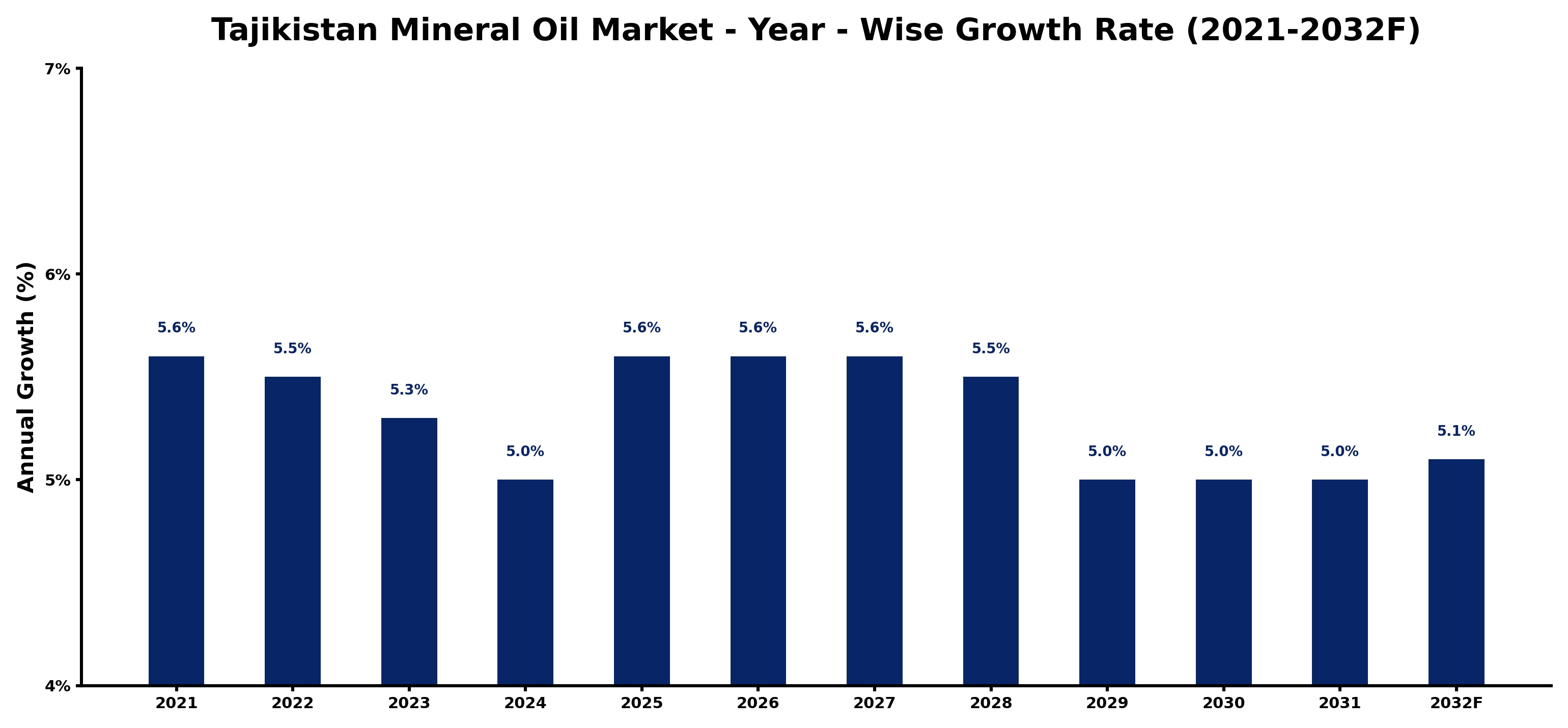
The table below presents the year‑wise growth rates along with the key drivers influencing the market
| Year | Growth Rate | Major Drivers |
| 2021 | 5.6% | Expansion of manufacturing activities |
| 2022 | 5.5% | Growing urbanization and commercial development |
| 2023 | 5.3% | Rising electricity demand across industries |
| 2024 | 5.0% | Increasing smart city development projects |
| 2025 | 5.6% | Growing urbanization and commercial development |
| 2026 | 5.6% | Increasing adoption of advanced technologies |
| 2027 | 5.6% | Expansion of transportation and logistics networks |
| 2028 | 5.5% | Expansion of manufacturing activities |
| 2029 | 5.0% | Increasing adoption of advanced technologies |
| 2030 | 5.0% | Expansion of commercial construction activities |
| 2031 | 5.0% | Rising electricity demand across industries |
| 2032 | 5.1% | Increasing industrial automation investments |
Note - Market size estimations and growth projections presented in this report are based on 6Wresearch’s advanced forecasting approach, validated with industry datasets as of June 2026.
Tajikistan Mineral Oil Market Synopsis
A significant characteristic of the Tajikistan Mineral Oil Market is its heavy reliance on imported petroleum products, as the nation lacks substantial oil reserves. This dependency positions the country as an import-driven market, thereby increasing vulnerability to global price fluctuations and supply disruptions.
Conversely, the government's focus on bolstering energy efficiency and expanding refining capacities provides a silver lining in this challenging landscape. While current infrastructure limitations hinder efficient distribution, strategic investments can open new pathways for growth and sustainability.
Tajikistan Mineral Oil Market Key Takeaways
- The market is import-driven, primarily relying on international suppliers for its petroleum needs.
- Government initiatives are aimed at attracting foreign investments and improving sector infrastructure.
- Fluctuating global oil prices pose significant challenges for local market stability.
- Rising urbanization and industrial activities are key drivers of mineral oil demand.
- Investment opportunities exist across exploration, refining, and distribution sectors.
Evaluation of Restraints in Tajikistan Mineral Oil Market
The Tajikistan Mineral Oil Market faces critical restraints stemming from its lack of domestic production capabilities. As the nation largely depends on imported oil, it is highly susceptible to external market volatility and international price swings. Additionally, inadequate infrastructure, particularly in transportation and storage, hampers the efficient distribution of mineral oil products. These challenges are exacerbated by regulatory inconsistencies, which create a less predictable environment for investors, further limiting the market's growth potential.
Tajikistan Mineral Oil Market Trends
The market is currently witnessing a shift towards increased investment in refining capacities, aimed at reducing import dependency. Additionally, there is a growing focus on energy efficiency and the adoption of cleaner technologies, reflecting global trends in the energy sector. Urbanization and a burgeoning population continue to escalate demand for refined petroleum products, particularly in transportation and industrial applications.
Tajikistan Mineral Oil Market Opportunities
Investment opportunities in Tajikistan's mineral oil market are rich and varied. With untapped oil and gas reserves waiting to be explored, the potential for local production and export is significant. Additionally, developing transportation and storage infrastructure will not only facilitate the movement of oil but also enhance the sector's overall efficiency. Investors can also look toward downstream activities like refining and distribution, which are essential for meeting rising domestic demands and enabling potential exports.
Government Initiatives in the Tajikistan Mineral Oil Market
The Tajikistan government has rolled out several policies designed to bolster the mineral oil market, such as the establishment of the State Unitary Enterprise (SUE) Tojiktransnafta. This organization is responsible for overseeing the transportation and storage of oil products, ensuring smoother logistics. Additionally, the government has introduced various measures to lure foreign investments, including tax incentives and fostering partnerships with international firms. Compliance with international environmental standards is also emphasized, ensuring that the mineral oil sector develops sustainably.
Future Insights of the Tajikistan Mineral Oil Market
The outlook for the Tajikistan Mineral Oil Market from 2026 to 2032 appears robust, driven largely by anticipated increases in foreign investments targeting exploration and production. The country's strategic position along key transit routes will likely facilitate trade in mineral oil, paving the way for economic benefits. Continued government focus on infrastructure improvements and energy security initiatives will further enhance the market's growth potential, although challenges related to pricing volatility and regulatory frameworks may require careful management.
Tajikistan Mineral Oil Market Latest Developments (May 2025 - June 2026)
Recent developments in the Tajikistan Mineral Oil Market reflect ongoing efforts to modernize and enhance the efficiency of oil transportation and storage. The government has ramped up initiatives aimed at fostering public-private partnerships to improve infrastructure capabilities. Increased focus is being placed on environmental standards in oil extraction and processing, aligning local practices with international norms to attract foreign investment.
Tajikistan Mineral Oil Market - Key Attractiveness of the Report
- 10 Years of Market Numbers
- Historical Data Starting from 2022 to 2025
- Base Year: 2025
- Forecast Data until 2032
- Key Performance Indicators Impacting the Market
- Major Upcoming Developments and Projects
Key Highlights of the Report:
- Tajikistan Mineral Oil Market Outlook
- Market Size of Tajikistan Mineral Oil Market, 2025
- Forecast of Tajikistan Mineral Oil Market, 2032
- Historical Data and Forecast of Tajikistan Mineral Oil Revenues & Volume for the Period 2022-2032F
- Tajikistan Mineral Oil Market Trend Evolution
- Tajikistan Mineral Oil Market Drivers and Challenges
- Tajikistan Mineral Oil Price Trends
- Tajikistan Mineral Oil Porter's Five Forces
- Tajikistan Mineral Oil Industry Life Cycle
- Historical Data and Forecast of Tajikistan Mineral Oil Market Revenues & Volume By Grade for the Period 2022-2032F
- Historical Data and Forecast of Tajikistan Mineral Oil Market Revenues & Volume By Technical Oil for the Period 2022-2032F
- Historical Data and Forecast of Tajikistan Mineral Oil Market Revenues & Volume By White Oil for the Period 2022-2032F
- Historical Data and Forecast of Tajikistan Mineral Oil Market Revenues & Volume By Application for the Period 2022-2032F
- Historical Data and Forecast of Tajikistan Mineral Oil Market Revenues & Volume By Baby Oil for the Period 2022-2032F
- Historical Data and Forecast of Tajikistan Mineral Oil Market Revenues & Volume By Cosmetics for the Period 2022-2032F
- Historical Data and Forecast of Tajikistan Mineral Oil Market Revenues & Volume By Skin Care Products for the Period 2022-2032F
- Historical Data and Forecast of Tajikistan Mineral Oil Market Revenues & Volume By Hair Care Products for the Period 2022-2032F
- Historical Data and Forecast of Tajikistan Mineral Oil Market Revenues & Volume By Consumer Goods for the Period 2022-2032F
- Historical Data and Forecast of Tajikistan Mineral Oil Market Revenues & Volume By Others for the Period 2022-2032F
- Tajikistan Mineral Oil Import Export Trade Statistics
- Market Opportunity Assessment By Grade
- Market Opportunity Assessment By Application
- Tajikistan Mineral Oil Top Companies Market Share
- Tajikistan Mineral Oil Competitive Benchmarking By Technical and Operational Parameters
- Tajikistan Mineral Oil Company Profiles
- Tajikistan Mineral Oil Key Strategic Recommendations






































