Bangladesh Mineral Oil Market Size, Share & Growth Rate
The Bangladesh Mineral Oil Market was estimated at USD 461 Million in 2025 and is projected to reach USD 637 Million by 2032, growing at a CAGR of 4.7% from 2026 to 2032. This growth trajectory is primarily fueled by the burgeoning automotive and industrial sectors, which rely heavily on mineral oil for lubricants and hydraulic fluids. As urbanization and infrastructure projects expand across the nation, the demand for mineral oil is set to rise significantly, thereby driving market expansion.
Bangladesh Mineral Oil Market Year-wise Growth Rate and Key Drivers
This graph highlights how the Bangladesh Mineral Oil Market has steadily grown over the years, supported by major growth factors.
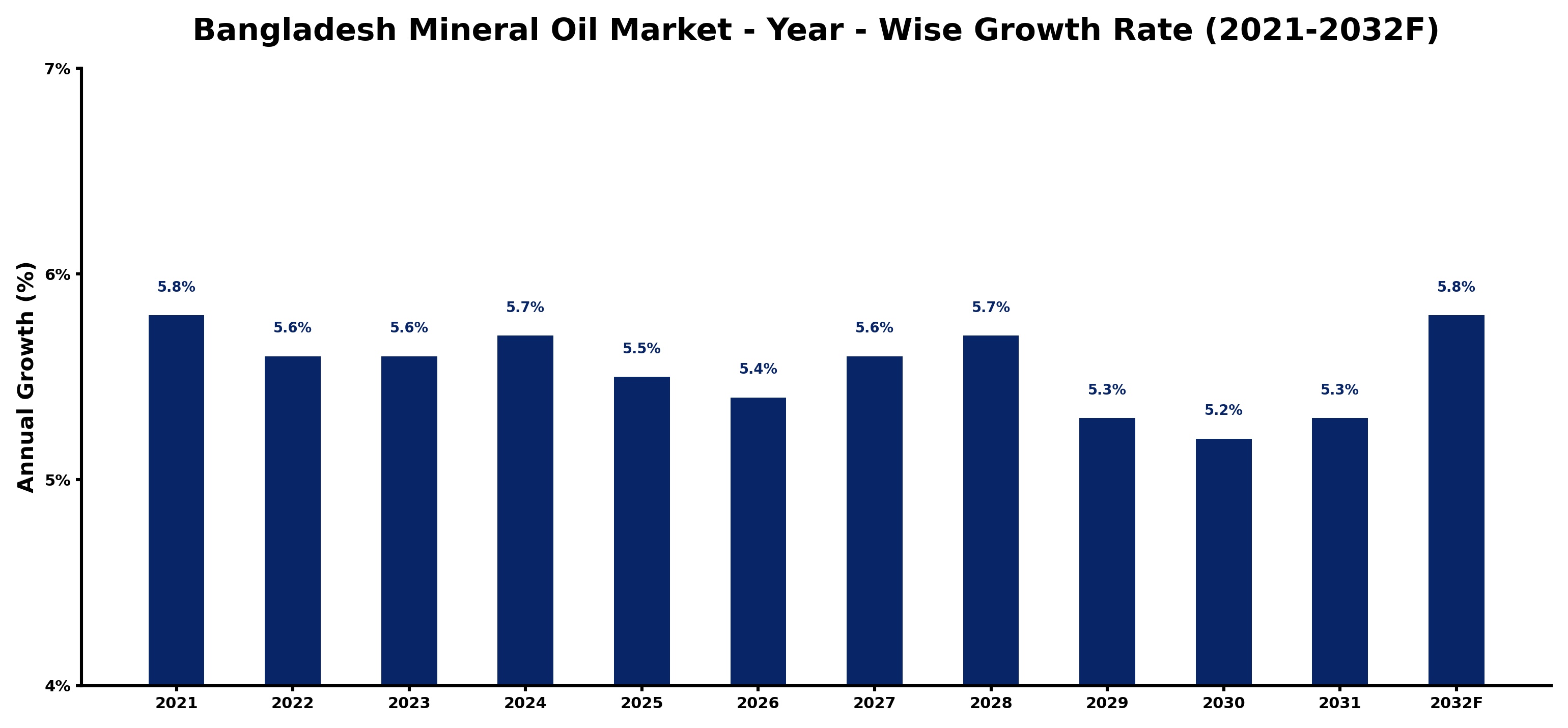
The table below presents the year‑wise growth rates along with the key drivers influencing the market
| Year | Growth Rate | Major Drivers |
| 2021 | 5.8% | Increasing industrial infrastructure investments |
| 2022 | 5.6% | Increasing industrial automation investments |
| 2023 | 5.6% | Expansion of transportation and logistics networks |
| 2024 | 5.7% | Increasing adoption of advanced technologies |
| 2025 | 5.5% | Increasing adoption of advanced technologies |
| 2026 | 5.4% | Growing renewable energy integration projects |
| 2027 | 5.6% | Increasing smart city development projects |
| 2028 | 5.7% | Government infrastructure modernization initiatives |
| 2029 | 5.3% | Rising electricity demand across industries |
| 2030 | 5.2% | Increasing industrial infrastructure investments |
| 2031 | 5.3% | Increasing adoption of advanced technologies |
| 2032 | 5.8% | Rapid growth in telecom and data center sectors |
Note - Market size estimations and growth projections presented in this report are based on 6Wresearch’s advanced forecasting approach, validated with industry datasets as of June 2026.
Bangladesh Mineral Oil Market Synopsis
In Bangladesh, the use of mineral oil spans various applications, notably in the automotive sector, where it acts as a critical lubricant in vehicles. The growth of this sector has led to an increased requirement for high-performance mineral oils to enhance efficiency and longevity in machinery.
Moreover, the manufacturing industry is significantly contributing to mineral oil consumption, particularly in processes requiring gear oils and transformer oils. With continuous infrastructural developments, this demand is expected to intensify, ensuring robust market growth over the coming years.
Bangladesh Mineral Oil Market Key Takeaways
- The market is poised for steady growth, driven by multiple industrial applications.
- Ongoing urbanization and infrastructural developments will boost demand for mineral oil.
- Environmental concerns are prompting shifts towards alternative oil solutions.
- Government regulations will play a critical role in shaping market dynamics.
- Challenges include price volatility and competition from synthetic alternatives.
Evaluation of Restraints in Bangladesh Mineral Oil Market
The Bangladesh Mineral Oil Market faces notable restraints, most prominently price volatility tied to fluctuations in crude oil prices. This unpredictability can impact profit margins for manufacturers and end-users alike. Additionally, growing environmental concerns are prompting a shift toward bio-based alternatives, which can pose a competitive challenge to traditional mineral oils. Regulatory compliance presents another layer of complexity, as companies must navigate quality standards and environmental guidelines to operate effectively in this landscape.
Bangladesh Mineral Oil Market Trends
Current trends indicate a rising preference for specialized mineral oils tailored for specific industrial applications, such as high-performance lubricants and environmentally friendly formulations. Furthermore, advancements in refining technologies are leading to improved product quality, which is becoming increasingly important in sectors like automotive and manufacturing.
Additionally, the trend towards sustainability is influencing product offerings, with a notable interest in mineral oils that minimize environmental impact while delivering high performance. This evolution in consumer preferences is reshaping product development strategies within the market.
Bangladesh Mineral Oil Market Opportunities
As the market evolves, substantial growth and investment opportunities are emerging in the production of high-quality, specialized mineral oils. Companies can capitalize on the ongoing demand from the automotive and manufacturing sectors by innovating product lines that cater to specific performance needs. Additionally, the increasing focus on environmentally sustainable solutions presents avenues for developing bio-based alternatives that align with modern regulatory standards and consumer preferences.
Government Initiatives in the Bangladesh Mineral Oil Market
The government of Bangladesh is expected to implement policies that regulate the mineral oil market through quality standards, import tariffs, and environmental regulations. These initiatives will aim to ensure the safety and purity of mineral oils across various industries, including automotive, manufacturing, and cosmetics. Moreover, government programs may also address oil spill prevention and cleanup efforts, emphasizing the importance of minimizing environmental impact in mineral oil production and use.
Future Insights of the Bangladesh Mineral Oil Market
Looking ahead to 2026-2032, the Bangladesh Mineral Oil Market is set to witness a transformative phase characterized by increased industrial activities and infrastructural developments. As sectors such as automotive and manufacturing continue to expand, the demand for high-quality mineral oils will rise correspondingly. Furthermore, investment in refining capabilities and a focus on sustainable practices will likely shape the competitive landscape, ensuring that the market not only grows but evolves in response to shifting consumer expectations and regulatory frameworks.
Bangladesh Mineral Oil Market Latest Developments (May 2025 - June 2026)
Recent developments within the Bangladesh Mineral Oil Market have indicated a heightened emphasis on product innovation and sustainability. Various initiatives are underway to enhance product formulations, making them more efficient while also adhering to emerging environmental standards. As regulatory bodies tighten their oversight on oil quality and environmental practices, companies are actively investing in compliance and improvement measures to stay competitive in this dynamic landscape.
Bangladesh Mineral Oil Market - Key Attractiveness of the Report
- 10 Years of Market Numbers
- Historical Data Starting from 2022 to 2025
- Base Year: 2025
- Forecast Data until 2032
- Key Performance Indicators Impacting the Market
- Major Upcoming Developments and Projects
Key Highlights of the Report:
- Bangladesh Mineral Oil Market Outlook
- Market Size of Bangladesh Mineral Oil Market, 2025
- Forecast of Bangladesh Mineral Oil Market, 2032
- Historical Data and Forecast of Bangladesh Mineral Oil Revenues & Volume for the Period 2022-2032F
- Bangladesh Mineral Oil Market Trend Evolution
- Bangladesh Mineral Oil Market Drivers and Challenges
- Bangladesh Mineral Oil Price Trends
- Bangladesh Mineral Oil Porter's Five Forces
- Bangladesh Mineral Oil Industry Life Cycle
- Historical Data and Forecast of Bangladesh Mineral Oil Market Revenues & Volume By Grade for the Period 2022-2032F
- Historical Data and Forecast of Bangladesh Mineral Oil Market Revenues & Volume By Technical Oil for the Period 2022-2032F
- Historical Data and Forecast of Bangladesh Mineral Oil Market Revenues & Volume By White Oil for the Period 2022-2032F
- Historical Data and Forecast of Bangladesh Mineral Oil Market Revenues & Volume By Application for the Period 2022-2032F
- Historical Data and Forecast of Bangladesh Mineral Oil Market Revenues & Volume By Baby Oil for the Period 2022-2032F
- Historical Data and Forecast of Bangladesh Mineral Oil Market Revenues & Volume By Cosmetics for the Period 2022-2032F
- Historical Data and Forecast of Bangladesh Mineral Oil Market Revenues & Volume By Skin Care Products for the Period 2022-2032F
- Historical Data and Forecast of Bangladesh Mineral Oil Market Revenues & Volume By Hair Care Products for the Period 2022-2032F
- Historical Data and Forecast of Bangladesh Mineral Oil Market Revenues & Volume By Consumer Goods for the Period 2022-2032F
- Historical Data and Forecast of Bangladesh Mineral Oil Market Revenues & Volume By Others for the Period 2022-2032F
- Bangladesh Mineral Oil Import Export Trade Statistics
- Market Opportunity Assessment By Grade
- Market Opportunity Assessment By Application
- Bangladesh Mineral Oil Top Companies Market Share
- Bangladesh Mineral Oil Competitive Benchmarking By Technical and Operational Parameters
- Bangladesh Mineral Oil Company Profiles
- Bangladesh Mineral Oil Key Strategic Recommendations






































