India Mineral Oil Market Size, Share & Growth Rate
The India Mineral Oil Market was estimated at USD 1364 Million in 2025 and is projected to reach USD 1963 Million by 2032, growing at a CAGR of 5.3% from 2026 to 2032. This growth trajectory is primarily fueled by increasing urbanization and a rising middle-class disposable income, factors that are enhancing consumption patterns across the nation. Moreover, the burgeoning demand for lubricants stemming from diverse industries plays a pivotal role in bolstering market dynamics.
India Mineral Oil Market Growth Rate Analysis (2021-2032)
The India Mineral Oil Market has shown notable recovery and growth in recent years, rebounding from a decline of -3.0% in 2021 to a robust 9.0% in 2022, primarily driven by a resurgence in consumer demand and increased industrial activity post-pandemic. This upward trend continues, with growth rates projected at 7.6% in 2023 and gradually increasing to 7.9% by 2026. Factors contributing to this momentum include ongoing investments in infrastructure, the energy transition initiatives, and advancements in extraction technologies. However, the growth rate is expected to stabilize at around 6.0% to 6.6% from 2030 onwards, reflecting evolving market dynamics and potential shifts toward alternative energy sources.
India Mineral Oil Market Year-wise Growth Rate and Key Drivers
This graph highlights how the India Mineral Oil Market has steadily grown over the past five years, supported by major growth factors.
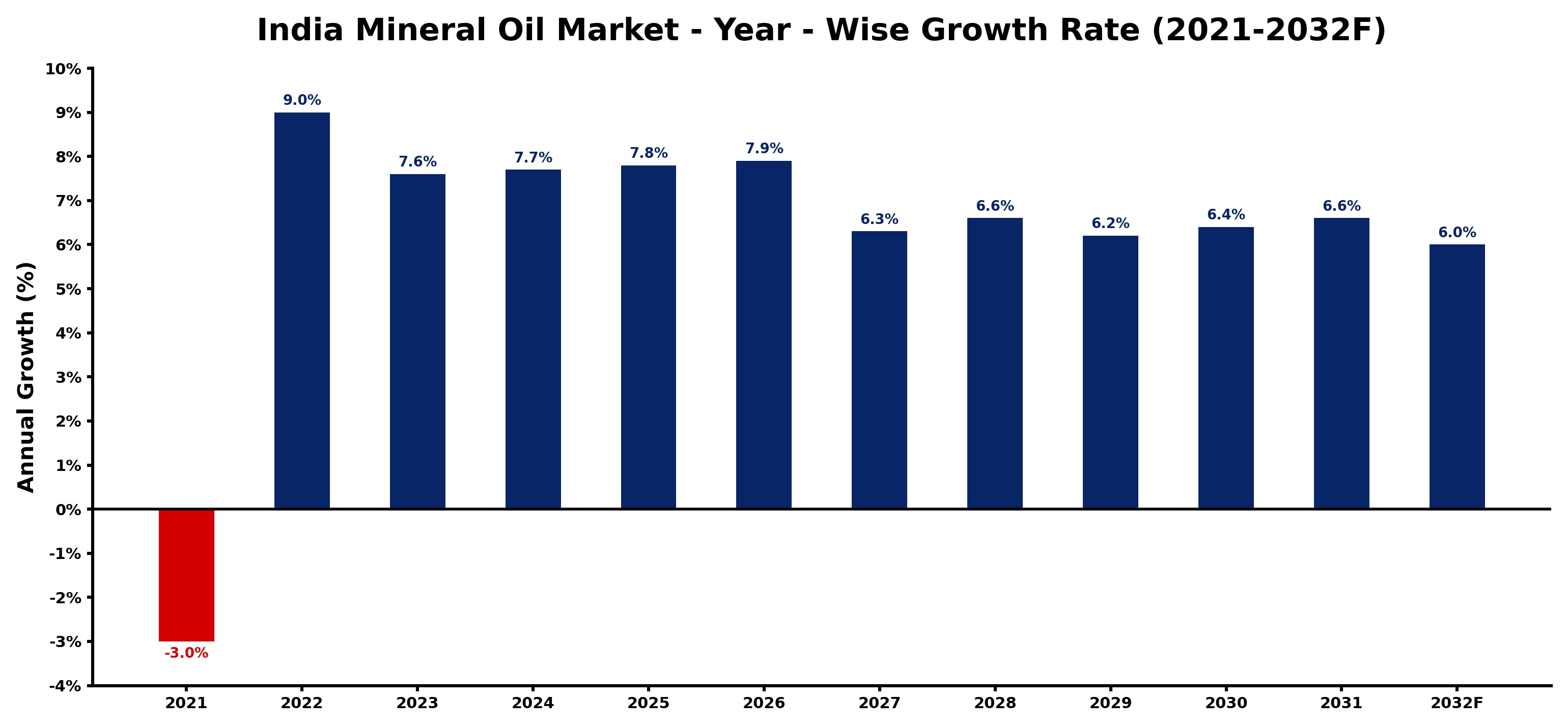
The table below presents the year‑wise growth rates along with the key drivers influencing the market
| Year | Growth Rate | Major Drivers |
| 2021 | -3.0% | Increasing industrial infrastructure investments |
| 2022 | 9.0% | Growing renewable energy integration projects |
| 2023 | 7.6% | Expansion of transportation and logistics networks |
| 2024 | 7.7% | Rising electricity demand across industries |
| 2025 | 7.8% | Rising electricity demand across industries |
| 2026 | 7.9% | Rising electricity demand across industries |
| 2027 | 6.3% | Increasing industrial automation investments |
| 2028 | 6.6% | Expansion of transportation and logistics networks |
| 2029 | 6.2% | Growing urbanization and commercial development |
| 2030 | 6.4% | Increasing adoption of advanced technologies |
| 2031 | 6.6% | Increasing industrial infrastructure investments |
| 2032 | 6.0% | Expansion of manufacturing activities |
Note - Market size estimations and growth projections presented in this report are based on 6Wresearch’s advanced forecasting approach, validated with industry datasets as of June 2026.
India Mineral Oil Market Synopsis
While the India Mineral Oil Market has demonstrated robust performance recently, the future promises even greater momentum. The synergy of rapid industrialization and technological advancements is increasingly aligning with consumer needs, creating a fertile ground for sustained growth in this sector.
As urban centers expand and infrastructure projects accelerate, the demand for mineral oils is expected to escalate, particularly within the automotive and manufacturing segments. The trajectory towards energy conservation and efficient petroleum use further supports the positive outlook for the market in the coming years.
India Mineral Oil Market Key Takeaways
- The market is set to grow at a CAGR of 5.3%, driven by urbanization and disposable income.
- Technological advancements are enhancing product efficiency and consumer appeal.
- Rising industrial demand for lubricants is a significant growth driver.
- Government initiatives towards energy efficiency are aiding market development.
- Biofuel blending and sustainability trends are reshaping market dynamics.
Evaluation of Restraints in India Mineral Oil Market
Despite the optimistic growth prospects for the India Mineral Oil Market, several restraints continue to pose challenges. Stringent regulations aimed at environmental protection and safety standards create hurdles for market participants. Furthermore, volatile raw material prices can disrupt supply chains, making strategic pricing difficult. The high import duties on finished mineral oil products also restrict competitive pricing, while competition from global entities with superior technological capabilities pressures domestic players. These factors create a landscape where companies must innovate consistently while adhering to regulatory frameworks.
India Mineral Oil Market Trends
The India Mineral Oil Market is witnessing significant trends that are shaping both demand and technological advancements. The inclination towards biofuel blending is rising, as consumers and industries alike seek sustainable energy solutions. Innovations in lubricant formulations are enhancing performance and longevity, catering to the evolving demands of various sectors. Furthermore, automation and smart technologies are beginning to integrate into production processes, allowing for more efficient management of mineral oil applications.
India Mineral Oil Market Opportunities
The opportunities for growth in the India Mineral Oil Market are abundant, particularly in sectors where urbanization and industrialization intersect. Emerging markets within tier-2 and tier-3 cities present a lucrative avenue as the middle class expands its purchasing power. Investment in R&D focusing on high-performance lubricants and environmentally friendly products will also yield competitive advantages. Additionally, public-private partnerships aimed at energy conservation could foster innovation and market expansion.
Government Initiatives in the India Mineral Oil Market
The Indian government is implementing various initiatives that influence the Mineral Oil Market positively. Policies focused on energy conservation and efficiency are being prioritized, with programs aimed at promoting the use of sustainable and alternative energy sources. Investments in infrastructure development further catalyze market growth, driving demand for petroleum products. Additionally, government regulations are increasingly encouraging the adoption of cleaner technologies, setting the stage for a progressive shift in the industry.
Future Insights of the India Mineral Oil Market
Looking ahead to 2026-2032, the India Mineral Oil Market is poised for transformative growth. The interplay between economic expansion and consumer preferences will dictate the pace of market development. Innovations in lubricants and the rising trend of biofuel blending are expected to become mainstream, further enhancing market attractiveness. With strategic initiatives supporting sustainability and efficiency, the market stands at a pivotal juncture, ready to leverage opportunities presented by both domestic and international players.
India Mineral Oil Market Latest Developments (May 2025 - June 2026)
In the recent months leading up to mid-2026, the India Mineral Oil Market has observed a significant shift towards sustainable practices, with increased focus on biofuels and innovative lubricant formulations. Industry players are investing heavily in R&D to align with both regulatory standards and consumer demands for environmentally friendly products. Moreover, strategic partnerships are being formed to enhance distribution channels and technological capabilities, marking a dynamic evolution in market strategies.
India Mineral Oil Market - Key Attractiveness of the Report
- 10 Years of Market Numbers
- Historical Data Starting from 2022 to 2025
- Base Year: 2025
- Forecast Data until 2032
- Key Performance Indicators Impacting the Market
- Major Upcoming Developments and Projects
Key Highlights of the Report:
- India Mineral Oil Market Outlook
- Market Size of India Mineral Oil Market, 2025
- Forecast of India Mineral Oil Market, 2032F
- Historical Data and Forecast of India Mineral Oil Revenues & Volume for the Period 2022-2032F
- India Mineral Oil Market Trend Evolution
- India Mineral Oil Market Drivers and Challenges
- India Mineral Oil Price Trends
- India Mineral Oil Porter's Five Forces
- India Mineral Oil Industry Life Cycle
- Historical Data and Forecast of India Mineral Oil Market Revenues & Volume By Grade for the Period 2022-2032F
- Historical Data and Forecast of India Mineral Oil Market Revenues & Volume By Technical Oil for the Period 2022-2032F
- Historical Data and Forecast of India Mineral Oil Market Revenues & Volume By White Oil for the Period 2022-2032F
- Historical Data and Forecast of India Mineral Oil Market Revenues & Volume By Application for the Period 2022-2032F
- Historical Data and Forecast of India Mineral Oil Market Revenues & Volume By Baby Oil for the Period 2022-2032F
- Historical Data and Forecast of India Mineral Oil Market Revenues & Volume By Cosmetics for the Period 2022-2032F
- Historical Data and Forecast of India Mineral Oil Market Revenues & Volume By Skin Care Products for the Period 2022-2032F
- Historical Data and Forecast of India Mineral Oil Market Revenues & Volume By Hair Care Products for the Period 2022-2032F
- Historical Data and Forecast of India Mineral Oil Market Revenues & Volume By Consumer Goods for the Period 2022-2032F
- Historical Data and Forecast of India Mineral Oil Market Revenues & Volume By Others for the Period 2022-2032F
- India Mineral Oil Import Export Trade Statistics
- Market Opportunity Assessment By Grade
- Market Opportunity Assessment By Application
- India Mineral Oil Top Companies Market Share
- India Mineral Oil Competitive Benchmarking By Technical and Operational Parameters
- India Mineral Oil Company Profiles
- India Mineral Oil Key Strategic Recommendations






































