Tunisia Mineral Oil Market Size, Share & Growth Rate
The Tunisia Mineral Oil Market was estimated at USD 499 Million in 2025 and is projected to reach USD 676 Million by 2032, growing at a CAGR of 4.4% from 2026 to 2032. This growth trajectory is primarily fueled by the rising demand for mineral oils across various industrial applications, particularly in lubricants and automotive sectors. Moreover, technological advancements and a burgeoning manufacturing base in Tunisia are further enhancing the market's potential.
Tunisia Mineral Oil Market Year-wise Growth Rate and Key Drivers
This graph highlights how the Tunisia Mineral Oil Market has steadily grown over the years, supported by major growth factors.
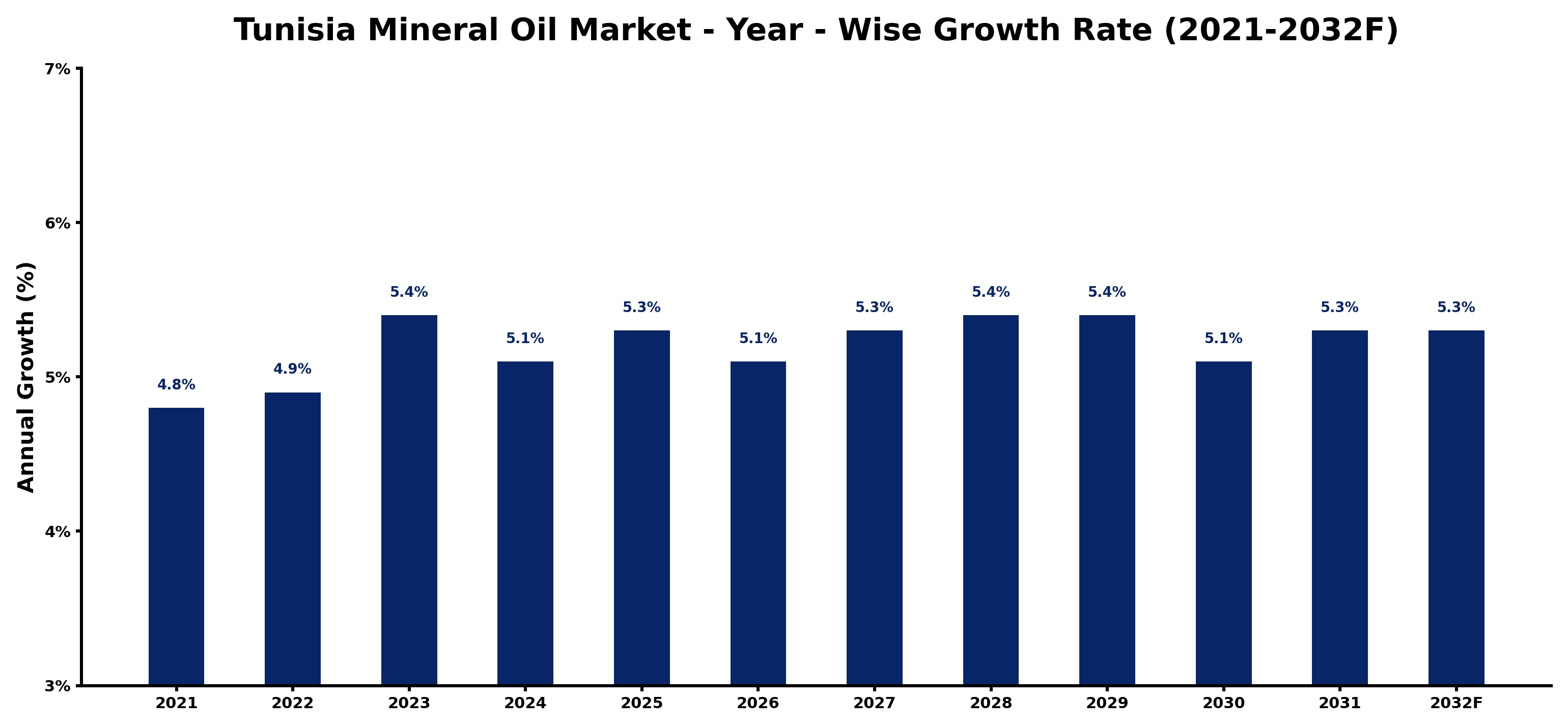
The table below presents the year‑wise growth rates along with the key drivers influencing the market
| Year | Growth Rate | Major Drivers |
| 2021 | 4.8% | Increasing industrial automation investments |
| 2022 | 4.9% | Government infrastructure modernization initiatives |
| 2023 | 5.4% | Increasing industrial infrastructure investments |
| 2024 | 5.1% | Growing renewable energy integration projects |
| 2025 | 5.3% | Expansion of transportation and logistics networks |
| 2026 | 5.1% | Rapid growth in telecom and data center sectors |
| 2027 | 5.3% | Expansion of transportation and logistics networks |
| 2028 | 5.4% | Expansion of transportation and logistics networks |
| 2029 | 5.4% | Increasing industrial infrastructure investments |
| 2030 | 5.1% | Expansion of commercial construction activities |
| 2031 | 5.3% | Expansion of manufacturing activities |
| 2032 | 5.3% | Government infrastructure modernization initiatives |
Note - Market size estimations and growth projections presented in this report are based on 6Wresearch’s advanced forecasting approach, validated with industry datasets as of June 2026.
Tunisia Mineral Oil Market Synopsis
The strongest force currently shaping the Tunisia Mineral Oil Market is the increasing industrial activity, which demands reliable lubrication solutions for machinery and automotive engines. This upsurge in industrialization is accompanied by a growing focus on high-performance formulations, particularly those emphasizing thermal stability and specific viscosity characteristics.
In addition, the healthcare and cosmetics industries are becoming significant consumers of mineral oils, further diversifying the market. These sectors are pushing for quality oils that not only meet performance standards but also adhere to strict regulatory compliance on sustainability and environmental impact.
Tunisia Mineral Oil Market Key Takeaways
- The Tunisia Mineral Oil Market is poised for significant growth, driven by the expanding industrial base.
- Technological innovations in mineral oil formulations are enhancing performance and extending equipment life.
- Regulatory pressures focused on environmental sustainability are shaping market dynamics.
- The demand for high-performance lubricants is a critical driver across various sectors, including automotive and industrial.
- Government policies promote energy security and environmental protection, influencing market strategies.
Evaluation of Restraints in Tunisia Mineral Oil Market
Despite the growth potential, the Tunisia Mineral Oil Market grapples with notable constraints. Environmental concerns surrounding oil exploration and production pose significant challenges, often leading to stricter regulations. Additionally, fluctuations in global oil prices can create uncertainty for local suppliers and manufacturers, complicating long-term planning and investment. Geopolitical instability in the region further complicates supply chains, making it imperative for market players to devise strategies that mitigate these risks.
Tunisia Mineral Oil Market Trends
Key trends influencing the Tunisia Mineral Oil Market include a rising preference for low-viscosity oils aimed at enhancing energy efficiency in machinery and vehicles. Furthermore, the increasing integration of high-performance additives is improving the durability and lifespan of equipment. These technological enhancements are vital as industries seek solutions that balance performance with cost-effectiveness.
Tunisia Mineral Oil Market Opportunities
Significant growth opportunities lie in the expansion of the automotive and manufacturing sectors, both of which require superior mineral oil products. Additionally, the increasing focus on sustainable practices opens avenues for businesses to innovate in eco-friendly formulations, presenting a competitive advantage. Investment in research and development to create advanced oil formulations tailored to specific industry needs can also yield substantial returns.
Government Initiatives in the Tunisia Mineral Oil Market
The Tunisian government is actively promoting initiatives that bolster energy security while ensuring environmental protection. Policies surrounding oil exploration and production are coupled with stringent environmental impact assessments. These regulations are designed not only to safeguard natural resources but also to foster sustainable resource management practices within the mineral oil sector.
Future Insights of the Tunisia Mineral Oil Market
Looking ahead to 2026-2032, the Tunisia Mineral Oil Market is expected to experience a dynamic shift characterized by technological advancements and regulatory adaptations. As industries increasingly adopt high-performance lubricants and prioritize environmental sustainability, the market will likely see a surge in demand for innovative products. Government policies aimed at enhancing energy security will continue to shape the landscape, presenting numerous opportunities for growth.
Tunisia Mineral Oil Market Latest Developments (May 2025 - June 2026)
Recent developments in the Tunisia Mineral Oil Market indicate a strong focus on upgrading production facilities to meet modern environmental standards. The push for sustainable practices is leading many companies to invest in green technologies that minimize environmental impact. Additionally, ongoing collaborations between public and private sectors aim to enhance supply chain resilience and drive innovation in mineral oil applications.
Tunisia Mineral Oil Market - Key Attractiveness of the Report
- 10 Years of Market Numbers
- Historical Data Starting from 2022 to 2025
- Base Year: 2025
- Forecast Data until 2032
- Key Performance Indicators Impacting the Market
- Major Upcoming Developments and Projects
Key Highlights of the Report:
- Tunisia Mineral Oil Market Outlook
- Market Size of Tunisia Mineral Oil Market, 2025
- Forecast of Tunisia Mineral Oil Market, 2032
- Historical Data and Forecast of Tunisia Mineral Oil Revenues & Volume for the Period 2022-2032F
- Tunisia Mineral Oil Market Trend Evolution
- Tunisia Mineral Oil Market Drivers and Challenges
- Tunisia Mineral Oil Price Trends
- Tunisia Mineral Oil Porter's Five Forces
- Tunisia Mineral Oil Industry Life Cycle
- Historical Data and Forecast of Tunisia Mineral Oil Market Revenues & Volume By Grade for the Period 2022-2032F
- Historical Data and Forecast of Tunisia Mineral Oil Market Revenues & Volume By Technical Oil for the Period 2022-2032F
- Historical Data and Forecast of Tunisia Mineral Oil Market Revenues & Volume By White Oil for the Period 2022-2032F
- Historical Data and Forecast of Tunisia Mineral Oil Market Revenues & Volume By Application for the Period 2022-2032F
- Historical Data and Forecast of Tunisia Mineral Oil Market Revenues & Volume By Baby Oil for the Period 2022-2032F
- Historical Data and Forecast of Tunisia Mineral Oil Market Revenues & Volume By Cosmetics for the Period 2022-2032F
- Historical Data and Forecast of Tunisia Mineral Oil Market Revenues & Volume By Skin Care Products for the Period 2022-2032F
- Historical Data and Forecast of Tunisia Mineral Oil Market Revenues & Volume By Hair Care Products for the Period 2022-2032F
- Historical Data and Forecast of Tunisia Mineral Oil Market Revenues & Volume By Consumer Goods for the Period 2022-2032F
- Historical Data and Forecast of Tunisia Mineral Oil Market Revenues & Volume By Others for the Period 2022-2032F
- Tunisia Mineral Oil Import Export Trade Statistics
- Market Opportunity Assessment By Grade
- Market Opportunity Assessment By Application
- Tunisia Mineral Oil Top Companies Market Share
- Tunisia Mineral Oil Competitive Benchmarking By Technical and Operational Parameters
- Tunisia Mineral Oil Company Profiles
- Tunisia Mineral Oil Key Strategic Recommendations






































