Egypt Mineral Oil Market Size, Share & Growth Rate
The Egypt Mineral Oil Market was estimated at USD 494 Million in 2025 and is projected to reach USD 661 Million by 2032, growing at a CAGR of 4.2% from 2026 to 2032. This growth trajectory is driven by an increasing demand for high-quality mineral oils across various sectors, particularly automotive lubricants and cosmetics. Additionally, government initiatives aimed at enhancing local production capabilities are supporting market expansion.
Egypt Mineral Oil Market Year-wise Growth Rate and Key Drivers
This graph highlights how the Egypt Mineral Oil Market has steadily grown over the years, supported by major growth factors.
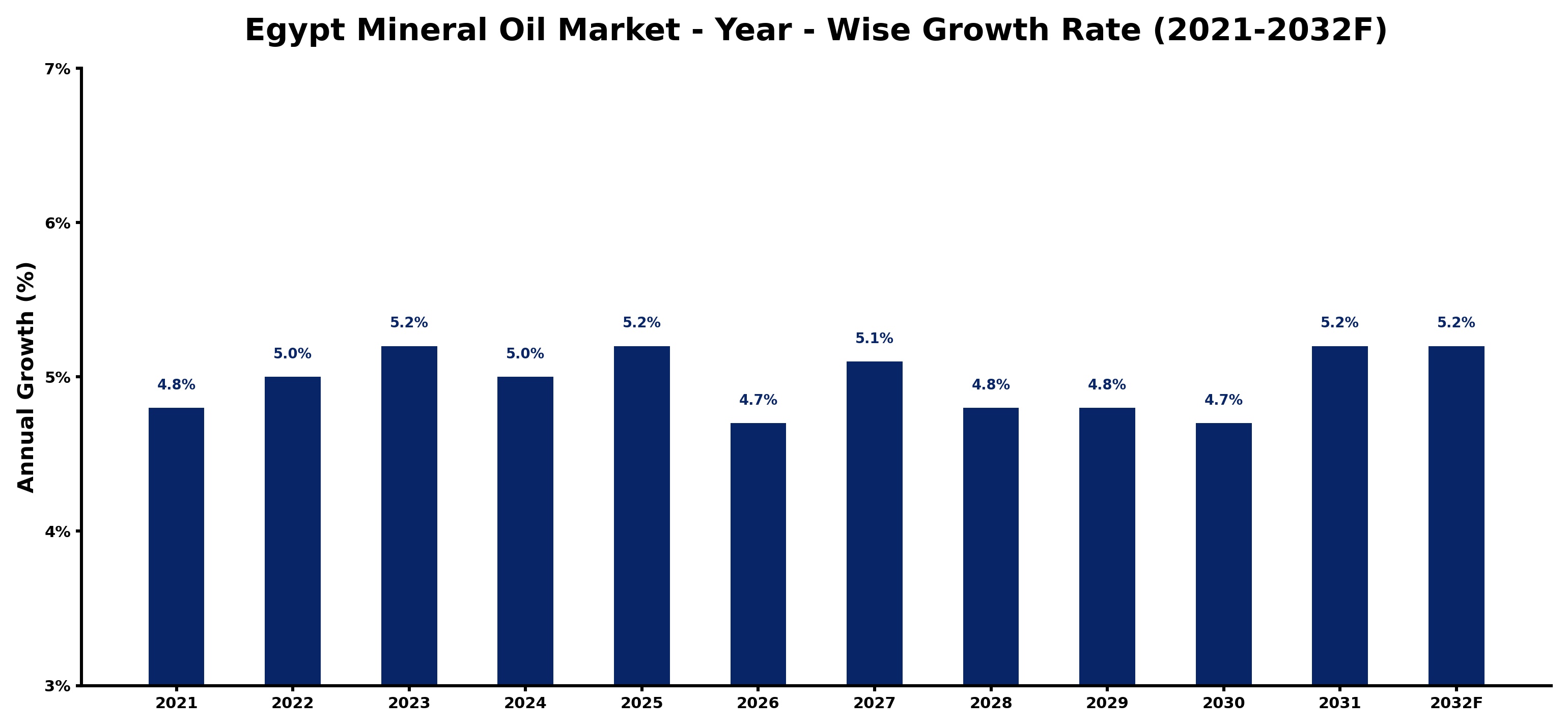
The table below presents the year‑wise growth rates along with the key drivers influencing the market
| Year | Growth Rate | Major Drivers |
| 2021 | 4.8% | Rising electricity demand across industries |
| 2022 | 5.0% | Growing renewable energy integration projects |
| 2023 | 5.2% | Increasing smart city development projects |
| 2024 | 5.0% | Increasing industrial infrastructure investments |
| 2025 | 5.2% | Increasing smart city development projects |
| 2026 | 4.7% | Expansion of transportation and logistics networks |
| 2027 | 5.1% | Increasing industrial automation investments |
| 2028 | 4.8% | Rising electricity demand across industries |
| 2029 | 4.8% | Expansion of manufacturing activities |
| 2030 | 4.7% | Expansion of commercial construction activities |
| 2031 | 5.2% | Rising electricity demand across industries |
| 2032 | 5.2% | Growing urbanization and commercial development |
Note - Market size estimations and growth projections presented in this report are based on 6Wresearch’s advanced forecasting approach, validated with industry datasets as of June 2026.
Egypt Mineral Oil Market Synopsis
Recent momentum in the Egypt Mineral Oil Market reflects a robust demand from industries that rely on mineral oil's unique properties. The automotive and personal care sectors are seeing increased consumption, which bodes well for future market stability.
Looking ahead, the market is poised for growth as domestic production ramps up in response to government incentives. This shift towards local sourcing is expected to play a crucial role in meeting the rising demand while mitigating the impact of international market fluctuations.
Egypt Mineral Oil Market Key Takeaways
- The market is projected to grow steadily, driven by demand from key industries such as automotive and personal care.
- Government initiatives are fostering local production capabilities to reduce reliance on imports.
- Price volatility in raw materials remains a significant challenge for manufacturers.
- Competition from synthetic oil alternatives is becoming increasingly pronounced.
- Regulatory compliance regarding environmental standards presents ongoing operational costs.
Evaluation of Restraints in Egypt Mineral Oil Market
The Egypt Mineral Oil Market faces notable restraints that could impact its potential. The most pressing issue is the volatility in raw material pricing, which complicates pricing strategies for manufacturers. This is further compounded by the rising popularity of synthetic alternatives, which are gaining traction in sectors where cost-efficiency is a primary concern. Additionally, stringent environmental regulations regarding disposal and emissions impose significant compliance costs that can strain smaller manufacturers, limiting their ability to compete effectively.
Egypt Mineral Oil Market Trends
Current trends in the Egypt Mineral Oil Market highlight a growing preference for eco-friendly and sustainable products, which is influencing consumer behavior across various sectors. Furthermore, advancements in refining technologies are allowing for the production of higher-quality mineral oils, enhancing their appeal in demanding applications. There is also an increasing emphasis on formulations that align with consumer health and safety expectations, particularly in the cosmetics and personal care industries.
Egypt Mineral Oil Market Opportunities
The potential for growth in the Egypt Mineral Oil Market is significant, particularly in sectors such as pharmaceuticals and industrial applications. Investment opportunities lie in upgrading refining technologies to enhance product quality and operational efficiency. Additionally, the increasing demand for specialized formulations presents a chance for manufacturers to differentiate their offerings and capture niche markets. As the government continues to support local production, businesses can benefit from incentives and a more favorable operating environment.
Government Initiatives in the Egypt Mineral Oil Market
The Egyptian government plays an active role in shaping the mineral oil landscape through policies that aim to boost local production and reduce dependency on imports. Incentives are offered to companies investing in refining technologies, aimed at enhancing the quality and sustainability of mineral oil products. Additionally, regulatory frameworks are being established to ensure environmentally responsible practices in extraction and processing, which align with global sustainability trends.
Future Insights of the Egypt Mineral Oil Market
From 2026 to 2032, the Egypt Mineral Oil Market is expected to evolve significantly, influenced by ongoing industrial growth and increased local production. The combined effect of technological advancements and governmental support will likely drive further demand, particularly in high-quality applications. Market players who can adapt to consumer preferences for sustainability and innovation will find themselves well-positioned to capitalize on emerging opportunities.
Egypt Mineral Oil Market Latest Developments (May 2025 - June 2026)
Recent developments in the Egypt Mineral Oil Market indicate a shift towards modernization and sustainability. Companies are increasingly investing in eco-friendly refining processes, reflecting a broader industry trend towards reducing environmental impact. Additionally, there has been a notable uptick in collaborative efforts among industry stakeholders to enhance product quality and address regulatory compliance issues. This renewed focus on innovation and efficiency is setting the stage for a dynamic market environment.
Egypt Mineral Oil Market - Key Attractiveness of the Report
- 10 Years of Market Numbers
- Historical Data Starting from 2022 to 2025
- Base Year: 2025
- Forecast Data until 2032
- Key Performance Indicators Impacting the Market
- Major Upcoming Developments and Projects
Key Highlights of the Report:
- Egypt Mineral Oil Market Outlook
- Market Size of Egypt Mineral Oil Market, 2025
- Forecast of Egypt Mineral Oil Market, 2032
- Historical Data and Forecast of Egypt Mineral Oil Revenues & Volume for the Period 2022-2032F
- Egypt Mineral Oil Market Trend Evolution
- Egypt Mineral Oil Market Drivers and Challenges
- Egypt Mineral Oil Price Trends
- Egypt Mineral Oil Porter's Five Forces
- Egypt Mineral Oil Industry Life Cycle
- Historical Data and Forecast of Egypt Mineral Oil Market Revenues & Volume By Grade for the Period 2022-2032F
- Historical Data and Forecast of Egypt Mineral Oil Market Revenues & Volume By Technical Oil for the Period 2022-2032F
- Historical Data and Forecast of Egypt Mineral Oil Market Revenues & Volume By White Oil for the Period 2022-2032F
- Historical Data and Forecast of Egypt Mineral Oil Market Revenues & Volume By Application for the Period 2022-2032F
- Historical Data and Forecast of Egypt Mineral Oil Market Revenues & Volume By Baby Oil for the Period 2022-2032F
- Historical Data and Forecast of Egypt Mineral Oil Market Revenues & Volume By Cosmetics for the Period 2022-2032F
- Historical Data and Forecast of Egypt Mineral Oil Market Revenues & Volume By Skin Care Products for the Period 2022-2032F
- Historical Data and Forecast of Egypt Mineral Oil Market Revenues & Volume By Hair Care Products for the Period 2022-2032F
- Historical Data and Forecast of Egypt Mineral Oil Market Revenues & Volume By Consumer Goods for the Period 2022-2032F
- Historical Data and Forecast of Egypt Mineral Oil Market Revenues & Volume By Others for the Period 2022-2032F
- Egypt Mineral Oil Import Export Trade Statistics
- Market Opportunity Assessment By Grade
- Market Opportunity Assessment By Application
- Egypt Mineral Oil Top Companies Market Share
- Egypt Mineral Oil Competitive Benchmarking By Technical and Operational Parameters
- Egypt Mineral Oil Company Profiles
- Egypt Mineral Oil Key Strategic Recommendations






































