Kenya Mineral Oil Market Size, Share & Growth Rate
The Kenya Mineral Oil Market was estimated at USD 172 Million in 2025 and is projected to reach USD 225 Million by 2032, growing at a CAGR of 3.9% from 2026 to 2032. This growth trajectory is driven by increased industrialization and urbanization in the country, alongside a burgeoning automotive sector. The rising demand for mineral oils in lubricants, cosmetics, and pharmaceuticals further fuels this expansion, positioning Kenya as a significant player in the regional market.
Kenya Mineral Oil Market Year-wise Growth Rate and Key Drivers
This graph highlights how the Kenya Mineral Oil Market has steadily grown over the years, supported by major growth factors.
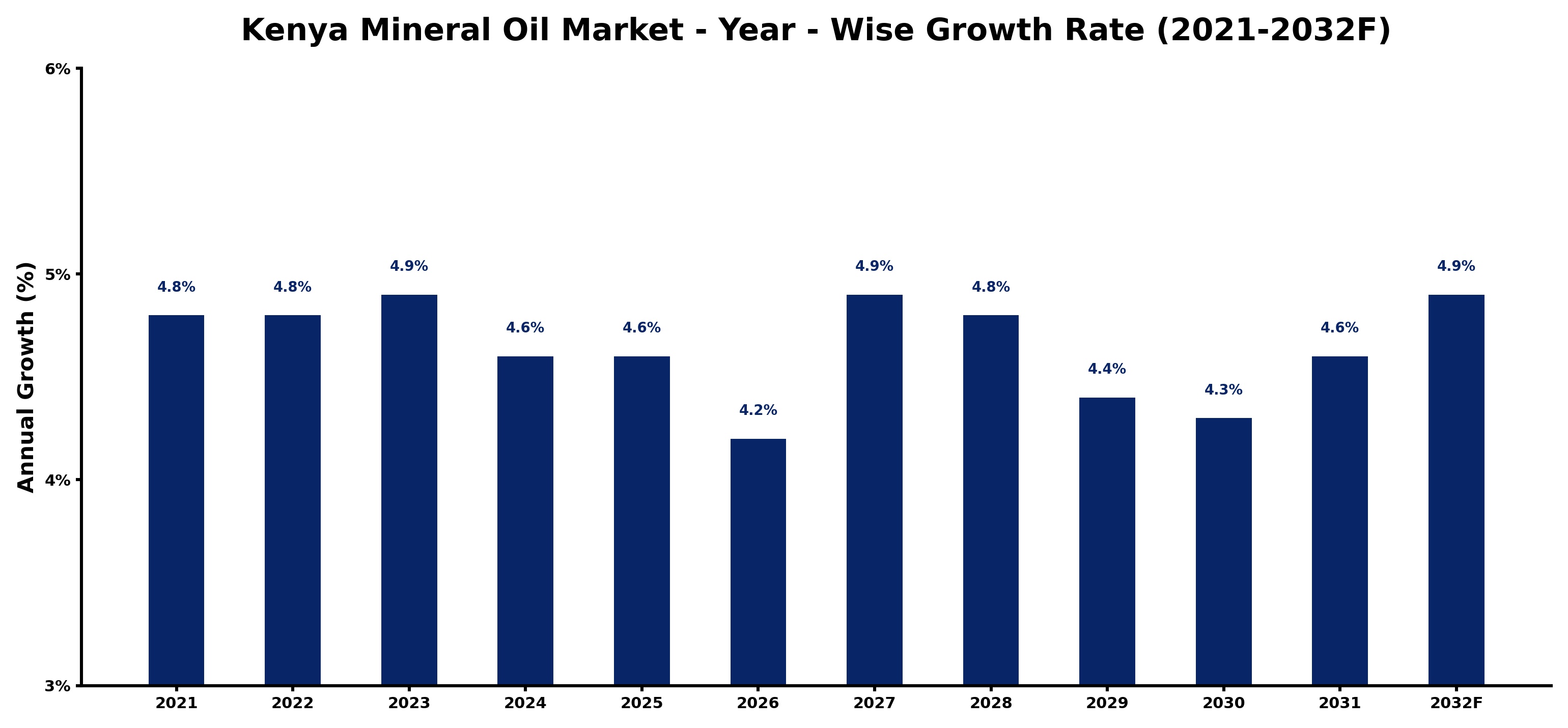
The table below presents the year‑wise growth rates along with the key drivers influencing the market
| Year | Growth Rate | Major Drivers |
| 2021 | 4.8% | Growing urbanization and commercial development |
| 2022 | 4.8% | Increasing industrial automation investments |
| 2023 | 4.9% | Expansion of commercial construction activities |
| 2024 | 4.6% | Expansion of manufacturing activities |
| 2025 | 4.6% | Rapid growth in telecom and data center sectors |
| 2026 | 4.2% | Expansion of transportation and logistics networks |
| 2027 | 4.9% | Increasing industrial infrastructure investments |
| 2028 | 4.8% | Expansion of transportation and logistics networks |
| 2029 | 4.4% | Expansion of commercial construction activities |
| 2030 | 4.3% | Expansion of manufacturing activities |
| 2031 | 4.6% | Rapid growth in telecom and data center sectors |
| 2032 | 4.9% | Growing urbanization and commercial development |
Note - Market size estimations and growth projections presented in this report are based on 6Wresearch’s advanced forecasting approach, validated with industry datasets as of June 2026.
Kenya Mineral Oil Market Synopsis
In Kenya, mineral oils are essential across multiple applications, particularly in automotive lubricants and cosmetic formulations. The cosmetic industry, in particular, has seen an upsurge in demand for high-quality emollients, which has positively impacted the mineral oil sector.
Furthermore, the pharmaceutical sector's reliance on mineral oils for specific medicinal formulations underscores their critical role in healthcare. As urban centers expand and industrial activities increase, the consumption of mineral oils in industrial processes is expected to rise, solidifying their importance in Kenya's economic landscape.
Kenya Mineral Oil Market Key Takeaways
- Strong growth projected with a CAGR of 3.9% from 2026 to 2032.
- Key applications include automotive lubricants, cosmetics, and pharmaceuticals.
- Urbanization and industrialization are significant drivers of market demand.
- Government policies focus on compliance and environmental sustainability.
- Challenges include import dependency and fluctuating crude oil prices.
Evaluation of Restraints in Kenya Mineral Oil Market
Despite promising growth, the Kenya Mineral Oil Market faces notable constraints that impede its full potential. The fluctuating prices of crude oil create a volatile environment for both suppliers and consumers, impacting pricing strategies and profitability. Additionally, the country's reliance on imports for refined petroleum products exacerbates issues related to market stability.
Environmental concerns surrounding oil exploration and extraction present another hurdle. Market participants must navigate complex regulatory frameworks while seeking to address sustainability issues, particularly as public awareness of environmental risks grows. These factors collectively challenge the market's robustness, requiring strategic adaptations from stakeholders.
Kenya Mineral Oil Market Trends
One prominent trend shaping the Kenya Mineral Oil Market is the increasing adoption of eco-friendly alternatives. As environmental awareness rises, consumers and businesses alike are gravitating towards sustainable lubricants and formulations. This shift is prompting manufacturers to innovate and align their offerings with emerging sustainability standards.
Additionally, digital transformation is influencing distribution and supply chain dynamics within the market. E-commerce platforms are becoming more relevant, providing new channels for reaching consumers while optimizing logistics. The intersection of technology and traditional market practices presents opportunities for more efficient operations.
Kenya Mineral Oil Market Opportunities
The growth potential in the Kenya Mineral Oil Market lies in the diversification of applications and the development of value-added products. With urbanization driving demand, there is a unique opportunity to enhance product offerings in both the automotive and cosmetic sectors. Furthermore, investment in refining capacity could reduce dependency on imports, promoting local production.
Additionally, as regulations evolve to encourage sustainable practices, businesses that invest in green technology and eco-friendly products will likely capture a growing share of the market. Innovations in biodegradable lubricants and efficient processing techniques can create a competitive edge, opening new revenue streams.
Government Initiatives in the Kenya Mineral Oil Market
The Kenyan government has implemented several initiatives aimed at promoting sustainable practices within the mineral oil sector. Policies encouraging the use of environmentally friendly alternatives are becoming more prevalent, reflecting a commitment to ecological preservation. Moreover, regulatory frameworks are being developed to streamline compliance for market participants, ensuring that environmental risks are adequately addressed.
Investment in infrastructure improvements is also a key focus, aimed at enhancing distribution and reducing costs associated with logistics. By fostering a conducive environment for market growth, these government strategies play a crucial role in shaping the future landscape of the Kenya Mineral Oil Market.
Future Insights of the Kenya Mineral Oil Market
Looking ahead to the years 2026-2032, the Kenya Mineral Oil Market is poised for steady growth driven by ongoing industrialization and urban expansion. The increasing demand for high-performance lubricants in the automotive sector, coupled with innovations in product formulations, will serve as major growth catalysts. A stronger emphasis on environmental compliance and the development of eco-friendly alternatives will also redefine market dynamics.
As businesses adapt to changing consumer preferences and regulatory landscapes, the focus will likely shift towards sustainability. Companies that proactively embrace these shifts will be better positioned to capitalize on emerging opportunities, ensuring long-term success in this evolving market.
Kenya Mineral Oil Market Latest Developments (May 2025 - June 2026)
Recent developments in the Kenya Mineral Oil Market have highlighted the push towards adopting green technologies. Several initiatives aimed at increasing the production of biodegradable oils have gained traction, indicating a shift in market priorities. Additionally, investments in refining capabilities are being prioritized to enhance local production and decrease reliance on imports.
Furthermore, collaborations between government bodies and industry stakeholders are underway to develop clearer regulatory frameworks that support sustainable practices. This concerted effort suggests an encouraging direction for the market, with an eye towards balancing economic growth with environmental responsibility.
Kenya Mineral Oil Market - Key Attractiveness of the Report
- 10 Years of Market Numbers
- Historical Data Starting from 2022 to 2025
- Base Year: 2025
- Forecast Data until 2032
- Key Performance Indicators Impacting the Market
- Major Upcoming Developments and Projects
Key Highlights of the Report:
- Kenya Mineral Oil Market Outlook
- Market Size of Kenya Mineral Oil Market, 2025
- Forecast of Kenya Mineral Oil Market, 2032
- Historical Data and Forecast of Kenya Mineral Oil Revenues & Volume for the Period 2022-2032F
- Kenya Mineral Oil Market Trend Evolution
- Kenya Mineral Oil Market Drivers and Challenges
- Kenya Mineral Oil Price Trends
- Kenya Mineral Oil Porter's Five Forces
- Kenya Mineral Oil Industry Life Cycle
- Historical Data and Forecast of Kenya Mineral Oil Market Revenues & Volume By Grade for the Period 2022-2032F
- Historical Data and Forecast of Kenya Mineral Oil Market Revenues & Volume By Technical Oil for the Period 2022-2032F
- Historical Data and Forecast of Kenya Mineral Oil Market Revenues & Volume By White Oil for the Period 2022-2032F
- Historical Data and Forecast of Kenya Mineral Oil Market Revenues & Volume By Application for the Period 2022-2032F
- Historical Data and Forecast of Kenya Mineral Oil Market Revenues & Volume By Baby Oil for the Period 2022-2032F
- Historical Data and Forecast of Kenya Mineral Oil Market Revenues & Volume By Cosmetics for the Period 2022-2032F
- Historical Data and Forecast of Kenya Mineral Oil Market Revenues & Volume By Skin Care Products for the Period 2022-2032F
- Historical Data and Forecast of Kenya Mineral Oil Market Revenues & Volume By Hair Care Products for the Period 2022-2032F
- Historical Data and Forecast of Kenya Mineral Oil Market Revenues & Volume By Consumer Goods for the Period 2022-2032F
- Historical Data and Forecast of Kenya Mineral Oil Market Revenues & Volume By Others for the Period 2022-2032F
- Kenya Mineral Oil Import Export Trade Statistics
- Market Opportunity Assessment By Grade
- Market Opportunity Assessment By Application
- Kenya Mineral Oil Top Companies Market Share
- Kenya Mineral Oil Competitive Benchmarking By Technical and Operational Parameters
- Kenya Mineral Oil Company Profiles
- Kenya Mineral Oil Key Strategic Recommendations






































