Myanmar Mineral Oil Market Size, Share & Growth Rate
The Myanmar Mineral Oil Market was estimated at USD 371 Million in 2025 and is projected to reach USD 495 Million by 2032, growing at a CAGR of 4.2% from 2026 to 2032. This promising trajectory is largely attributed to increasing industrial activities and a growing demand for high-quality mineral oils in diverse applications such as lubricants and cosmetics. As the market evolves, businesses are actively seeking versatile mineral oil solutions, further propelling growth in this sector.
Myanmar Mineral Oil Market Year-wise Growth Rate and Key Drivers
This graph highlights how the Myanmar Mineral Oil Market has steadily grown over the years, supported by major growth factors.
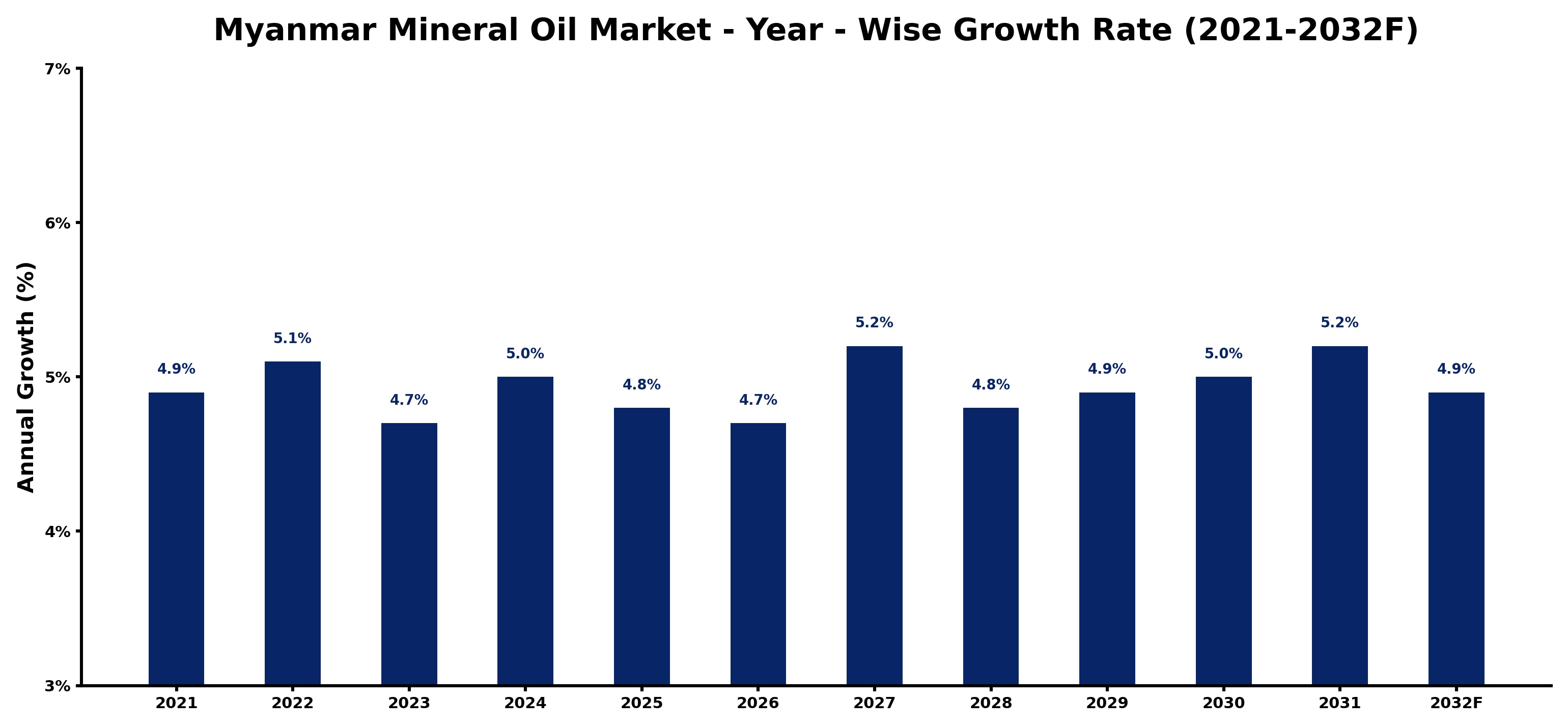
The table below presents the year‑wise growth rates along with the key drivers influencing the market
| Year | Growth Rate | Major Drivers |
| 2021 | 4.9% | Expansion of commercial construction activities |
| 2022 | 5.1% | Growing urbanization and commercial development |
| 2023 | 4.7% | Growing renewable energy integration projects |
| 2024 | 5.0% | Growing urbanization and commercial development |
| 2025 | 4.8% | Increasing smart city development projects |
| 2026 | 4.7% | Increasing industrial infrastructure investments |
| 2027 | 5.2% | Expansion of manufacturing activities |
| 2028 | 4.8% | Expansion of manufacturing activities |
| 2029 | 4.9% | Government infrastructure modernization initiatives |
| 2030 | 5.0% | Increasing industrial automation investments |
| 2031 | 5.2% | Increasing industrial infrastructure investments |
| 2032 | 4.9% | Increasing industrial infrastructure investments |
Note - Market size estimations and growth projections presented in this report are based on 6Wresearch’s advanced forecasting approach, validated with industry datasets as of June 2026.
Myanmar Mineral Oil Market Synopsis
While Myanmar's mineral oil market has recently witnessed momentum driven by rising industrial applications, it is poised for significant transformation as global trends shift towards sustainability and alternative energy sources. Despite challenges such as import reliance and supply chain constraints, the market is heading towards a more diversified future.
Current market dynamics reflect a resilient demand for mineral oils across multiple sectors, including automotive and manufacturing. The increasing push for quality products, coupled with government initiatives, is likely to shape the path forward, offering strategic opportunities for stakeholders invested in the Myanmar Mineral Oil Market.
Myanmar Mineral Oil Market Key Takeaways
- Growing industrial activities are driving demand for mineral oils across diverse applications.
- Myanmar's market faces challenges due to heavy reliance on imports and limited domestic production.
- The government supports mineral oil production through favorable energy policies and regulations.
- Emerging trends indicate a shift toward sustainable practices and technologies within the sector.
- The market is set for a steady growth trajectory, projected at a CAGR of 4.2% from 2026 to 2032.
Evaluation of Restraints in Myanmar Mineral Oil Market
The Myanmar Mineral Oil Market grapples with significant limitations stemming from its dependence on imports, which can lead to supply shortages and elevated costs. Furthermore, underdeveloped infrastructure and regulatory barriers pose additional challenges for exploration and production activities. These factors create an environment of uncertainty, affecting market stability and investment potential. Moreover, the ongoing global fluctuations in oil prices, coupled with environmental concerns, complicate the market landscape and highlight the need for innovative and sustainable practices.
Myanmar Mineral Oil Market Trends
Recent trends within the Myanmar Mineral Oil Market reveal a marked shift towards eco-friendly solutions and the development of high-performance oils that meet stringent quality standards. Businesses are increasingly investing in research and development to enhance product offerings while simultaneously addressing environmental challenges. The integration of digital technologies in production and supply chain management is also gaining traction, further optimizing operational efficiency.
Myanmar Mineral Oil Market Opportunities
Amidst challenges, significant growth and investment opportunities lie within the expanding industrial sectors. The automotive and manufacturing industries continue to demand reliable mineral oil solutions, offering avenues for local production enhancements. Additionally, a proactive government stance towards energy production presents a unique opportunity for industry players to explore local partnerships and contribute to a more sustainable mineral oil ecosystem.
Government Initiatives in the Myanmar Mineral Oil Market
The Myanmar government has implemented various policies aimed at bolstering the mineral oil sector. These initiatives prioritize enhancing local manufacturing capabilities, ensuring product quality, and promoting environmentally compliant practices. Furthermore, increased public spending on infrastructure projects is expected to facilitate the exploration and extraction of mineral oil resources, fostering an environment conducive to market growth.
Future Insights of the Myanmar Mineral Oil Market
Looking ahead, the Myanmar Mineral Oil Market is projected to evolve significantly between 2026 and 2032. With a steady compound annual growth rate of 4.2%, driven by an increase in industrial activities and quality-focused product demand, the market is likely to attract more investments. The ongoing transition towards sustainable practices and innovative technologies will further shape the competitive landscape, presenting opportunities for stakeholders to capitalize on emerging trends.
Myanmar Mineral Oil Market Latest Developments (May 2025 - June 2026)
In the latest developments within the Myanmar Mineral Oil Market, various industry stakeholders are increasingly focusing on enhancing production capabilities and diversifying product offerings to meet growing demands. As regulatory frameworks evolve, businesses are adapting to incorporate more sustainable practices. Additionally, the government has ramped up its initiatives to improve infrastructure, fostering a more conducive environment for exploration and extraction efforts.
Myanmar Mineral Oil Market - Key Attractiveness of the Report
- 10 Years of Market Numbers
- Historical Data Starting from 2022 to 2025
- Base Year: 2025
- Forecast Data until 2032
- Key Performance Indicators Impacting the Market
- Major Upcoming Developments and Projects
Key Highlights of the Report:
- Myanmar Mineral Oil Market Outlook
- Market Size of Myanmar Mineral Oil Market, 2025
- Forecast of Myanmar Mineral Oil Market, 2032
- Historical Data and Forecast of Myanmar Mineral Oil Revenues & Volume for the Period 2022-2032F
- Myanmar Mineral Oil Market Trend Evolution
- Myanmar Mineral Oil Market Drivers and Challenges
- Myanmar Mineral Oil Price Trends
- Myanmar Mineral Oil Porter's Five Forces
- Myanmar Mineral Oil Industry Life Cycle
- Historical Data and Forecast of Myanmar Mineral Oil Market Revenues & Volume By Grade for the Period 2022-2032F
- Historical Data and Forecast of Myanmar Mineral Oil Market Revenues & Volume By Technical Oil for the Period 2022-2032F
- Historical Data and Forecast of Myanmar Mineral Oil Market Revenues & Volume By White Oil for the Period 2022-2032F
- Historical Data and Forecast of Myanmar Mineral Oil Market Revenues & Volume By Application for the Period 2022-2032F
- Historical Data and Forecast of Myanmar Mineral Oil Market Revenues & Volume By Baby Oil for the Period 2022-2032F
- Historical Data and Forecast of Myanmar Mineral Oil Market Revenues & Volume By Cosmetics for the Period 2022-2032F
- Historical Data and Forecast of Myanmar Mineral Oil Market Revenues & Volume By Skin Care Products for the Period 2022-2032F
- Historical Data and Forecast of Myanmar Mineral Oil Market Revenues & Volume By Hair Care Products for the Period 2022-2032F
- Historical Data and Forecast of Myanmar Mineral Oil Market Revenues & Volume By Consumer Goods for the Period 2022-2032F
- Historical Data and Forecast of Myanmar Mineral Oil Market Revenues & Volume By Others for the Period 2022-2032F
- Myanmar Mineral Oil Import Export Trade Statistics
- Market Opportunity Assessment By Grade
- Market Opportunity Assessment By Application
- Myanmar Mineral Oil Top Companies Market Share
- Myanmar Mineral Oil Competitive Benchmarking By Technical and Operational Parameters
- Myanmar Mineral Oil Company Profiles
- Myanmar Mineral Oil Key Strategic Recommendations






































