Nepal Mineral Oil Market Size, Share & Growth Rate
The Nepal Mineral Oil Market was estimated at USD 742 Million in 2025 and is projected to reach USD 1092 Million by 2032, growing at a CAGR of 5.7% from 2026 to 2032. This growth trajectory is underpinned by a robust demand for petroleum products, especially from the transportation sector. As Nepal's economy evolves, with a marked increase in industrial activities and urbanization, the need for reliable energy sources is becoming increasingly critical.
Nepal Mineral Oil Market Year-wise Growth Rate and Key Drivers
This graph highlights how the Nepal Mineral Oil Market has steadily grown over the years, supported by major growth factors.
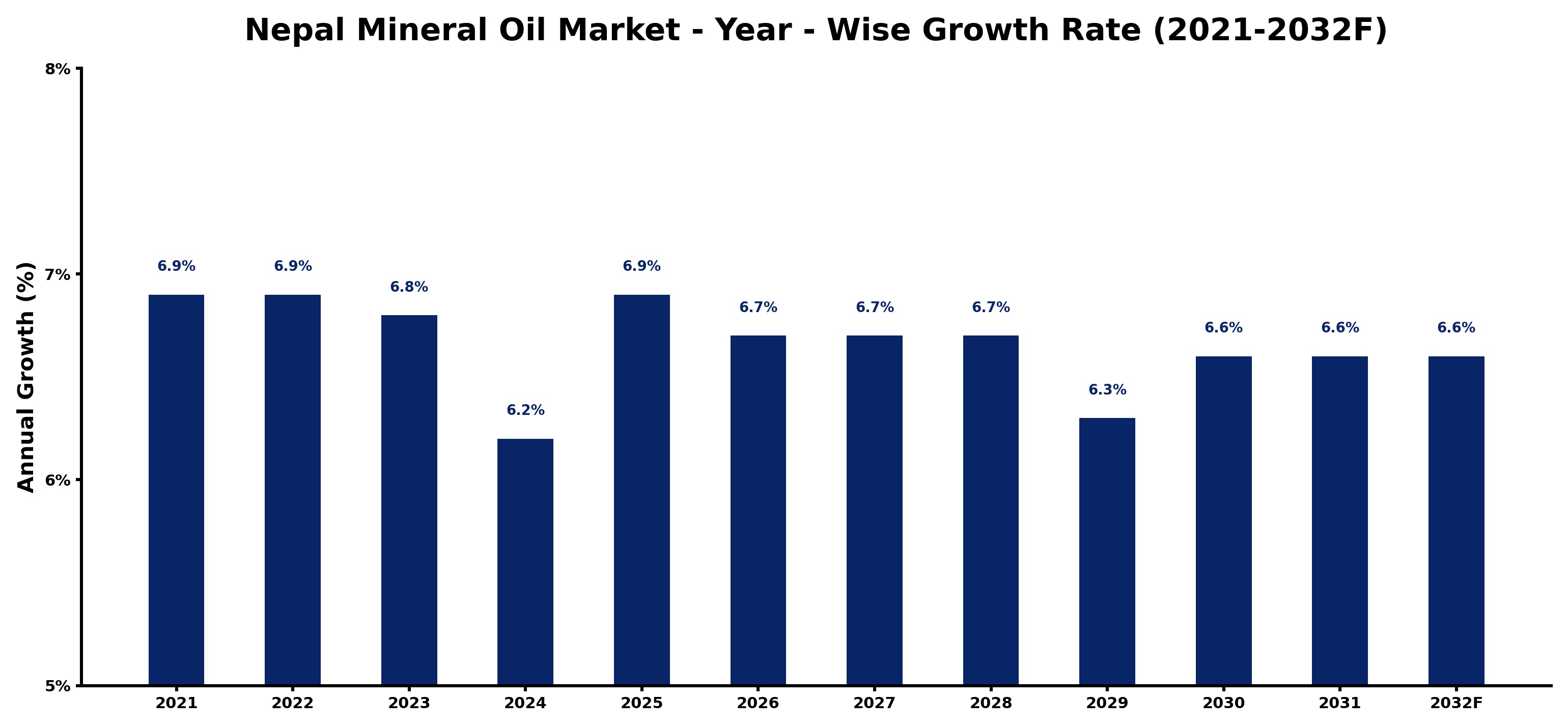
The table below presents the year‑wise growth rates along with the key drivers influencing the market
| Year | Growth Rate | Major Drivers |
| 2021 | 6.9% | Expansion of transportation and logistics networks |
| 2022 | 6.9% | Increasing industrial automation investments |
| 2023 | 6.8% | Government infrastructure modernization initiatives |
| 2024 | 6.2% | Government infrastructure modernization initiatives |
| 2025 | 6.9% | Expansion of manufacturing activities |
| 2026 | 6.7% | Expansion of commercial construction activities |
| 2027 | 6.7% | Growing renewable energy integration projects |
| 2028 | 6.7% | Growing renewable energy integration projects |
| 2029 | 6.3% | Expansion of transportation and logistics networks |
| 2030 | 6.6% | Increasing smart city development projects |
| 2031 | 6.6% | Expansion of transportation and logistics networks |
| 2032 | 6.6% | Growing renewable energy integration projects |
Note - Market size estimations and growth projections presented in this report are based on 6Wresearch's advanced forecasting approach, validated with industry datasets as of June 2026.
Nepal Mineral Oil Market Synopsis
The Nepal Mineral Oil Market is currently navigating a period of increased consumption, fueled by rapid industrialization and a burgeoning transportation network. However, the market is poised to undergo significant transformations as it confronts future shifts towards renewable energy and sustainability initiatives.
While recent momentum has focused on maximizing the extraction and production of traditional mineral oil products, the landscape is changing. Stakeholders are now actively exploring cleaner alternatives, indicating a potential pivot that could redefine market dynamics and consumer expectations in the years ahead.
Nepal Mineral Oil Market Key Takeaways
- The market is experiencing robust growth driven by industrialization and urban development.
- Government initiatives are focused on reducing import dependency and promoting domestic production.
- Investment in technology and infrastructure is crucial for future sustainability.
- The shift towards cleaner energy sources poses both challenges and opportunities.
- Increased demand for lubricants and fuels in transportation highlights the market's resilience.
Evaluation of Restraints in Nepal Mineral Oil Market
Despite its promising prospects, the Nepal Mineral Oil Market is impeded by several significant challenges. Inadequate infrastructure for storage and distribution hinders efficient supply chain management, while limited investment in modern technology restricts exploration and production capabilities. Additionally, the heavy reliance on imported oil exposes the market to global price fluctuations, further complicating economic stability. Regulatory hurdles and environmental concerns add layers of complexity that must be navigated to unlock the full potential of this market.
Nepal Mineral Oil Market Trends
Current trends in the Nepal Mineral Oil Market showcase a heightened consumption of petroleum products, largely influenced by expanding industrial and transportation sectors. Concurrently, there is a noticeable shift towards sustainable practices, with an increasing emphasis on renewable energy solutions. Companies are beginning to prioritize efficiency in oil production, aligning with global trends that favor environmentally responsible practices while still meeting domestic energy needs.
Nepal Mineral Oil Market Opportunities
Investment opportunities abound in the Nepal Mineral Oil Market, particularly with the recent discoveries of oil reserves in the Terai region. This has attracted both domestic and foreign investors eager to explore and develop these untapped resources. Additionally, the government's supportive policies and frameworks aimed at fostering investment create a conducive environment for developing infrastructure, such as refineries and distribution networks, thus presenting significant long-term returns.
Government Initiatives in the Nepal Mineral Oil Market
The Nepalese government is actively shaping the mineral oil landscape through a range of policies focused on enhancing production capabilities and reducing import reliance. Licensing requirements for exploration and extraction have been established to ensure regulated growth, while taxation measures aim to create revenue streams from the sector. Initiatives are also in place to encourage investment in technology and promote advancements that enhance competitiveness, emphasizing the government's commitment to balancing economic growth with environmental sustainability.
Future Insights of the Nepal Mineral Oil Market
Looking ahead to 2026-2032, the Nepal Mineral Oil Market is expected to continue its upward trajectory, driven by increasing demand across automotive, manufacturing, and energy sectors. Infrastructure projects and a growing economy will further boost the consumption of mineral oil products. However, the trend towards renewable energy and cleaner fuels will require strategic planning and adaptation by industry stakeholders. If managed effectively, this transition could lead to new opportunities for growth, allowing domestic players to explore untapped market segments.
Nepal Mineral Oil Market Latest Developments (May 2025 - June 2026)
Recent developments in the Nepal Mineral Oil Market indicate a continued push for modernization and efficiency improvements within the sector. Efforts are being made to enhance infrastructure capabilities, particularly in transportation and storage, while discussions around sustainable practices are gaining traction. The government is also engaging with various stakeholders to explore potential collaborations aimed at fostering growth and reducing environmental impacts, signaling a commitment to a more resilient energy future.
Nepal Mineral Oil Market - Key Attractiveness of the Report
- 10 Years of Market Numbers
- Historical Data Starting from 2022 to 2025
- Base Year: 2025
- Forecast Data until 2032
- Key Performance Indicators Impacting the Market
- Major Upcoming Developments and Projects
Key Highlights of the Report:
- Nepal Mineral Oil Market Outlook
- Market Size of Nepal Mineral Oil Market, 2025
- Forecast of Nepal Mineral Oil Market, 2032
- Historical Data and Forecast of Nepal Mineral Oil Revenues & Volume for the Period 2022-2032F
- Nepal Mineral Oil Market Trend Evolution
- Nepal Mineral Oil Market Drivers and Challenges
- Nepal Mineral Oil Price Trends
- Nepal Mineral Oil Porter's Five Forces
- Nepal Mineral Oil Industry Life Cycle
- Historical Data and Forecast of Nepal Mineral Oil Market Revenues & Volume By Grade for the Period 2022-2032F
- Historical Data and Forecast of Nepal Mineral Oil Market Revenues & Volume By Technical Oil for the Period 2022-2032F
- Historical Data and Forecast of Nepal Mineral Oil Market Revenues & Volume By White Oil for the Period 2022-2032F
- Historical Data and Forecast of Nepal Mineral Oil Market Revenues & Volume By Application for the Period 2022-2032F
- Historical Data and Forecast of Nepal Mineral Oil Market Revenues & Volume By Baby Oil for the Period 2022-2032F
- Historical Data and Forecast of Nepal Mineral Oil Market Revenues & Volume By Cosmetics for the Period 2022-2032F
- Historical Data and Forecast of Nepal Mineral Oil Market Revenues & Volume By Skin Care Products for the Period 2022-2032F
- Historical Data and Forecast of Nepal Mineral Oil Market Revenues & Volume By Hair Care Products for the Period 2022-2032F
- Historical Data and Forecast of Nepal Mineral Oil Market Revenues & Volume By Consumer Goods for the Period 2022-2032F
- Historical Data and Forecast of Nepal Mineral Oil Market Revenues & Volume By Others for the Period 2022-2032F
- Nepal Mineral Oil Import Export Trade Statistics
- Market Opportunity Assessment By Grade
- Market Opportunity Assessment By Application
- Nepal Mineral Oil Top Companies Market Share
- Nepal Mineral Oil Competitive Benchmarking By Technical and Operational Parameters
- Nepal Mineral Oil Company Profiles
- Nepal Mineral Oil Key Strategic Recommendations






































