Jordan Mineral Oil Market Size, Share & Growth Rate
The Jordan Mineral Oil Market was estimated at USD 400 Million in 2025 and is projected to reach USD 539 Million by 2032, growing at a CAGR of 4.4% from 2026 to 2032. This growth trajectory is primarily fueled by the rising demand across key sectors such as automotive, pharmaceuticals, and cosmetics. The increasing production of personal care products, alongside a booming healthcare sector, underscores the significant role mineral oil plays in various applications, enhancing its market potential.
Jordan Mineral Oil Market Year-wise Growth Rate and Key Drivers
This graph highlights how the Jordan Mineral Oil Market has steadily grown over the years, supported by major growth factors.
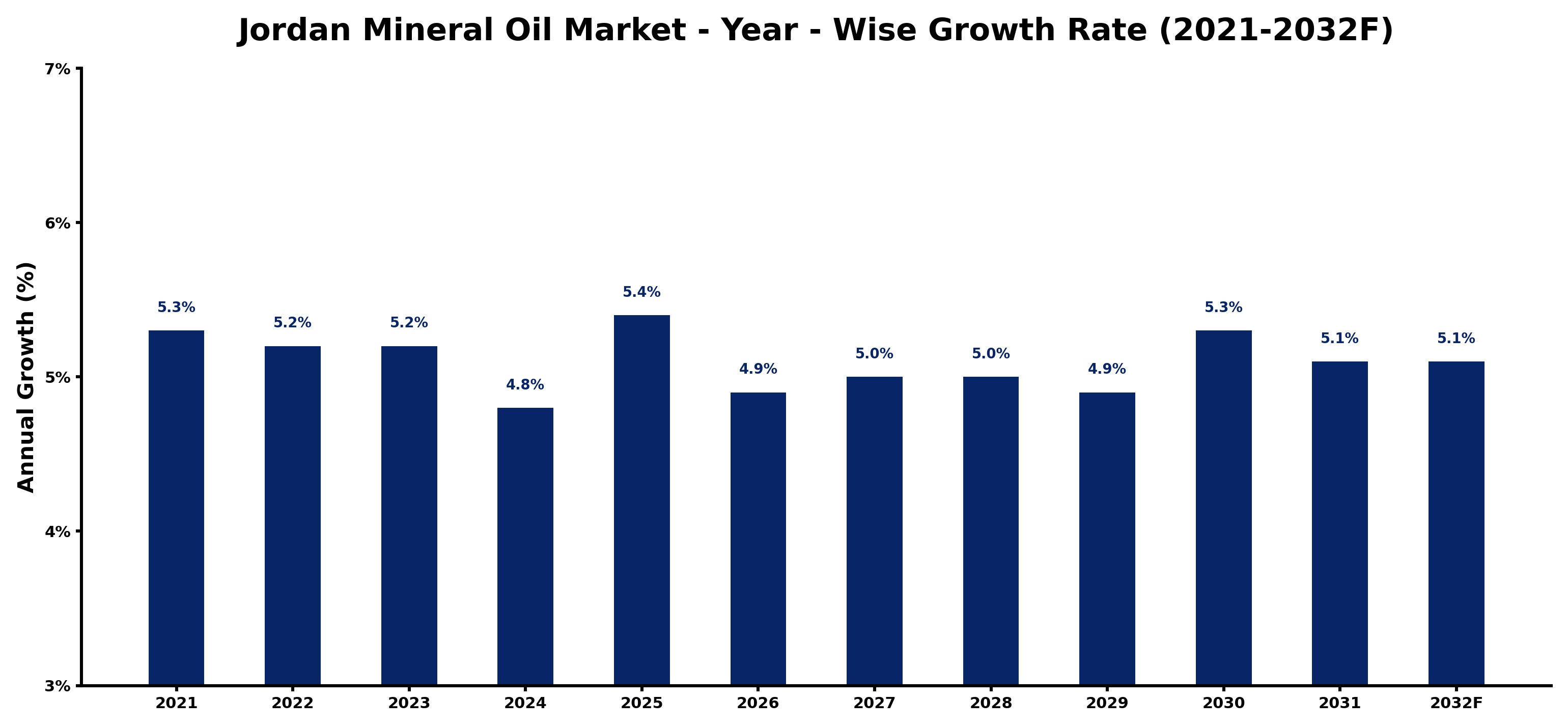
The table below presents the year‑wise growth rates along with the key drivers influencing the market
| Year | Growth Rate | Major Drivers |
| 2021 | 5.3% | Increasing adoption of advanced technologies |
| 2022 | 5.2% | Increasing smart city development projects |
| 2023 | 5.2% | Expansion of manufacturing activities |
| 2024 | 4.8% | Increasing smart city development projects |
| 2025 | 5.4% | Growing urbanization and commercial development |
| 2026 | 4.9% | Increasing adoption of advanced technologies |
| 2027 | 5.0% | Growing urbanization and commercial development |
| 2028 | 5.0% | Increasing smart city development projects |
| 2029 | 4.9% | Expansion of transportation and logistics networks |
| 2030 | 5.3% | Growing renewable energy integration projects |
| 2031 | 5.1% | Expansion of commercial construction activities |
| 2032 | 5.1% | Growing urbanization and commercial development |
Note - Market size estimations and growth projections presented in this report are based on 6Wresearch’s advanced forecasting approach, validated with industry datasets as of June 2026.
Jordan Mineral Oil Market Synopsis
The strongest force shaping the Jordan mineral oil market today is the expanding personal care and cosmetics industry. As consumer awareness about skincare grows, products that utilize mineral oil for their lubricating and moisturizing properties are gaining traction, driving demand significantly.
Moreover, the automotive and manufacturing sectors also continue to rely heavily on mineral oil for lubrication and cooling applications. This consistent reliance highlights mineral oil's integral role, ensuring ongoing market stability and growth in Jordan.
Jordan Mineral Oil Market Key Takeaways
- The market is driven by increased demand in personal care and industrial applications.
- Growing healthcare developments are expanding the usage of mineral oil.
- Environmental regulations are shaping production and compliance standards.
- There is rising competition from synthetic and bio-based oils.
- Government policies are focused on sustainability and energy security in the sector.
Evaluation of Restraints in Jordan Mineral Oil Market
Despite its robust growth, the Jordan mineral oil market encounters significant restraints, notably stringent environmental regulations. These regulations impose compliance costs that can burden producers and distributors. Additionally, as consumer preferences shift towards more sustainable products, the competition from synthetic and bio-based alternatives poses a real challenge. This dynamic urges stakeholders to innovate while adhering to environmental standards, making it imperative for the market to adapt and evolve.
Jordan Mineral Oil Market Trends
Emerging trends in the Jordan mineral oil market indicate a growing emphasis on sustainability and eco-friendliness. More industries are exploring bio-based alternatives, driven by consumer demand for greener products. Furthermore, technological advancements are enhancing the performance characteristics of mineral oils, paving the way for applications that require superior lubricating and insulating properties.
Jordan Mineral Oil Market Opportunities
Investment opportunities are evolving, particularly in the sectors of personal care and pharmaceuticals, where innovation is paramount. Companies looking to leverage mineral oil's properties can capitalize on developing specialized formulations that meet emerging consumer preferences. Additionally, exploring collaborations with green technology firms could open pathways to combining traditional mineral oils with sustainable practices.
Government Initiatives in the Jordan Mineral Oil Market
Government initiatives regarding the mineral oil market in Jordan focus on ensuring energy security while promoting environmentally responsible practices. Regulatory frameworks dictate the exploration and production processes, aiming for quality standards that not only protect resources but also ensure market stability. Public spending in infrastructure related to sustainable energy resources is also noteworthy, as it aligns with broader environmental goals.
Future Insights of the Jordan Mineral Oil Market
Looking towards 2026-2032, the Jordan mineral oil market is poised for steady growth, driven by both industrial demand and the continuous evolution of consumer preferences. As regulatory frameworks become more comprehensive, firms will need to balance compliance with innovation. The intersection of traditional uses and modern sustainability initiatives will likely define the market's landscape, ensuring that mineral oil maintains its relevance in an increasingly competitive environment.
Jordan Mineral Oil Market Latest Developments (May 2025 - June 2026)
Recent industry developments indicate a growing focus on sustainable practices and innovative applications within the Jordan mineral oil market. Companies are prioritizing research and development, aiming to enhance the environmental friendliness of their products. Additionally, collaborations with sectors like cosmetics are increasing, reflecting a shift toward integrating mineral oil into modern, eco-conscious formulations.
Jordan Mineral Oil Market - Key Attractiveness of the Report
- 10 Years of Market Numbers
- Historical Data Starting from 2022 to 2025
- Base Year: 2025
- Forecast Data until 2032
- Key Performance Indicators Impacting the Market
- Major Upcoming Developments and Projects
Key Highlights of the Report:
- Jordan Mineral Oil Market Outlook
- Market Size of Jordan Mineral Oil Market, 2025
- Forecast of Jordan Mineral Oil Market, 2032
- Historical Data and Forecast of Jordan Mineral Oil Revenues & Volume for the Period 2022-2032F
- Jordan Mineral Oil Market Trend Evolution
- Jordan Mineral Oil Market Drivers and Challenges
- Jordan Mineral Oil Price Trends
- Jordan Mineral Oil Porter's Five Forces
- Jordan Mineral Oil Industry Life Cycle
- Historical Data and Forecast of Jordan Mineral Oil Market Revenues & Volume By Grade for the Period 2022-2032F
- Historical Data and Forecast of Jordan Mineral Oil Market Revenues & Volume By Technical Oil for the Period 2022-2032F
- Historical Data and Forecast of Jordan Mineral Oil Market Revenues & Volume By White Oil for the Period 2022-2032F
- Historical Data and Forecast of Jordan Mineral Oil Market Revenues & Volume By Application for the Period 2022-2032F
- Historical Data and Forecast of Jordan Mineral Oil Market Revenues & Volume By Baby Oil for the Period 2022-2032F
- Historical Data and Forecast of Jordan Mineral Oil Market Revenues & Volume By Cosmetics for the Period 2022-2032F
- Historical Data and Forecast of Jordan Mineral Oil Market Revenues & Volume By Skin Care Products for the Period 2022-2032F
- Historical Data and Forecast of Jordan Mineral Oil Market Revenues & Volume By Hair Care Products for the Period 2022-2032F
- Historical Data and Forecast of Jordan Mineral Oil Market Revenues & Volume By Consumer Goods for the Period 2022-2032F
- Historical Data and Forecast of Jordan Mineral Oil Market Revenues & Volume By Others for the Period 2022-2032F
- Jordan Mineral Oil Import Export Trade Statistics
- Market Opportunity Assessment By Grade
- Market Opportunity Assessment By Application
- Jordan Mineral Oil Top Companies Market Share
- Jordan Mineral Oil Competitive Benchmarking By Technical and Operational Parameters
- Jordan Mineral Oil Company Profiles
- Jordan Mineral Oil Key Strategic Recommendations






































