Vietnam Mineral Oil Market Size, Share & Growth Rate
The Vietnam Mineral Oil Market was estimated at USD 152 Million in 2025 and is projected to reach USD 214 Million by 2032, growing at a CAGR of 5.0% from 2026 to 2032. This growth trajectory is fueled by the robust demand for mineral oil across key industries, particularly as Vietnam continues to industrialize. As transportation and manufacturing sectors expand, the need for mineral oil as a crucial input remains strong, thus driving market potential.
Vietnam Mineral Oil Market Growth Rate Analysis (2021-2032)
The Vietnam mineral oil market has exhibited notable growth, particularly in 2023, where it surged by 8.5%, attributed to increased industrial activity and rising consumer demand for lubricants in automotive and manufacturing sectors. Following this peak, projections indicate a slight normalization with growth rates of 5.2% in 2024 and 6.6% in 2025, as investments in infrastructure and energy transition initiatives gain traction. However, annual growth is expected to fluctuate slightly; for instance, a modest 5.4% is anticipated in both 2030 and 2031, as digitalization and technological advancements reshape production efficiency and consumer preferences. The evolving landscape suggests sustained, albeit varying, demand for mineral oil as industries adapt to changing dynamics.
Vietnam Mineral Oil Market Year-wise Growth Rate and Key Drivers
This graph highlights how the Vietnam Mineral Oil Market has steadily grown over the past five years, supported by major growth factors.
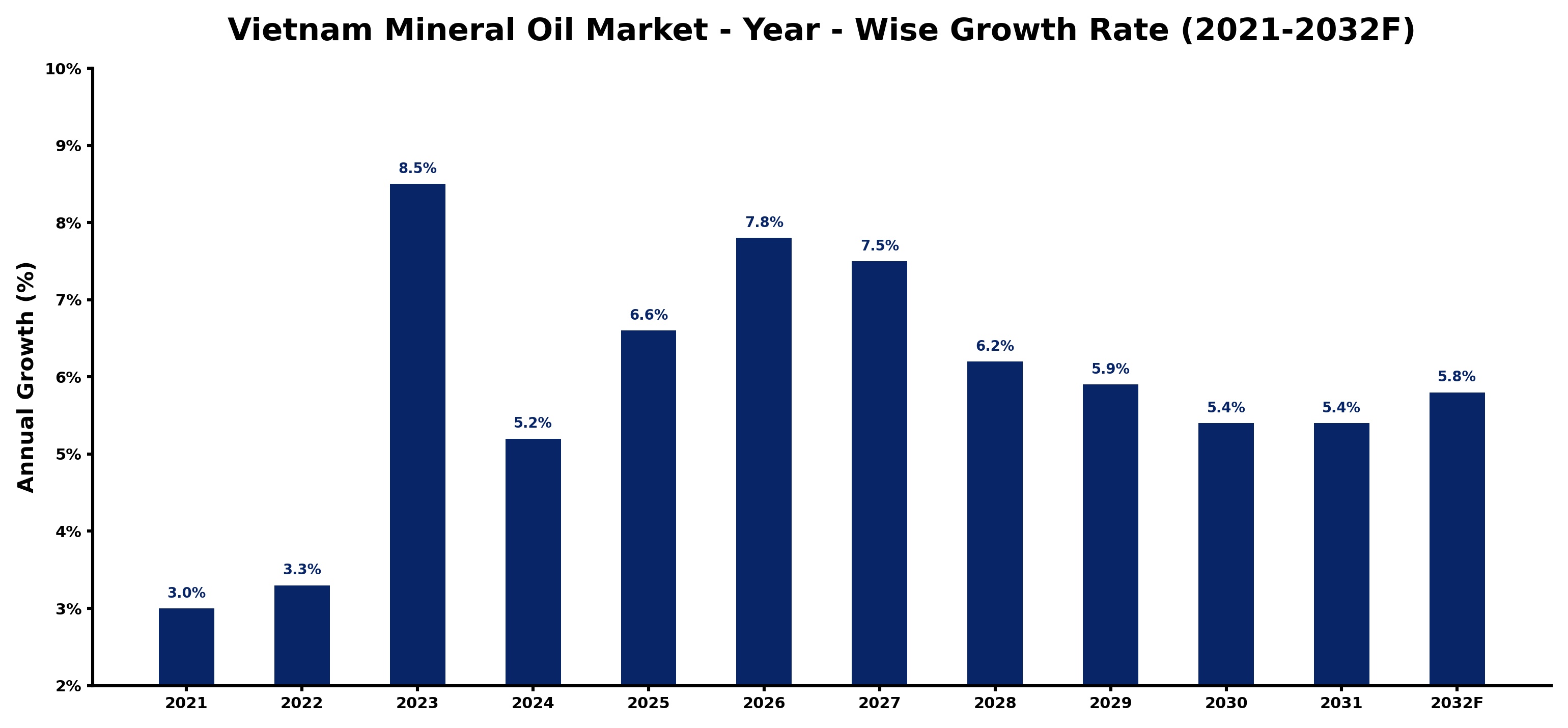
The table below presents the year‑wise growth rates along with the key drivers influencing the market
| Year | Growth Rate | Major Drivers |
| 2021 | 3.0% | Increasing industrial automation investments |
| 2022 | 3.3% | Government infrastructure modernization initiatives |
| 2023 | 8.5% | Expansion of transportation and logistics networks |
| 2024 | 5.2% | Increasing industrial infrastructure investments |
| 2025 | 6.6% | Expansion of commercial construction activities |
| 2026 | 7.8% | Rising electricity demand across industries |
| 2027 | 7.5% | Expansion of transportation and logistics networks |
| 2028 | 6.2% | Increasing adoption of advanced technologies |
| 2029 | 5.9% | Expansion of commercial construction activities |
| 2030 | 5.4% | Increasing industrial automation investments |
| 2031 | 5.4% | Growing renewable energy integration projects |
| 2032 | 5.8% | Expansion of commercial construction activities |
Note - Market size estimations and growth projections presented in this report are based on 6Wresearch’s advanced forecasting approach, validated with industry datasets as of June 2026.
Vietnam Mineral Oil Market Synopsis
The strongest force currently shaping the Vietnam Mineral Oil Market is the rapidly increasing demand from the automotive sector. With the number of vehicles on the road rising, this sector relies heavily on mineral oil for lubrication, thereby driving consumption significantly.
Additionally, the manufacturing industry is a vital contributor to the market, where mineral oil is essential in various production processes, including plastics and chemicals. As these industries grow, they create a steady need for mineral oil, establishing a solid foundation for market expansion.
Vietnam Mineral Oil Market Key Takeaways
- The market is projected to grow at a CAGR of 5.0%, indicating a positive outlook for investments.
- Demand from the automotive and manufacturing sectors is key to driving market growth.
- Environmental regulations are increasingly influencing market dynamics and product offerings.
- Strategic collaborations among industry players are critical to maintaining competitive advantage.
- The recovery post-COVID-19 presents new opportunities for adaptation and innovation in the market.
Evaluation of Restraints in Vietnam Mineral Oil Market
Despite the optimistic growth projections, the Vietnam Mineral Oil Market faces significant restraints stemming from environmental concerns. Rising awareness around the adverse impacts of mineral oil, such as oil spills and soil contamination, has led to stricter regulations that complicate operations for businesses. Moreover, the increased focus on sustainability is pushing firms to explore alternative lubricants, making it imperative to innovate continuously to align with these evolving expectations.
Vietnam Mineral Oil Market Trends
A notable trend shaping the Vietnam Mineral Oil Market is the shift towards eco-friendly products. As environmental regulations tighten, companies are exploring bio-based and synthetic alternatives, which not only meet compliance requirements but also appeal to environmentally conscious consumers. Additionally, advances in technology are leading to more efficient extraction and refining processes, enhancing product offerings.
Moreover, the integration of digital technologies in supply chain management is on the rise, optimizing logistics and reducing costs. This trend not only streamlines operations but also provides enhanced data analytics capabilities, enabling better decision-making for market players.
Vietnam Mineral Oil Market Opportunities
Genuine growth opportunities lie in the exploration of green technology and sustainable practices within the mineral oil sector. Companies that invest in R&D for environmentally friendly alternatives can gain a competitive edge. Furthermore, the increased vehicle sales forecasted in Vietnam's automotive market presents a lucrative avenue for mineral oil suppliers. Collaborative efforts with technology firms to enhance refining processes and product formulations could open new doors for innovation and profitability.
Government Initiatives in the Vietnam Mineral Oil Market
The Vietnamese government is actively fostering the development of the mineral oil market through supportive policies aimed at enhancing energy security and promoting industrial growth. Investments in infrastructure and energy sectors are being prioritized, with specific attention to regulations that encourage sustainable practices. Furthermore, initiatives to reduce reliance on fossil fuels are gaining traction, creating a landscape where businesses can explore new technologies while adhering to emerging environmental standards.
Future Insights of the Vietnam Mineral Oil Market
Looking ahead to 2026-2032, the Vietnam Mineral Oil Market is set for transformative growth, anchored by robust industrial demand and strategic adaptations to environmental standards. As businesses pivot to embrace sustainable practices, the innovation of cleaner alternatives will play a pivotal role in market dynamics. Additionally, the resurgence of economic activities post-pandemic signals a rebound in demand that companies can capitalize on through diversified product portfolios and enhanced service offerings.
Vietnam Mineral Oil Market Latest Developments (May 2025 - June 2026)
Recent developments in the Vietnam Mineral Oil Market indicate a shift towards greater sustainability initiatives, as firms begin launching eco-friendly product lines in response to consumer demand and regulatory pressures. Additionally, there has been a notable increase in partnerships between mineral oil suppliers and tech firms aimed at optimizing refining processes and reducing costs. As these collaborations mature, they are expected to drive innovation and efficiency within the sector.
Vietnam Mineral Oil Market - Key Attractiveness of the Report
- 10 Years of Market Numbers
- Historical Data Starting from 2022 to 2025
- Base Year: 2025
- Forecast Data until 2032
- Key Performance Indicators Impacting the Market
- Major Upcoming Developments and Projects
Key Highlights of the Report:
- Vietnam Mineral Oil Market Outlook
- Market Size of Vietnam Mineral Oil Market, 2025
- Forecast of Vietnam Mineral Oil Market, 2032F
- Historical Data and Forecast of Vietnam Mineral Oil Revenues & Volume for the Period 2022-2032F
- Vietnam Mineral Oil Market Trend Evolution
- Vietnam Mineral Oil Market Drivers and Challenges
- Vietnam Mineral Oil Price Trends
- Vietnam Mineral Oil Porter's Five Forces
- Vietnam Mineral Oil Industry Life Cycle
- Historical Data and Forecast of Vietnam Mineral Oil Market Revenues & Volume By Grade for the Period 2022-2032F
- Historical Data and Forecast of Vietnam Mineral Oil Market Revenues & Volume By Technical Oil for the Period 2022-2032F
- Historical Data and Forecast of Vietnam Mineral Oil Market Revenues & Volume By White Oil for the Period 2022-2032F
- Historical Data and Forecast of Vietnam Mineral Oil Market Revenues & Volume By Application for the Period 2022-2032F
- Historical Data and Forecast of Vietnam Mineral Oil Market Revenues & Volume By Baby Oil for the Period 2022-2032F
- Historical Data and Forecast of Vietnam Mineral Oil Market Revenues & Volume By Cosmetics for the Period 2022-2032F
- Historical Data and Forecast of Vietnam Mineral Oil Market Revenues & Volume By Skin Care Products for the Period 2022-2032F
- Historical Data and Forecast of Vietnam Mineral Oil Market Revenues & Volume By Hair Care Products for the Period 2022-2032F
- Historical Data and Forecast of Vietnam Mineral Oil Market Revenues & Volume By Consumer Goods for the Period 2022-2032F
- Historical Data and Forecast of Vietnam Mineral Oil Market Revenues & Volume By Others for the Period 2022-2032F
- Vietnam Mineral Oil Import Export Trade Statistics
- Market Opportunity Assessment By Grade
- Market Opportunity Assessment By Application
- Vietnam Mineral Oil Top Companies Market Share
- Vietnam Mineral Oil Competitive Benchmarking By Technical and Operational Parameters
- Vietnam Mineral Oil Company Profiles
- Vietnam Mineral Oil Key Strategic Recommendations






































