Russia Mineral Oil Market Size, Share & Growth Rate
The Russia Mineral Oil Market was estimated at USD 109 Million in 2025 and is projected to reach USD 119 Million by 2032, growing at a CAGR of 1.3% from 2026 to 2032. This growth trajectory is largely driven by the robust demand for mineral oils in various applications, including automotive, industrial lubrication, and personal care products. Furthermore, the ongoing technological advancements in oil refining processes and increasing regulatory compliance for sustainability standards are enhancing the market's outlook.
Russia Mineral Oil Market Year-wise Growth Rate and Key Drivers
This graph highlights how the Russia Mineral Oil Market has steadily grown over the years, supported by major growth factors.
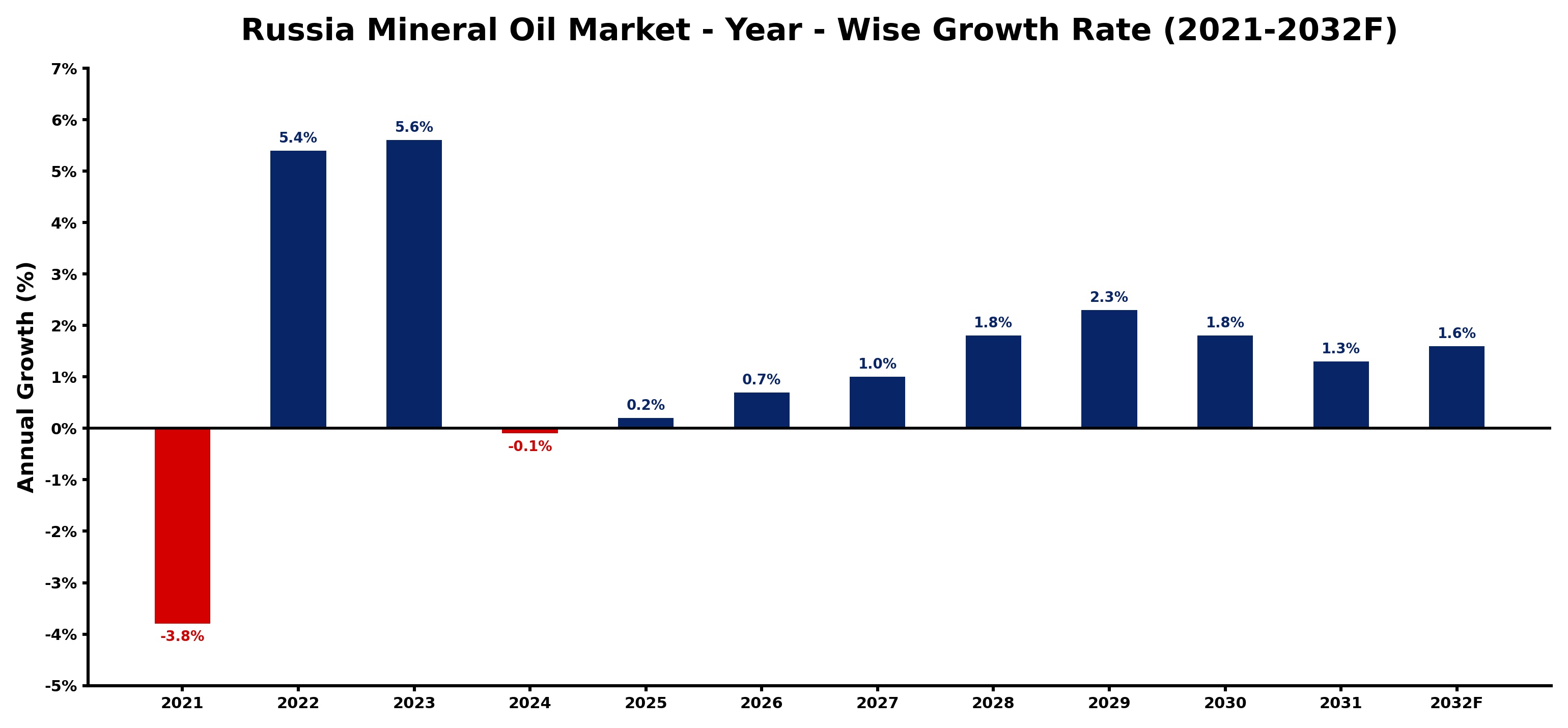
The table below presents the year‑wise growth rates along with the key drivers influencing the market
| Year | Growth Rate | Major Drivers |
| 2021 | -3.8% | Rapid growth in telecom and data center sectors |
| 2022 | 5.4% | Expansion of transportation and logistics networks |
| 2023 | 5.6% | Growing urbanization and commercial development |
| 2024 | -0.1% | Increasing smart city development projects |
| 2025 | 0.2% | Rapid growth in telecom and data center sectors |
| 2026 | 0.7% | Rising electricity demand across industries |
| 2027 | 1.0% | Increasing smart city development projects |
| 2028 | 1.8% | Increasing industrial infrastructure investments |
| 2029 | 2.3% | Increasing adoption of advanced technologies |
| 2030 | 1.8% | Increasing smart city development projects |
| 2031 | 1.3% | Increasing industrial automation investments |
| 2032 | 1.6% | Expansion of commercial construction activities |
Note - Market size estimations and growth projections presented in this report are based on 6Wresearch's advanced forecasting approach, validated with industry datasets as of June 2026.
Russia Mineral Oil Market Synopsis
In Russia, mineral oils play a critical role in the operation of hydraulic systems and lubricants across numerous industries. Their versatility allows them to be utilized in automotive engines, transformers, and even cosmetics, making them essential for both industrial and consumer sectors.
As the demand for high-performance lubricants grows, so does the focus on formulating eco-friendly mineral oils. These innovations are crucial not just for compliance with stringent environmental regulations but also for meeting consumer expectations regarding sustainability and safety.
Russia Mineral Oil Market Key Takeaways
- Mineral oils are pivotal in numerous applications, including automotive lubricants and industrial processes.
- Technological advancements are driving efficiency in oil refining and formulation processes.
- The market is witnessing increasing demand for eco-friendly formulations amid growing environmental regulations.
- Government policies focus on energy security, impacting supply dynamics and pricing strategies.
- Investment in sustainable mineral oil solutions is becoming essential for industry players.
Evaluation of Restraints in Russia Mineral Oil Market
Despite its potential, the Russia Mineral Oil Market faces several restraints that can impede growth. Environmental sustainability remains a pressing concern, as producers strive to innovate while complying with evolving regulatory landscapes. The reliance on traditional mineral oils in certain applications can create challenges in diversifying product offerings. Additionally, market volatility due to geopolitical tensions and global oil price fluctuations can impact investment decisions, creating uncertainty for stakeholders in the mineral oil sector.
Russia Mineral Oil Market Trends
One prominent trend in the Russia Mineral Oil Market is the shift towards bio-based and synthetic alternatives that aim to reduce the carbon footprint. Furthermore, the increasing incorporation of advanced additives in mineral oils is enhancing their performance in extreme conditions. As the automotive sector increasingly focuses on fuel efficiency and emissions reduction, the demand for high-quality lubricants is likely to rise, steering innovations in formulation and technology.
Russia Mineral Oil Market Opportunities
The evolving landscape presents substantial opportunities for growth within the market, particularly in the automotive and industrial lubrication segments. Investments in R&D to create high-performance, environmentally friendly products can distinguish players in this competitive arena. Moreover, the cosmetics and pharmaceutical applications of mineral oils are expanding, offering avenues for diversification and enhanced revenue streams.
Government Initiatives in the Russia Mineral Oil Market
Government policies in Russia significantly influence the mineral oil market, with a focus on enhancing energy security and promoting sustainable practices. Regulatory frameworks are in place to oversee oil exploration, production, and environmental protection, facilitating a stable supply chain. Additionally, public spending initiatives aimed at fostering technological advancement in the mineral oil sector support industry growth while ensuring compliance with stringent environmental regulations.
Future Insights of the Russia Mineral Oil Market
Looking ahead to 2026-2032, the Russia Mineral Oil Market is poised for gradual growth propelled by both industrial demand and consumer preferences shifting towards sustainability. The push for greener formulations will likely prompt innovation among manufacturers, with more focus on bio-based alternatives. As market dynamics continue to evolve, companies that invest in sustainable technologies will find themselves well-positioned to capture emerging opportunities.
Russia Mineral Oil Market Latest Developments (May 2025 - June 2026)
Recent developments in the Russia Mineral Oil Market indicate a growing trend towards sustainable practices and innovative formulations. Industry players are increasingly collaborating to enhance their R&D capabilities, focusing on the production of eco-friendly mineral oils that meet both regulatory requirements and consumer demand. Additionally, there is a marked increase in investment in refining technologies aimed at improving efficiency and reducing emissions in mineral oil production.
Russia Mineral Oil Market - Key Attractiveness of the Report
- 10 Years of Market Numbers
- Historical Data Starting from 2022 to 2025
- Base Year: 2025
- Forecast Data until 2032
- Key Performance Indicators Impacting the Market
- Major Upcoming Developments and Projects
Key Highlights of the Report:
- Russia Mineral Oil Market Outlook
- Market Size of Russia Mineral Oil Market, 2025
- Forecast of Russia Mineral Oil Market, 2032
- Historical Data and Forecast of Russia Mineral Oil Revenues & Volume for the Period 2022-2032F
- Russia Mineral Oil Market Trend Evolution
- Russia Mineral Oil Market Drivers and Challenges
- Russia Mineral Oil Price Trends
- Russia Mineral Oil Porter's Five Forces
- Russia Mineral Oil Industry Life Cycle
- Historical Data and Forecast of Russia Mineral Oil Market Revenues & Volume By Grade for the Period 2022-2032F
- Historical Data and Forecast of Russia Mineral Oil Market Revenues & Volume By Technical Oil for the Period 2022-2032F
- Historical Data and Forecast of Russia Mineral Oil Market Revenues & Volume By White Oil for the Period 2022-2032F
- Historical Data and Forecast of Russia Mineral Oil Market Revenues & Volume By Application for the Period 2022-2032F
- Historical Data and Forecast of Russia Mineral Oil Market Revenues & Volume By Baby Oil for the Period 2022-2032F
- Historical Data and Forecast of Russia Mineral Oil Market Revenues & Volume By Cosmetics for the Period 2022-2032F
- Historical Data and Forecast of Russia Mineral Oil Market Revenues & Volume By Skin Care Products for the Period 2022-2032F
- Historical Data and Forecast of Russia Mineral Oil Market Revenues & Volume By Hair Care Products for the Period 2022-2032F
- Historical Data and Forecast of Russia Mineral Oil Market Revenues & Volume By Consumer Goods for the Period 2022-2032F
- Historical Data and Forecast of Russia Mineral Oil Market Revenues & Volume By Others for the Period 2022-2032F
- Russia Mineral Oil Import Export Trade Statistics
- Market Opportunity Assessment By Grade
- Market Opportunity Assessment By Application
- Russia Mineral Oil Top Companies Market Share
- Russia Mineral Oil Competitive Benchmarking By Technical and Operational Parameters
- Russia Mineral Oil Company Profiles
- Russia Mineral Oil Key Strategic Recommendations






































