Georgia Mineral Oil Market Size, Share & Growth Rate
The Georgia Mineral Oil Market was estimated at USD 490 Million in 2025 and is projected to reach USD 654 Million by 2032, growing at a CAGR of 4.2% from 2026 to 2032. This robust growth trajectory is propelled by the region's increasing industrialization and expanding automotive sector, which in turn heightens the demand for various mineral oil products. Additionally, technological advancements in refining and the formulation of high-performance lubricants enhance product offerings and stimulate further market expansion.
Georgia Mineral Oil Market Year-wise Growth Rate and Key Drivers
This graph highlights how the Georgia Mineral Oil Market has steadily grown over the years, supported by major growth factors.
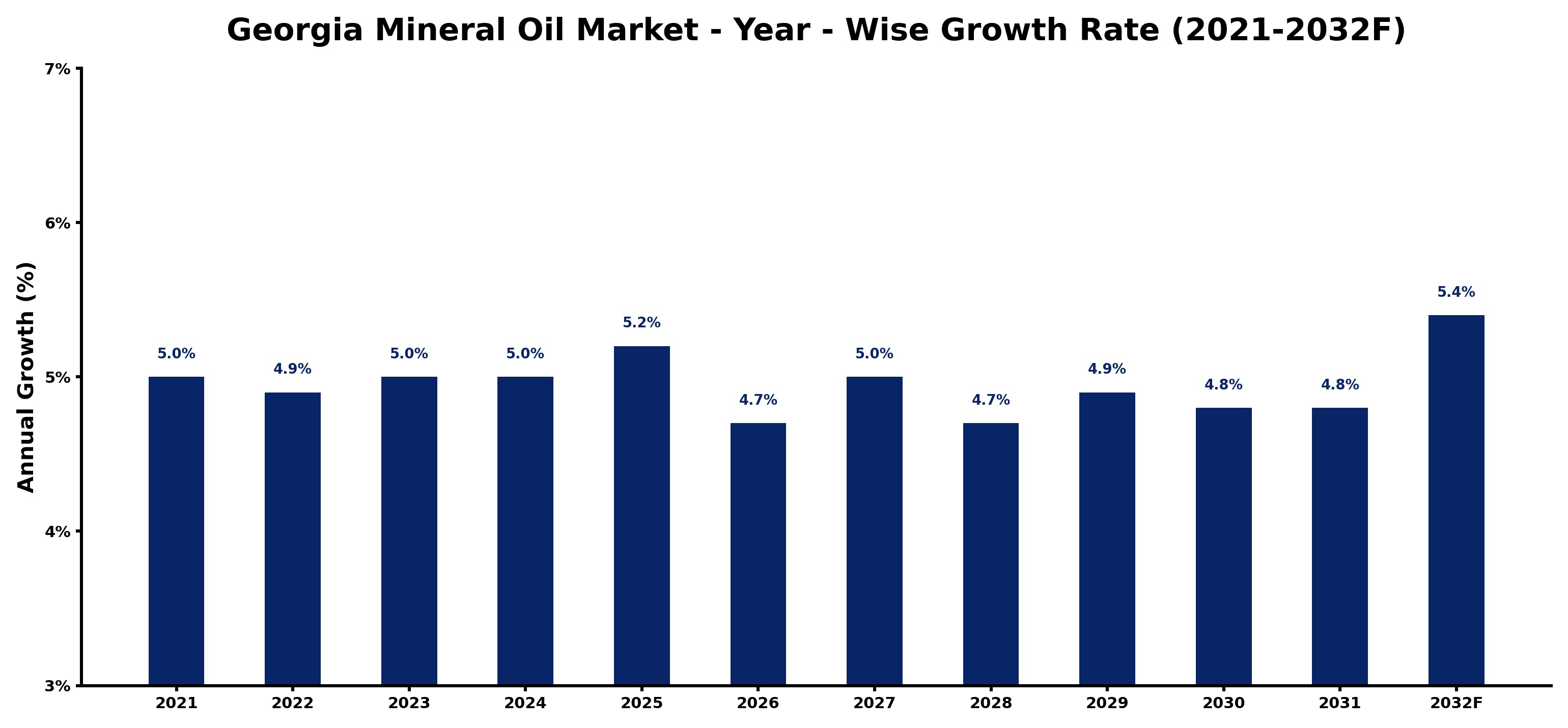
The table below presents the year‑wise growth rates along with the key drivers influencing the market
| Year | Growth Rate | Major Drivers |
| 2021 | 5.0% | Increasing smart city development projects |
| 2022 | 4.9% | Increasing adoption of advanced technologies |
| 2023 | 5.0% | Government infrastructure modernization initiatives |
| 2024 | 5.0% | Government infrastructure modernization initiatives |
| 2025 | 5.2% | Rapid growth in telecom and data center sectors |
| 2026 | 4.7% | Rising electricity demand across industries |
| 2027 | 5.0% | Expansion of transportation and logistics networks |
| 2028 | 4.7% | Increasing adoption of advanced technologies |
| 2029 | 4.9% | Government infrastructure modernization initiatives |
| 2030 | 4.8% | Expansion of transportation and logistics networks |
| 2031 | 4.8% | Expansion of transportation and logistics networks |
| 2032 | 5.4% | Growing urbanization and commercial development |
Note - Market size estimations and growth projections presented in this report are based on 6Wresearch's advanced forecasting approach, validated with industry datasets as of June 2026.
Georgia Mineral Oil Market Synopsis
The Georgia mineral oil market is a vital segment supporting a diverse range of applications from industrial lubricants to personal care products. As the state experiences a surge in industrial activity and automotive ownership, the significance of mineral oil products in maintaining operational efficiency becomes increasingly pronounced.
Current trends reflect a shift towards sustainability, pushing manufacturers to innovate in terms of eco-friendly formulations and practices. This drive is complemented by a favorable regulatory environment aimed at optimizing product performance while addressing environmental concerns.
Georgia Mineral Oil Market Key Takeaways
- The market is driven by rising demand in industrial, automotive, and cosmetic sectors.
- Technological innovations are leading to enhanced product formulations and applications.
- Sustainability initiatives are influencing the development of eco-friendly mineral oil products.
- Government policies are promoting quality standards and environmental regulations.
- Investment in infrastructure and industrial development is supporting market growth.
Evaluation of Restraints in Georgia Mineral Oil Market
While the Georgia Mineral Oil Market showcases promising growth, several restraints pose challenges. One primary concern lies in balancing product performance with increasing environmental regulations. Manufacturers must adapt to stringent guidelines regarding toxicity, biodegradability, and disposal practices, necessitating significant investment in R&D. Additionally, competition from alternative lubricant solutions exerts pressure on pricing, compelling market participants to continuously innovate and refine their offerings to maintain competitiveness.
Georgia Mineral Oil Market Trends
Currently, the Georgia Mineral Oil Market is witnessing a trend towards the integration of bio-based additives and sustainable practices within traditional formulations. Manufacturers are increasingly focused on enhancing thermal stability and lubricity while reducing environmental impact. Furthermore, advancements in additive technology are resulting in more tailored solutions that meet specific application requirements, particularly in high-performance sectors such as automotive and machinery.
Georgia Mineral Oil Market Opportunities
The expansion of the Georgia mineral oil market presents several growth opportunities. Increasing industrial activities and infrastructure projects are expected to elevate the demand for hydraulic fluids and lubrication solutions. Additionally, the rising automotive sector, coupled with a trend towards electric vehicles, creates avenues for the development of specialized mineral oils. Moreover, as consumer preferences shift towards sustainable products, companies can capitalize on this shift by innovating eco-friendly mineral oil formulations.
Government Initiatives in the Georgia Mineral Oil Market
The Georgia government has recognized the importance of the mineral oil sector within the state's industrial ecosystem. Recent initiatives include the establishment of quality standards for mineral oil products, aimed at enhancing product safety and effectiveness. Furthermore, environmental regulations are being enforced to ensure sustainable practices in oil refining and disposal, facilitating a balanced approach to economic growth and environmental stewardship.
Future Insights of the Georgia Mineral Oil Market
Looking ahead to 2026-2032, the Georgia Mineral Oil Market is poised for significant transformation driven by technological advancements and changing consumer preferences. The ongoing emphasis on sustainability will lead to a broader adoption of environmentally friendly practices, potentially reshaping the landscape of mineral oil applications. Additionally, as industries evolve, there will be a growing demand for high-performance lubricants, positioning the market for continued growth and innovation.
Georgia Mineral Oil Market Latest Developments (May 2025 - June 2026)
The mineral oil market in Georgia has seen noteworthy developments, including collaborations aimed at enhancing product sustainability and performance. Industry stakeholders are increasingly investing in research focused on bio-based additives and the reduction of carbon footprints associated with mineral oil production. Moreover, there is a rising interest in developing specialized products tailored for emerging applications, particularly in the automotive and electrical sectors.
Georgia Mineral Oil Market - Key Attractiveness of the Report
- 10 Years of Market Numbers
- Historical Data Starting from 2022 to 2025
- Base Year: 2025
- Forecast Data until 2032
- Key Performance Indicators Impacting the Market
- Major Upcoming Developments and Projects
Key Highlights of the Report:
- Georgia Mineral Oil Market Outlook
- Market Size of Georgia Mineral Oil Market, 2025
- Forecast of Georgia Mineral Oil Market, 2032
- Historical Data and Forecast of Georgia Mineral Oil Revenues & Volume for the Period 2022-2032F
- Georgia Mineral Oil Market Trend Evolution
- Georgia Mineral Oil Market Drivers and Challenges
- Georgia Mineral Oil Price Trends
- Georgia Mineral Oil Porter's Five Forces
- Georgia Mineral Oil Industry Life Cycle
- Historical Data and Forecast of Georgia Mineral Oil Market Revenues & Volume By Grade for the Period 2022-2032F
- Historical Data and Forecast of Georgia Mineral Oil Market Revenues & Volume By Technical Oil for the Period 2022-2032F
- Historical Data and Forecast of Georgia Mineral Oil Market Revenues & Volume By White Oil for the Period 2022-2032F
- Historical Data and Forecast of Georgia Mineral Oil Market Revenues & Volume By Application for the Period 2022-2032F
- Historical Data and Forecast of Georgia Mineral Oil Market Revenues & Volume By Baby Oil for the Period 2022-2032F
- Historical Data and Forecast of Georgia Mineral Oil Market Revenues & Volume By Cosmetics for the Period 2022-2032F
- Historical Data and Forecast of Georgia Mineral Oil Market Revenues & Volume By Skin Care Products for the Period 2022-2032F
- Historical Data and Forecast of Georgia Mineral Oil Market Revenues & Volume By Hair Care Products for the Period 2022-2032F
- Historical Data and Forecast of Georgia Mineral Oil Market Revenues & Volume By Consumer Goods for the Period 2022-2032F
- Historical Data and Forecast of Georgia Mineral Oil Market Revenues & Volume By Others for the Period 2022-2032F
- Georgia Mineral Oil Import Export Trade Statistics
- Market Opportunity Assessment By Grade
- Market Opportunity Assessment By Application
- Georgia Mineral Oil Top Companies Market Share
- Georgia Mineral Oil Competitive Benchmarking By Technical and Operational Parameters
- Georgia Mineral Oil Company Profiles
- Georgia Mineral Oil Key Strategic Recommendations






































