Turkey Mineral Oil Market Size, Share & Growth Rate
The Turkey Mineral Oil Market was estimated at USD 283 Million in 2025 and is projected to reach USD 377 Million by 2032, growing at a CAGR of 4.2% from 2026 to 2032. This growth is being fueled by increasing demand across multiple sectors, particularly in industrial lubricants and pharmaceuticals, where the need for high-quality mineral oils with superior thermal stability and purity is paramount. Additionally, as manufacturers implement advanced refining technologies and prioritize sustainability, market expansion is further bolstered by evolving consumer preferences and regulatory compliance.
Turkey Mineral Oil Market Year-wise Growth Rate and Key Drivers
This graph highlights how the Turkey Mineral Oil Market has steadily grown over the years, supported by major growth factors.
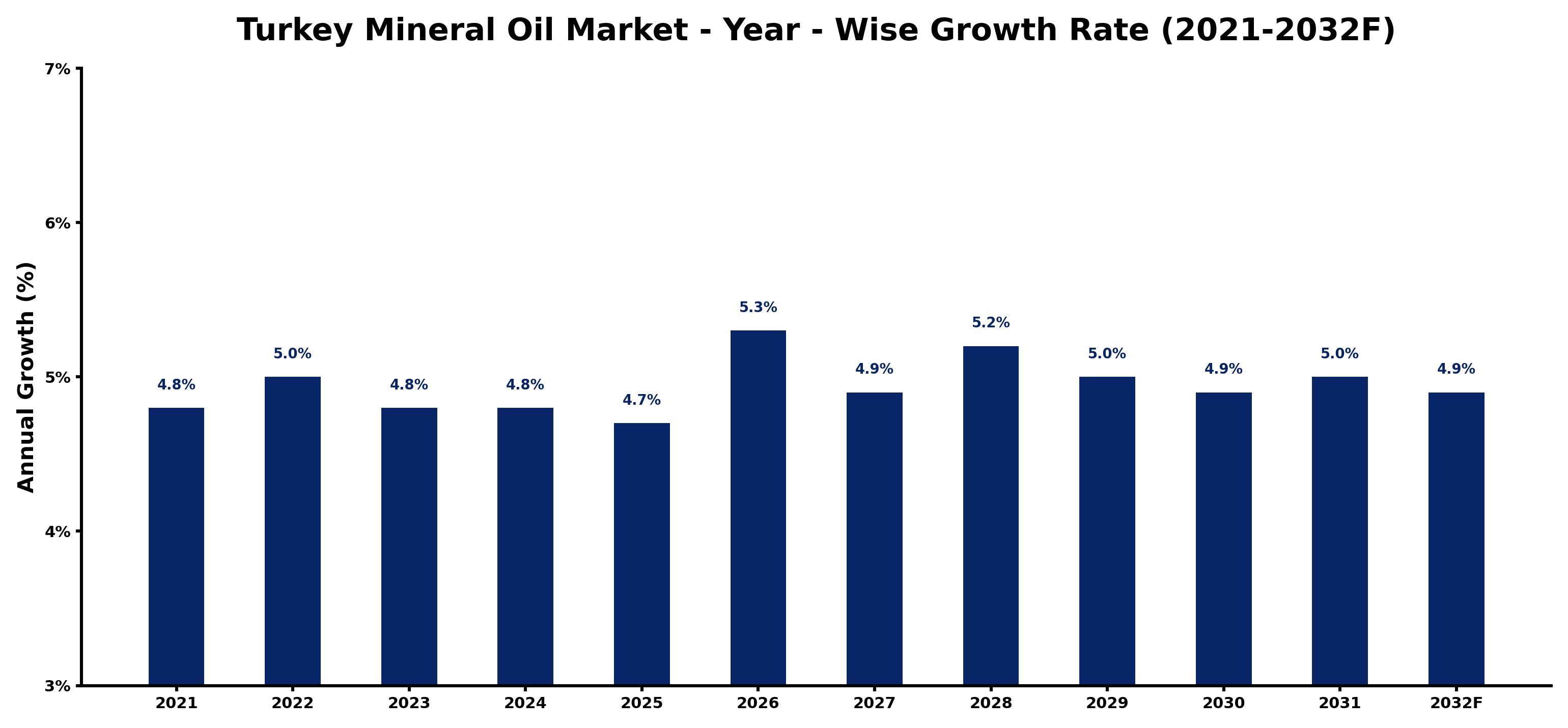
The table below presents the year‑wise growth rates along with the key drivers influencing the market
| Year | Growth Rate | Major Drivers |
| 2021 | 4.8% | Rising electricity demand across industries |
| 2022 | 5.0% | Rapid growth in telecom and data center sectors |
| 2023 | 4.8% | Increasing adoption of advanced technologies |
| 2024 | 4.8% | Increasing adoption of advanced technologies |
| 2025 | 4.7% | Increasing industrial infrastructure investments |
| 2026 | 5.3% | Increasing industrial infrastructure investments |
| 2027 | 4.9% | Expansion of transportation and logistics networks |
| 2028 | 5.2% | Rapid growth in telecom and data center sectors |
| 2029 | 5.0% | Increasing industrial infrastructure investments |
| 2030 | 4.9% | Increasing industrial infrastructure investments |
| 2031 | 5.0% | Increasing smart city development projects |
| 2032 | 4.9% | Rapid growth in telecom and data center sectors |
Note - Market size estimations and growth projections presented in this report are based on 6Wresearch's advanced forecasting approach, validated with industry datasets as of June 2026.
Turkey Mineral Oil Market Synopsis
In Turkey, the mineral oil market plays a crucial role in supporting various industries, particularly automotive and cosmetics. The demand for mineral oils that exhibit exceptional lubrication properties and conform to stringent quality standards is driving production efforts and innovations across the sector.
Turkey's geographical position also enhances its market potential, enabling it to serve as a hub for mineral oil distribution in the region. As the country continues to develop its infrastructure and technology, the mineral oil market is likely to see improvements in supply chain efficiency, thereby promoting higher market penetration.
Turkey Mineral Oil Market Key Takeaways
- The market is projected to witness a steady growth rate driven by diverse industrial applications.
- Regulatory frameworks are increasingly emphasizing sustainability and product safety.
- Technological advancements in refining processes are leading to enhanced product quality.
- High purity standards are critical in applications across pharmaceuticals and cosmetics.
- Geographical advantages bolster Turkey's position as a key player in the regional mineral oil supply chain.
Evaluation of Restraints in Turkey Mineral Oil Market
Despite the favorable growth trajectory, the Turkey Mineral Oil Market faces notable restraints. Fluctuations in crude oil prices create uncertainty in operational costs, making financial planning challenging for manufacturers. Furthermore, strict regulatory pressures related to environmental sustainability require continuous investments in cleaner and more efficient refining practices. This necessitates companies to balance compliance with profitability, complicating the business landscape in which they operate.
Turkey Mineral Oil Market Trends
Current trends in the Turkey Mineral Oil Market highlight a significant shift towards bio-based alternatives and synthetic lubricants. These innovations are being driven by heightened environmental awareness and regulatory pressures for sustainable practices. Additionally, advancements in the formulation of high-performance mineral oils are transforming the product landscape, enabling better performance in diverse industrial applications.
As consumer preferences continue to evolve, a growing focus on product purity and effectiveness is emerging. Companies are increasingly prioritizing research and development to create tailored solutions that meet specific industry needs, enhancing both performance and safety.
Turkey Mineral Oil Market Opportunities
The Turkey Mineral Oil Market is ripe with opportunities for investment, particularly in the development of sustainable and bio-based oil alternatives. As industries seek to reduce their carbon footprint, there is a burgeoning demand for environmentally-friendly formulations. Additionally, expanding into new industrial applications, such as renewable energy and advanced manufacturing, presents avenues for market players to capture emerging segments and drive growth.
Government Initiatives in the Turkey Mineral Oil Market
Government policies in Turkey are increasingly focused on ensuring product safety and fostering sustainable practices within the mineral oil industry. Regulatory frameworks are being established to enforce quality standards and promote environmentally friendly sourcing and refining methods. Public spending initiatives are also supporting infrastructure improvements and technological advancements, ultimately benefiting the market's growth and compliance efforts.
Future Insights of the Turkey Mineral Oil Market
Looking ahead to 2026-2032, the Turkey Mineral Oil Market is set to undergo transformative changes driven by innovation and regulatory compliance. The focus will likely shift towards integrating advanced technologies and green practices in mineral oil production. As consumers and industries increasingly prioritize sustainability, companies that adapt to these demands are expected to thrive, positioning Turkey as a competitive player in the global mineral oil landscape.
Turkey Mineral Oil Market Latest Developments (May 2025 - June 2026)
Recent developments in the Turkey Mineral Oil Market indicate a growing trend towards the adoption of cutting-edge refining technologies aimed at improving product quality and reducing environmental impact. As firms respond to regulatory pressures, investments in cleaner production methodologies are becoming commonplace. Additionally, the market is witnessing heightened interest in collaborative initiatives aimed at enhancing supply chain efficiency and product innovation, reflecting a strategic shift towards greater operational effectiveness.
Turkey Mineral Oil Market - Key Attractiveness of the Report
- 10 Years of Market Numbers
- Historical Data Starting from 2022 to 2025
- Base Year: 2025
- Forecast Data until 2032
- Key Performance Indicators Impacting the Market
- Major Upcoming Developments and Projects
Key Highlights of the Report:
- Turkey Mineral Oil Market Outlook
- Market Size of Turkey Mineral Oil Market, 2025
- Forecast of Turkey Mineral Oil Market, 2032
- Historical Data and Forecast of Turkey Mineral Oil Revenues & Volume for the Period 2022-2032F
- Turkey Mineral Oil Market Trend Evolution
- Turkey Mineral Oil Market Drivers and Challenges
- Turkey Mineral Oil Price Trends
- Turkey Mineral Oil Porter's Five Forces
- Turkey Mineral Oil Industry Life Cycle
- Historical Data and Forecast of Turkey Mineral Oil Market Revenues & Volume By Grade for the Period 2022-2032F
- Historical Data and Forecast of Turkey Mineral Oil Market Revenues & Volume By Technical Oil for the Period 2022-2032F
- Historical Data and Forecast of Turkey Mineral Oil Market Revenues & Volume By White Oil for the Period 2022-2032F
- Historical Data and Forecast of Turkey Mineral Oil Market Revenues & Volume By Application for the Period 2022-2032F
- Historical Data and Forecast of Turkey Mineral Oil Market Revenues & Volume By Baby Oil for the Period 2022-2032F
- Historical Data and Forecast of Turkey Mineral Oil Market Revenues & Volume By Cosmetics for the Period 2022-2032F
- Historical Data and Forecast of Turkey Mineral Oil Market Revenues & Volume By Skin Care Products for the Period 2022-2032F
- Historical Data and Forecast of Turkey Mineral Oil Market Revenues & Volume By Hair Care Products for the Period 2022-2032F
- Historical Data and Forecast of Turkey Mineral Oil Market Revenues & Volume By Consumer Goods for the Period 2022-2032F
- Historical Data and Forecast of Turkey Mineral Oil Market Revenues & Volume By Others for the Period 2022-2032F
- Turkey Mineral Oil Import Export Trade Statistics
- Market Opportunity Assessment By Grade
- Market Opportunity Assessment By Application
- Turkey Mineral Oil Top Companies Market Share
- Turkey Mineral Oil Competitive Benchmarking By Technical and Operational Parameters
- Turkey Mineral Oil Company Profiles
- Turkey Mineral Oil Key Strategic Recommendations






































