Ghana Mineral Oil Market Size, Share & Growth Rate
The Ghana Mineral Oil Market was estimated at USD 312 Million in 2025 and is projected to reach USD 441 Million by 2032, growing at a CAGR of 5.1% from 2026 to 2032. This robust growth trajectory is primarily driven by an uptick in industrial activities across various sectors, particularly automotive, manufacturing, and construction. The increasing demand for high-quality lubricants and specialty oils tailored for specific applications plays a pivotal role in this expanding market.
Ghana Mineral Oil Market Year-wise Growth Rate and Key Drivers
This graph highlights how the Ghana Mineral Oil Market has steadily grown over the years, supported by major growth factors.
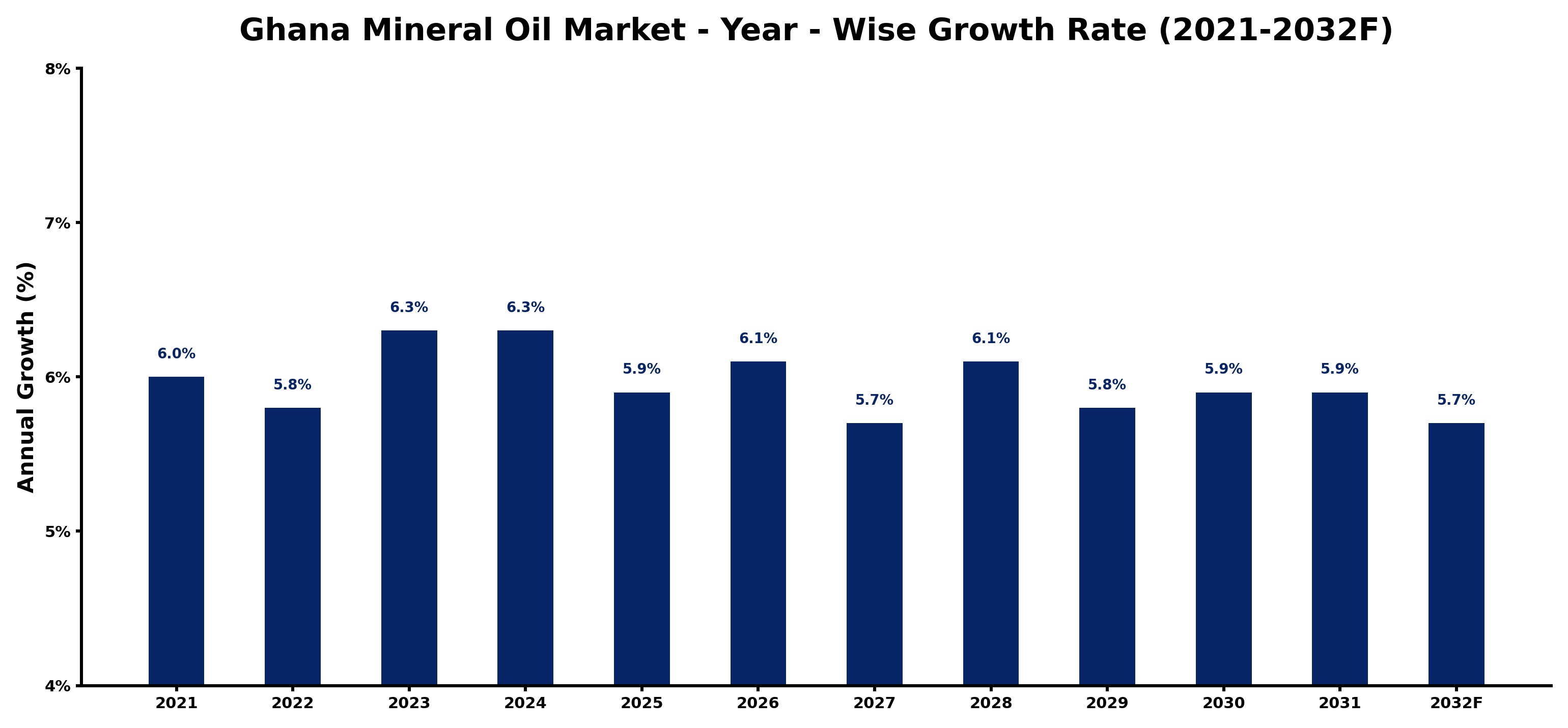
The table below presents the year‑wise growth rates along with the key drivers influencing the market
| Year | Growth Rate | Major Drivers |
| 2021 | 6.0% | Expansion of commercial construction activities |
| 2022 | 5.8% | Growing renewable energy integration projects |
| 2023 | 6.3% | Expansion of manufacturing activities |
| 2024 | 6.3% | Expansion of manufacturing activities |
| 2025 | 5.9% | Growing urbanization and commercial development |
| 2026 | 6.1% | Increasing industrial infrastructure investments |
| 2027 | 5.7% | Growing renewable energy integration projects |
| 2028 | 6.1% | Expansion of transportation and logistics networks |
| 2029 | 5.8% | Increasing industrial automation investments |
| 2030 | 5.9% | Rapid growth in telecom and data center sectors |
| 2031 | 5.9% | Rising electricity demand across industries |
| 2032 | 5.7% | Increasing industrial automation investments |
Note - Market size estimations and growth projections presented in this report are based on 6Wresearch's advanced forecasting approach, validated with industry datasets as of June 2026.
Ghana Mineral Oil Market Synopsis
Currently, Ghana's mineral oil market is experiencing a significant surge, fueled by the nation's rapid industrialization and infrastructure development. This heightened demand for mineral oils is largely influenced by the automotive and manufacturing sectors, which rely heavily on superior lubricants and hydraulic fluids for optimal performance and efficiency.
As Ghana continues to develop its energy landscape, there is a noticeable shift towards innovative oil formulations, including environmentally friendly options. Such advancements not only enhance operational efficiency but also align with global sustainability trends, setting the stage for a dynamic market landscape.
Ghana Mineral Oil Market Key Takeaways
- The market is poised for steady growth driven by increased demand across automotive and manufacturing sectors.
- Innovation in oil formulations, including low-viscosity and eco-friendly oils, is reshaping product offerings.
- Government policies are fostering transparency and sustainability in mineral oil resource management.
- The market's future is promising, with significant investments anticipated in the coming years.
- Technological advancements are crucial for maintaining competitive advantages in the mineral oil sector.
Evaluation of Restraints in Ghana Mineral Oil Market
Despite its growth potential, the Ghana mineral oil market faces notable challenges. The increasing regulatory focus on environmental standards is reshaping operational practices, pushing companies to adapt swiftly. Additionally, as awareness regarding the adverse effects of mineral oil consumption rises, market players are under pressure to shift towards more sustainable practices. Competition from alternative lubricants and oils is intensifying, necessitating innovation and differentiation for survival.
Ghana Mineral Oil Market Trends
One significant trend is the growing emphasis on environmentally sustainable mineral oils. Companies are developing formulations that minimize ecological impact, reflecting a global shift towards greener products. Moreover, the demand for advanced lubricant technologies, particularly in high-performance machinery, is expanding. This aligns with the rising need for efficiency and longevity in equipment usage, particularly in the automotive and manufacturing sectors.
Ghana Mineral Oil Market Opportunities
The market presents lucrative opportunities for investment, particularly in the realm of research and development for innovative oil formulations. There is a burgeoning demand for specialized products that meet the specific needs of various industries, which creates space for tailored solutions. Additionally, as Ghana enhances its infrastructure, the potential for new applications of mineral oils across emerging sectors becomes increasingly evident.
Government Initiatives in the Ghana Mineral Oil Market
The Ghanaian government has implemented several initiatives aimed at ensuring sustainable development in the mineral oil sector. Policies focus on promoting responsible exploration and extraction practices while enhancing compliance with environmental regulations. Additionally, the government is fostering partnerships between oil companies and local communities, aiming to maximize socio-economic benefits from mineral oil production while minimizing environmental impacts.
Future Insights of the Ghana Mineral Oil Market
Looking ahead to 2026-2032, the Ghana mineral oil market is expected to undergo considerable transformation, driven by technological innovations and evolving regulatory landscapes. As industries increasingly adopt advanced machinery and equipment, the demand for high-performance lubricants will continue to rise. Furthermore, the pursuit of sustainable practices will shape product development and market strategies, positioning the Ghana mineral oil sector for growth amidst global changes.
Ghana Mineral Oil Market Latest Developments (May 2025 - June 2026)
Recent trends in the Ghana mineral oil market indicate a shift towards increased investment in eco-friendly products. Companies are prioritizing research into alternative formulations to meet both local and international standards. Additionally, collaboration between industry stakeholders and government entities is gaining momentum, focusing on enhancing the sustainability of extraction processes while ensuring the socio-economic upliftment of communities involved.
Ghana Mineral Oil Market - Key Attractiveness of the Report
- 10 Years of Market Numbers
- Historical Data Starting from 2022 to 2025
- Base Year: 2025
- Forecast Data until 2032
- Key Performance Indicators Impacting the Market
- Major Upcoming Developments and Projects
Key Highlights of the Report:
- Ghana Mineral Oil Market Outlook
- Market Size of Ghana Mineral Oil Market, 2025
- Forecast of Ghana Mineral Oil Market, 2032
- Historical Data and Forecast of Ghana Mineral Oil Revenues & Volume for the Period 2022-2032F
- Ghana Mineral Oil Market Trend Evolution
- Ghana Mineral Oil Market Drivers and Challenges
- Ghana Mineral Oil Price Trends
- Ghana Mineral Oil Porter's Five Forces
- Ghana Mineral Oil Industry Life Cycle
- Historical Data and Forecast of Ghana Mineral Oil Market Revenues & Volume By Grade for the Period 2022-2032F
- Historical Data and Forecast of Ghana Mineral Oil Market Revenues & Volume By Technical Oil for the Period 2022-2032F
- Historical Data and Forecast of Ghana Mineral Oil Market Revenues & Volume By White Oil for the Period 2022-2032F
- Historical Data and Forecast of Ghana Mineral Oil Market Revenues & Volume By Application for the Period 2022-2032F
- Historical Data and Forecast of Ghana Mineral Oil Market Revenues & Volume By Baby Oil for the Period 2022-2032F
- Historical Data and Forecast of Ghana Mineral Oil Market Revenues & Volume By Cosmetics for the Period 2022-2032F
- Historical Data and Forecast of Ghana Mineral Oil Market Revenues & Volume By Skin Care Products for the Period 2022-2032F
- Historical Data and Forecast of Ghana Mineral Oil Market Revenues & Volume By Hair Care Products for the Period 2022-2032F
- Historical Data and Forecast of Ghana Mineral Oil Market Revenues & Volume By Consumer Goods for the Period 2022-2032F
- Historical Data and Forecast of Ghana Mineral Oil Market Revenues & Volume By Others for the Period 2022-2032F
- Ghana Mineral Oil Import Export Trade Statistics
- Market Opportunity Assessment By Grade
- Market Opportunity Assessment By Application
- Ghana Mineral Oil Top Companies Market Share
- Ghana Mineral Oil Competitive Benchmarking By Technical and Operational Parameters
- Ghana Mineral Oil Company Profiles
- Ghana Mineral Oil Key Strategic Recommendations






































