Algeria Physical Security Market Size & Growth Rate (2026-2032)
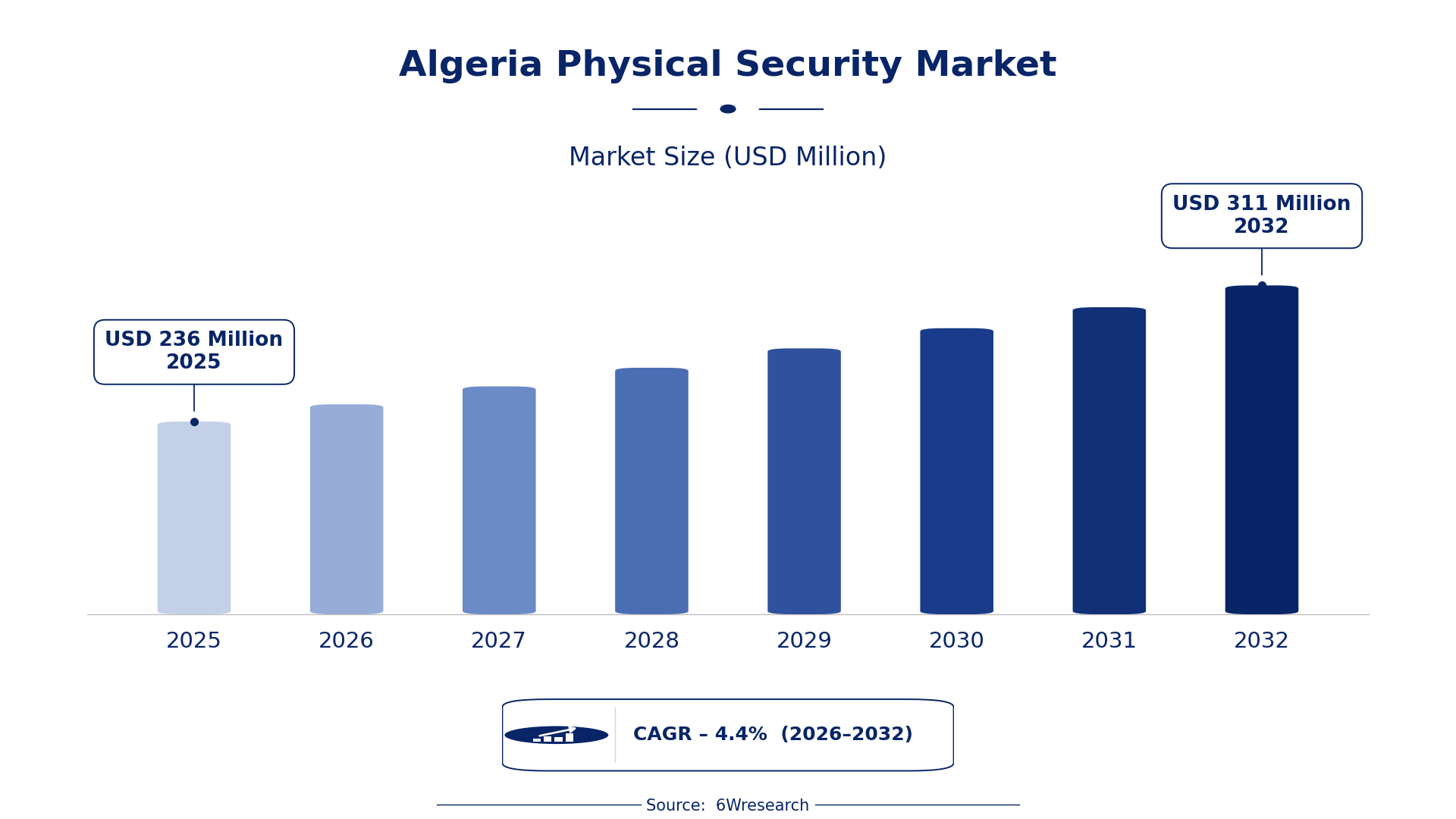
The Algeria Physical Security Market was estimated at USD 236 Million in 2025 and is projected to reach USD 311 Million by 2032, growing at a CAGR of 4.4% from 2026 to 2032.
Algeria Physical Security Market Synopsis
The Algeria Physical Security Market is at a crossroads, balancing between the urgent demand for enhanced security solutions and the ongoing challenges posed by economic uncertainties. As more entities recognize the critical need for comprehensive security measures, the market is gearing up for substantial growth driven by both public and private sector investments.
Rapid developments in security technology, including video surveillance and access control systems, are reshaping the market. Stakeholders are increasingly prioritizing advanced solutions to combat a range of threats, ensuring that security frameworks not only protect assets but also provide peace of mind for individuals and organizations alike.
Algeria Physical Security Market Year-wise Growth Rate and Key Drivers
This graph illustrates the annual growth rates of the Algeria Physical Security Market from 2021 to 2032, highlighting a steady upward trajectory and projected expansion over the forecast period.
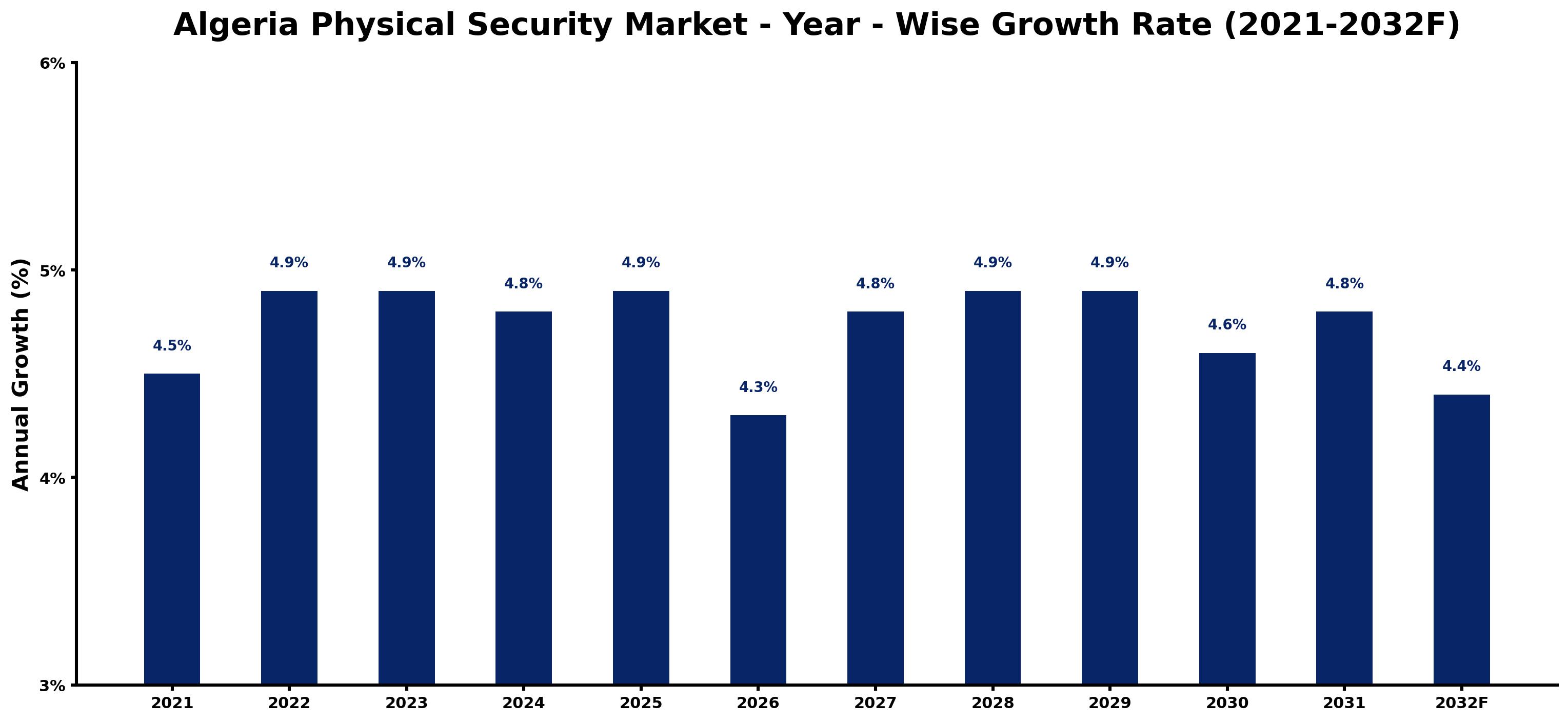
The table below presents the year‑wise growth rates along with the key drivers influencing the market
| Year | Growth Rate | Major Drivers |
| 2021 | 4.5% | Increase in urban crime rates prompting safety investments. |
| 2022 | 4.9% | Government regulations improving security standards in public spaces. |
| 2023 | 4.9% | Heightened focus on digital surveillance technology adoption. |
| 2024 | 4.8% | Local businesses enhancing security against cybersecurity threats. |
| 2025 | 4.9% | Growing tourism driving demand for enhanced physical security. |
| 2026 | 4.3% | New national security policies mandating upgraded security measures. |
| 2027 | 4.8% | Rise in private sector security service contracts observed. |
| 2028 | 4.9% | Increased investment in security infrastructure for oil facilities. |
| 2029 | 4.9% | Security solutions supporting Algeria's sporting event safety efforts. |
| 2030 | 4.6% | Urban development projects requiring integrated security solutions. |
| 2031 | 4.8% | Public-private partnerships fostering advanced security technology deployment. |
| 2032 | 4.4% | Demand for personal safety solutions in urban populations. |
Note: Market size estimations and growth projections presented in this report are based on 6Wresearch's proprietary forecasting methodology, utilizing the latest available industry data, government publications, and primary research inputs.
Algeria Physical Security Market Key Takeaways
Below are some of the specific key takeaways from the market, including:
- The market is experiencing steady growth due to heightened awareness of security measures across various sectors.
- Technological advancements are driving the demand for integrated security solutions.
- Government policies are increasingly supporting the adoption of advanced security technologies.
- Investment opportunities are emerging in cloud-based security solutions and cybersecurity measures.
- Challenges such as political instability and infrastructure limitations continue to impact market dynamics.
Evaluation of Restraints in Algeria Physical Security Market
The Algeria Physical Security Market faces significant hurdles primarily due to political instability, economic fluctuations, and systemic corruption. These elements create a challenging business environment, often deterring investment and complicating the effective implementation of security measures. on top of that, inadequate infrastructure and limited access to cutting-edge technologies hinder the development of robust security systems, making it difficult for businesses to fully protect their assets. With the ongoing threat of regional conflicts and terrorism, companies must remain agile, continuously adapting their strategies and investments in security technologies.
Algeria Physical Security Market Trends
Recent trends indicate a notable shift towards the adoption of advanced security solutions, driven by increasing safety concerns. Video surveillance systems equipped with analytics for enhanced monitoring are gaining traction, as organizations seek to improve threat detection capabilities. on top of that, integrated security systems that combine access control, intrusion detection, and video surveillance are becoming the norm. The rise of cloud-based solutions is also notable, providing scalability and remote monitoring, while biometric access control systems are gaining popularity for their higher authentication capabilities.
Algeria Physical Security Market Opportunities
Investors should closely monitor opportunities within the Algeria Physical Security Market, particularly in advanced solutions such as video surveillance and access control systems. The surge in interest for cybersecurity measures to protect these systems from cyber threats also presents lucrative avenues for growth. As Algeria invests in modernizing its infrastructure and prioritizing public safety, the physical security sector stands to benefit from enhanced demand for technology-driven security solutions.
Government Initiatives in the Algeria Physical Security Market
Government initiatives are playing a crucial role in shaping the Algeria Physical Security Market. With an emphasis on enhancing national security and public safety, the government is implementing various regulations and policies designed to foster the development of physical security infrastructure. This concerted effort is expected to create a supportive environment for growth in the sector.
- A regulatory framework introduced in late 2023 mandates the use of advanced security technologies in critical infrastructures.
- Currently ongoing is a national security enhancement programme aimed at upgrading surveillance systems in urban areas.
- Planned for 2026 is a public-private partnership initiative expected to expand security infrastructure across key sectors.
- Recent initiatives have focused on training and certification of local security companies to ensure compliance with international standards.
- The government is collaborating with international agencies to develop best practices in physical security measures.
Future Insights of the Algeria Physical Security Market
Looking ahead to 2026-2032, the Algeria Physical Security Market is set for substantial expansion. The ongoing focus on securing critical infrastructure, combined with urbanization and industrial growth, will fuel demand for comprehensive physical security solutions. Additionally, the integration of advanced technologies like AI and IoT in security measures promises to enhance operational effectiveness, enabling stakeholders to stay ahead of emerging threats.
Algeria Physical Security Market Latest Developments
In the last year, the Algeria Physical Security Market has witnessed a flurry of activity marked by technological advancements and strategic partnerships. Companies are responding to the increasing need for security by launching innovative products and services tailored to local demands. This trend is indicative of the market's potential as it evolves to meet the complex security needs of the region.
- A major technology vendor launched a new line of smart surveillance cameras in Q1 2025, aimed at enhancing real-time threat detection.
- Currently ongoing is a partnership between a leading security service provider and a telecommunications company to improve network-based security solutions.
- A planned initiative set for mid-2026 focuses on upgrading public safety systems in collaboration with local government authorities.
- An initiative aimed at enhancing cybersecurity measures for physical security systems was launched in early 2025, targeting critical infrastructure.
- A regional operator is currently developing an integrated security platform that combines various physical security technologies, expected to complete rollout by late 2025.
Algeria Physical Security Market - Key Attractiveness of the Report
- 10 Years of Market Numbers
- Historical Data Starting from 2022 to 2025
- Base Year: 2025
- Forecast Data until 2032
- Key Performance Indicators Impacting the Market
- Major Upcoming Developments and Projects
Key Highlights of the Report:
- Algeria Physical Security Market Outlook
- Market Size of Algeria Physical Security Market, 2025
- Forecast of Algeria Physical Security Market, 2032
- Historical Data and Forecast of Algeria Physical Security Revenues & Volume for the Period 2022-2032F
- Algeria Physical Security Market Trend Evolution
- Algeria Physical Security Market Drivers and Challenges
- Algeria Physical Security Price Trends
- Algeria Physical Security Porter's Five Forces
- Algeria Physical Security Industry Life Cycle
- Historical Data and Forecast of Algeria Physical Security Market Revenues & Volume By Component for the Period 2022-2032F
- Historical Data and Forecast of Algeria Physical Security Market Revenues & Volume By Systems (PACS, PSIM, PIAM, Video Surveillance, Fire and Life Safety) for the Period 2022-2032F
- Historical Data and Forecast of Algeria Physical Security Market Revenues & Volume By Services for the Period 2022-2032F
- Historical Data and Forecast of Algeria Physical Security Market Revenues & Volume By Vertical for the Period 2022-2032F
- Historical Data and Forecast of Algeria Physical Security Market Revenues & Volume By BFSI for the Period 2022-2032F
- Historical Data and Forecast of Algeria Physical Security Market Revenues & Volume By Government for the Period 2022-2032F
- Historical Data and Forecast of Algeria Physical Security Market Revenues & Volume By Retail for the Period 2022-2032F
- Historical Data and Forecast of Algeria Physical Security Market Revenues & Volume By Transportation for the Period 2022-2032F
- Historical Data and Forecast of Algeria Physical Security Market Revenues & Volume By Residential for the Period 2022-2032F
- Historical Data and Forecast of Algeria Physical Security Market Revenues & Volume By Telecom and IT for the Period 2022-2032F
- Historical Data and Forecast of Algeria Physical Security Market Revenues & Volume By Other Verticals (Healthcare, Manufacturing, Energy and Utilities, and Education). for the Period 2022-2032F
- Historical Data and Forecast of Algeria Physical Security Market Revenues & Volume By Organization Size for the Period 2022-2032F
- Historical Data and Forecast of Algeria Physical Security Market Revenues & Volume By SMEs for the Period 2022-2032F
- Historical Data and Forecast of Algeria Physical Security Market Revenues & Volume By Large Enterprises for the Period 2022-2032F
- Algeria Physical Security Import Export Trade Statistics
- Market Opportunity Assessment By Component
- Market Opportunity Assessment By Vertical
- Market Opportunity Assessment By Organization Size
- Algeria Physical Security Top Companies Market Share
- Algeria Physical Security Competitive Benchmarking By Technical and Operational Parameters
- Algeria Physical Security Company Profiles
- Algeria Physical Security Key Strategic Recommendations






































