Argentina Auto Parts And Accessories Market Size, Share & Growth Rate
The Argentina Auto Parts And Accessories Market was estimated at USD 1463 Million in 2025 and is projected to reach USD 2133 Million by 2032, growing at a CAGR of 5.5% from 2026 to 2032. This growth trajectory is fueled by rising vehicle ownership alongside an escalating demand for aftermarket products. Additionally, the increasing consumer focus on eco-friendly components and smart technologies further amplifies the markets potential.
Argentina Auto Parts And Accessories Market Year-wise Growth Rate and Key Drivers
This graph highlights how the Argentina Auto Parts And Accessories Market has steadily grown over the years, supported by major growth factors.
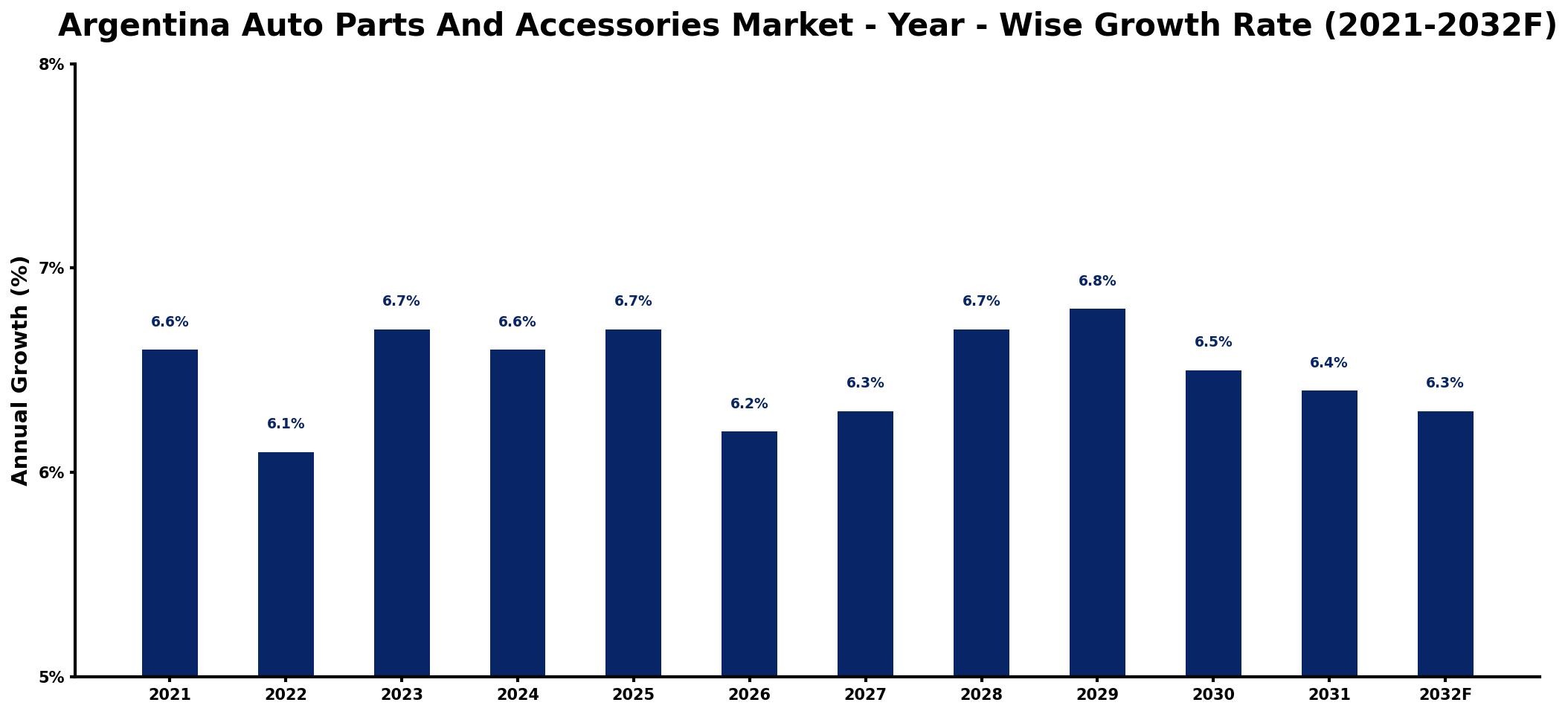
The table below presents the year‑wise growth rates along with the key drivers influencing the market
| Year | Growth Rate | Major Drivers |
| 2021 | 6.6% | Rising consumer purchasing power |
| 2022 | 6.1% | Increased vehicle ownership rates |
| 2023 | 6.7% | Expansion of e-commerce platforms |
| 2024 | 6.6% | Growth in urban transportation needs |
| 2025 | 6.7% | Investment in local manufacturing |
| 2026 | 6.2% | Technological advancements in logistics |
| 2027 | 6.3% | Growing demand for sustainable solutions |
| 2028 | 6.7% | Increase in vehicle maintenance services |
| 2029 | 6.8% | Surge in fleet management solutions |
| 2030 | 6.5% | Development of smart mobility initiatives |
| 2031 | 6.4% | Rise in aftermarket service offerings |
| 2032 | 6.3% | Enhancements in supply chain efficiency |
Note: Market size estimations and growth projections presented in this report are based on 6Wresearch's proprietary forecasting methodology, utilizing the latest available industry data, government publications, and primary research inputs.
Argentina Auto Parts And Accessories Market Synopsis
The Argentine auto parts and accessories market is witnessing a significant transformation, primarily driven by a shift in consumer preferences towards sustainable and innovative products. As the number of vehicles on the road continues to rise, so does the need for reliable and efficient auto parts, encompassing everything from engine components to decorative accessories.
Local manufacturers are stepping up to meet this growing demand, while international brands also vie for market share by offering competitive prices and innovative solutions. The market is characterized by a healthy mix of domestic production and imports, with government policies shaping the landscape significantly.
Argentina Auto Parts And Accessories Market Key Takeaways
- The market is on a growth path, with robust demand anticipated due to increased vehicle ownership.
- Eco-friendly and smart automotive components are becoming increasingly popular among consumers.
- Investment opportunities abound, particularly in manufacturing high-quality aftermarket parts.
- Government policies play a crucial role in shaping market dynamics through import tariffs and local production support.
- The market's future is promising, driven by innovation and consumer demand for customization.
Evaluation of Restraints in Argentina Auto Parts And Accessories Market
The Argentina Auto Parts and Accessories Market faces notable challenges that could restrain its growth. Economic instability remains a pressing concern, particularly with high inflation and fluctuating currency exchange rates, which can dampen consumer purchasing power. Additionally, stringent import restrictions and high tariffs imposed by the government create barriers for foreign companies looking to penetrate or expand within the market. These factors contribute to a complex business environment for local manufacturers, who also face competition from lower-priced imported products.
Argentina Auto Parts And Accessories Market Trends
Emerging trends in the Argentina Auto Parts and Accessories Market reflect a growing consumer inclination towards eco-friendliness and customization. As environmental awareness rises, demand for electric vehicle components and hybrid accessories is gaining momentum. Furthermore, technological innovations, including the incorporation of smart features in auto parts, are revolutionizing the landscape. Consumers are increasingly seeking personalized vehicle accessories that not only enhance aesthetics but also improve functionality, signaling a clear shift toward customized solutions.
Argentina Auto Parts And Accessories Market Opportunities
Investment prospects within the Argentina Auto Parts and Accessories Market are ripe for exploration. The burgeoning automotive sector presents opportunities for manufacturing innovative components like batteries, tires, and advanced electrical parts. Moreover, the rise of e-commerce platforms and optimized distribution channels offers an avenue to broaden customer reach. Collaborating with local automotive manufacturers to tailor product offerings for diverse vehicle models could further solidify market presence and drive growth.
Government Initiatives in the Argentina Auto Parts And Accessories Market
Government policies in Argentina significantly impact the auto parts and accessories market. With an aim to protect domestic production, import tariffs and regulations are enforced to encourage local manufacturing. These policies not only safeguard local manufacturers but also foster a preference for domestically produced auto components. Safety and quality regulations further ensure that products entering the market meet stringent standards, thereby enhancing consumer confidence in local offerings.
Future Insights of the Argentina Auto Parts And Accessories Market
Looking ahead to 2026-2032, the Argentina Auto Parts and Accessories Market is expected to continue its growth trend, buoyed by increasing vehicle ownership and technological advancements. Consumer demand for innovative and sustainable solutions will likely guide product development and marketing strategies. Furthermore, supportive government initiatives geared towards strengthening the domestic automotive industry will enhance opportunities for both local and foreign investors, setting a promising stage for market expansion.
Argentina Auto Parts And Accessories Market Latest Developments (2025 - 2026)
Recent developments in the Argentina Auto Parts and Accessories Market indicate a steady alignment with global trends towards sustainability and technology. The introduction of new eco-friendly components and smart automotive technologies highlights the industry's responsiveness to consumer demands. Additionally, local manufacturers are increasingly investing in innovation, while distribution networks are evolving to incorporate digital platforms, ensuring wider accessibility for consumers.
Argentina Auto Parts And Accessories Market - Key Attractiveness of the Report
- 10 Years of Market Numbers
- Historical Data Starting from 2022 to 2025
- Base Year: 2025
- Forecast Data until 2032
- Key Performance Indicators Impacting the Market
- Major Upcoming Developments and Projects
Key Highlights of the Report:
- Argentina Auto Parts And Accessories Market Outlook
- Market Size of Argentina Auto Parts And Accessories Market, 2025
- Forecast of Argentina Auto Parts And Accessories Market, 2032
- Historical Data and Forecast of Argentina Auto Parts And Accessories Revenues & Volume for the Period 2022-2032F
- Argentina Auto Parts And Accessories Market Trend Evolution
- Argentina Auto Parts And Accessories Market Drivers and Challenges
- Argentina Auto Parts And Accessories Price Trends
- Argentina Auto Parts And Accessories Porter's Five Forces
- Argentina Auto Parts And Accessories Industry Life Cycle
- Historical Data and Forecast of Argentina Auto Parts And Accessories Market Revenues & Volume By Product for the Period 2022-2032F
- Historical Data and Forecast of Argentina Auto Parts And Accessories Market Revenues & Volume By Driveline & Powertrain for the Period 2022-2032F
- Historical Data and Forecast of Argentina Auto Parts And Accessories Market Revenues & Volume By Interiors & Exteriors for the Period 2022-2032F
- Historical Data and Forecast of Argentina Auto Parts And Accessories Market Revenues & Volume By Electronics for the Period 2022-2032F
- Historical Data and Forecast of Argentina Auto Parts And Accessories Market Revenues & Volume By Bodies & Chassis for the Period 2022-2032F
- Historical Data and Forecast of Argentina Auto Parts And Accessories Market Revenues & Volume By Wheel & Tires for the Period 2022-2032F
- Historical Data and Forecast of Argentina Auto Parts And Accessories Market Revenues & Volume By Others for the Period 2022-2032F
- Historical Data and Forecast of Argentina Auto Parts And Accessories Market Revenues & Volume By Application for the Period 2022-2032F
- Historical Data and Forecast of Argentina Auto Parts And Accessories Market Revenues & Volume By OEMs for the Period 2022-2032F
- Historical Data and Forecast of Argentina Auto Parts And Accessories Market Revenues & Volume By Aftermarket for the Period 2022-2032F
- Argentina Auto Parts And Accessories Import Export Trade Statistics
- Market Opportunity Assessment By Product
- Market Opportunity Assessment By Application
- Argentina Auto Parts And Accessories Top Companies Market Share
- Argentina Auto Parts And Accessories Competitive Benchmarking By Technical and Operational Parameters
- Argentina Auto Parts And Accessories Company Profiles
- Argentina Auto Parts And Accessories Key Strategic Recommendations






































