Argentina Cloud Managed Services Market Size & Growth Rate (2026-2032)
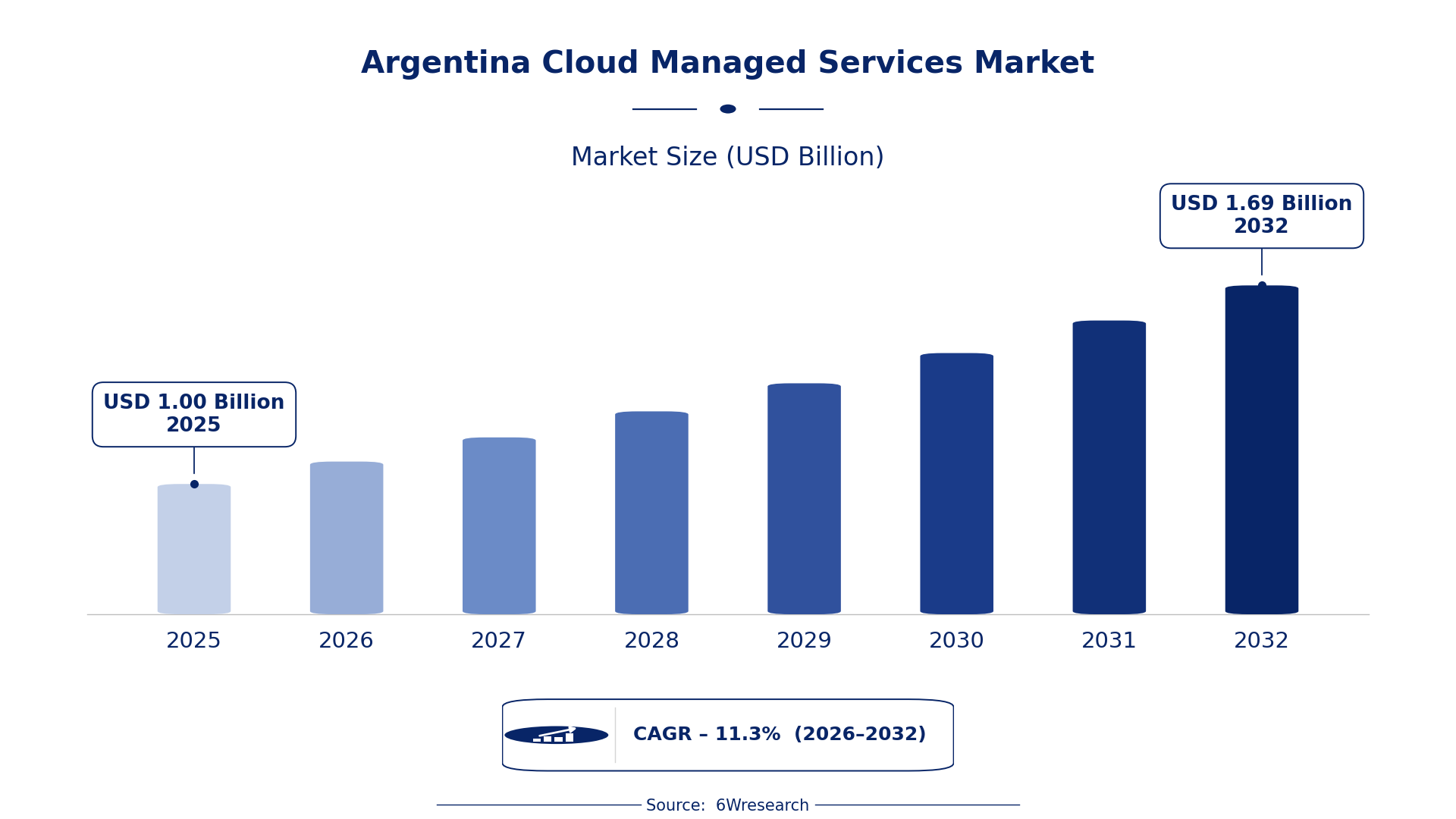
The Argentina Cloud Managed Services Market was estimated at USD 1000 Million in 2025 and is projected to reach USD 1686 Million by 2032, growing at a CAGR of 11.3% from 2026 to 2032.
Argentina Cloud Managed Services Market Synopsis
The driving force behind the Argentina Cloud Managed Services market is the increasing complexity of IT environments. Organizations are increasingly recognizing that outsourcing cloud management tasks to specialized providers enables them to focus on their core business while ensuring optimal performance of their cloud infrastructure.
As businesses embrace cloud-based technologies, the need for expertise in cloud migration, security, monitoring, and optimization is on the rise. This trend reflects a shift towards operational efficiency and cost optimization, as companies seek to enhance agility and innovation through strategic partnerships with managed service providers.
Argentina Cloud Managed Services Market Year-wise Growth Rate and Key Drivers
This graph illustrates the annual growth rates of the Argentina Cloud Managed Services Market from 2021 to 2032, highlighting a steady upward trajectory and projected expansion over the forecast period.
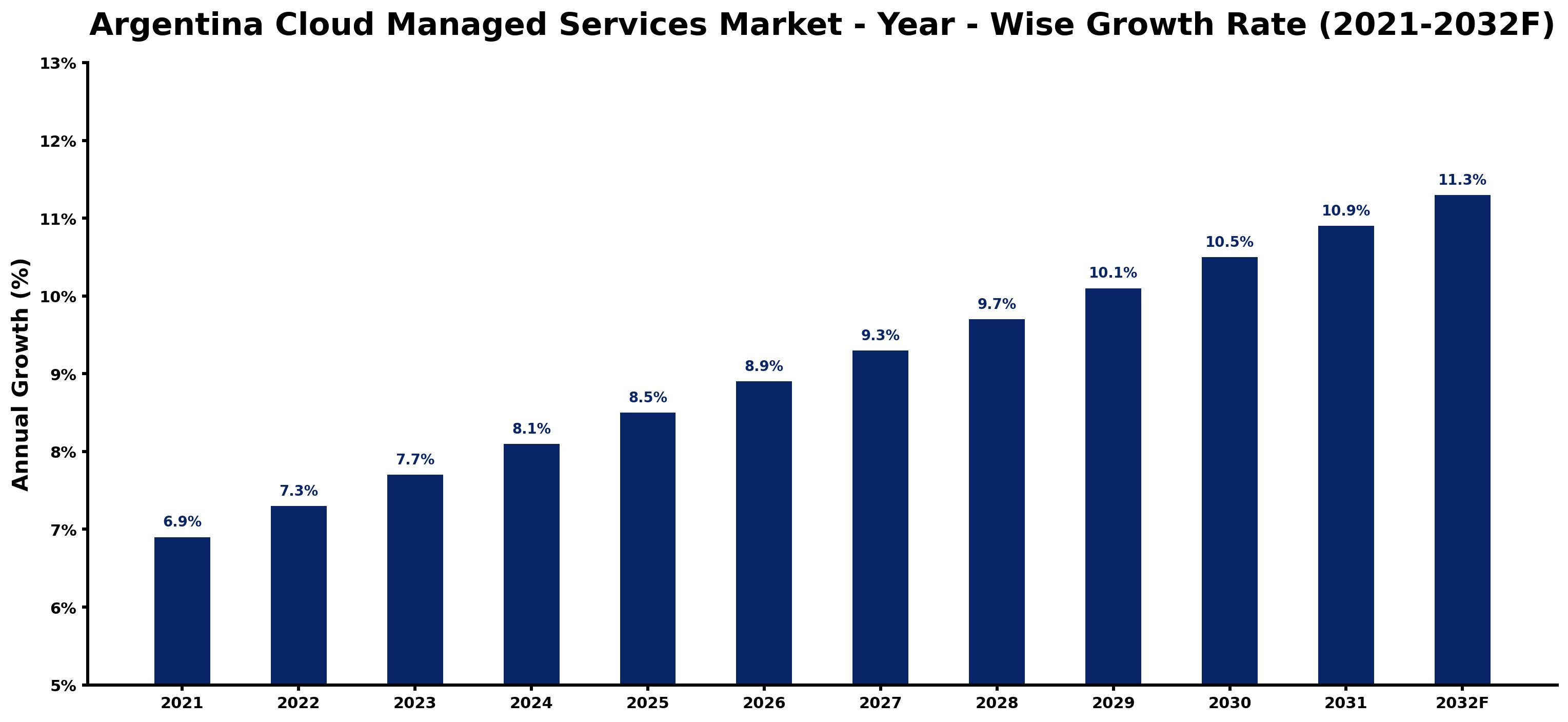
The table below presents the year‑wise growth rates along with the key drivers influencing the market
| Year | Growth Rate | Major Drivers |
| 2021 | 6.9% | Government Digital Transformation Plan boosting cloud adoption |
| 2022 | 7.3% | Increase in remote work fueling cloud service demand |
| 2023 | 7.7% | Regulatory framework for data protection enhancing cloud trust |
| 2024 | 8.1% | Local startups adopting cloud for scalability and innovation |
| 2025 | 8.5% | Rising investments in fintech driving cloud solutions need |
| 2026 | 8.9% | Telecom upgrades improving internet access for cloud services |
| 2027 | 9.3% | Healthcare providers transitioning to cloud for better data management |
| 2028 | 9.7% | Education sector increasing online platforms reliant on cloud |
| 2029 | 10.1% | Growing e-commerce market driving cloud infrastructure demands |
| 2030 | 10.5% | Government initiatives promoting public sector cloud services |
| 2031 | 10.9% | Increased cyber threats pushing businesses to adopt secure cloud |
| 2032 | 11.3% | Sustainability initiatives pushing businesses towards cloud efficiency |
Note: Market size estimations and growth projections presented in this report are based on 6Wresearch's proprietary forecasting methodology, utilizing the latest available industry data, government publications, and primary research inputs.
Argentina Cloud Managed Services Market Key Takeaways
Below are some of the specific key takeaways from the market, including:
- The market is experiencing rapid growth driven by the increasing adoption of cloud technologies.
- Organizations are prioritizing cybersecurity and compliance, influencing their choice of managed service providers.
- Cost optimization is a critical factor for businesses looking to enhance their IT operations.
- Government policies are supportive of outsourcing IT management, promoting partnerships between MSPs and local enterprises.
- Businesses are leveraging external expertise to simplify their cloud operations and improve overall efficiency.
Evaluation of Restraints in Argentina Cloud Managed Services Market
The Argentina Cloud Managed Services market faces challenges primarily in convincing organizations about the benefits of outsourcing. Many businesses are still hesitant to relinquish control over their cloud management to external partners. This reluctance stems from concerns about security, compliance, and the fear of losing critical insights that internal teams possess. The task for managed service providers is to effectively communicate how outsourcing can actually free up internal resources, thereby allowing organizations to focus on innovation while ensuring robust security measures are in place.
Argentina Cloud Managed Services Market Trends
A notable trend shaping the Argentina Cloud Managed Services market is the increasing focus on hybrid cloud solutions. Organizations are looking to blend public and private cloud services to meet their specific needs. This approach allows for greater flexibility and control over data security.
Additionally, the rise of automation and AI-driven solutions is making waves in the market, as businesses seek to streamline operations and reduce manual interventions. These technologies promise improved efficiency and faster response times, which are becoming essential in today’s fast-paced business environment.
Argentina Cloud Managed Services Market Opportunities
The cloud managed services sector in Argentina is ripe with opportunities for growth. As more organizations recognize the advantages of cloud solutions, demand for specialized services will continue to rise. There is particular potential in sectors such as healthcare and finance, where compliance and security are paramount.
on top of that, the ongoing digital transformation across various industries presents opportunities for managed service providers to offer tailored solutions that address specific business challenges. Investing in partnerships and collaborations will be critical for firms looking to expand their footprint in this competitive market.
Government Initiatives in the Argentina Cloud Managed Services Market
Government policies in Argentina are actively encouraging the adoption of cloud managed services, recognizing their potential to enhance operational efficiency and reduce costs. The regulatory environment is fostering collaborations between public entities and managed service providers, ensuring that both sectors can benefit from shared expertise and resources.
- A recently completed initiative aimed to promote cloud technologies among public institutions, ensuring they can effectively manage their digital transformation.
- A current program is underway to enhance cybersecurity measures for cloud services used by government agencies, focusing on compliance with international standards.
- Upcoming legislation is expected to streamline the procurement process for cloud managed services, making it easier for public and private entities to engage with providers.
- A national strategy for digital infrastructure development is currently being drafted to improve connectivity and access to cloud services across the country.
- Ongoing efforts include training programs to develop local talent in cloud management, fostering a skilled workforce for the growing market.
Future Insights of the Argentina Cloud Managed Services Market
Looking ahead to 2026-2032, the Argentina Cloud Managed Services market is expected to continue its upward trajectory. The demand for cloud solutions will be driven by the increasing digitization of businesses and the necessity for efficient IT operations. As organizations become more sophisticated in their use of cloud technologies, the need for specialized managed services will only intensify.
Emerging technologies such as AI and machine learning will play a critical role in shaping service offerings, allowing providers to deliver more tailored and efficient solutions. The market is on track for significant advancements as businesses seek to harness the full potential of their cloud investments.
Argentina Cloud Managed Services Market Latest Developments
Recent activity in the Argentina Cloud Managed Services market has highlighted a strong push towards innovation and collaboration. Over the past year, numerous developments have aimed at enhancing the capabilities of managed service providers and supporting businesses in their cloud journeys.
- A major technology vendor announced a partnership in early 2025 with local firms to enhance cloud service offerings, focusing on industry-specific solutions.
- An initiative that began in mid-2025 is currently underway, aiming to improve cybersecurity frameworks for cloud services used by financial institutions.
- A rollout expected to begin in the second half of 2026 will introduce a new certification program for cloud service providers, ensuring compliance with updated industry standards.
- In late 2024, a prominent managed service provider launched a suite of AI-driven tools designed to optimize cloud resource management, receiving positive feedback from early adopters.
- Planning stages are underway for a national cloud services conference aimed at fostering dialogue between businesses and service providers, set to take place in early 2027.
Argentina Cloud Managed Services Market - Key Attractiveness of the Report
- 10 Years of Market Numbers
- Historical Data Starting from 2022 to 2025
- Base Year: 2025
- Forecast Data until 2032
- Key Performance Indicators Impacting the Market
- Major Upcoming Developments and Projects
Key Highlights of the Report:
- Argentina Cloud Managed Services Market Outlook
- Market Size of Argentina Cloud Managed Services Market, 2025
- Forecast of Argentina Cloud Managed Services Market, 2032
- Historical Data and Forecast of Argentina Cloud Managed Services Revenues & Volume for the Period 2022-2032F
- Argentina Cloud Managed Services Market Trend Evolution
- Argentina Cloud Managed Services Market Drivers and Challenges
- Argentina Cloud Managed Services Price Trends
- Argentina Cloud Managed Services Porter's Five Forces
- Argentina Cloud Managed Services Industry Life Cycle
- Historical Data and Forecast of Argentina Cloud Managed Services Market Revenues & Volume By Service Type for the Period 2022-2032F
- Historical Data and Forecast of Argentina Cloud Managed Services Market Revenues & Volume By Managed Security Services for the Period 2022-2032F
- Historical Data and Forecast of Argentina Cloud Managed Services Market Revenues & Volume By Managed Network Services for the Period 2022-2032F
- Historical Data and Forecast of Argentina Cloud Managed Services Market Revenues & Volume By Managed Infrastructure Services for the Period 2022-2032F
- Historical Data and Forecast of Argentina Cloud Managed Services Market Revenues & Volume By Managed Communication & Collaboration Services for the Period 2022-2032F
- Historical Data and Forecast of Argentina Cloud Managed Services Market Revenues & Volume By Managed Mobility Services for the Period 2022-2032F
- Historical Data and Forecast of Argentina Cloud Managed Services Market Revenues & Volume By Managed Business Services for the Period 2022-2032F
- Historical Data and Forecast of Argentina Cloud Managed Services Market Revenues & Volume By Security Services for the Period 2022-2032F
- Historical Data and Forecast of Argentina Cloud Managed Services Market Revenues & Volume By Managed Identity & Access Management for the Period 2022-2032F
- Historical Data and Forecast of Argentina Cloud Managed Services Market Revenues & Volume By Managed Antivirus/Anti-Malware for the Period 2022-2032F
- Historical Data and Forecast of Argentina Cloud Managed Services Market Revenues & Volume By Managed Firewall for the Period 2022-2032F
- Historical Data and Forecast of Argentina Cloud Managed Services Market Revenues & Volume By Managed Risk & Compliance Management for the Period 2022-2032F
- Historical Data and Forecast of Argentina Cloud Managed Services Market Revenues & Volume By Managed Vulnerability Management for the Period 2022-2032F
- Historical Data and Forecast of Argentina Cloud Managed Services Market Revenues & Volume By Managed Security Information & Event Management for the Period 2022-2032F
- Historical Data and Forecast of Argentina Cloud Managed Services Market Revenues & Volume By Managed Intrusion Detection System/Intrusion Prevention System for the Period 2022-2032F
- Historical Data and Forecast of Argentina Cloud Managed Services Market Revenues & Volume By Managed Data Loss Prevention for the Period 2022-2032F
- Historical Data and Forecast of Argentina Cloud Managed Services Market Revenues & Volume By Network Services for the Period 2022-2032F
- Historical Data and Forecast of Argentina Cloud Managed Services Market Revenues & Volume By Managed Network Provisioning for the Period 2022-2032F
- Historical Data and Forecast of Argentina Cloud Managed Services Market Revenues & Volume By Managed Network Monitoring & Management for the Period 2022-2032F
- Historical Data and Forecast of Argentina Cloud Managed Services Market Revenues & Volume By Infrastructure Services for the Period 2022-2032F
- Historical Data and Forecast of Argentina Cloud Managed Services Market Revenues & Volume By Storage Management for the Period 2022-2032F
- Historical Data and Forecast of Argentina Cloud Managed Services Market Revenues & Volume By Server Management for the Period 2022-2032F
- Historical Data and Forecast of Argentina Cloud Managed Services Market Revenues & Volume By Managed Print Services for the Period 2022-2032F
- Historical Data and Forecast of Argentina Cloud Managed Services Market Revenues & Volume By Managed Communication & Collaboration Services for the Period 2022-2032F
- Historical Data and Forecast of Argentina Cloud Managed Services Market Revenues & Volume By Managed Voice Over Internet Protocol for the Period 2022-2032F
- Historical Data and Forecast of Argentina Cloud Managed Services Market Revenues & Volume By Managed Unified Communication as a Service for the Period 2022-2032F
- Historical Data and Forecast of Argentina Cloud Managed Services Market Revenues & Volume By Managed Mobility Services for the Period 2022-2032F
- Historical Data and Forecast of Argentina Cloud Managed Services Market Revenues & Volume By Device Management Services for the Period 2022-2032F
- Historical Data and Forecast of Argentina Cloud Managed Services Market Revenues & Volume By Application Management Services for the Period 2022-2032F
- Historical Data and Forecast of Argentina Cloud Managed Services Market Revenues & Volume By Managed Business Services for the Period 2022-2032F
- Historical Data and Forecast of Argentina Cloud Managed Services Market Revenues & Volume By Business Process Services for the Period 2022-2032F
- Historical Data and Forecast of Argentina Cloud Managed Services Market Revenues & Volume By Continuity & Disaster Recovery Services for the Period 2022-2032F
- Historical Data and Forecast of Argentina Cloud Managed Services Market Revenues & Volume By Other Managed Business Services for the Period 2022-2032F
- Historical Data and Forecast of Argentina Cloud Managed Services Market Revenues & Volume By Organization Size for the Period 2022-2032F
- Historical Data and Forecast of Argentina Cloud Managed Services Market Revenues & Volume By SMEs for the Period 2022-2032F
- Historical Data and Forecast of Argentina Cloud Managed Services Market Revenues & Volume By Large Enterprises for the Period 2022-2032F
- Argentina Cloud Managed Services Import Export Trade Statistics
- Market Opportunity Assessment By Service Type
- Market Opportunity Assessment By Security Services
- Market Opportunity Assessment By Network Services
- Market Opportunity Assessment By Infrastructure Services
- Market Opportunity Assessment By Managed Communication & Collaboration Services
- Market Opportunity Assessment By Managed Mobility Services
- Market Opportunity Assessment By Managed Business Services
- Market Opportunity Assessment By Organization Size
- Argentina Cloud Managed Services Top Companies Market Share
- Argentina Cloud Managed Services Competitive Benchmarking By Technical and Operational Parameters
- Argentina Cloud Managed Services Company Profiles
- Argentina Cloud Managed Services Key Strategic Recommendations






































