Argentina Energy Security Market Size & Growth Rate (2026-2032)
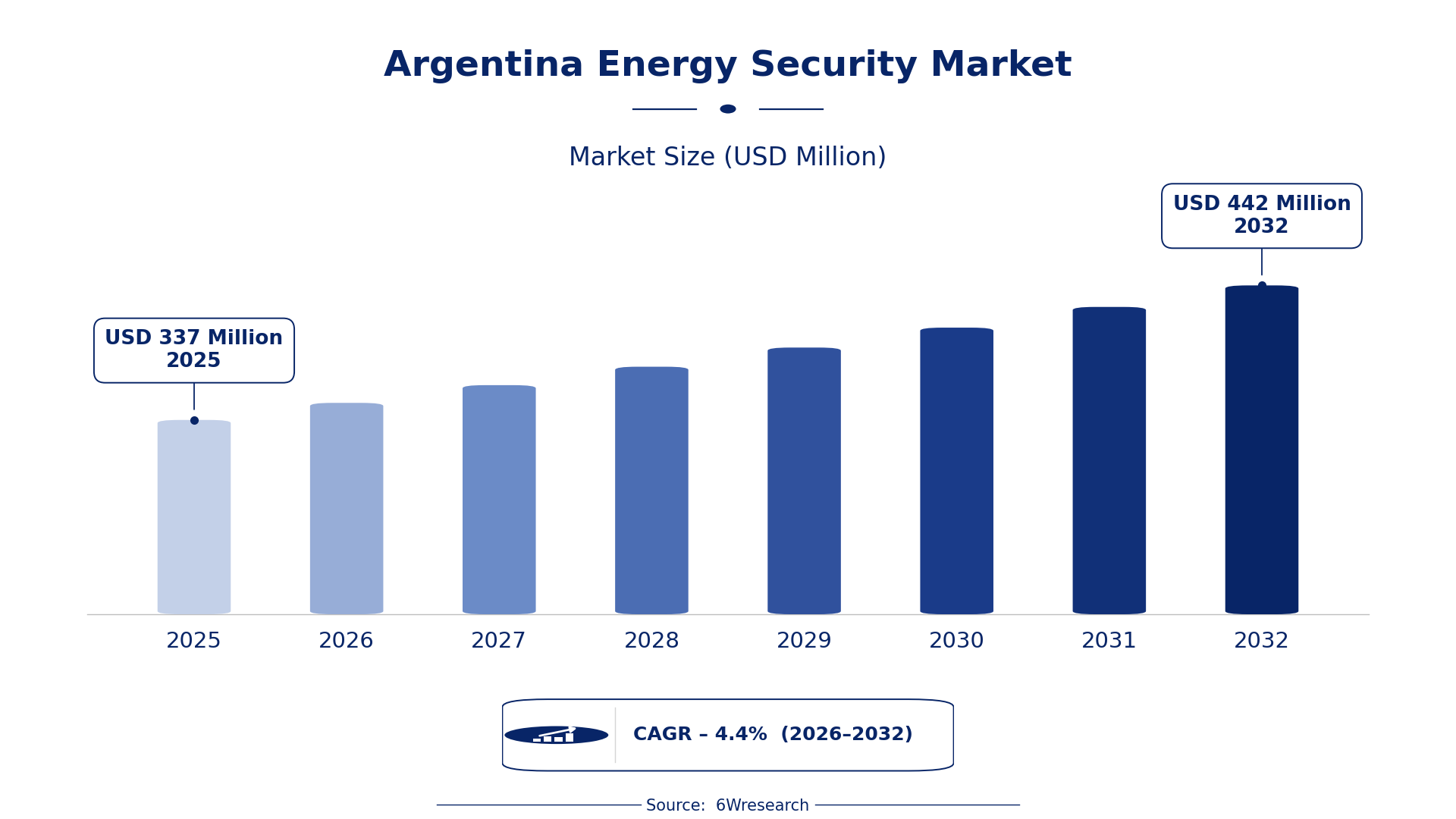
The Argentina Energy Security Market was estimated at USD 337 Million in 2025 and is projected to reach USD 442 Million by 2032, growing at a CAGR of 4.4% from 2026 to 2032.
Argentina Energy Security Market Synopsis
The Argentina Energy Security Market is at a critical juncture, where increasing energy demands are pushing the country towards a more self-sufficient and sustainable energy framework. Recent investments in renewable resources signal a shift from dependency on imported energy sources, setting the stage for a more resilient energy infrastructure.
As Argentina embraces renewable energy technologies, including solar and wind, the market is projected to grow steadily. This transition is not merely a reaction to global trends; it reflects a national strategy aiming to bolster energy independence and security while addressing environmental concerns.
Argentina Energy Security Market Year-wise Growth Rate and Key Drivers
This graph illustrates the annual growth rates of the Argentina Energy Security Market from 2021 to 2032, highlighting a steady upward trajectory and projected expansion over the forecast period.
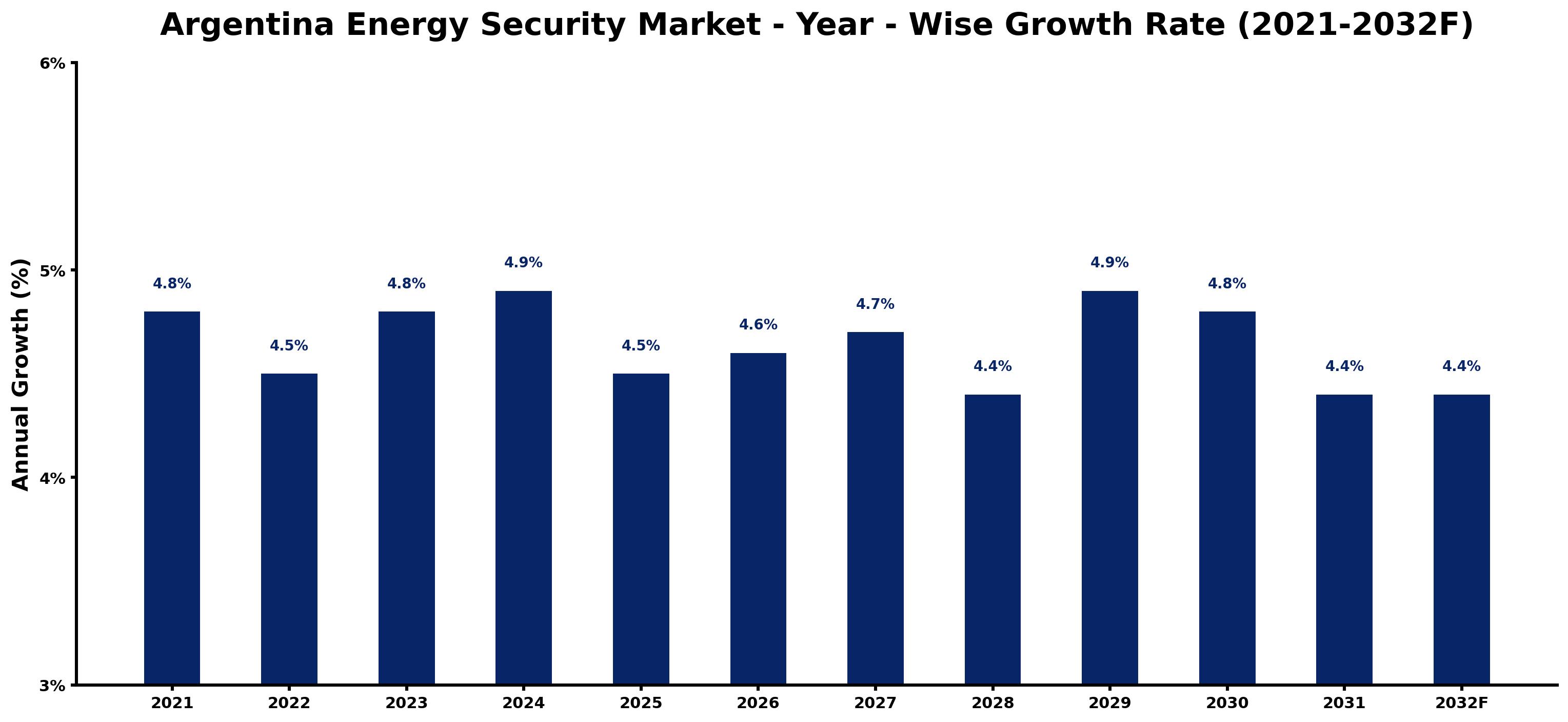
The table below presents the year‑wise growth rates along with the key drivers influencing the market
| Year | Growth Rate | Major Drivers |
| 2021 | 4.8% | Government incentives for renewable energy investments implemented |
| 2022 | 4.5% | Increased focus on energy independence from imported fuels |
| 2023 | 4.8% | Growing local support for alternative energy initiatives |
| 2024 | 4.9% | Strengthened regulatory framework for energy efficiency standards |
| 2025 | 4.5% | Investment in wind energy projects along Atlantic coast |
| 2026 | 4.6% | Emergence of local startups in clean energy technologies |
| 2027 | 4.7% | Public awareness campaigns promoting energy conservation efforts |
| 2028 | 4.4% | Adoption of smart grid technology in urban centers |
| 2029 | 4.9% | Commitment to reduce carbon emissions through renewable sources |
| 2030 | 4.8% | Bilateral agreements facilitating energy trade in region |
| 2031 | 4.4% | Increased private investment in energy innovation hubs |
| 2032 | 4.4% | Public-private partnerships enhancing energy infrastructure development |
Note: Market size estimations and growth projections presented in this report are based on 6Wresearch's proprietary forecasting methodology, utilizing the latest available industry data, government publications, and primary research inputs.
Argentina Energy Security Market Key Takeaways
Below are some of the specific key takeaways from the market, including:
- Continued investment in renewable energy is reshaping the energy supply model.
- Government initiatives focus on reducing fossil fuel reliance and promoting sustainability.
- Emerging technologies in energy storage are crucial for stabilizing the grid.
- Infrastructure upgrades are essential to support increased renewable energy production.
- Strategic partnerships could enhance investment opportunities for foreign companies.
Evaluation of Restraints in Argentina Energy Security Market
A notable restraint in the Argentina Energy Security Market stems from the existing reliance on imported energy. This dependency exposes the country to fluctuations in global prices and supply chain disruptions, adversely affecting domestic energy stability. Compounding this challenge, insufficient investment in local energy infrastructure limits the expansion of alternative energy sources, which could otherwise enhance energy independence. Addressing these restraints requires focused government policies and strategic investments in domestic resources.
Argentina Energy Security Market Trends
Several trends are actively shaping the Argentina Energy Security Market. The pivot towards renewable energy is not just a trend but a necessity, driven by environmental and economic factors. Energy efficiency measures are gaining traction, particularly within industrial sectors, fostering demand for innovative solutions. on top of that, the integration of smart technologies into energy management systems is promoting enhanced operational efficiency and reliability in energy distribution.
Argentina Energy Security Market Opportunities
Opportunities abound in the Argentina Energy Security Market, especially in the realms of renewable energy projects and energy storage solutions. The government’s commitment to fostering a renewable energy ecosystem opens avenues for investments in solar and wind power. Additionally, companies that provide smart energy solutions can capitalize on the growing focus on energy efficiency in both residential and commercial sectors, presenting lucrative entry points for foreign investors.
Government Initiatives in the Argentina Energy Security Market
Government policies are pivotal in shaping the Argentina Energy Security Market, focusing on enhancing domestic production and reducing the reliance on imports. These regulatory frameworks are designed to bolster renewable energy capacity, ensuring that the market can sustainably meet demand. Such initiatives are vital for both energy security and environmental considerations, making them a priority for policymakers.
- A recently completed initiative includes the Renewable Energy Law, which sets ambitious targets for integrating wind and solar energy into the national grid.
- A current project underway aims to modernize the transmission network to improve energy distribution efficiency across urban and rural areas.
- Planned regulations are expected to be introduced by 2026, mandating minimum energy efficiency standards for new industrial developments.
- The government is also developing a public-private partnership framework to incentivize investment in renewable energy technology.
- Ongoing tax incentives for renewable energy projects have been crucial in attracting foreign direct investment in the energy sector.
Future Insights of the Argentina Energy Security Market
Looking ahead to 2026-2032, the Argentina Energy Security Market appears to be on a positive trajectory. The increasing commitment to renewable energy and modernization of infrastructure will likely foster a more secure energy environment. However, stakeholders must remain vigilant to external economic pressures and policy fluctuations that could impede progress. The proactive development of new technologies and strong governance will be essential for maintaining momentum.
Argentina Energy Security Market Latest Developments
In the past year, the Argentina Energy Security Market has seen significant movements, reflecting both challenges and opportunities. Renewed investment in green technologies is reshaping the market, with several key initiatives now in motion.
- A major technology vendor launched an advanced energy management system in early 2025, aimed at optimizing energy consumption for commercial buildings.
- An ongoing initiative began in mid-2025 to construct new wind farms, which are expected to significantly increase the renewable energy contribution to the grid.
- By mid-2026, a planned rollout of smart meters is anticipated to enhance energy tracking and efficiency for residential users.
- A public awareness campaign, initiated in Q2 2025, is promoting energy conservation practices across households and businesses.
- Collaboration agreements established in early 2025 are paving the way for international partnerships focused on energy innovation.
Argentina Energy Security Market - Key Attractiveness of the Report
- 10 Years of Market Numbers
- Historical Data Starting from 2022 to 2025
- Base Year: 2025
- Forecast Data until 2032
- Key Performance Indicators Impacting the Market
- Major Upcoming Developments and Projects
Key Highlights of the Report:
- Argentina Energy Security Market Outlook
- Market Size of Argentina Energy Security Market, 2025
- Forecast of Argentina Energy Security Market, 2032
- Historical Data and Forecast of Argentina Energy Security Revenues & Volume for the Period 2022-2032F
- Argentina Energy Security Market Trend Evolution
- Argentina Energy Security Market Drivers and Challenges
- Argentina Energy Security Price Trends
- Argentina Energy Security Porter's Five Forces
- Argentina Energy Security Industry Life Cycle
- Historical Data and Forecast of Argentina Energy Security Market Revenues & Volume By Power Plants for the Period 2022-2032F
- Historical Data and Forecast of Argentina Energy Security Market Revenues & Volume By Nuclear for the Period 2022-2032F
- Historical Data and Forecast of Argentina Energy Security Market Revenues & Volume By Thermal for the Period 2022-2032F
- Historical Data and Forecast of Argentina Energy Security Market Revenues & Volume By Hydro for the Period 2022-2032F
- Historical Data and Forecast of Argentina Energy Security Market Revenues & Volume By Oil for the Period 2022-2032F
- Historical Data and Forecast of Argentina Energy Security Market Revenues & Volume By Gas for the Period 2022-2032F
- Historical Data and Forecast of Argentina Energy Security Market Revenues & Volume By Renewable Energy for the Period 2022-2032F
- Historical Data and Forecast of Argentina Energy Security Market Revenues & Volume By Technologies for the Period 2022-2032F
- Historical Data and Forecast of Argentina Energy Security Market Revenues & Volume By Physical for the Period 2022-2032F
- Historical Data and Forecast of Argentina Energy Security Market Revenues & Volume By Network Security for the Period 2022-2032F
- Argentina Energy Security Import Export Trade Statistics
- Market Opportunity Assessment By Power Plants
- Market Opportunity Assessment By Technologies
- Argentina Energy Security Top Companies Market Share
- Argentina Energy Security Competitive Benchmarking By Technical and Operational Parameters
- Argentina Energy Security Company Profiles
- Argentina Energy Security Key Strategic Recommendations






































