Argentina Facility Management Market Size & Growth Rate (2026-2032)
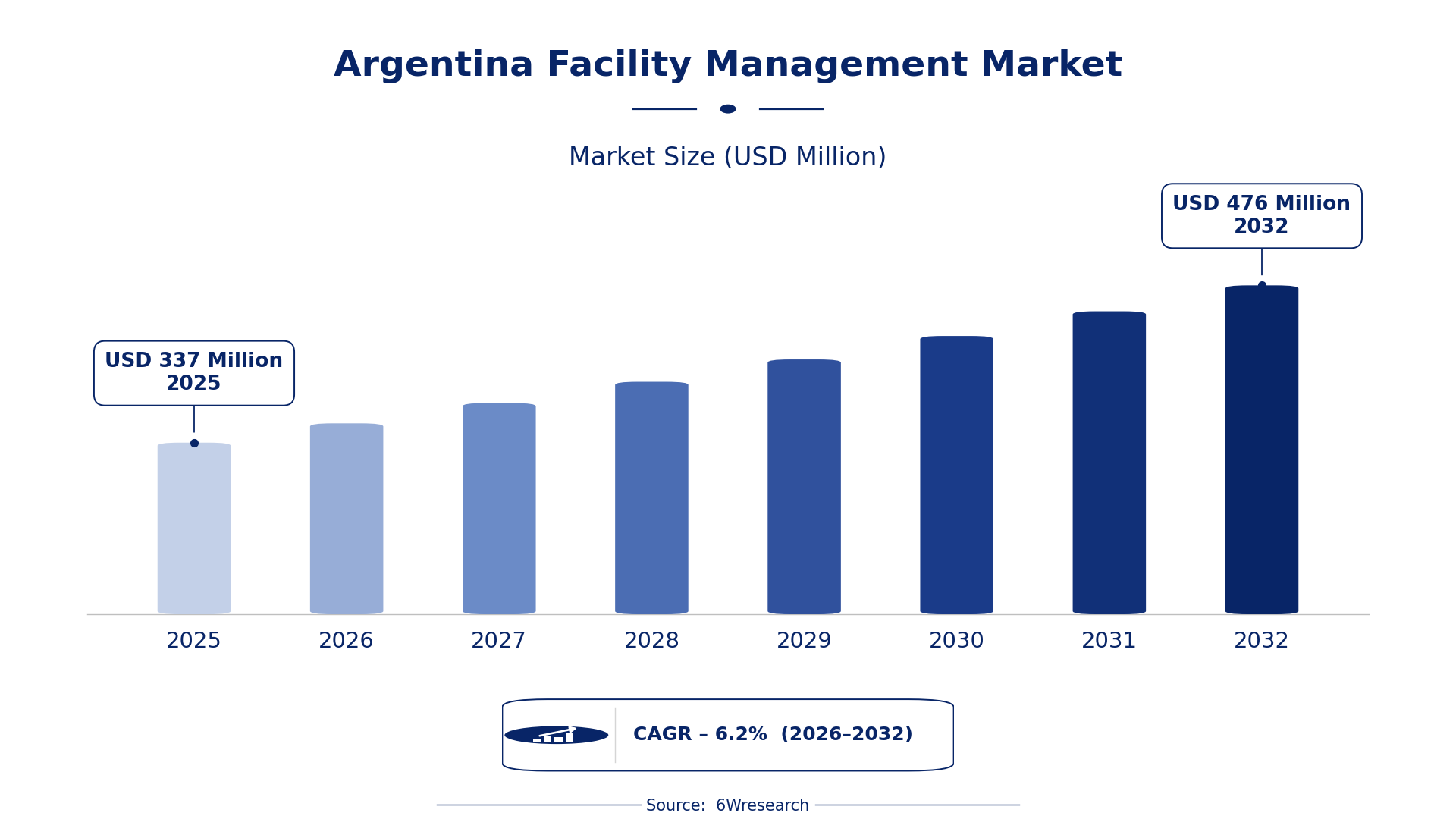
The Argentina Facility Management Market was estimated at USD 337 Million in 2025 and is projected to reach USD 476 Million by 2032, growing at a CAGR of 6.2% from 2026 to 2032.
Argentina Facility Management Market Synopsis
A notable increase in the outsourcing of facility management services has become evident in Argentina, driven by a desire for cost efficiency among businesses. Organizations are increasingly recognizing the value of dedicating resources to core activities while entrusting facility maintenance and management to specialized providers.
As companies expand, the demand for comprehensive services, such as maintenance, security, and energy management, is on the rise. The market is responding to this demand with an influx of innovative solutions, particularly those leveraging technology to enhance service delivery and operational efficiency.
Argentina Facility Management Market Year-wise Growth Rate and Key Drivers
This graph illustrates the annual growth rates of the Argentina Facility Management Market from 2021 to 2032, highlighting a steady upward trajectory and projected expansion over the forecast period.
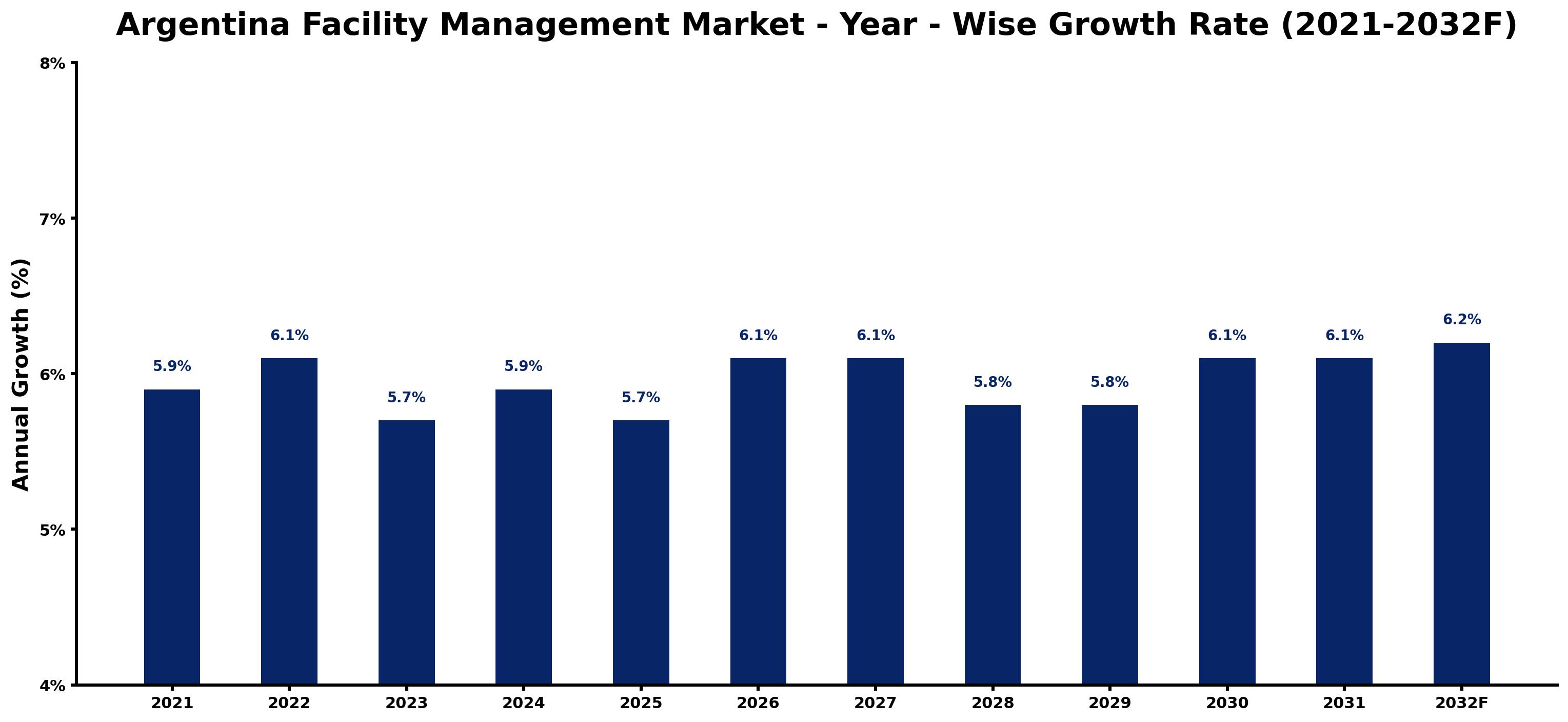
The table below presents the year‑wise growth rates along with the key drivers influencing the market
| Year | Growth Rate | Major Drivers |
| 2021 | 5.9% | Buenos Aires green building initiatives increasing facility upgrades |
| 2022 | 6.1% | Government support for energy-efficient facilities boosting demand |
| 2023 | 5.7% | Post-pandemic workplace adjustments driving facility management services |
| 2024 | 5.9% | Rise in remote work prompting flexibility in facility management |
| 2025 | 5.7% | New regulations enhancing safety standards for building operations |
| 2026 | 6.1% | Increased investment in maintenance services post-recession recovery |
| 2027 | 6.1% | Growing urbanization demands specialized facility management solutions |
| 2028 | 5.8% | Government incentives for sustainable building practices attracting investments |
| 2029 | 5.8% | Focus on digital facilities management technology adoption rising |
| 2030 | 6.1% | Emerging trends in workspace optimization shaping service offerings |
| 2031 | 6.1% | Regulatory push towards smart building systems influencing market |
| 2032 | 6.2% | Increased demand for integrated facility services in commercial sector |
Note: Market size estimations and growth projections presented in this report are based on 6Wresearch's proprietary forecasting methodology, utilizing the latest available industry data, government publications, and primary research inputs.
Argentina Facility Management Market Key Takeaways
Below are some of the specific key takeaways from the market, including:
- The market is seeing a shift towards technology-driven solutions, including IoT and AI applications.
- Regulatory pressures are pushing firms towards sustainable practices and energy efficiency.
- Collaboration between facility management firms and tech providers is becoming increasingly crucial.
- The post-pandemic focus on workplace wellness is reshaping service demands.
- Economic factors, including currency volatility, continue to influence market growth.
Evaluation of Restraints in Argentina Facility Management Market
Economic instability in Argentina is a major factor restraining growth in the facility management sector. Businesses often hesitate to invest in outsourced services during periods of uncertainty, leading to fluctuations in demand. on top of that, the lack of standardized regulations creates significant barriers for new entrants, hampering competition and innovation. Skilled labor shortages further complicate the landscape, making it challenging for existing firms to maintain high service standards.
Argentina Facility Management Market Trends
The facility management sector in Argentina is witnessing a significant technological transformation. Companies are increasingly adopting IoT-enabled devices to enhance efficiency and resource management. AI-powered analytics tools are gaining traction, enabling firms to optimize operations and predict maintenance needs proactively.
Additionally, there is a growing emphasis on integrated facility management services that prioritize employee wellness, hygiene, and environmental sustainability. This trend is being driven by heightened awareness around workplace health, particularly in the wake of the pandemic.
Argentina Facility Management Market Opportunities
Significant opportunities exist in the Argentina Facility Management Market, particularly in specialized service areas. Energy management and space utilization optimization are emerging as key growth sectors. Companies that can provide tailored solutions to address specific industry challenges, particularly in healthcare and commercial real estate, will be well-positioned to capitalize on this demand. Collaboration with technology partners to deliver innovative services could also open up new avenues for growth.
Government Initiatives in the Argentina Facility Management Market
The Argentine government is actively shaping the Facility Management Market through a series of initiatives aimed at promoting sustainability and compliance with safety regulations. Recent efforts include the introduction of regulations that emphasize energy efficiency in commercial buildings, highlighting the importance of reducing environmental impact while ensuring compliance with labor laws.
- A regulatory framework introduced in 2025 mandating improved energy efficiency standards in commercial facilities.
- Current initiatives focusing on waste management and recycling practices to enhance sustainability within the facility management sector.
- A national program encouraging the adoption of green technologies in facility operations, which is underway and expected to yield measurable results by late 2026.
- Planned public-private partnerships aimed at developing smart building technologies to improve operational efficiency by 2028.
Future Insights of the Argentina Facility Management Market
Looking ahead, the Argentina Facility Management Market is expected to grow steadily as the demand for efficient property management solutions continues to rise. Urbanization and infrastructure development will be key drivers of market expansion, along with the ongoing trend of outsourcing non-core business functions. Businesses are increasingly recognizing the value of professional facility management services, particularly those that incorporate innovative technologies, which will play a crucial role in shaping the future of this sector.
Argentina Facility Management Market Latest Developments
Recent activity in the Argentina Facility Management Market reflects a strong push towards innovation and efficiency. Over the past year, companies have been focused on integrating advanced technologies into their service offerings, paving the way for enhanced performance and client satisfaction.
- A major technology vendor launched an AI-driven analytics platform in Q1 2025, designed to optimize facility operations.
- An initiative that began in mid-2025 is currently underway, aimed at enhancing cleaning protocols in response to heightened health and safety standards.
- A leading regional operator announced plans to expand its service offerings to include integrated energy management solutions, with a rollout expected by early 2026.
- In late 2025, a pilot program was successfully completed, showcasing smart building technology in a commercial setting.
Argentina Facility Management Market - Key Attractiveness of the Report
- 10 Years of Market Numbers
- Historical Data Starting from 2022 to 2025
- Base Year: 2025
- Forecast Data until 2032
- Key Performance Indicators Impacting the Market
- Major Upcoming Developments and Projects
Key Highlights of the Report:
- Argentina Facility Management Market Outlook
- Market Size of Argentina Facility Management Market, 2025
- Forecast of Argentina Facility Management Market, 2032
- Historical Data and Forecast of Argentina Facility Management Revenues & Volume for the Period 2022-2032F
- Argentina Facility Management Market Trend Evolution
- Argentina Facility Management Market Drivers and Challenges
- Argentina Facility Management Price Trends
- Argentina Facility Management Porter's Five Forces
- Argentina Facility Management Industry Life Cycle
- Historical Data and Forecast of Argentina Facility Management Market Revenues & Volume By Component for the Period 2022-2032F
- Historical Data and Forecast of Argentina Facility Management Market Revenues & Volume By Solutions for the Period 2022-2032F
- Historical Data and Forecast of Argentina Facility Management Market Revenues & Volume By Services for the Period 2022-2032F
- Historical Data and Forecast of Argentina Facility Management Market Revenues & Volume By Deployment Mode for the Period 2022-2032F
- Historical Data and Forecast of Argentina Facility Management Market Revenues & Volume By Cloud for the Period 2022-2032F
- Historical Data and Forecast of Argentina Facility Management Market Revenues & Volume By On-premises for the Period 2022-2032F
- Historical Data and Forecast of Argentina Facility Management Market Revenues & Volume By Organization Size for the Period 2022-2032F
- Historical Data and Forecast of Argentina Facility Management Market Revenues & Volume By Large enterprises for the Period 2022-2032F
- Historical Data and Forecast of Argentina Facility Management Market Revenues & Volume By Small and medium-sized enterprises (SMEs) for the Period 2022-2032F
- Historical Data and Forecast of Argentina Facility Management Market Revenues & Volume By Vertical for the Period 2022-2032F
- Historical Data and Forecast of Argentina Facility Management Market Revenues & Volume By BFSI for the Period 2022-2032F
- Historical Data and Forecast of Argentina Facility Management Market Revenues & Volume By IT and Telecom for the Period 2022-2032F
- Historical Data and Forecast of Argentina Facility Management Market Revenues & Volume By Government and Public Administration for the Period 2022-2032F
- Historical Data and Forecast of Argentina Facility Management Market Revenues & Volume By Healthcare for the Period 2022-2032F
- Historical Data and Forecast of Argentina Facility Management Market Revenues & Volume By Education for the Period 2022-2032F
- Historical Data and Forecast of Argentina Facility Management Market Revenues & Volume By Retail for the Period 2022-2032F
- Historical Data and Forecast of Argentina Facility Management Market Revenues & Volume By Energy and Utilities for the Period 2022-2032F
- Historical Data and Forecast of Argentina Facility Management Market Revenues & Volume By Manufacturing for the Period 2022-2032F
- Argentina Facility Management Import Export Trade Statistics
- Market Opportunity Assessment By Component
- Market Opportunity Assessment By Deployment Mode
- Market Opportunity Assessment By Organization Size
- Market Opportunity Assessment By Vertical
- Argentina Facility Management Top Companies Market Share
- Argentina Facility Management Competitive Benchmarking By Technical and Operational Parameters
- Argentina Facility Management Company Profiles
- Argentina Facility Management Key Strategic Recommendations






































