Argentina Food Retail Market Summary
The argentina food retail market was estimated at USD 1135 Million in 2025 and is projected to reach USD 1988 Million by 2032, growing at a CAGR of 9.6% from 2026 to 2032.
Argentina Food Retail Market Year-wise Growth Rate and Key Drivers
This graph highlights how the Argentina Food Retail Market has steadily grown over the past five years, supported by major growth factors.
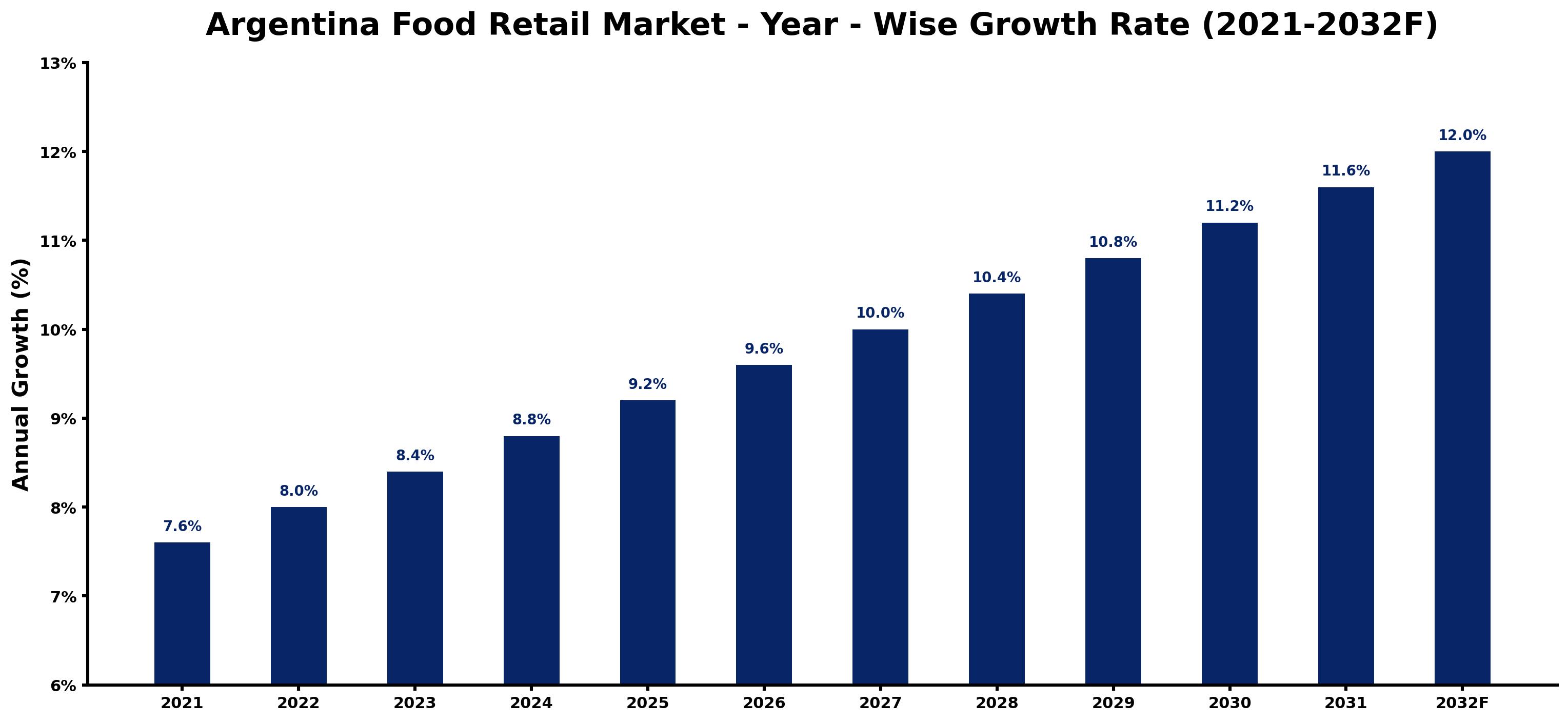
The table below presents the year wise growth rates along with the key drivers influencing the market
| Year | Growth Rate | Major Drivers |
| 2021 | 7.6% | Post-lockdown retail projects saw a swift shift to digital platforms. |
| 2022 | 8.0% | Inflationary pressures influenced consumer spending habits across various food sectors. |
| 2023 | 8.4% | Urbanization trends resulted in a higher demand for convenient food options. |
| 2024 | 8.8% | Local sourcing gained popularity as consumers preferred fresh, regional products. |
| 2025 | 9.2% | E-commerce integration transformed traditional shopping experiences, enhancing convenience. |
| 2026 | 9.6% | Health-conscious choices became mainstream, driving organic and natural food sales. |
| 2027 | 10.0% | Sustainability awareness influenced packaging and product offerings in the market. |
| 2028 | 10.4% | Emerging brands focused on plant-based foods captured younger demographics enthusiastically. |
| 2029 | 10.8% | Technological innovations in logistics improved supply chain efficiency significantly. |
| 2030 | 11.2% | Consumer preferences shifted towards transparency in ingredient sourcing and production. |
| 2031 | 11.6% | Investment in local community initiatives bolstered brand loyalty among consumers. |
| 2032 | 12.0% | Collaborations between retailers and local farms strengthened supply chain partnerships. |
Note - Market size estimations and growth projections presented in this report are based on 6Wresearch's advanced forecasting approach, validated with industry datasets as of June 2026.
Argentina Food Retail Market Synopsis
The Argentina Food Retail Market is projected to reach 9.6% and witness significant growth during the forecast period (2026-2032). This market is characterized by a diverse array of retail formats that cater to varying consumer demands, including supermarkets, hypermarkets, and specialized food stores. Additionally, the emerging trend of e-commerce platforms continues to reshape consumer shopping behaviors, particularly as convenience becomes a central purchasing criterion. Several key trends, driven by shifting consumer preferences and economic factors, will influence the overall landscape of the Argentina Food Retail Market.
Argentina Food Retail Market Growth Drivers
Several factors are contributing to the growth of the Argentina Food Retail Market. Firstly, the increasing disposable income levels among consumers are leading to greater spending power, allowing for a shift towards premium and organic food products. Secondly, the growing awareness of health and wellness is prompting consumers to seek organic and healthier options, reflecting a broader trend towards sustainability. Thirdly, urbanization is driving demand for convenient shopping formats, resulting in the expansion of supermarkets and convenience stores in densely populated areas. Fourthly, government initiatives aimed at promoting food safety and supporting local producers are enhancing market dynamics. Finally, the rapid adoption of technology is facilitating the growth of e-commerce in the food retail sector, catering to changing consumer preferences for online shopping.
Argentina Food Retail Market Trends and Opportunities
The Argentina Food Retail Market is witnessing notable trends that present substantial opportunities. A significant trend is the rise in demand for organic and locally sourced food products, driven by a growing consumer inclination towards sustainability and quality. Coupled with this, there is an increasing preference for premium and gourmet food items, as consumers become more discerning about quality. Furthermore, the e-commerce sector is expanding, as the convenience of online grocery shopping is being recognized, particularly post-pandemic. The popularity of artisanal and handmade products is also on the rise, reflecting a consumer desire to support small-scale producers and enjoy unique offerings. These trends not only reshape consumer preferences but also create fertile ground for innovative retail formats and business models in the market.
Argentina Food Retail Market Challenges and Restraints
Despite its growth potential, the Argentina Food Retail Market faces several challenges. Economic instability and high inflation rates pose significant threats to consumer purchasing power, potentially leading to a reduction in demand for non-essential food items. Furthermore, the market is highly competitive, with numerous local and international entities vying for market share, which can pressure profit margins. Infrastructure issues, particularly in terms of transportation and logistics, can disrupt supply chains and hinder distribution efforts. Additionally, unpredictable government regulations may impose compliance challenges, creating further obstacles for retailers. These challenges necessitate strategic adaptability among market participants to successfully navigate the prevailing economic and regulatory environment.
Argentina Food Retail Market Investment Opportunities
The Argentina Food Retail Market presents multiple avenues for investment and growth. With a large, diverse consumer base, there is considerable potential for the expansion of modern retail formats such as specialized health-focused stores and online grocery platforms. Investing in the renovation and modernization of traditional grocery outlets to improve customer experiences could provide significant returns. Moreover, as demand for organic and ethically sourced food continues to rise, investors have the opportunity to support sustainable practices within the food retail sector. The adaptation of digital technologies to enhance operational efficiency and customer engagement is another promising area for investment, providing opportunities to capitalize on evolving consumer preferences.
Argentina Food Retail Market Government Investment and Initiatives
The government plays a crucial role in regulating and supporting the Argentina Food Retail Market through various policies and initiatives. One significant measure is the implementation of the Price Control Program, which aims to mitigate inflation and maintain food affordability for consumers. Additionally, restrictions on food imports are enforced to protect local producers, ensuring a competitive domestic market. The government also enforces stringent food safety regulations, including inspections and labeling requirements, aimed at ensuring consumer protection. Furthermore, initiatives to promote healthy eating habits and combat food insecurity include subsidies for essential food items, which directly impact market dynamics. These governmental strategies create a framework that balances consumer protection with the support of domestic industries, facilitating a stable market environment.
Argentina Food Retail Market Latest Developments (May 2025 - June 2026)
In the period from May 2025 to June 2026, the Argentina Food Retail Market has seen several notable developments that reflect ongoing shifts in consumer behavior and retail strategies. The growth of e-commerce has accelerated, with retailers enhancing their online shopping platforms to meet the increasing demand for convenience. Additionally, there has been a marked increase in the number of alternative food retail formats, including farmers' markets and organic food stores, catering to the rising consumer interest in local products. Retailers are also actively innovating their product offerings to include more health-focused and organic items, responding to consumer preferences for sustainable and healthier choices. Furthermore, partnerships between local producers and retailers are becoming more common, fostering a collaborative approach to meet consumer demand for authenticity and quality. These trends indicate a dynamic evolution within the market, driven by both consumer preferences and strategic adaptations among retailers.
Argentina Food Retail Market - Key Attractiveness of the Report
- 10 Years of Market Numbers
- Historical Data Starting from 2022 to 2025
- Base Year: 2025
- Forecast Data until 2032
- Key Performance Indicators Impacting the Market
- Major Upcoming Developments and Projects
Key Highlights of the Report:
- Argentina Food Retail Market Outlook
- Market Size of Argentina Food Retail Market, 2025
- Forecast of Argentina Food Retail Market, 2032F
- Historical Data and Forecast of Argentina Food Retail Revenues & Volume for the Period 2022-2032F
- Argentina Food Retail Market Trend Evolution
- Argentina Food Retail Market Drivers and Challenges
- Argentina Food Retail Price Trends
- Argentina Food Retail Porter's Five Forces
- Argentina Food Retail Industry Life Cycle
- Historical Data and Forecast of Argentina Food Retail Market Revenues & Volume By Product Types for the Period 2022-2032F
- Historical Data and Forecast of Argentina Food Retail Market Revenues & Volume By Unpackaged Food for the Period 2022-2032F
- Historical Data and Forecast of Argentina Food Retail Market Revenues & Volume By Packaged Food for the Period 2022-2032F
- Historical Data and Forecast of Argentina Food Retail Market Revenues & Volume By Drinks for the Period 2022-2032F
- Historical Data and Forecast of Argentina Food Retail Market Revenues & Volume By Household Products for the Period 2022-2032F
- Historical Data and Forecast of Argentina Food Retail Market Revenues & Volume By Packaging Types for the Period 2022-2032F
- Historical Data and Forecast of Argentina Food Retail Market Revenues & Volume By Boxes for the Period 2022-2032F
- Historical Data and Forecast of Argentina Food Retail Market Revenues & Volume By Cans for the Period 2022-2032F
- Historical Data and Forecast of Argentina Food Retail Market Revenues & Volume By Cellophane Wrapping for the Period 2022-2032F
- Historical Data and Forecast of Argentina Food Retail Market Revenues & Volume By Cylindrical Cardboard for the Period 2022-2032F
- Argentina Food Retail Import Export Trade Statistics
- Market Opportunity Assessment By Product Types
- Market Opportunity Assessment By Packaging Types
- Argentina Food Retail Top Companies Market Share
- Argentina Food Retail Competitive Benchmarking By Technical and Operational Parameters
- Argentina Food Retail Company Profiles
- Argentina Food Retail Key Strategic Recommendations






































