Argentina Industrial Fasteners Market Size Growth Rate
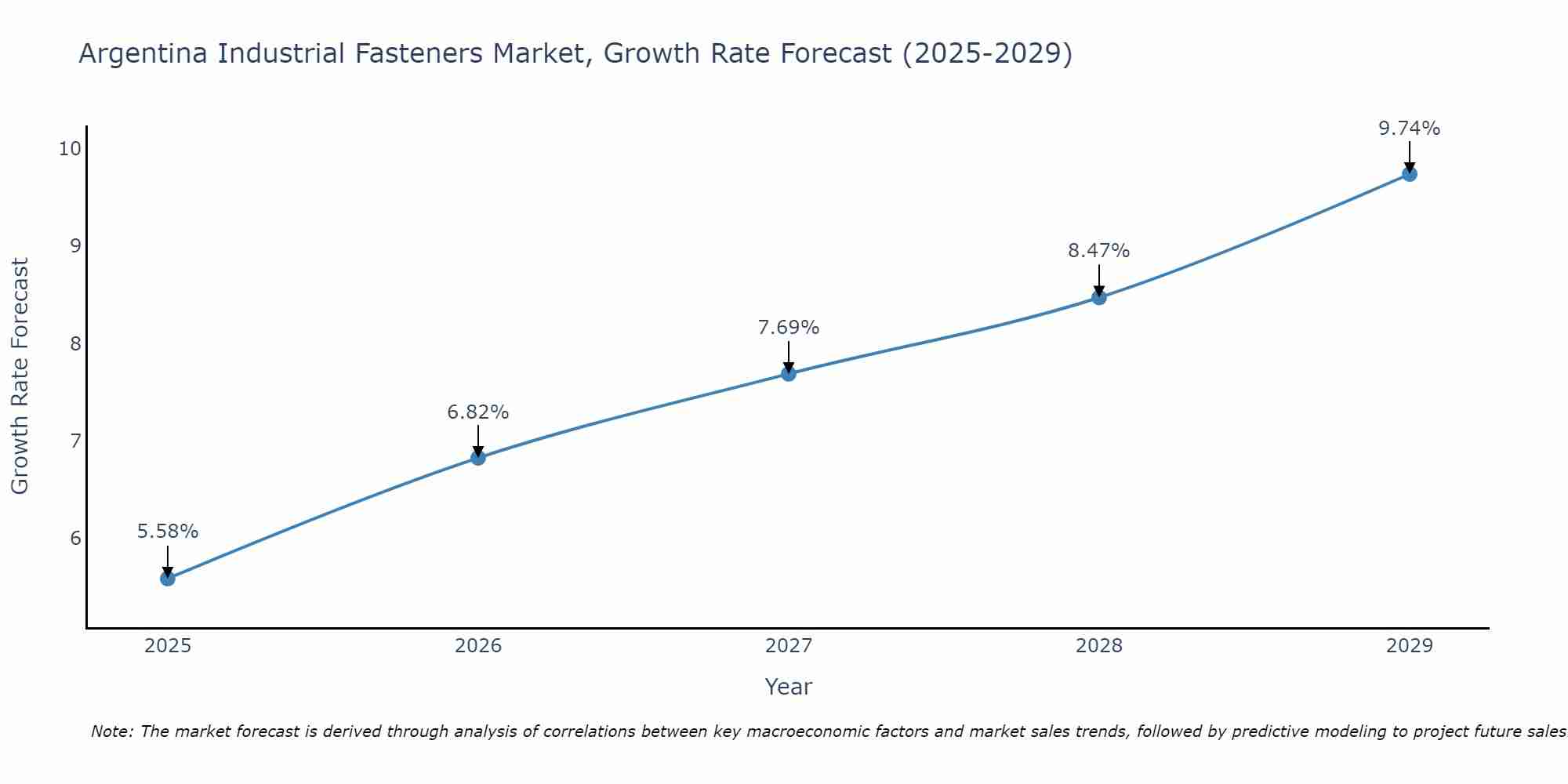
The Argentina Industrial Fasteners Market is poised for steady growth rate improvements from 2025 to 2029. From 5.58% in 2025, the growth rate steadily ascends to 9.74% in 2029.
Argentina Industrial Fasteners Market Synopsis
The industrial fasteners market in Argentina serves as a linchpin for construction, automotive, aerospace, and manufacturing sectors, facilitating the assembly and joining of various components. Bolts, screws, nuts, and rivets are among the essential products in this market, catering to diverse needs ranging from heavy-duty construction to precision engineering. Market trends indicate a shift towards lightweight and corrosion-resistant fasteners, aligning with sustainability and durability objectives across industries.
Drivers of the market
The Argentina Industrial Fasteners Market is influenced by several factors contributing to the demand for fastening solutions across various industrial sectors. Fasteners such as screws, bolts, nuts, and rivets are essential components in manufacturing and construction activities, providing structural integrity and reliability to assembled products and structures. The market growth is driven by the expansion of industries such as automotive, aerospace, construction, and machinery manufacturing, which require a wide range of fastening solutions for assembly, maintenance, and repair purposes. Additionally, the increasing investments in infrastructure development projects in Argentina are driving the demand for fasteners for building construction, roadways, bridges, and railways. Moreover, technological advancements in fastener materials, designs, and coatings to enhance strength, durability, and corrosion resistance are expected to further propel the growth of the industrial fasteners market in Argentina.
Challenges of the market
The Argentina Industrial Fasteners market confronts various challenges, including intense competition from low-cost imports and fluctuating raw material prices. Manufacturers struggle to maintain profit margins amid rising production costs, driven by factors such as energy expenses and labor wages. Moreover, ensuring product quality and compliance with industry standards presents a continuous challenge for market players. Economic uncertainties and political instability further exacerbate the challenges, leading to market volatility and hindering long-term strategic planning. Additionally, technological advancements require significant investments, posing barriers to entry for smaller players in the market.
Government Policy of the market
In Argentina, the government has enacted policies to ensure the quality and safety standards of industrial fasteners. Regulatory bodies oversee compliance with standards to guarantee the reliability of fasteners used in various industries, including construction, automotive, and manufacturing.
Key Highlights of the Report:
- Argentina Industrial Fasteners Market Outlook
- Market Size of Argentina Industrial Fasteners Market, 2024
- Forecast of Argentina Industrial Fasteners Market, 2031
- Historical Data and Forecast of Argentina Industrial Fasteners Revenues & Volume for the Period 2018 - 2031
- Argentina Industrial Fasteners Market Trend Evolution
- Argentina Industrial Fasteners Market Drivers and Challenges
- Argentina Industrial Fasteners Price Trends
- Argentina Industrial Fasteners Porter's Five Forces
- Argentina Industrial Fasteners Industry Life Cycle
- Historical Data and Forecast of Argentina Industrial Fasteners Market Revenues & Volume By Raw Material for the Period 2018 - 2031
- Historical Data and Forecast of Argentina Industrial Fasteners Market Revenues & Volume By Plastic for the Period 2018 - 2031
- Historical Data and Forecast of Argentina Industrial Fasteners Market Revenues & Volume By Metal for the Period 2018 - 2031
- Historical Data and Forecast of Argentina Industrial Fasteners Market Revenues & Volume By Product for the Period 2018 - 2031
- Historical Data and Forecast of Argentina Industrial Fasteners Market Revenues & Volume By Externally Threaded for the Period 2018 - 2031
- Historical Data and Forecast of Argentina Industrial Fasteners Market Revenues & Volume By Internally Threaded for the Period 2018 - 2031
- Historical Data and Forecast of Argentina Industrial Fasteners Market Revenues & Volume By Non-threaded for the Period 2018 - 2031
- Historical Data and Forecast of Argentina Industrial Fasteners Market Revenues & Volume By Aerospace Grade for the Period 2018 - 2031
- Historical Data and Forecast of Argentina Industrial Fasteners Market Revenues & Volume By Application for the Period 2018 - 2031
- Historical Data and Forecast of Argentina Industrial Fasteners Market Revenues & Volume By Automotive for the Period 2018 - 2031
- Historical Data and Forecast of Argentina Industrial Fasteners Market Revenues & Volume By Aerospace for the Period 2018 - 2031
- Historical Data and Forecast of Argentina Industrial Fasteners Market Revenues & Volume By Building & Construction for the Period 2018 - 2031
- Historical Data and Forecast of Argentina Industrial Fasteners Market Revenues & Volume By Industrial Machinery for the Period 2018 - 2031
- Historical Data and Forecast of Argentina Industrial Fasteners Market Revenues & Volume By Lawn and Garden for the Period 2018 - 2031
- Historical Data and Forecast of Argentina Industrial Fasteners Market Revenues & Volume By Plumbing Products for the Period 2018 - 2031
- Historical Data and Forecast of Argentina Industrial Fasteners Market Revenues & Volume By Others for the Period 2018 - 2031
- Argentina Industrial Fasteners Import Export Trade Statistics
- Market Opportunity Assessment By Raw Material
- Market Opportunity Assessment By Product
- Market Opportunity Assessment By Application
- Argentina Industrial Fasteners Top Companies Market Share
- Argentina Industrial Fasteners Competitive Benchmarking By Technical and Operational Parameters
- Argentina Industrial Fasteners Company Profiles
- Argentina Industrial Fasteners Key Strategic Recommendations






































