Argentina Oil & Gas Pumps Market Size, Share & Growth Rate
The Argentina Oil & Gas Pumps Market was estimated at USD 384 Million in 2025 and is projected to reach USD 502 Million by 2032, growing at a CAGR of 3.9% from 2026 to 2032. This growth trajectory is primarily driven by a robust push towards increased oil and gas exploration activities, fueled by recent discoveries of untapped reserves. Coupled with government initiatives aimed at energizing the sector, the demand for efficient pumping solutions is set to expand significantly.
Argentina Oil & Gas Pumps Market Year-wise Growth Rate and Key Drivers
This graph highlights how the Argentina Oil & Gas Pumps Market has steadily grown over the years, supported by major growth factors.
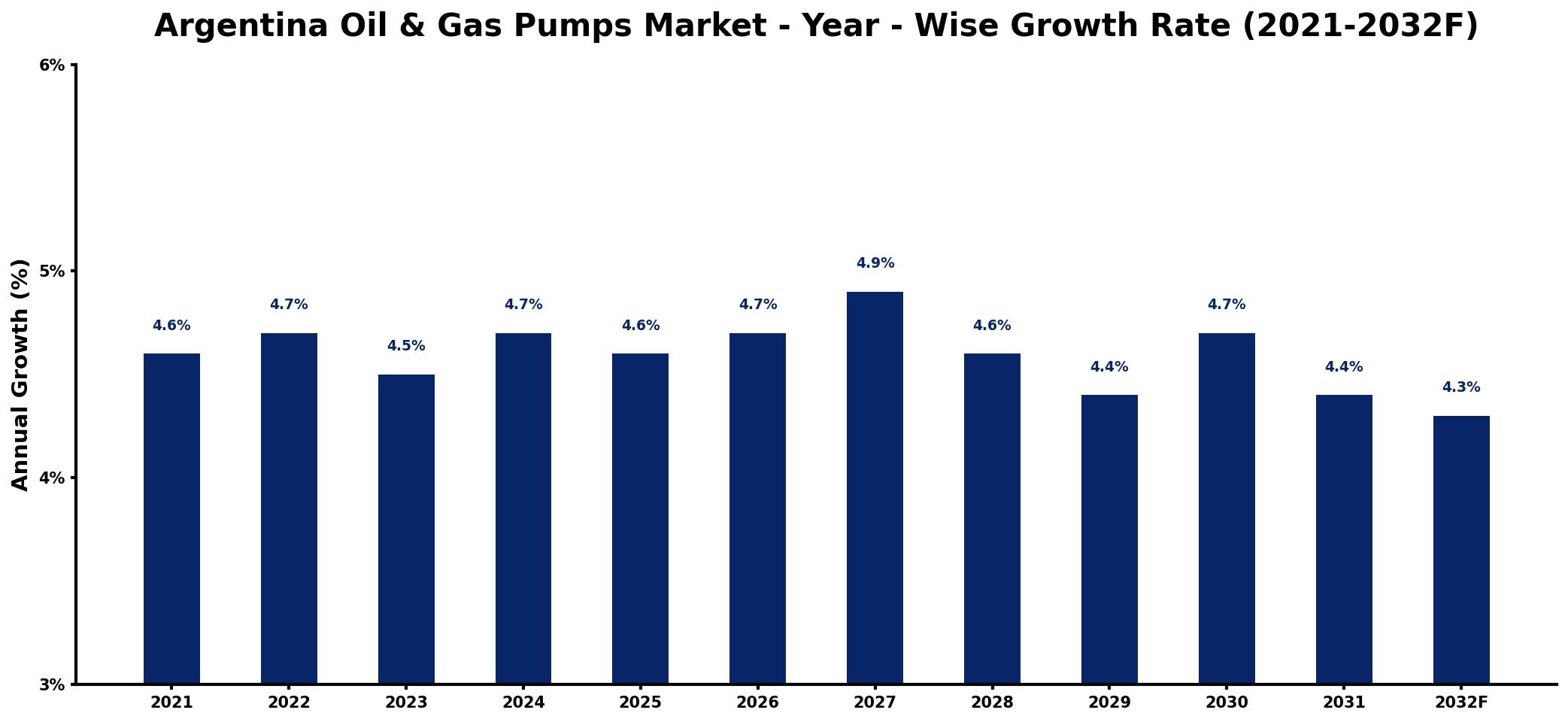
The table below presents the year‑wise growth rates along with the key drivers influencing the market
| Year | Growth Rate | Major Drivers |
| 2021 | 4.6% | Increased industrial production activities |
| 2022 | 4.7% | Rising energy sector investments |
| 2023 | 4.5% | Growing infrastructure development projects |
| 2024 | 4.7% | Expansion of renewable energy initiatives |
| 2025 | 4.6% | Boost in export opportunities |
| 2026 | 4.7% | Technological advancements in equipment |
| 2027 | 4.9% | Higher demand from construction sector |
| 2028 | 4.6% | Increased regulatory support initiatives |
| 2029 | 4.4% | Growth in transportation networks |
| 2030 | 4.7% | Surge in domestic consumption trends |
| 2031 | 4.4% | rising infrastructure development spending |
| 2032 | 4.3% | Rising focus on sustainability goals |
Note: Market size estimations and growth projections presented in this report are based on 6Wresearch's proprietary forecasting methodology, utilizing the latest available industry data, government publications, and primary research inputs.
Argentina Oil & Gas Pumps Market Synopsis
The Argentina Oil & Gas Pumps Market is currently navigating an era of significant growth, bolstered by rising investments in exploration and production activities. This uptrend is accompanied by a marked demand for advanced pumping technologies designed to optimize efficiency and minimize maintenance costs.
As new reserves come to light, the focus on reliable and sustainable pump solutions becomes ever more critical. Industry stakeholders are increasingly adapting to environmental concerns by pursuing innovations that align with sustainable practices in oil and gas operations.
- The market is set for steady growth driven by investments and new oil & gas discoveries.
- Increased focus on digitalization and automation is enhancing operational efficiencies.
- There is a notable shift towards sustainable and environmentally friendly pumping solutions.
- Key players are investing in advanced technologies to cater to evolving industry demands.
- Government policies are promoting stability and growth in the sector through regulatory support.
Despite the positive outlook, the Argentina Oil & Gas Pumps Market faces significant restraints that could hinder growth. Fluctuating oil prices present a volatile environment, making it challenging for companies to secure consistent investments. Furthermore, regulatory uncertainties can delay project approvals and implementation, complicating financial planning for operators. Additionally, limited access to capital can restrict the ability of smaller players to compete effectively, requiring them to focus on strategic partnerships and alliances to remain viable in a rapidly evolving market.
Several critical trends are currently shaping the Argentina Oil & Gas Pumps Market. One of the most significant is the increasing demand for pumps that are both efficient and reliable, aimed at optimizing production processes while reducing operational costs. This has led to the accelerated adoption of smart pumping technologies featuring digital monitoring systems that enhance performance.
Moreover, sustainability is becoming a central theme as the industry shifts toward more energy-efficient and environmentally friendly pumping solutions. This commitment to greener practices is influencing product development, with manufacturers innovating new pump designs and materials tailored for challenging conditions.
Investment opportunities abound within the Argentina Oil & Gas Pumps Market, particularly for entities willing to embrace technological advancements. With vast reserves still awaiting extraction, the demand for sophisticated pumping equipment is on the rise. Companies investing in innovative solutions aimed at enhancing operational efficiency while minimizing environmental footprints can find lucrative returns. Additionally, the market's needs for maintenance services and spare parts present considerable opportunities for service-oriented businesses.
The Argentine government has implemented a suite of initiatives designed to bolster the Oil & Gas Pumps Market. Regulatory frameworks now in place ensure that safety standards and environmental protections are adhered to by companies in the sector. Incentives such as tax breaks for investments in renewable energy technologies illustrate the government's commitment to fostering a robust energy landscape. By actively promoting sustainable practices, these policies help create a stable environment for market growth.
Looking ahead, the Argentina Oil & Gas Pumps Market is poised for steady expansion driven by heightened investments in exploration and production. As more reserves are tapped and foreign investments increase, the demand for robust pumping solutions will continue to climb. The trajectory toward advanced technologies focused on improving operational efficiency and minimizing environmental impact will further shape the market. However, stakeholders must remain vigilant against market volatility and regulatory fluctuations that may challenge growth prospects.
Recent developments in the Argentina Oil & Gas Pumps Market have highlighted a growing trend towards the adoption of digital solutions and automation in pumping operations. Companies are actively investing in research and development to integrate smart technologies into their pump systems, enhancing real-time monitoring capabilities. Additionally, industry discussions are focusing on collaboration efforts to address environmental challenges, leading to innovations aimed at achieving higher energy efficiency. These changes reflect an industry responding to both market demands and regulatory pressures.
- 10 Years of Market Numbers
- Historical Data Starting from 2022 to 2025
- Base Year: 2025
- Forecast Data until 2032
- Key Performance Indicators Impacting the Market
- Major Upcoming Developments and Projects
Key Highlights of the Report:
- Argentina Oil & Gas Pumps Market Outlook
- Market Size of Argentina Oil & Gas Pumps Market, 2025
- Forecast of Argentina Oil & Gas Pumps Market, 2032
- Historical Data and Forecast of Argentina Oil & Gas Pumps Revenues & Volume for the Period 2022-2032F
- Argentina Oil & Gas Pumps Market Trend Evolution
- Argentina Oil & Gas Pumps Market Drivers and Challenges
- Argentina Oil & Gas Pumps Price Trends
- Argentina Oil & Gas Pumps Porter's Five Forces
- Argentina Oil & Gas Pumps Industry Life Cycle
- Historical Data and Forecast of Argentina Oil & Gas Pumps Market Revenues & Volume By Type for the Period 2022-2032F
- Historical Data and Forecast of Argentina Oil & Gas Pumps Market Revenues & Volume By Submersible Pumps for the Period 2022-2032F
- Historical Data and Forecast of Argentina Oil & Gas Pumps Market Revenues & Volume By Non-submersible Pumps for the Period 2022-2032F
- Historical Data and Forecast of Argentina Oil & Gas Pumps Market Revenues & Volume By Pump Type for the Period 2022-2032F
- Historical Data and Forecast of Argentina Oil & Gas Pumps Market Revenues & Volume By Centrifugal Pump for the Period 2022-2032F
- Historical Data and Forecast of Argentina Oil & Gas Pumps Market Revenues & Volume By Positive Displacement Pump for the Period 2022-2032F
- Historical Data and Forecast of Argentina Oil & Gas Pumps Market Revenues & Volume By Cryogenic Pump for the Period 2022-2032F
- Historical Data and Forecast of Argentina Oil & Gas Pumps Market Revenues & Volume By Application for the Period 2022-2032F
- Historical Data and Forecast of Argentina Oil & Gas Pumps Market Revenues & Volume By Upstream for the Period 2022-2032F
- Historical Data and Forecast of Argentina Oil & Gas Pumps Market Revenues & Volume By Midstream for the Period 2022-2032F
- Historical Data and Forecast of Argentina Oil & Gas Pumps Market Revenues & Volume By Downstream for the Period 2022-2032F
- Argentina Oil & Gas Pumps Import Export Trade Statistics
- Market Opportunity Assessment By Type
- Market Opportunity Assessment By Pump Type
- Market Opportunity Assessment By Application
- Argentina Oil & Gas Pumps Top Companies Market Share
- Argentina Oil & Gas Pumps Competitive Benchmarking By Technical and Operational Parameters
- Argentina Oil & Gas Pumps Company Profiles
- Argentina Oil & Gas Pumps Key Strategic Recommendations






































