Romania Oil & Gas Pumps Market Size, Share & Growth Rate
The Romania Oil & Gas Pumps Market was estimated at USD 235 Million in 2025 and is projected to reach USD 328 Million by 2032, growing at a CAGR of 4.9% from 2026 to 2032. This growth trajectory is primarily driven by increasing investments in oil and gas exploration and production, alongside the rising need for efficient pumping solutions. As the country enhances its infrastructure to support domestic oil and gas production, the demand for advanced pump technologies is expected to escalate.
Romania Oil & Gas Pumps Market Year-wise Growth Rate and Key Drivers
This graph highlights how the Romania Oil & Gas Pumps Market has steadily grown over the years, supported by major growth factors.
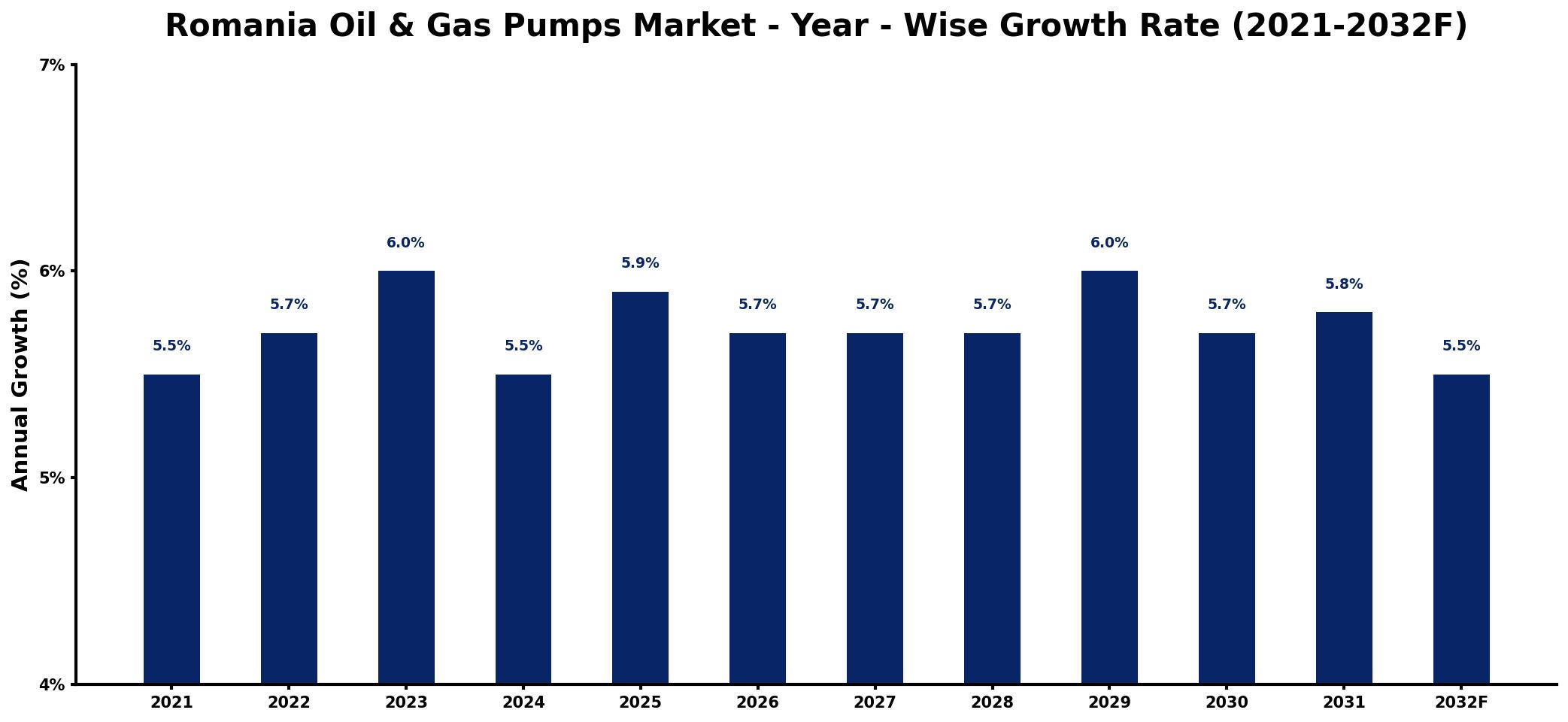
The table below presents the year‑wise growth rates along with the key drivers influencing the market
| Year | Growth Rate | Major Drivers |
| 2021 | 5.5% | increased industrial manufacturing activity |
| 2022 | 5.7% | rising energy sector investments |
| 2023 | 6.0% | expansion of infrastructure projects |
| 2024 | 5.5% | growing demand for renewable energy |
| 2025 | 5.9% | increased transportation sector needs |
| 2026 | 5.7% | enhanced environmental regulations compliance |
| 2027 | 5.7% | development of urban facilities |
| 2028 | 5.7% | boost in international trade agreements |
| 2029 | 6.0% | advancements in technology integration |
| 2030 | 5.7% | growing focus on sustainability initiatives |
| 2031 | 5.8% | improved processing technologies adoption |
| 2032 | 5.5% | increased public sector funding |
Note: Market size estimations and growth projections presented in this report are based on 6Wresearch's proprietary forecasting methodology, utilizing the latest available industry data, government publications, and primary research inputs.
Romania Oil & Gas Pumps Market Synopsis
The Romania Oil & Gas Pumps Market is experiencing steady growth, reflecting the country's pivotal role in the European oil and gas industry. Multinational companies dominate this landscape, providing a diverse array of pumps tailored to various industry needs, including centrifugal, reciprocating, and rotary pumps.
As Romania invests in enhancing its extraction and refining capabilities, there is a marked shift towards innovative technologies that promise improved efficiency and reduced environmental impacts. These trends align with broader market demands for reliable solutions that can navigate the challenges of modern oil and gas operations.
- The market is driven by increasing investments in oil & gas exploration and domestic production.
- Technological advancements are a key focus, improving pump efficiency and reducing costs.
- Environmental regulations are pushing for greener pump technologies within the sector.
- Digitalization and automation are becoming integral to operational efficiency in pump systems.
- Ongoing government support is aimed at attracting further investments into the oil & gas sector.
While the Romania Oil & Gas Pumps Market shows considerable promise, it faces notable restraints that could affect its growth. Fluctuating oil prices create uncertainty, impacting investment decisions and operational viability for players in the industry. Strict environmental regulations necessitate higher compliance costs for companies, compelling them to adapt their operations accordingly. Moreover, the emergence of renewable energy sources introduces competition, prompting the need for continuous innovation to maintain relevance in a changing energy landscape.
Key trends in the Romania Oil & Gas Pumps Market reflect a shift towards efficiency and sustainability. There is a rising demand for technologically advanced pumps that optimize extraction processes and minimize environmental footprints. Furthermore, the integration of digital solutions is enhancing operational efficiency, with companies increasingly adopting automation to streamline their processes. Another trend is the growing preference for high-pressure pumps, particularly in offshore drilling, as operators seek to maximize output while ensuring compliance with stringent regulations.
The Romania Oil & Gas Pumps Market presents numerous investment opportunities, particularly for those willing to innovate. As the demand for reliable pumping equipment rises, investments in advanced pump technologies that deliver higher efficiency and sustainability are likely to yield significant returns. Additionally, the aftermarket segment, which includes maintenance and spare parts supply, offers substantial growth potential as existing infrastructures require ongoing support. Partnerships with local distributors or manufacturing firms could further strengthen market position and foster long-term growth.
The Romanian government has implemented several initiatives aimed at enhancing the oil & gas landscape. These initiatives focus on energy security and increasing domestic production, with incentives designed to attract investments into the sector. Partnerships, tax breaks, and subsidies are part of a strategic approach to encourage exploration and extraction activities. Simultaneously, regulations are in place to ensure environmental protection and operational safety, reinforcing the commitment to sustainable practices within the oil & gas industry.
Looking ahead, the Romania Oil & Gas Pumps Market is poised for continued expansion between 2026 and 2032. Factors such as rising energy demands, coupled with ongoing investments in oil and gas infrastructure, will drive this growth. Technological advancements focusing on pump efficiency and environmental sustainability are expected to play pivotal roles in shaping market dynamics. However, fluctuations in oil prices and evolving regulatory landscapes could present challenges that necessitate agility and strategic foresight from market participants.
Recent developments in the Romania Oil & Gas Pumps Market reflect a clear commitment to modernization and sustainability. Industry stakeholders are increasingly focused on adopting cutting-edge technologies aimed at enhancing pump efficiency and reducing environmental impacts. Furthermore, collaborative initiatives between government bodies and private enterprises are emerging, aimed at boosting domestic production capabilities and infrastructure. These directions indicate a transformative period for the market as it aligns with global standards and practices.
- 10 Years of Market Numbers
- Historical Data Starting from 2022 to 2025
- Base Year: 2025
- Forecast Data until 2032
- Key Performance Indicators Impacting the Market
- Major Upcoming Developments and Projects
Key Highlights of the Report:
- Romania Oil & Gas Pumps Market Outlook
- Market Size of Romania Oil & Gas Pumps Market, 2025
- Forecast of Romania Oil & Gas Pumps Market, 2032
- Historical Data and Forecast of Romania Oil & Gas Pumps Revenues & Volume for the Period 2022-2032F
- Romania Oil & Gas Pumps Market Trend Evolution
- Romania Oil & Gas Pumps Market Drivers and Challenges
- Romania Oil & Gas Pumps Price Trends
- Romania Oil & Gas Pumps Porter's Five Forces
- Romania Oil & Gas Pumps Industry Life Cycle
- Historical Data and Forecast of Romania Oil & Gas Pumps Market Revenues & Volume By Type for the Period 2022-2032F
- Historical Data and Forecast of Romania Oil & Gas Pumps Market Revenues & Volume By Submersible Pumps for the Period 2022-2032F
- Historical Data and Forecast of Romania Oil & Gas Pumps Market Revenues & Volume By Non-submersible Pumps for the Period 2022-2032F
- Historical Data and Forecast of Romania Oil & Gas Pumps Market Revenues & Volume By Pump Type for the Period 2022-2032F
- Historical Data and Forecast of Romania Oil & Gas Pumps Market Revenues & Volume By Centrifugal Pump for the Period 2022-2032F
- Historical Data and Forecast of Romania Oil & Gas Pumps Market Revenues & Volume By Positive Displacement Pump for the Period 2022-2032F
- Historical Data and Forecast of Romania Oil & Gas Pumps Market Revenues & Volume By Cryogenic Pump for the Period 2022-2032F
- Historical Data and Forecast of Romania Oil & Gas Pumps Market Revenues & Volume By Application for the Period 2022-2032F
- Historical Data and Forecast of Romania Oil & Gas Pumps Market Revenues & Volume By Upstream for the Period 2022-2032F
- Historical Data and Forecast of Romania Oil & Gas Pumps Market Revenues & Volume By Midstream for the Period 2022-2032F
- Historical Data and Forecast of Romania Oil & Gas Pumps Market Revenues & Volume By Downstream for the Period 2022-2032F
- Romania Oil & Gas Pumps Import Export Trade Statistics
- Market Opportunity Assessment By Type
- Market Opportunity Assessment By Pump Type
- Market Opportunity Assessment By Application
- Romania Oil & Gas Pumps Top Companies Market Share
- Romania Oil & Gas Pumps Competitive Benchmarking By Technical and Operational Parameters
- Romania Oil & Gas Pumps Company Profiles
- Romania Oil & Gas Pumps Key Strategic Recommendations






































