Argentina Organic Fruits and Vegetables Market: Import Trend Analysis
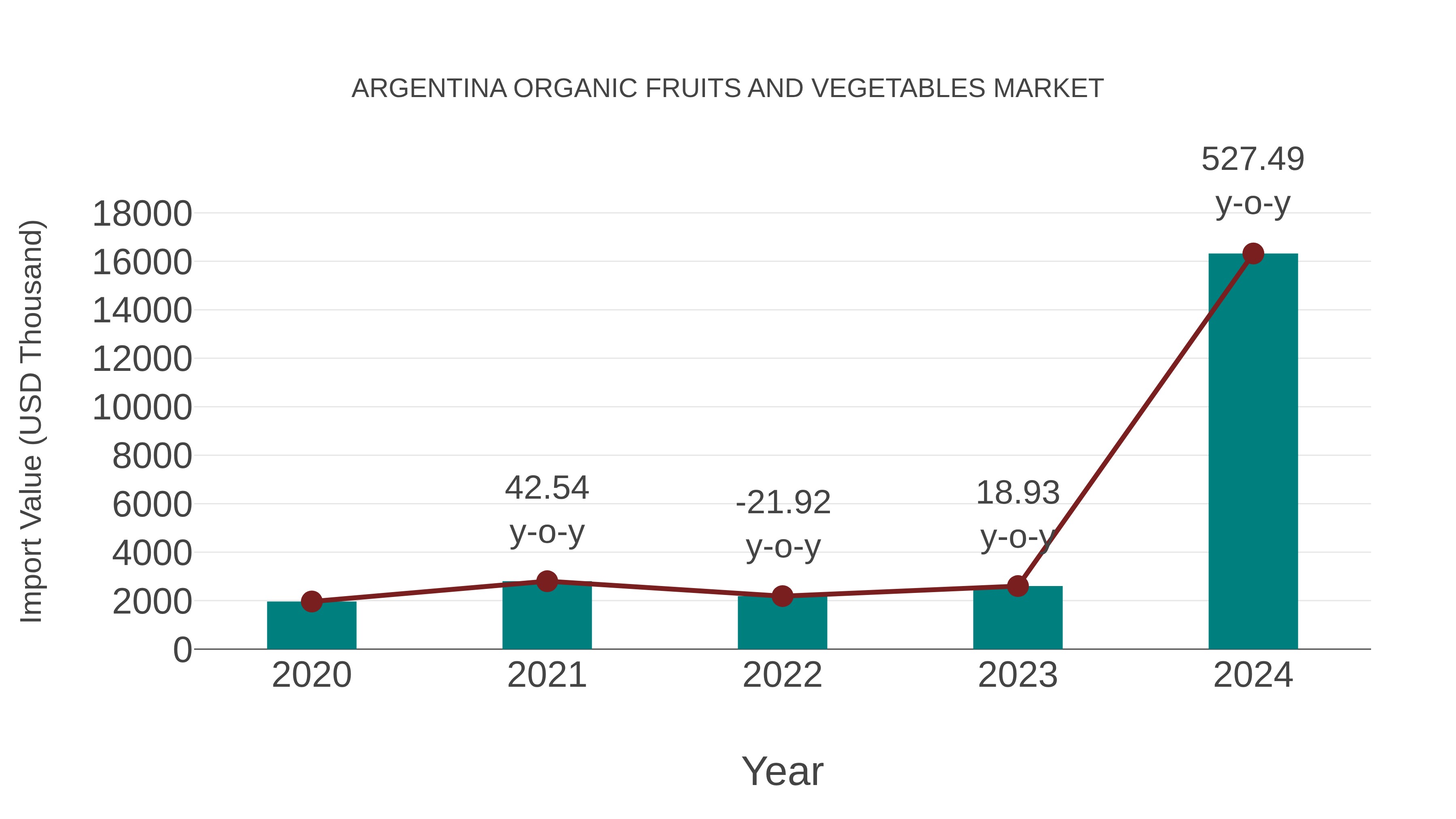
The import trend of organic fruits and vegetables in Argentina during 2020-2024 saw a significant increase. The Compound Annual Growth Rate (CAGR) from 2020 to 2024 was 69.76%. In 2023-2024, there was a notable year-on-year growth rate of 527.49%. These figures indicate a substantial rise in imports during this period.
Argentina Organic Fruits And Vegetables Market Synopsis
The Argentina organic fruits and vegetables market is experiencing steady growth driven by increasing consumer awareness of the health and environmental benefits of organic produce. The market is witnessing a shift towards organic farming practices due to rising concerns about pesticide residues in conventional fruits and vegetables. Key players in the market are focusing on expanding their organic product offerings and distribution channels to meet the growing demand. Government initiatives promoting organic farming and certification programs are also contributing to market growth. Consumer preferences for locally sourced and sustainably produced organic fruits and vegetables are shaping market trends, with a notable rise in demand for organic citrus fruits, berries, leafy greens, and root vegetables. Overall, the Argentina organic fruits and vegetables market presents promising opportunities for producers, retailers, and consumers alike.
Argentina Organic Fruits And Vegetables Market Trends
The Argentina organic fruits and vegetables market is experiencing a growing demand fueled by increasing consumer awareness of health and environmental concerns. Consumers are increasingly seeking out organic produce due to its perceived health benefits, superior taste, and lower environmental impact compared to conventionally grown produce. The market is also seeing a trend towards more sustainable and ethical farming practices, with many consumers supporting local farmers and producers. Additionally, the COVID-19 pandemic has further boosted the market as consumers are prioritizing health and wellness, leading to an increased interest in organic products. Overall, the Argentina organic fruits and vegetables market is projected to continue its growth trajectory as consumers prioritize healthier and more sustainable food options.
Argentina Organic Fruits And Vegetables Market Challenges
In the Argentina organic fruits and vegetables market, some challenges include limited consumer awareness and education about the benefits of organic products, leading to a smaller market share compared to conventional produce. Additionally, high production costs and certification expenses make it difficult for small-scale farmers to enter the organic market, impacting overall supply. The lack of standardized regulations and certification processes also hinders the growth of the sector, creating confusion among consumers and reducing trust in the authenticity of organic products. Furthermore, logistical issues such as transportation and storage can result in higher prices for organic produce, making it less competitive in the market. Overall, addressing these challenges through increased education, support for small farmers, and improved regulations could help boost the Argentina organic fruits and vegetables market.
Argentina Organic Fruits And Vegetables Market Investment Opportunities
The Argentina organic fruits and vegetables market presents promising investment opportunities due to the increasing consumer preference for healthy and sustainable food options. With growing awareness of the health benefits of organic produce and concerns about environmental sustainability, there is a rising demand for organic fruits and vegetables in Argentina. Investors can capitalize on this trend by supporting local organic farms, investing in distribution channels to reach a wider market, and exploring opportunities in value-added products such as organic juices or snacks. Additionally, there is potential for expanding exports of organic produce to international markets, leveraging Argentina`s reputation for high-quality agricultural products. Overall, the Argentina organic fruits and vegetables market offers a fertile ground for investment with the potential for long-term growth and profitability.
Jordan Agar Market Government Policies
The government of Argentina has implemented various policies to support the organic fruits and vegetables market in the country. These policies include financial incentives, subsidies, and technical assistance to encourage farmers to adopt organic farming practices. Additionally, there are regulations in place to ensure the certification and labeling of organic products, providing consumers with confidence in the authenticity of organic produce. The government also promotes organic agriculture through public awareness campaigns and educational programs to highlight the benefits of organic farming for both the environment and public health. Overall, these policies aim to boost the organic fruits and vegetables market in Argentina by creating a supportive regulatory and economic environment for organic farmers and businesses.
Argentina Organic Fruits And Vegetables Market Future Outlook
The Argentina Organic Fruits and Vegetables Market is anticipated to experience steady growth in the coming years, driven by increasing consumer awareness of the health and environmental benefits of organic produce. The rising demand for chemical-free and sustainably produced fruits and vegetables, coupled with a growing preference for organic products among health-conscious consumers, is expected to fuel market expansion. Government initiatives to promote organic farming practices and the availability of organic certification programs are likely to further boost market growth. Additionally, the export potential of Argentina`s organic produce presents opportunities for market players to tap into international markets and increase profitability. Overall, the Argentina Organic Fruits and Vegetables Market is poised for a positive trajectory in the foreseeable future.
Key Highlights of the Report:
- Argentina Organic Fruits And Vegetables Market Outlook
- Market Size of Argentina Organic Fruits And Vegetables Market, 2025
- Forecast of Argentina Organic Fruits And Vegetables Market, 2032
- Historical Data and Forecast of Argentina Organic Fruits And Vegetables Revenues & Volume for the Period 2022 - 2032F
- Argentina Organic Fruits And Vegetables Market Trend Evolution
- Argentina Organic Fruits And Vegetables Market Drivers and Challenges
- Argentina Organic Fruits And Vegetables Price Trends
- Argentina Organic Fruits And Vegetables Porter's Five Forces
- Argentina Organic Fruits And Vegetables Industry Life Cycle
- Historical Data and Forecast of Argentina Organic Fruits And Vegetables Market Revenues & Volume By Product Type for the Period 2022 - 2032F
- Historical Data and Forecast of Argentina Organic Fruits And Vegetables Market Revenues & Volume By Organic Fruits for the Period 2022 - 2032F
- Historical Data and Forecast of Argentina Organic Fruits And Vegetables Market Revenues & Volume By Organic Vegetables for the Period 2022 - 2032F
- Historical Data and Forecast of Argentina Organic Fruits And Vegetables Market Revenues & Volume By Form for the Period 2022 - 2032F
- Historical Data and Forecast of Argentina Organic Fruits And Vegetables Market Revenues & Volume By Fresh for the Period 2022 - 2032F
- Historical Data and Forecast of Argentina Organic Fruits And Vegetables Market Revenues & Volume By Frozen for the Period 2022 - 2032F
- Historical Data and Forecast of Argentina Organic Fruits And Vegetables Market Revenues & Volume By End User for the Period 2022 - 2032F
- Historical Data and Forecast of Argentina Organic Fruits And Vegetables Market Revenues & Volume By Residential for the Period 2022 - 2032F
- Historical Data and Forecast of Argentina Organic Fruits And Vegetables Market Revenues & Volume By Commercial for the Period 2022 - 2032F
- Historical Data and Forecast of Argentina Organic Fruits And Vegetables Market Revenues & Volume By Distribution Channel for the Period 2022 - 2032F
- Historical Data and Forecast of Argentina Organic Fruits And Vegetables Market Revenues & Volume By Supermarket for the Period 2022 - 2032F
- Historical Data and Forecast of Argentina Organic Fruits And Vegetables Market Revenues & Volume By Hypermarket for the Period 2022 - 2032F
- Historical Data and Forecast of Argentina Organic Fruits And Vegetables Market Revenues & Volume By Convenience Store for the Period 2022 - 2032F
- Historical Data and Forecast of Argentina Organic Fruits And Vegetables Market Revenues & Volume By Online Sale Channel for the Period 2022 - 2032F
- Historical Data and Forecast of Argentina Organic Fruits And Vegetables Market Revenues & Volume By Others for the Period 2022 - 2032F
- Argentina Organic Fruits And Vegetables Import Export Trade Statistics
- Market Opportunity Assessment By Product Type
- Market Opportunity Assessment By Form
- Market Opportunity Assessment By End User
- Market Opportunity Assessment By Distribution Channel
- Argentina Organic Fruits And Vegetables Top Companies Market Share
- Argentina Organic Fruits And Vegetables Competitive Benchmarking By Technical and Operational Parameters
- Argentina Organic Fruits And Vegetables Company Profiles
- Argentina Organic Fruits And Vegetables Key Strategic Recommendations






































