Argentina Photosensitive Semiconductor Device Market Size, Share & Growth Rate
The Argentina Photosensitive Semiconductor Device Market was estimated at USD 724 Million in 2025 and is projected to reach USD 1296 Million by 2032, growing at a CAGR of 8.7% from 2026 to 2032. This robust growth trajectory is fueled by the increasing integration of digital imaging technologies across various sectors, including automotive, consumer electronics, and healthcare. Moreover, a heightened focus on security applications and advancements in imaging technologies are propelling demand further, ensuring a solid foundation for continued expansion in the coming years.
Argentina Photosensitive Semiconductor Device Market Year-wise Growth Rate and Key Drivers
This graph highlights how the Argentina Photosensitive Semiconductor Device Market has steadily grown over the years, supported by major growth factors.
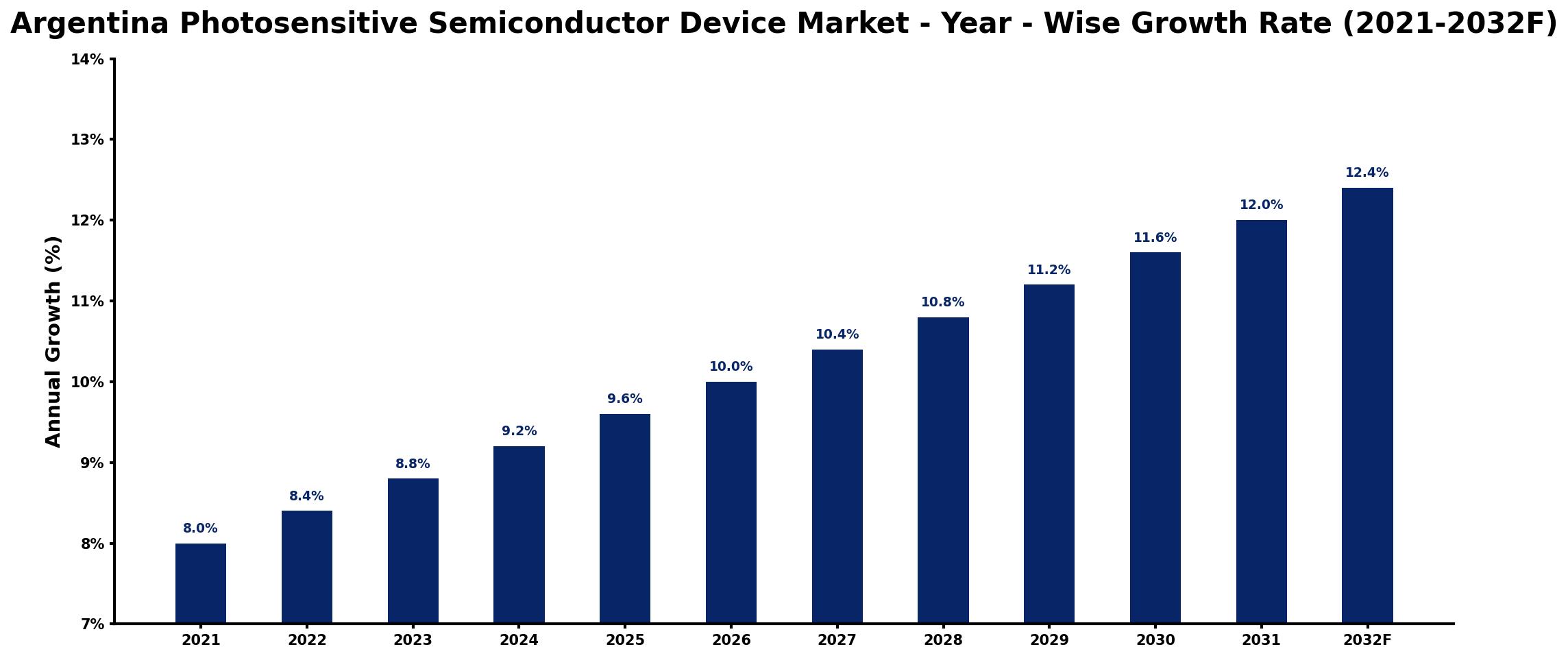
The table below presents the year‑wise growth rates along with the key drivers influencing the market
| Year | Growth Rate | Major Drivers |
| 2021 | 8.0% | Rising demand for renewable energy |
| 2022 | 8.4% | Increased investment in technology sector |
| 2023 | 8.8% | Growing applications in automotive industry |
| 2024 | 9.2% | Expansion of smart city initiatives |
| 2025 | 9.6% | Development of advanced communication systems |
| 2026 | 10.0% | Surge in consumer electronics adoption |
| 2027 | 10.4% | Growth in industrial automation solutions |
| 2028 | 10.8% | Increasing focus on energy efficiency |
| 2029 | 11.2% | Emergence of wearable technology trends |
| 2030 | 11.6% | Rise in government infrastructure projects |
| 2031 | 12.0% | expanding manufacturing base activity |
| 2032 | 12.4% | Growing interest in sustainable practices |
Note: Market size estimations and growth projections presented in this report are based on 6Wresearch's proprietary forecasting methodology, utilizing the latest available industry data, government publications, and primary research inputs.
Argentina Photosensitive Semiconductor Device Market Synopsis
The Argentina Photosensitive Semiconductor Device Market is on an upward trajectory, driven by technological innovation and a growing demand for advanced imaging solutions. As industries prioritize quality and efficiency, devices such as image sensors and photodiodes are becoming essential in applications ranging from smartphones to security systems.
The convergence of IoT and smart city initiatives has further catalyzed the need for photosensitive devices that offer enhanced performance, particularly in low-light conditions. This evolving landscape signals a shift toward more sophisticated technologies, aligning with global trends and consumer expectations.
Argentina Photosensitive Semiconductor Device Market Key Takeaways
- The market is set for strong growth, with an expected CAGR of 8.7% from 2026 to 2032.
- Key drivers include the adoption of advanced imaging technologies in automotive and healthcare sectors.
- Strong demand for security and surveillance solutions is enhancing market opportunities.
- Local manufacturers face competition but can thrive by innovating and forming strategic partnerships.
- Government initiatives are aimed at promoting domestic production and research in semiconductor technologies.
Evaluation of Restraints in Argentina Photosensitive Semiconductor Device Market
Despite the positive growth outlook, several restraints challenge the Argentina Photosensitive Semiconductor Device Market. Economic fluctuations often impact consumer purchasing power, creating uncertainty in demand. Furthermore, regulatory complexities and currency exchange volatility can disrupt pricing strategies for manufacturers. Local companies must navigate these hurdles while competing against global players who might have more robust resources and technology. Intellectual property issues and potential supply chain disruptions are also critical areas that need addressing to ensure sustained growth in this sector.
Argentina Photosensitive Semiconductor Device Market Trends
A notable trend in the Argentina Photosensitive Semiconductor Device Market is the increasing preference for CMOS sensors, which deliver higher resolution and performance efficiency. Additionally, as smart city concepts gain traction, theres a burgeoning requirement for devices capable of rapid imaging and enhanced sensitivity. The security sector is increasingly leaning on advanced photodetectors, showcasing the versatility and growing application range of photosensitive semiconductor technologies.
Argentina Photosensitive Semiconductor Device Market Opportunities
Investors in the Argentina Photosensitive Semiconductor Device Market can explore several lucrative opportunities. The acceleration of technology in sectors like automotive and healthcare signifies a ripe landscape for advanced sensor development. Furthermore, the continuous evolution of applications like augmented reality and 3D imaging enhances the prospects for innovation. Collaborative efforts with local manufacturers to innovate and meet rising demands can unlock significant competitive advantages.
Government Initiatives in the Argentina Photosensitive Semiconductor Device Market
The Argentine government has implemented several initiatives to foster growth within the semiconductor sector. These include import tariffs that aim to protect domestic production, alongside tax breaks and subsidies encouraging investments in research and development. Such policies are designed not only to bolster local industries but also to ensure compliance with international environmental standards through regulations on the use and disposal of semiconductor devices.
Future Insights of the Argentina Photosensitive Semiconductor Device Market
Looking ahead to 2026-2032, the Argentina Photosensitive Semiconductor Device Market is poised for sustained growth, propelled by advancements in manufacturing technologies and the proliferation of digital devices. Increased adoption of smartphones and digital imaging in automotive applications will also influence market dynamics positively. While challenges like raw material price fluctuations exist, strategic collaborations and innovation will play critical roles in leveraging opportunities in this evolving landscape.
Argentina Photosensitive Semiconductor Device Market Latest Developments (2025 - 2026)
Recent developments indicate a strong push towards innovation within the Argentina Photosensitive Semiconductor Device Market. Companies are intensifying their research efforts to introduce next-generation products that align with emerging technological demands. Additionally, collaborations with academic institutions and industry bodies are becoming more prevalent, facilitating knowledge transfer and enhancing the local manufacturing capabilities in semiconductor technology.
Argentina Photosensitive Semiconductor Device Market - Key Attractiveness of the Report
- 10 Years of Market Numbers
- Historical Data Starting from 2022 to 2025
- Base Year: 2025
- Forecast Data until 2032
- Key Performance Indicators Impacting the Market
- Major Upcoming Developments and Projects
Key Highlights of the Report:
- Argentina Photosensitive Semiconductor Device Market Outlook
- Market Size of Argentina Photosensitive Semiconductor Device Market, 2025
- Forecast of Argentina Photosensitive Semiconductor Device Market, 2032
- Historical Data and Forecast of Argentina Photosensitive Semiconductor Device Revenues & Volume for the Period 2022-2032F
- Argentina Photosensitive Semiconductor Device Market Trend Evolution
- Argentina Photosensitive Semiconductor Device Market Drivers and Challenges
- Argentina Photosensitive Semiconductor Device Price Trends
- Argentina Photosensitive Semiconductor Device Porter's Five Forces
- Argentina Photosensitive Semiconductor Device Industry Life Cycle
- Historical Data and Forecast of Argentina Photosensitive Semiconductor Device Market Revenues & Volume By Device for the Period 2022-2032F
- Historical Data and Forecast of Argentina Photosensitive Semiconductor Device Market Revenues & Volume By Photocell for the Period 2022-2032F
- Historical Data and Forecast of Argentina Photosensitive Semiconductor Device Market Revenues & Volume By Photodiode for the Period 2022-2032F
- Historical Data and Forecast of Argentina Photosensitive Semiconductor Device Market Revenues & Volume By Phototransistor for the Period 2022-2032F
- Historical Data and Forecast of Argentina Photosensitive Semiconductor Device Market Revenues & Volume By Photoresistor for the Period 2022-2032F
- Historical Data and Forecast of Argentina Photosensitive Semiconductor Device Market Revenues & Volume By Photo IC for the Period 2022-2032F
- Historical Data and Forecast of Argentina Photosensitive Semiconductor Device Market Revenues & Volume By End User for the Period 2022-2032F
- Historical Data and Forecast of Argentina Photosensitive Semiconductor Device Market Revenues & Volume By Automotive and Transportation for the Period 2022-2032F
- Historical Data and Forecast of Argentina Photosensitive Semiconductor Device Market Revenues & Volume By Consumer Electronics for the Period 2022-2032F
- Historical Data and Forecast of Argentina Photosensitive Semiconductor Device Market Revenues & Volume By Aerospace and Defence for the Period 2022-2032F
- Historical Data and Forecast of Argentina Photosensitive Semiconductor Device Market Revenues & Volume By Healthcare for the Period 2022-2032F
- Historical Data and Forecast of Argentina Photosensitive Semiconductor Device Market Revenues & Volume By Industrial for the Period 2022-2032F
- Historical Data and Forecast of Argentina Photosensitive Semiconductor Device Market Revenues & Volume By Security and Survelliance for the Period 2022-2032F
- Argentina Photosensitive Semiconductor Device Import Export Trade Statistics
- Market Opportunity Assessment By Device
- Market Opportunity Assessment By End User
- Argentina Photosensitive Semiconductor Device Top Companies Market Share
- Argentina Photosensitive Semiconductor Device Competitive Benchmarking By Technical and Operational Parameters
- Argentina Photosensitive Semiconductor Device Company Profiles
- Argentina Photosensitive Semiconductor Device Key Strategic Recommendations






































