China Photosensitive Semiconductor Device Market Size, Share & Growth Rate
The China Photosensitive Semiconductor Device Market was estimated at USD 400 Million in 2025 and is projected to reach USD 527 Million by 2032, growing at a CAGR of 4.0% from 2026 to 2032. This steady growth trajectory is propelled by an increasing integration of photosensitive devices across multiple sectors including consumer electronics and automotive applications. The rapid shift towards smart technology and advanced imaging solutions further cements the market's expansion in the coming years.
China Photosensitive Semiconductor Device Market Year-wise Growth Rate and Key Drivers
This graph highlights how the China Photosensitive Semiconductor Device Market has steadily grown over the years, supported by major growth factors.
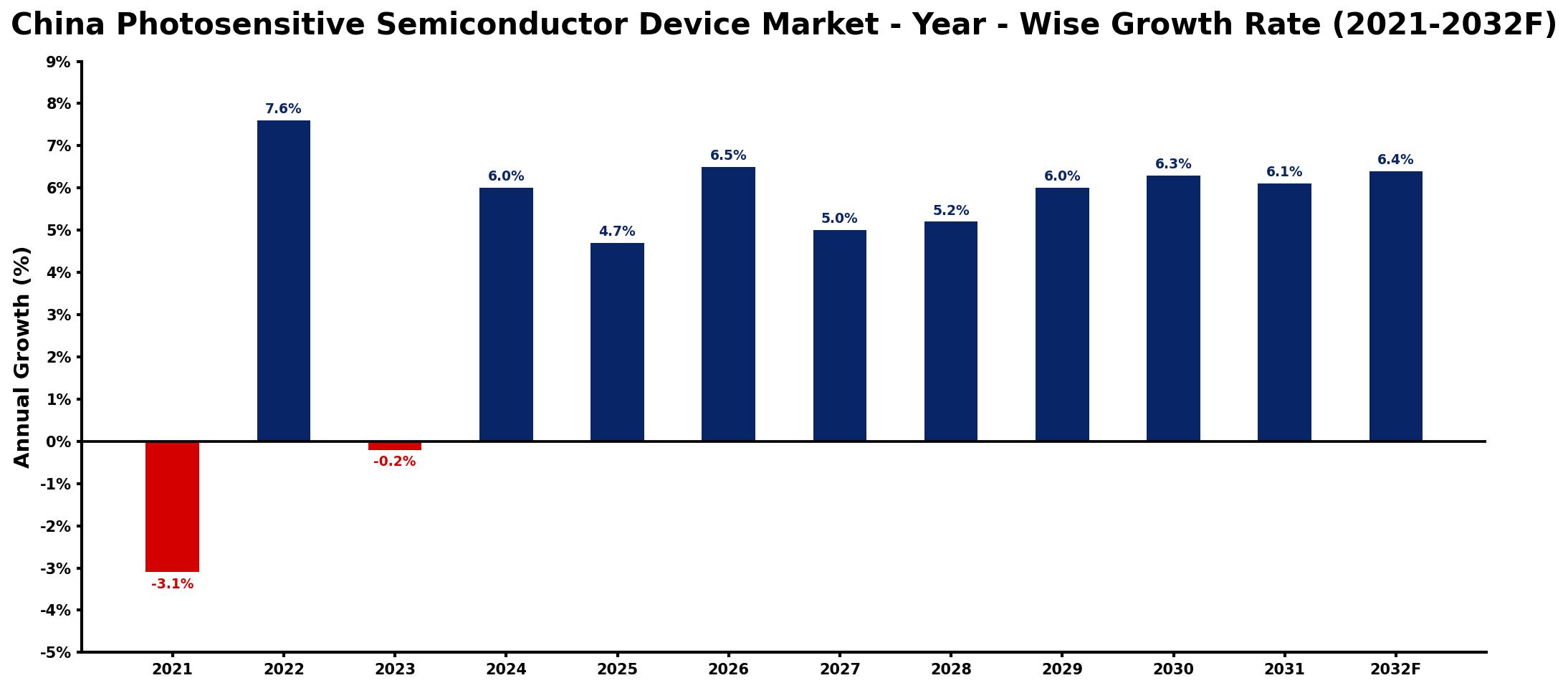
The table below presents the year‑wise growth rates along with the key drivers influencing the market
| Year | Growth Rate | Major Drivers |
| 2021 | -3.1% | Supply chain disruptions impact production |
| 2022 | 7.6% | Rising demand from renewable energy |
| 2023 | -0.2% | Market saturation in key segments |
| 2024 | 6.0% | Technological advancements drive adoption |
| 2025 | 4.7% | Increased investments in R&D |
| 2026 | 6.5% | Growing applications in automation |
| 2027 | 5.0% | Emerging markets expanding consumption |
| 2028 | 5.2% | Enhanced performance attracting users |
| 2029 | 6.0% | Integration with IoT technologies |
| 2030 | 6.3% | Consumer electronics demand surges |
| 2031 | 6.1% | Government initiatives support growth |
| 2032 | 6.4% | Sustainability trends enhance interest |
Note: Market size estimations and growth projections presented in this report are based on 6Wresearch's proprietary forecasting methodology, utilizing the latest available industry data, government publications, and primary research inputs.
China Photosensitive Semiconductor Device Market Synopsis
The strongest force currently shaping the China Photosensitive Semiconductor Device Market is the burgeoning demand for high-performance imaging sensors, driven by the proliferation of smartphones, security cameras, and automotive systems. As consumers and industries alike seek advanced capabilities, the need for innovative semiconductor devices has never been more pronounced.
Additionally, the rise of artificial intelligence and machine learning technologies is fostering a pressing need for sensors that can operate efficiently under varied conditions. With these advancements, companies are actively investing in R&D to develop solutions that enhance the sensitivity and efficiency of photosensitive devices, thereby capturing new market opportunities.
China Photosensitive Semiconductor Device Market Key Takeaways
- The market is witnessing significant growth due to increased demand across consumer electronics, automotive, and healthcare applications.
- Technological advancements in areas such as CMOS image sensors and photodiodes are revolutionizing product offerings.
- Government initiatives are fostering a favorable environment for domestic manufacturing and innovation.
- Investment in research and development is crucial for companies to stay competitive and meet evolving consumer needs.
- Emerging trends, including the rise of IoT and smart devices, are driving sustained demand for photosensitive semiconductor devices.
Evaluation of Restraints in China Photosensitive Semiconductor Device Market
While the market shows promise, it is not without its restraints. Intense competition from both domestic and international players poses a significant challenge, compelling companies to differentiate their offerings constantly. Additionally, the rapid pace of technological advancement means that firms must continually innovate or risk obsolescence. The regulatory environment can also be complex, requiring businesses to navigate a maze of compliance and intellectual property rights issues. Economic uncertainties and fluctuations in raw material prices further complicate the landscape, making it essential for firms to adapt swiftly and strategically.
China Photosensitive Semiconductor Device Market Trends
Current trends in the China Photosensitive Semiconductor Device Market include the escalating demand for image sensors in smartphones, automotive applications, and security systems. As autonomous driving technology develops, the adoption of advanced sensors, such as LiDAR, is on the rise. Moreover, there is a notable shift toward organic photodetectors, reflecting an industry-wide push to enhance sensitivity and energy efficiency. These advancements signify a transformative period in the market, with players investing heavily in next-generation technologies.
China Photosensitive Semiconductor Device Market Opportunities
Investment opportunities within the China Photosensitive Semiconductor Device Market are abundant, particularly in sectors experiencing rapid growth such as smartphones, security cameras, and automotive technologies. The increasing implementation of AI, augmented reality, and virtual reality is driving the need for sophisticated photosensitive components. Furthermore, the ongoing rollout of 5G technology and the development of IoT devices present further avenues for lucrative investments, as they are anticipated to require enhanced sensor capabilities to function effectively.
Government Initiatives in the China Photosensitive Semiconductor Device Market
Government policies are pivotal in shaping the dynamics of the China Photosensitive Semiconductor Device Market. Financial incentives, such as subsidies and tax breaks for R&D investments, encourage domestic manufacturing and innovation. The government also prioritizes import regulations that safeguard local manufacturers while promoting self-sufficiency in the semiconductor industry. Additionally, strong emphasis on intellectual property protection reflects a commitment to fostering an environment conducive to technological advancements.
Future Insights of the China Photosensitive Semiconductor Device Market
Looking ahead to 2026-2032, the future of the China Photosensitive Semiconductor Device Market appears robust. The increasing integration of sensors in automotive, industrial, and consumer applications will drive continuous growth. Investments in R&D and a focus on smart technology will further enhance product offerings. The ongoing development of smart cities and increased security measures will also stimulate demand, ensuring that this market remains at the forefront of technological innovation and economic significance.
China Photosensitive Semiconductor Device Market Latest Developments (2025 - 2026)
Recent developments in the China Photosensitive Semiconductor Device Market indicate a strong focus on enhancing the capabilities of imaging technologies. Companies are increasingly investing in next-gen photodetectors and image sensors that cater to the specific needs of emerging applications. Furthermore, collaborations between technology firms and research institutions are becoming more prevalent, aimed at fostering innovation and speeding up the time-to-market for advanced semiconductor solutions. The market dynamics suggest an exciting phase of growth and transformation.
China Photosensitive Semiconductor Device Market - Key Attractiveness of the Report
- 10 Years of Market Numbers
- Historical Data Starting from 2022 to 2025
- Base Year: 2025
- Forecast Data until 2032
- Key Performance Indicators Impacting the Market
- Major Upcoming Developments and Projects
Key Highlights of the Report:
- China Photosensitive Semiconductor Device Market Outlook
- Market Size of China Photosensitive Semiconductor Device Market, 2025
- Forecast of China Photosensitive Semiconductor Device Market, 2032
- Historical Data and Forecast of China Photosensitive Semiconductor Device Revenues & Volume for the Period 2022-2032F
- China Photosensitive Semiconductor Device Market Trend Evolution
- China Photosensitive Semiconductor Device Market Drivers and Challenges
- China Photosensitive Semiconductor Device Price Trends
- China Photosensitive Semiconductor Device Porter's Five Forces
- China Photosensitive Semiconductor Device Industry Life Cycle
- Historical Data and Forecast of China Photosensitive Semiconductor Device Market Revenues & Volume By Device for the Period 2022-2032F
- Historical Data and Forecast of China Photosensitive Semiconductor Device Market Revenues & Volume By Photocell for the Period 2022-2032F
- Historical Data and Forecast of China Photosensitive Semiconductor Device Market Revenues & Volume By Photodiode for the Period 2022-2032F
- Historical Data and Forecast of China Photosensitive Semiconductor Device Market Revenues & Volume By Phototransistor for the Period 2022-2032F
- Historical Data and Forecast of China Photosensitive Semiconductor Device Market Revenues & Volume By Photoresistor for the Period 2022-2032F
- Historical Data and Forecast of China Photosensitive Semiconductor Device Market Revenues & Volume By Photo IC for the Period 2022-2032F
- Historical Data and Forecast of China Photosensitive Semiconductor Device Market Revenues & Volume By End User for the Period 2022-2032F
- Historical Data and Forecast of China Photosensitive Semiconductor Device Market Revenues & Volume By Automotive and Transportation for the Period 2022-2032F
- Historical Data and Forecast of China Photosensitive Semiconductor Device Market Revenues & Volume By Consumer Electronics for the Period 2022-2032F
- Historical Data and Forecast of China Photosensitive Semiconductor Device Market Revenues & Volume By Aerospace and Defence for the Period 2022-2032F
- Historical Data and Forecast of China Photosensitive Semiconductor Device Market Revenues & Volume By Healthcare for the Period 2022-2032F
- Historical Data and Forecast of China Photosensitive Semiconductor Device Market Revenues & Volume By Industrial for the Period 2022-2032F
- Historical Data and Forecast of China Photosensitive Semiconductor Device Market Revenues & Volume By Security and Survelliance for the Period 2022-2032F
- China Photosensitive Semiconductor Device Import Export Trade Statistics
- Market Opportunity Assessment By Device
- Market Opportunity Assessment By End User
- China Photosensitive Semiconductor Device Top Companies Market Share
- China Photosensitive Semiconductor Device Competitive Benchmarking By Technical and Operational Parameters
- China Photosensitive Semiconductor Device Company Profiles
- China Photosensitive Semiconductor Device Key Strategic Recommendations






































