Argentina Ploughing and Cultivating Machinery Market Size, Share & Growth Rate
The Argentina Ploughing and Cultivating Machinery Market was estimated at USD 392 Million in 2025 and is projected to reach USD 535 Million by 2032, growing at a CAGR of 4.5% from 2026 to 2032. This growth is primarily driven by a robust shift towards mechanization in agriculture, where farmers are increasingly seeking efficient solutions to boost crop yields. Additionally, technological innovations in machinery are enabling improved precision farming, further accelerating the adoption of advanced cultivation equipment.
Argentina Ploughing and Cultivating Machinery Market Year-wise Growth Rate and Key Drivers
This graph highlights how the Argentina Ploughing and Cultivating Machinery Market has steadily grown over the years, supported by major growth factors.
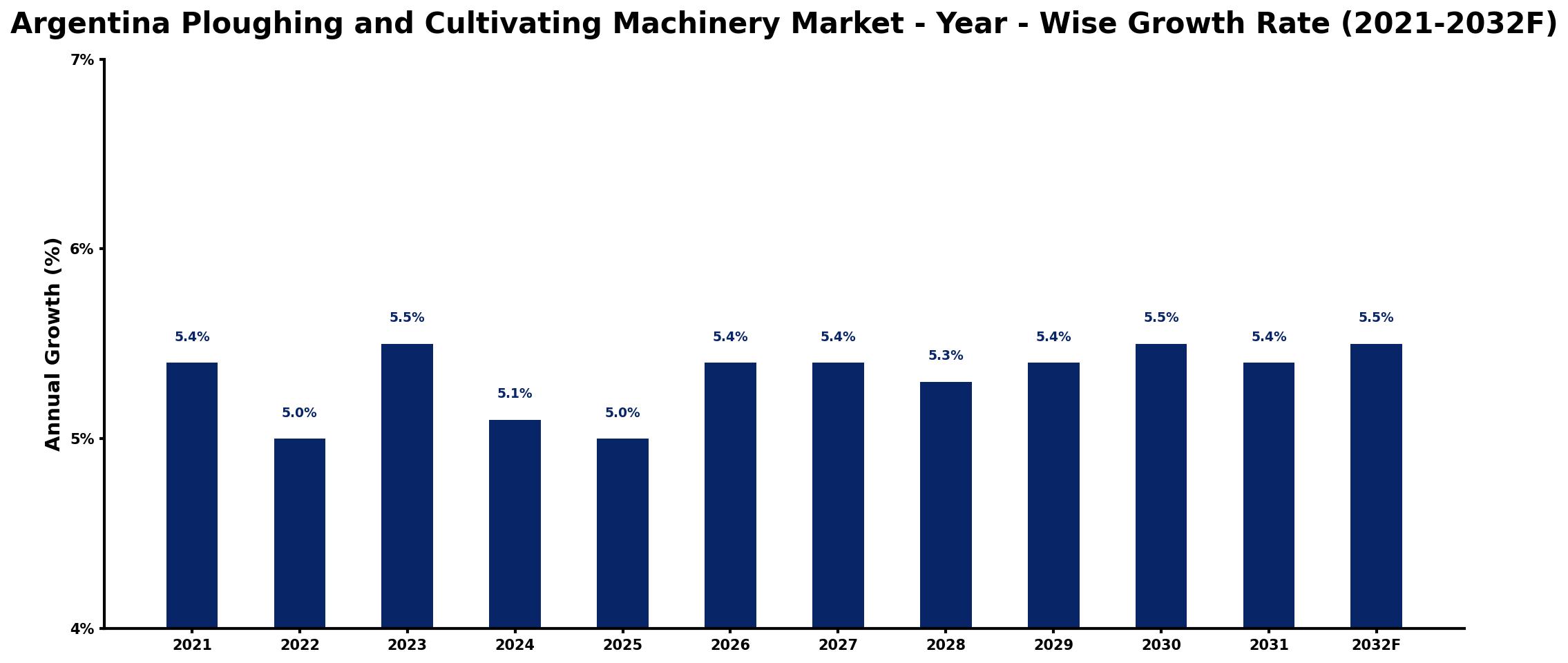
The table below presents the year‑wise growth rates along with the key drivers influencing the market
| Year | Growth Rate | Major Drivers |
| 2021 | 5.4% | Rising agricultural investment levels |
| 2022 | 5.0% | Increased demand for automation |
| 2023 | 5.5% | Expansion of sustainable farming practices |
| 2024 | 5.1% | Growth in export opportunities |
| 2025 | 5.0% | Technological advancements in agriculture |
| 2026 | 5.4% | Strengthening of rural infrastructure |
| 2027 | 5.4% | Surge in organic farming trends |
| 2028 | 5.3% | Government support for modernization |
| 2029 | 5.4% | Rising global food consumption rates |
| 2030 | 5.5% | Enhanced access to financing options |
| 2031 | 5.4% | Development of precision agriculture techniques |
| 2032 | 5.5% | Growing interest in agritech innovations |
Note: Market size estimations and growth projections presented in this report are based on 6Wresearch's proprietary forecasting methodology, utilizing the latest available industry data, government publications, and primary research inputs.
Argentina Ploughing and Cultivating Machinery Market Synopsis
The market for ploughing and cultivating machinery in Argentina has shown impressive momentum recently, driven by rising mechanization trends and a growing focus on sustainable agricultural practices. However, as the sector evolves, the demand for innovative and efficient machinery tailored to the unique needs of local farmers is set to reshape the market landscape.
Looking ahead, the Argentina Ploughing and Cultivating Machinery Market is positioned for expansion. With government support promoting modernization and technological adoption, alongside increasing consumer awareness of productivity benefits, the market is well-placed to thrive amid ongoing agricultural advancements.
Argentina Ploughing and Cultivating Machinery Market Key Takeaways
- Continuous demand for improved crop yields is driving mechanization in agriculture.
- Technological advancements are essential in developing machinery that meets evolving farmer needs.
- Government initiatives are facilitating access to modern agricultural equipment.
- Investment in sustainable farming practices is shaping machinery design and functionality.
- The competitive landscape includes both domestic and international manufacturers aiming for market share.
Evaluation of Restraints in Argentina Ploughing and Cultivating Machinery Market
Despite the growth potential, the Argentina Ploughing and Cultivating Machinery Market grapples with several constraints. Economic instability and fluctuating currency rates pose challenges for manufacturers and farmers alike, impacting investment decisions. Furthermore, high import tariffs on agricultural machinery restrict access to advanced technologies, particularly for small-scale farmers with limited credit options. These factors can hinder overall market growth, necessitating innovative strategies and cost-effective solutions from industry players to navigate the complexities of the Argentine agricultural landscape.
Argentina Ploughing and Cultivating Machinery Market Trends
The market is currently witnessing a significant trend towards advanced technology integration in farming machinery, including GPS guidance systems and automation features that enhance precision and efficiency. There is also a notable shift towards smaller, versatile machinery that caters to the needs of smaller farms and diverse cropping systems. Furthermore, the rising emphasis on sustainability has prompted the adoption of conservation tillage practices, influencing the design of new ploughing and cultivating equipment. As these trends continue to evolve, they are likely to redefine the operational landscape for Argentine farmers.
Argentina Ploughing and Cultivating Machinery Market Opportunities
Investment opportunities abound in the Argentina Ploughing and Cultivating Machinery Market, particularly in the realm of innovative and technologically advanced solutions tailored for local farmers. As the agricultural sector expands, there is a demand for machines that not only boost productivity but also align with sustainable farming practices. Collaborations with local manufacturers can further enhance market penetration and allow investors to tap into emerging trends more effectively. The evolving dynamics present a lucrative avenue for long-term returns as modernization efforts gain momentum.
Government Initiatives in the Argentina Ploughing and Cultivating Machinery Market
The Argentine government has actively implemented policies to bolster the Ploughing and Cultivating Machinery Market. This includes financial incentives and subsidies aimed at making advanced agricultural machinery more accessible to farmers. Additionally, the government promotes innovation within the sector by supporting research and development initiatives. Regulations are also in place to ensure safety and quality standards for machinery, fostering a conducive environment for growth and modernization within the agricultural landscape.
Future Insights of the Argentina Ploughing and Cultivating Machinery Market
From 2026 to 2032, the Argentina Ploughing and Cultivating Machinery Market is expected to maintain its growth trajectory, driven by increasing mechanization and technological advancements. Rising food demand will further stimulate investment in modern farming techniques. However, challenges such as high initial costs for equipment and limited access to credit facilities will necessitate ongoing adaptations in market strategies. Ultimately, the focus will shift toward developing cost-effective solutions that cater to the evolving requirements of the agricultural community.
Argentina Ploughing and Cultivating Machinery Market Latest Developments (2025 - 2026)
In recent months, the Argentina Ploughing and Cultivating Machinery Market has seen a notable uptick in interest towards precision agriculture technologies. Manufacturers are increasingly emphasizing automation and software integration to meet the demands of modern farmers. Additionally, collaborations between domestic and international firms are emerging to leverage localized insights and enhance product offerings. Overall, these developments indicate a proactive approach to addressing the challenges and opportunities present in the market.
Argentina Ploughing and Cultivating Machinery Market - Key Attractiveness of the Report
- 10 Years of Market Numbers
- Historical Data Starting from 2022 to 2025
- Base Year: 2025
- Forecast Data until 2032
- Key Performance Indicators Impacting the Market
- Major Upcoming Developments and Projects
Key Highlights of the Report:
- Argentina Ploughing and Cultivating Machinery Market Outlook
- Market Size of Argentina Ploughing and Cultivating Machinery Market, 2025
- Forecast of Argentina Ploughing and Cultivating Machinery Market, 2032
- Historical Data and Forecast of Argentina Ploughing and Cultivating Machinery Revenues & Volume for the Period 2022-2032F
- Argentina Ploughing and Cultivating Machinery Market Trend Evolution
- Argentina Ploughing and Cultivating Machinery Market Drivers and Challenges
- Argentina Ploughing and Cultivating Machinery Price Trends
- Argentina Ploughing and Cultivating Machinery Porter's Five Forces
- Argentina Ploughing and Cultivating Machinery Industry Life Cycle
- Historical Data and Forecast of Argentina Ploughing and Cultivating Machinery Market Revenues & Volume By Type for the Period 2022-2032F
- Historical Data and Forecast of Argentina Ploughing and Cultivating Machinery Market Revenues & Volume By Ploughs for the Period 2022-2032F
- Historical Data and Forecast of Argentina Ploughing and Cultivating Machinery Market Revenues & Volume By Harrows for the Period 2022-2032F
- Historical Data and Forecast of Argentina Ploughing and Cultivating Machinery Market Revenues & Volume By Others for the Period 2022-2032F
- Historical Data and Forecast of Argentina Ploughing and Cultivating Machinery Market Revenues & Volume By Application for the Period 2022-2032F
- Historical Data and Forecast of Argentina Ploughing and Cultivating Machinery Market Revenues & Volume By Soil Loosening for the Period 2022-2032F
- Historical Data and Forecast of Argentina Ploughing and Cultivating Machinery Market Revenues & Volume By Clod Size Reduction for the Period 2022-2032F
- Historical Data and Forecast of Argentina Ploughing and Cultivating Machinery Market Revenues & Volume By Clod Sorting for the Period 2022-2032F
- Historical Data and Forecast of Argentina Ploughing and Cultivating Machinery Market Revenues & Volume By Others for the Period 2022-2032F
- Argentina Ploughing and Cultivating Machinery Import Export Trade Statistics
- Market Opportunity Assessment By Type
- Market Opportunity Assessment By Application
- Argentina Ploughing and Cultivating Machinery Top Companies Market Share
- Argentina Ploughing and Cultivating Machinery Competitive Benchmarking By Technical and Operational Parameters
- Argentina Ploughing and Cultivating Machinery Company Profiles
- Argentina Ploughing and Cultivating Machinery Key Strategic Recommendations






































