Argentina Printed Electronics Market Size, Share & Growth Rate
The Argentina Printed Electronics Market was estimated at USD 193 Million in 2025 and is projected to reach USD 268 Million by 2032, growing at a CAGR of 4.8% from 2026 to 2032. This growth trajectory is largely driven by the increasing integration of printed electronics in diverse applications, including flexible displays and IoT devices, across the automotive, healthcare, and consumer electronics sectors. Furthermore, advancements in printing technologies and materials are enhancing the capabilities and adoption of printed electronic components, making them increasingly viable for large-scale production.
Argentina Printed Electronics Market Year-wise Growth Rate and Key Drivers
This graph highlights how the Argentina Printed Electronics Market has steadily grown over the years, supported by major growth factors.
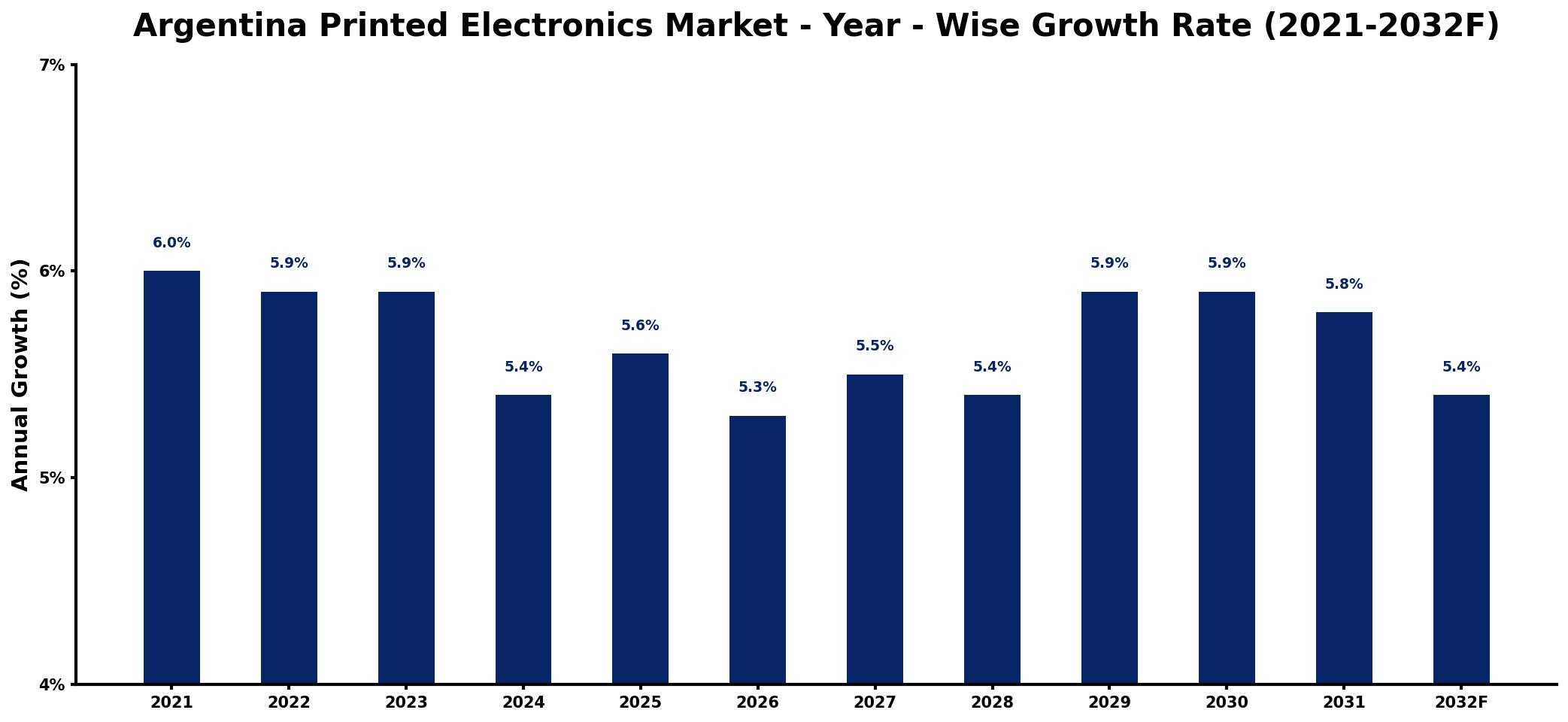
The table below presents the year‑wise growth rates along with the key drivers influencing the market
| Year | Growth Rate | Major Drivers |
| 2021 | 6.0% | Rising demand for innovative applications |
| 2022 | 5.9% | Increased investments in technology development |
| 2023 | 5.9% | Expansion of renewable energy projects |
| 2024 | 5.4% | expanding healthcare application demand |
| 2025 | 5.6% | Emergence of smart packaging solutions |
| 2026 | 5.3% | Advancements in flexible manufacturing processes |
| 2027 | 5.5% | improved processing technologies adoption |
| 2028 | 5.4% | Surge in wearable technology demand |
| 2029 | 5.9% | Growth in automotive sector applications |
| 2030 | 5.9% | Increased focus on sustainability initiatives |
| 2031 | 5.8% | Development of new market segments |
| 2032 | 5.4% | Rising interest in health monitoring |
Note: Market size estimations and growth projections presented in this report are based on 6Wresearch's proprietary forecasting methodology, utilizing the latest available industry data, government publications, and primary research inputs.
Argentina Printed Electronics Market Synopsis
At the forefront of the Argentina Printed Electronics Market is the burgeoning demand for flexible electronics, which is reshaping product designs and functionalities across industries. This shift is particularly evident as manufacturers seek lightweight, cost-effective solutions that do not compromise on performance.
Moreover, the rise of IoT devices is creating a significant push for printed electronics, as they offer unique advantages in terms of integration and scalability. With governments encouraging innovation and technological development, the market is poised for further expansion as new applications emerge.
Argentina Printed Electronics Market Key Takeaways
- The market is projected to grow from USD 193 Million in 2025 to USD 268 Million by 2032.
- Increasing adoption of IoT devices and smart packaging is a key driver of demand.
- Advancements in printing technologies are enhancing the capabilities of printed electronic components.
- Government initiatives are supporting infrastructure development and innovation in the electronics sector.
- Collaboration between key players and material suppliers is vital for enhancing product performance.
Evaluation of Restraints in Argentina Printed Electronics Market
While the Argentina Printed Electronics Market exhibits robust growth potential, several constraints can impede its progress. A notable challenge is the limited availability of specialized printing equipment and materials necessary for high-quality manufacturing. This scarcity can affect the scalability of production processes and overall cost-effectiveness. Additionally, ensuring reliability in printed electronics—particularly for flexible displays and RFID tags—requires rigorous quality control and process optimization. As the market matures, overcoming these barriers will be essential for sustaining growth and attracting investment.
Argentina Printed Electronics Market Trends
Current trends indicate a significant shift towards the integration of printed electronics in various sectors, particularly in healthcare applications, where wearable devices are becoming more prevalent. The emphasis on sustainability is also driving the development of eco-friendly electronic inks and substrates. Another emerging trend is the increasing collaboration between businesses and research institutions to foster innovation, develop new applications, and improve manufacturing processes, ensuring that Argentina remains competitive in the printed electronics landscape.
Argentina Printed Electronics Market Opportunities
Significant growth opportunities are emerging in the printed electronics market, particularly in the realms of smart packaging and IoT applications. The ability to produce lightweight, flexible components opens doors for novel products that can enhance user experiences in various industries. Moreover, government backing and initiatives aimed at fostering technology incubation and research can further propel investment in this sector, attracting both domestic and foreign players eager to capitalize on the growing demand.
Government Initiatives in the Argentina Printed Electronics Market
The Argentine government is keenly aware of the importance of the printed electronics sector and is implementing policies to stimulate growth. Initiatives may include research grants aimed at promoting innovation and technology development, along with tax incentives designed to encourage investment in manufacturing infrastructure. Moreover, programs focusing on talent development and intellectual property protection are expected to enhance the competitiveness of the printed electronics market, creating a favorable environment for emerging businesses and startups.
Future Insights of the Argentina Printed Electronics Market
As we look toward 2026-2032, the Argentina Printed Electronics Market is likely to experience robust growth, driven by continued advancements in printing technologies and increasing demand from various industries. The expansion of IoT applications will further accelerate the adoption of printed electronics, as businesses seek to leverage these technologies for enhanced functionality and reduced costs. The market is expected to evolve with more innovative applications emerging, necessitating ongoing investment in research and development to maintain a competitive edge.
Argentina Printed Electronics Market Latest Developments (2025 - 2026)
Recent developments in the Argentina Printed Electronics Market reflect a growing trend toward collaborative research and innovation. Various stakeholders are engaging in partnerships to enhance the capabilities of printed electronic components, focusing on both performance and sustainability. Additionally, as more companies explore the integration of printed electronics in their product lines, there is an increasing emphasis on technology transfer and knowledge sharing among industry players. These initiatives are set to drive the market forward, promoting growth and innovation.
Argentina Printed Electronics Market - Key Attractiveness of the Report
- 10 Years of Market Numbers
- Historical Data Starting from 2022 to 2025
- Base Year: 2025
- Forecast Data until 2032
- Key Performance Indicators Impacting the Market
- Major Upcoming Developments and Projects
Key Highlights of the Report:
- Argentina Printed Electronics Market Outlook
- Market Size of Argentina Printed Electronics Market, 2025
- Forecast of Argentina Printed Electronics Market, 2032
- Historical Data and Forecast of Argentina Printed Electronics Revenues & Volume for the Period 2022-2032F
- Argentina Printed Electronics Market Trend Evolution
- Argentina Printed Electronics Market Drivers and Challenges
- Argentina Printed Electronics Price Trends
- Argentina Printed Electronics Porter's Five Forces
- Argentina Printed Electronics Industry Life Cycle
- Historical Data and Forecast of Argentina Printed Electronics Market Revenues & Volume By Material for the Period 2022-2032F
- Historical Data and Forecast of Argentina Printed Electronics Market Revenues & Volume By Ink for the Period 2022-2032F
- Historical Data and Forecast of Argentina Printed Electronics Market Revenues & Volume By Substrate for the Period 2022-2032F
- Historical Data and Forecast of Argentina Printed Electronics Market Revenues & Volume By Technology for the Period 2022-2032F
- Historical Data and Forecast of Argentina Printed Electronics Market Revenues & Volume By Screen for the Period 2022-2032F
- Historical Data and Forecast of Argentina Printed Electronics Market Revenues & Volume By Inkjet for the Period 2022-2032F
- Historical Data and Forecast of Argentina Printed Electronics Market Revenues & Volume By Flexographic for the Period 2022-2032F
- Historical Data and Forecast of Argentina Printed Electronics Market Revenues & Volume By Gravure for the Period 2022-2032F
- Historical Data and Forecast of Argentina Printed Electronics Market Revenues & Volume By Device for the Period 2022-2032F
- Historical Data and Forecast of Argentina Printed Electronics Market Revenues & Volume By Displays for the Period 2022-2032F
- Historical Data and Forecast of Argentina Printed Electronics Market Revenues & Volume By Photovoltaic for the Period 2022-2032F
- Historical Data and Forecast of Argentina Printed Electronics Market Revenues & Volume By Lighting for the Period 2022-2032F
- Historical Data and Forecast of Argentina Printed Electronics Market Revenues & Volume By RFID for the Period 2022-2032F
- Historical Data and Forecast of Argentina Printed Electronics Market Revenues & Volume By Others for the Period 2022-2032F
- Argentina Printed Electronics Import Export Trade Statistics
- Market Opportunity Assessment By Material
- Market Opportunity Assessment By Technology
- Market Opportunity Assessment By Device
- Argentina Printed Electronics Top Companies Market Share
- Argentina Printed Electronics Competitive Benchmarking By Technical and Operational Parameters
- Argentina Printed Electronics Company Profiles
- Argentina Printed Electronics Key Strategic Recommendations






































