Argentina Quantum Cryptography Market Size & Growth Rate (2026-2032)
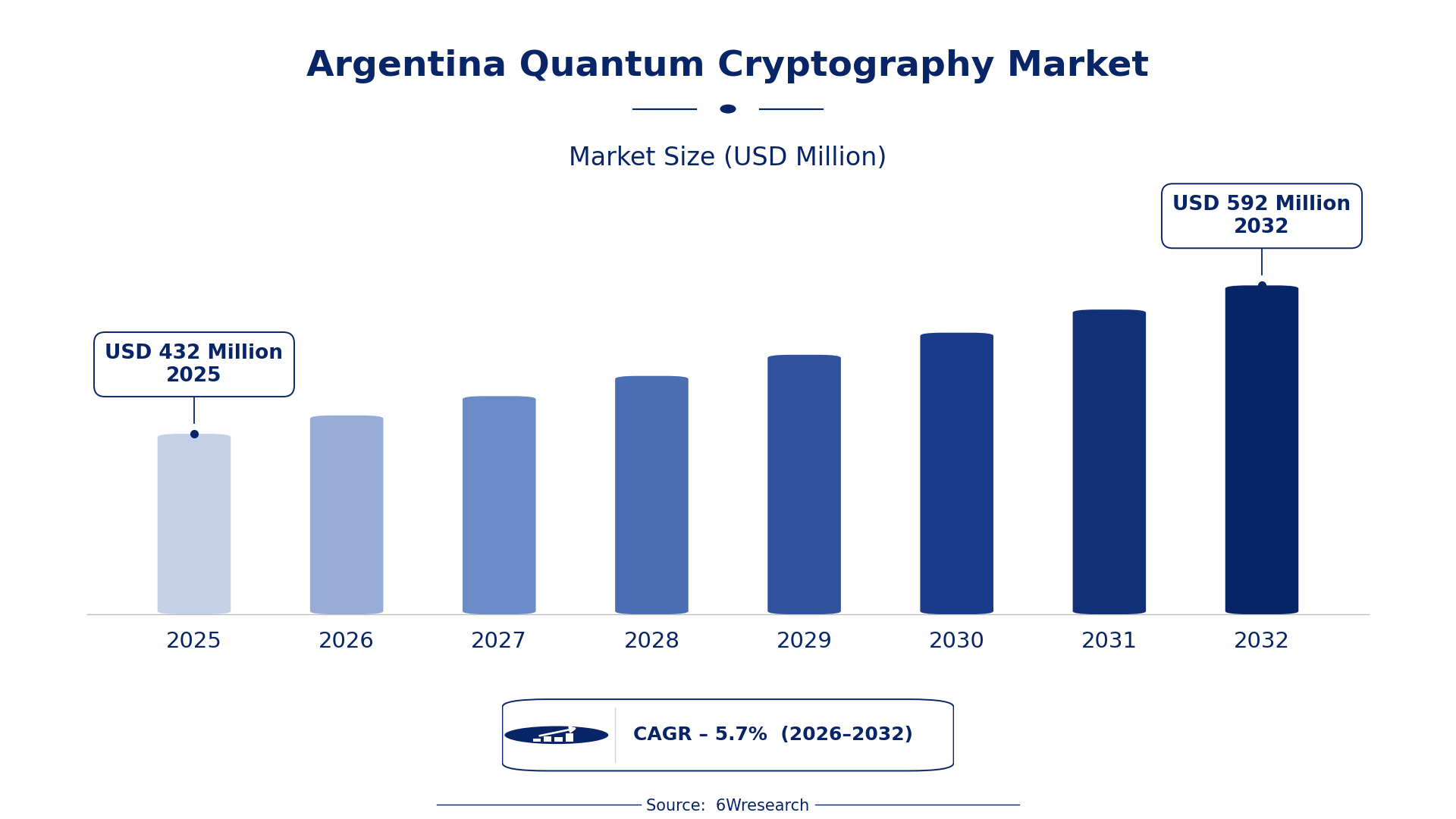
The Argentina Quantum Cryptography Market was estimated at USD 432 Million in 2025 and is projected to reach USD 592 Million by 2032, growing at a CAGR of 5.7% from 2026 to 2032.
Argentina Quantum Cryptography Market Synopsis
The primary force shaping the Argentina Quantum Cryptography Market today is the urgent need for advanced data security in the face of rising cybersecurity threats. Both public and private sectors are increasingly recognizing that conventional encryption methods can no longer guarantee protection against sophisticated cyberattacks, fueling interest in quantum-safe technologies.
Argentina's government agencies, financial institutions, and research organizations are investing heavily in quantum cryptography solutions to safeguard sensitive information. This growing emphasis on data privacy and integrity is stimulating demand for quantum key distribution (QKD) systems and other innovative cryptographic technologies.
Argentina Quantum Cryptography Market Year-wise Growth Rate and Key Drivers
This graph illustrates the annual growth rates of the Argentina Quantum Cryptography Market from 2021 to 2032, highlighting a steady upward trajectory and projected expansion over the forecast period.
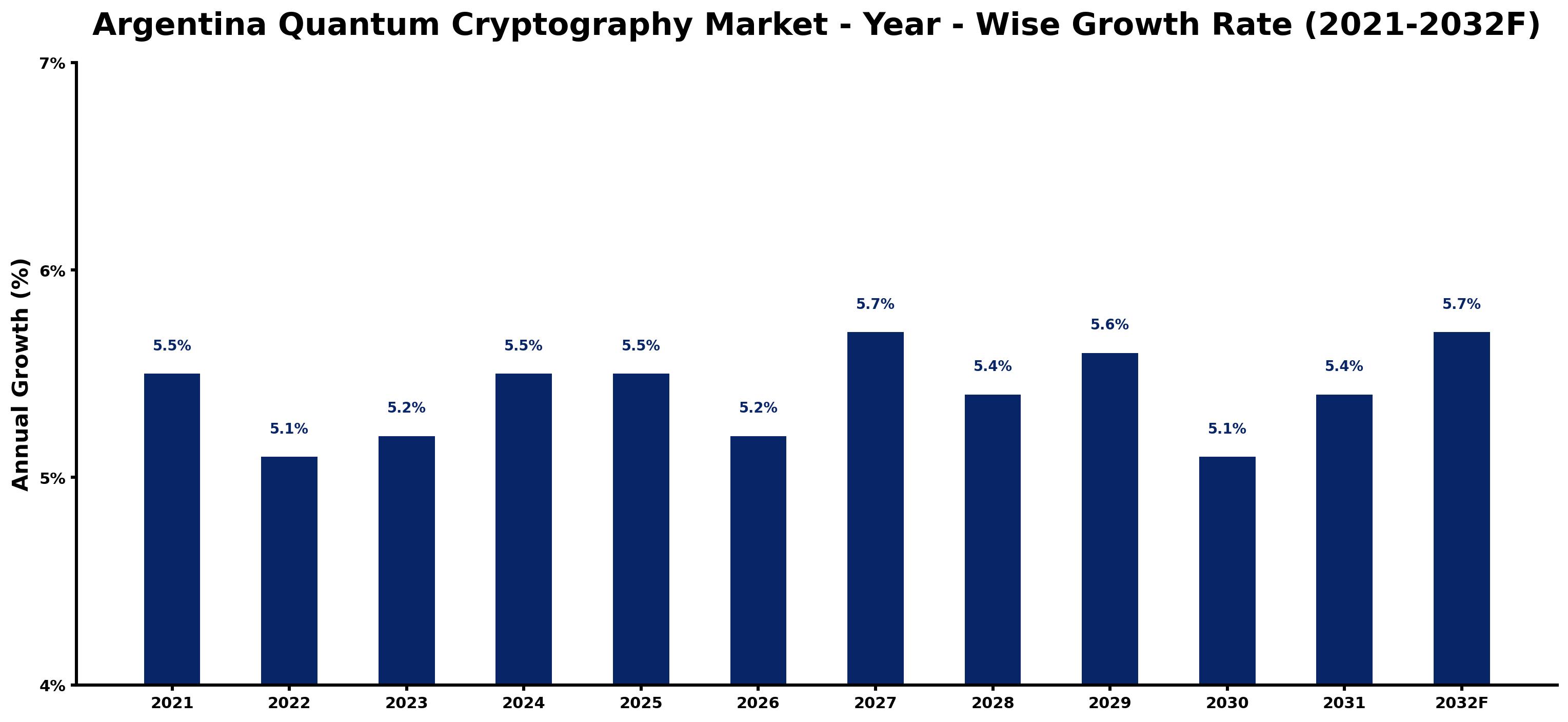
The table below presents the year‑wise growth rates along with the key drivers influencing the market
| Year | Growth Rate | Major Drivers |
| 2021 | 5.5% | National cybersecurity strategy prioritizes quantum encryption solutions. |
| 2022 | 5.1% | Increased government funding for advanced cryptographic research. |
| 2023 | 5.2% | Rising adoption of quantum technologies in telecommunications sector. |
| 2024 | 5.5% | Local universities enhancing quantum cryptography curriculum and research. |
| 2025 | 5.5% | Cybersecurity regulations pushing firms to implement quantum solutions. |
| 2026 | 5.2% | Strong growth in fintech boosting demand for secure communications. |
| 2027 | 5.7% | Partnerships between tech firms and defense agencies for security. |
| 2028 | 5.4% | Emerging startups focusing on quantum-resistant encryption technologies. |
| 2029 | 5.6% | Argentina's participation in international quantum initiatives fostering growth. |
| 2030 | 5.1% | Legislation mandating encryption for critical infrastructure protection. |
| 2031 | 5.4% | Increased awareness of data privacy fueling cryptography demand. |
| 2032 | 5.7% | Rising threats from cyber attacks driving innovation in security. |
Note: Market size estimations and growth projections presented in this report are based on 6Wresearch's proprietary forecasting methodology, utilizing the latest available industry data, government publications, and primary research inputs.
Argentina Quantum Cryptography Market Key Takeaways
Below are some of the specific key takeaways from the market, including:
- Robust investment in quantum-safe encryption technologies from diverse sectors, especially finance and government.
- Accelerating demand for quantum key distribution (QKD) systems as organizations seek to bolster their cybersecurity frameworks.
- Growing research initiatives aimed at developing post-quantum encryption algorithms and quantum random number generators.
- Increasing collaboration between academia and industry to innovate and commercialize quantum cryptography solutions.
- Emerging regulatory frameworks focused on establishing guidelines for the deployment of quantum encryption technologies.
Evaluation of Restraints in Argentina Quantum Cryptography Market
The Argentina Quantum Cryptography Market faces notable challenges that hinder its broader adoption. One major barrier is the complexity involved in developing and implementing quantum cryptographic systems, which often necessitate specialized skills and significant financial investment. This creates a gap between the technology's potential and its practical deployment.
on top of that, existing infrastructures and traditional cryptographic protocols present integration issues. Ensuring that quantum solutions can work alongside or replace legacy systems requires careful planning and collaboration among multiple stakeholders, complicating the path to market entry.
Argentina Quantum Cryptography Market Trends
Several trends are currently shaping the Argentina Quantum Cryptography Market. One notable trend is the increasing collaboration between public institutions and private enterprises to develop quantum cryptography solutions. This partnership not only accelerates innovation but also fosters a knowledge exchange that benefits the entire sector.
Additionally, advancements in quantum technology have spurred interest in quantum random number generators (QRNGs) as essential components for secure communications. As organizations become more aware of the implications of quantum computing on traditional encryption methods, there's a push to adopt quantum-resistant protocols.
Argentina Quantum Cryptography Market Opportunities
The market presents substantial opportunities for growth, particularly in sectors where data security is paramount. Financial services are increasingly seeking quantum cryptography solutions to protect sensitive transactions and customer information. Similarly, the healthcare industry is focusing on safeguarding patient data through advanced encryption methods.
In addition, the academic and research sectors are ripe for investment as they develop new cryptographic methods and educational programs. As awareness of quantum threats expands, businesses will look for expert guidance on integrating quantum technologies into their cybersecurity strategies, presenting a further avenue for growth.
Government Initiatives in the Argentina Quantum Cryptography Market
Government policies are actively shaping the Argentina Quantum Cryptography Market by fostering a supportive environment for research and development. These initiatives reflect a commitment to enhancing national cybersecurity capabilities while positioning Argentina as a leader in quantum technology innovation. The regulatory focus aims to create a comprehensive framework that encourages collaboration between industry stakeholders and research institutions.
- A recently completed funding program aimed at advancing quantum cryptography research in universities across Argentina.
- Currently ongoing partnerships between government agencies and technology firms to develop pilot projects for quantum key distribution systems.
- A planned regulatory framework set to be introduced by 2026, establishing standards for the deployment of quantum encryption technologies.
- An initiative focused on enhancing cybersecurity education within academic institutions, launched in early 2025, that includes quantum cryptography in the curriculum.
- A national strategy developed in late 2025, aimed at protecting critical infrastructure through quantum technologies.
Future Insights of the Argentina Quantum Cryptography Market
Looking forward to 2026-2032, the Argentina Quantum Cryptography Market is set to experience substantial growth driven by ongoing advancements in quantum technology and increasing cybersecurity demands. As awareness of quantum threats escalates, organizations will prioritize adopting quantum-resistant solutions.
The interplay between government policy and private sector initiatives will further catalyze market expansion, with investments in research and development paving the way for innovative applications. Argentina's focus on establishing a robust quantum infrastructure is likely to position it as a regional hub for quantum cryptography.
Argentina Quantum Cryptography Market Latest Developments
In the past 12-14 months, the Argentina Quantum Cryptography Market has witnessed a surge in activity, characterized by increased investment and collaborative projects. There is a palpable momentum building as stakeholders across various sectors prioritize quantum-safe encryption technologies to combat escalating cybersecurity threats.
- A major technology vendor launched a groundbreaking quantum key distribution system in Q1 2025, aimed at financial institutions.
- An ongoing initiative began in mid-2025 to develop a national quantum network for secure communications, expected to expand the reach of quantum cryptography solutions.
- A regulatory body is currently drafting guidelines for quantum encryption standards, with a public consultation phase underway as of late 2025.
- A public-private partnership was initiated in early 2025 to foster research on quantum random number generation, which remains active and funded.
- A planned conference in late 2026 will focus on the challenges and advancements in quantum cryptography, showcasing innovations from various industry players.
Argentina Quantum Cryptography Market - Key Attractiveness of the Report
- 10 Years of Market Numbers
- Historical Data Starting from 2022 to 2025
- Base Year: 2025
- Forecast Data until 2032
- Key Performance Indicators Impacting the Market
- Major Upcoming Developments and Projects
Key Highlights of the Report:
- Argentina Quantum Cryptography Market Outlook
- Market Size of Argentina Quantum Cryptography Market, 2025
- Forecast of Argentina Quantum Cryptography Market, 2032
- Historical Data and Forecast of Argentina Quantum Cryptography Revenues & Volume for the Period 2022-2032F
- Argentina Quantum Cryptography Market Trend Evolution
- Argentina Quantum Cryptography Market Drivers and Challenges
- Argentina Quantum Cryptography Price Trends
- Argentina Quantum Cryptography Porter's Five Forces
- Argentina Quantum Cryptography Industry Life Cycle
- Historical Data and Forecast of Argentina Quantum Cryptography Market Revenues & Volume By Component for the Period 2022-2032F
- Historical Data and Forecast of Argentina Quantum Cryptography Market Revenues & Volume By Solutions for the Period 2022-2032F
- Historical Data and Forecast of Argentina Quantum Cryptography Market Revenues & Volume By Services for the Period 2022-2032F
- Historical Data and Forecast of Argentina Quantum Cryptography Market Revenues & Volume By Services for the Period 2022-2032F
- Historical Data and Forecast of Argentina Quantum Cryptography Market Revenues & Volume By Consulting for the Period 2022-2032F
- Historical Data and Forecast of Argentina Quantum Cryptography Market Revenues & Volume By Advisory for the Period 2022-2032F
- Historical Data and Forecast of Argentina Quantum Cryptography Market Revenues & Volume By Deployment for the Period 2022-2032F
- Historical Data and Forecast of Argentina Quantum Cryptography Market Revenues & Volume By Integration for the Period 2022-2032F
- Historical Data and Forecast of Argentina Quantum Cryptography Market Revenues & Volume By Support for the Period 2022-2032F
- Historical Data and Forecast of Argentina Quantum Cryptography Market Revenues & Volume By Maintenance for the Period 2022-2032F
- Historical Data and Forecast of Argentina Quantum Cryptography Market Revenues & Volume By Security Type for the Period 2022-2032F
- Historical Data and Forecast of Argentina Quantum Cryptography Market Revenues & Volume By Network for the Period 2022-2032F
- Historical Data and Forecast of Argentina Quantum Cryptography Market Revenues & Volume By Application Security for the Period 2022-2032F
- Historical Data and Forecast of Argentina Quantum Cryptography Market Revenues & Volume By Vertical for the Period 2022-2032F
- Historical Data and Forecast of Argentina Quantum Cryptography Market Revenues & Volume By Government and defense for the Period 2022-2032F
- Historical Data and Forecast of Argentina Quantum Cryptography Market Revenues & Volume By BFSI for the Period 2022-2032F
- Historical Data and Forecast of Argentina Quantum Cryptography Market Revenues & Volume By Retail for the Period 2022-2032F
- Historical Data and Forecast of Argentina Quantum Cryptography Market Revenues & Volume By Healthcare for the Period 2022-2032F
- Historical Data and Forecast of Argentina Quantum Cryptography Market Revenues & Volume By Automotive for the Period 2022-2032F
- Historical Data and Forecast of Argentina Quantum Cryptography Market Revenues & Volume By Others (telecom, energy and utilities, logistics, and education) for the Period 2022-2032F
- Argentina Quantum Cryptography Import Export Trade Statistics
- Market Opportunity Assessment By Component
- Market Opportunity Assessment By Services
- Market Opportunity Assessment By Security Type
- Market Opportunity Assessment By Vertical
- Argentina Quantum Cryptography Top Companies Market Share
- Argentina Quantum Cryptography Competitive Benchmarking By Technical and Operational Parameters
- Argentina Quantum Cryptography Company Profiles
- Argentina Quantum Cryptography Key Strategic Recommendations






































