Argentina Security Analytics Market Size & Growth Rate (2026-2032)
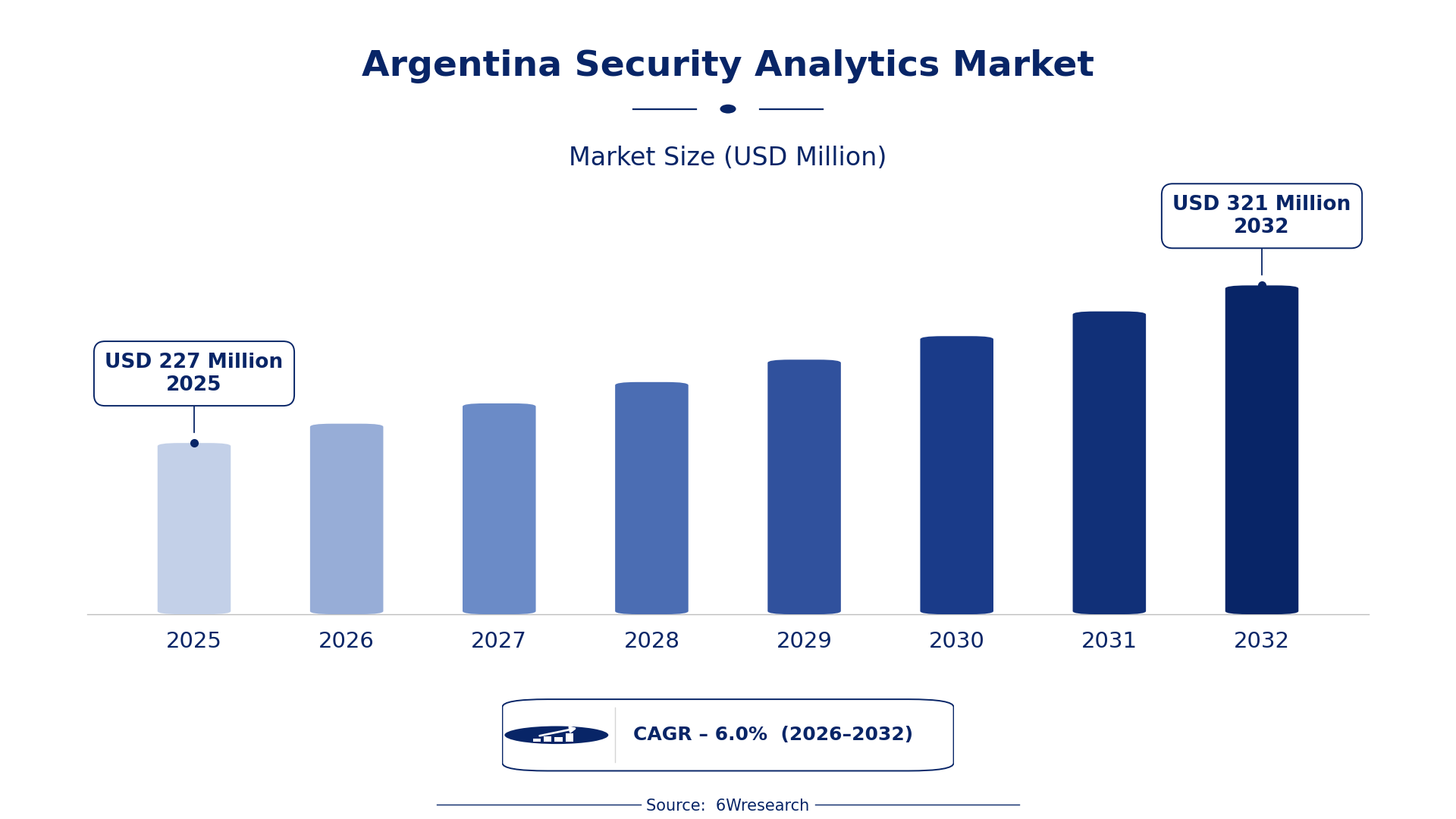
The Argentina Security Analytics Market was estimated at USD 227 Million in 2025 and is projected to reach USD 321 Million by 2032, growing at a CAGR of 6.0% from 2026 to 2032.
Argentina Security Analytics Market Synopsis
The Argentina Security Analytics Market is experiencing a period of notable expansion, driven by the urgent need for enhanced cybersecurity measures. As organizations face a wave of cyber threats, the demand for advanced security analytics tools has surged, pushing the market towards a promising trajectory.
With a growing emphasis on technologies like artificial intelligence and machine learning, Argentine companies are shifting their focus to proactive strategies that prioritize threat detection. This momentum not only reflects current vulnerabilities but also highlights the pivotal role of government regulations that mandate data protection, further incentivizing investment in security analytics.
Argentina Security Analytics Market Year-wise Growth Rate and Key Drivers
This graph illustrates the annual growth rates of the Argentina Security Analytics Market from 2021 to 2032, highlighting a steady upward trajectory and projected expansion over the forecast period.
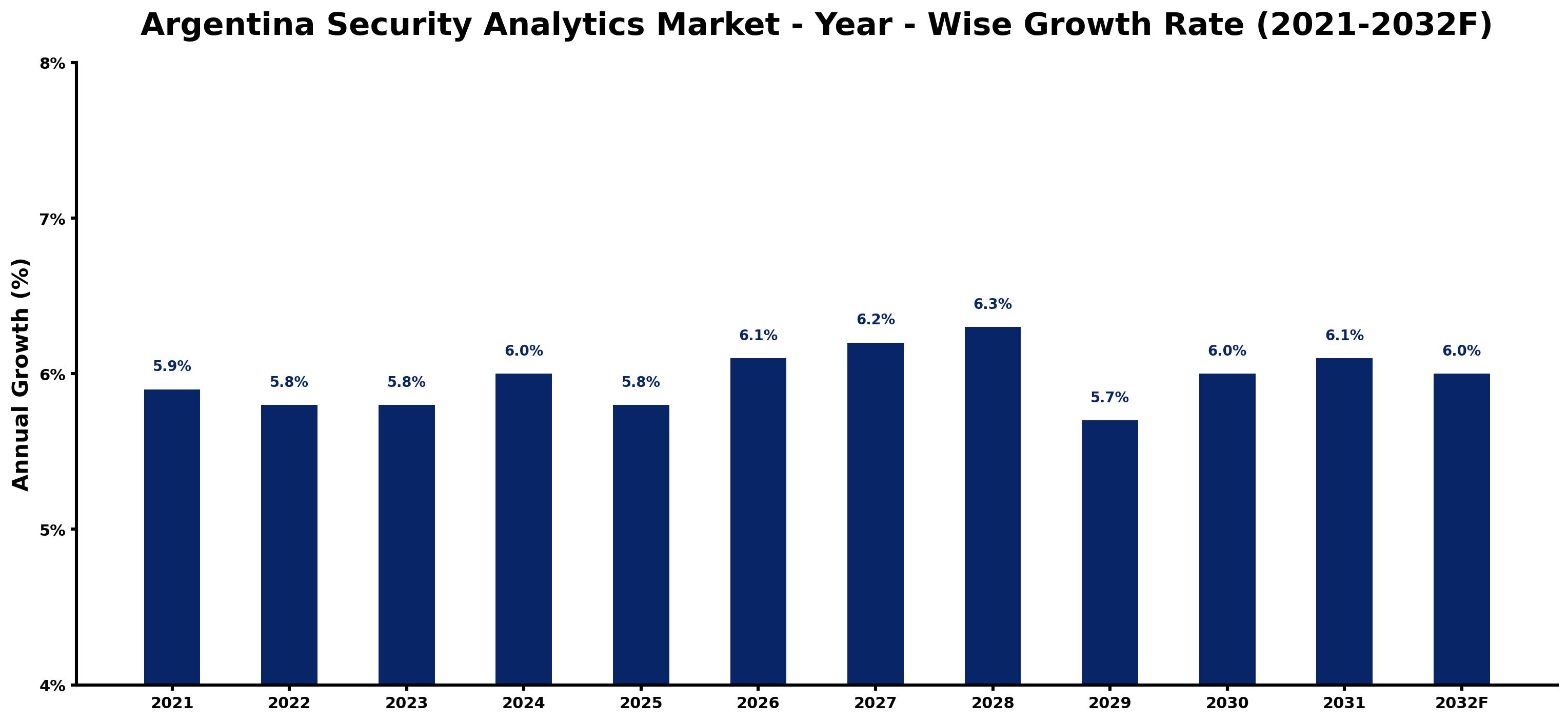
The table below presents the year‑wise growth rates along with the key drivers influencing the market
| Year | Growth Rate | Major Drivers |
| 2021 | 5.9% | New data privacy laws enhance demand for analytics. |
| 2022 | 5.8% | Local businesses investing in risk management solutions. |
| 2023 | 5.8% | Increased adoption of cloud services drives security needs. |
| 2024 | 6.0% | Government initiatives for securing critical infrastructure boost demand. |
| 2025 | 5.8% | Rapid growth in IoT devices escalates security analytics usage. |
| 2026 | 6.1% | Rising awareness of data breaches prompts analytics investment. |
| 2027 | 6.2% | Increased collaboration between tech firms and security agencies. |
| 2028 | 6.3% | Expanding digital infrastructure increases security analytics requirements. |
| 2029 | 5.7% | Regulatory incentives for cybersecurity investments attract businesses. |
| 2030 | 6.0% | Emergence of AI technologies in local security systems. |
| 2031 | 6.1% | Focus on urban security drives analytics market growth. |
| 2032 | 6.0% | Growing concerns over social unrest increase surveillance demand. |
Note: Market size estimations and growth projections presented in this report are based on 6Wresearch's proprietary forecasting methodology, utilizing the latest available industry data, government publications, and primary research inputs.
Argentina Security Analytics Market Key Takeaways
Below are some of the specific key takeaways from the market, including:
- The market is expected to see strong growth driven by the rising sophistication of cyber threats.
- Real-time monitoring and predictive analytics are becoming essential features in security analytics solutions.
- Cloud-based platforms are increasingly preferred for their scalability and flexibility.
- Investment opportunities exist in AI and machine learning to enhance security solutions.
- The finance, healthcare, and government sectors are leading adopters of security analytics tools.
Evaluation of Restraints in Argentina Security Analytics Market
The Argentina Security Analytics Market faces several constraints that could impede its growth trajectory. One of the primary challenges is compliance with stringent data protection regulations, particularly under the Personal Data Protection Law, which requires organizations to implement comprehensive security measures. Additionally, the escalating sophistication of cyber threats, such as ransomware attacks and advanced persistent threats, presents ongoing difficulties in timely detection and mitigation. Compounding these issues is the shortage of skilled cybersecurity professionals, which limits organizations' ability to effectively deploy and manage security analytics tools. Without addressing these barriers, the market's growth potential may remain constrained.
Argentina Security Analytics Market Trends
Emerging trends in the Argentina Security Analytics Market are reshaping how organizations approach cybersecurity. A notable shift is towards integrating threat intelligence with behavioral analytics, which allows companies to preemptively identify vulnerabilities. The increasing reliance on cloud solutions reflects a desire for adaptable security architectures, essential for handling fluctuating demands. Another trend is the growing focus on compliance with data privacy regulations, prompting businesses to invest in security analytics tools that ensure better governance and oversight of sensitive information.
Argentina Security Analytics Market Opportunities
The market is rife with investment opportunities, particularly as digital transformation accelerates across various sectors. Organizations are seeking solutions that not only enhance threat detection but also improve incident response times. Key areas for potential investment include user behavior analytics, threat intelligence platforms, and security information and event management (SIEM) solutions. on top of that, as local businesses partner with cybersecurity firms, there is an opening for innovative solutions tailored specifically to address regional security challenges.
Government Initiatives in the Argentina Security Analytics Market
Government policy plays a crucial role in shaping the Argentina Security Analytics Market. The Argentine government is actively implementing regulations aimed at enhancing data protection and privacy standards while encouraging investment in the cybersecurity sector. This proactive approach fosters collaboration between public and private entities to combat escalating cyber threats, making regulatory support essential for market development.
- A national digital infrastructure upgrade programme was launched in early 2023 to bolster cybersecurity readiness among businesses.
- A regulatory framework introduced in mid-2024 mandates enhanced security measures for organizations handling personal data.
- Current initiatives include the establishment of a public-private partnership focusing on workforce development to close the skills gap in cybersecurity.
- Upcoming plans for late 2025 include a nationwide cybersecurity awareness campaign aimed at educating businesses on best practices.
- A recently completed assessment of the national cybersecurity strategy aims to identify vulnerabilities within critical infrastructure.
Future Insights of the Argentina Security Analytics Market
Looking ahead to 2026-2032, the Argentina Security Analytics Market is set for continued growth, spurred by heightened cyber threats and stringent regulatory frameworks. As organizations increasingly prioritize cybersecurity, demand for advanced analytics solutions will likely escalate. The ongoing evolution of technology will further drive the need for agile tools capable of adapting to new threats. Greater awareness surrounding the importance of proactive security measures will solidify investments in this critical sector.
Argentina Security Analytics Market Latest Developments
Recent months have seen a surge in activity within the Argentina Security Analytics Market, reflecting both urgency and opportunity. Companies are rapidly advancing their cybersecurity capabilities in response to the escalating threat landscape, while new initiatives are emerging to bolster the sector's infrastructure.
- A major technology vendor announced a new security analytics platform in early 2025 aimed at small to medium-sized enterprises, designed to enhance accessibility.
- A collaborative effort began in mid-2025 between universities and tech firms to develop a training program focused on cybersecurity skills.
- By late 2025, a rollout of updated cloud-based security solutions is expected, enhancing scalability for local businesses.
- An initiative to conduct vulnerability assessments for government agencies is currently underway, aimed at strengthening public-sector defenses.
- A planned investment in AI-driven analytics technology is anticipated to commence in early 2026, targeting improved threat detection capabilities.
Argentina Security Analytics Market - Key Attractiveness of the Report
- 10 Years of Market Numbers
- Historical Data Starting from 2022 to 2025
- Base Year: 2025
- Forecast Data until 2032
- Key Performance Indicators Impacting the Market
- Major Upcoming Developments and Projects
Key Highlights of the Report:
- Argentina Security Analytics Market Outlook
- Market Size of Argentina Security Analytics Market, 2025
- Forecast of Argentina Security Analytics Market, 2032
- Historical Data and Forecast of Argentina Security Analytics Revenues & Volume for the Period 2022-2032F
- Argentina Security Analytics Market Trend Evolution
- Argentina Security Analytics Market Drivers and Challenges
- Argentina Security Analytics Price Trends
- Argentina Security Analytics Porter's Five Forces
- Argentina Security Analytics Industry Life Cycle
- Historical Data and Forecast of Argentina Security Analytics Market Revenues & Volume By Application for the Period 2022-2032F
- Historical Data and Forecast of Argentina Security Analytics Market Revenues & Volume By Web Security Analytics for the Period 2022-2032F
- Historical Data and Forecast of Argentina Security Analytics Market Revenues & Volume By Network Security Analytics for the Period 2022-2032F
- Historical Data and Forecast of Argentina Security Analytics Market Revenues & Volume By Endpoint SecurityAnalytics for the Period 2022-2032F
- Historical Data and Forecast of Argentina Security Analytics Market Revenues & Volume By Application Security Analytics for the Period 2022-2032F
- Historical Data and Forecast of Argentina Security Analytics Market Revenues & Volume By Others(Content Security, ICS Security, Database Security, Cloud Security) for the Period 2022-2032F
- Historical Data and Forecast of Argentina Security Analytics Market Revenues & Volume By Vertical for the Period 2022-2032F
- Historical Data and Forecast of Argentina Security Analytics Market Revenues & Volume By BFSI for the Period 2022-2032F
- Historical Data and Forecast of Argentina Security Analytics Market Revenues & Volume By Retail and eCommerce for the Period 2022-2032F
- Historical Data and Forecast of Argentina Security Analytics Market Revenues & Volume By Media and Entertainment for the Period 2022-2032F
- Historical Data and Forecast of Argentina Security Analytics Market Revenues & Volume By Travel and Hospitality for the Period 2022-2032F
- Historical Data and Forecast of Argentina Security Analytics Market Revenues & Volume By Telecom and IT for the Period 2022-2032F
- Historical Data and Forecast of Argentina Security Analytics Market Revenues & Volume By Healthcare for the Period 2022-2032F
- Historical Data and Forecast of Argentina Security Analytics Market Revenues & Volume By Others(automobile, government, and education) for the Period 2022-2032F
- Historical Data and Forecast of Argentina Security Analytics Market Revenues & Volume By Component for the Period 2022-2032F
- Historical Data and Forecast of Argentina Security Analytics Market Revenues & Volume By Platform for the Period 2022-2032F
- Historical Data and Forecast of Argentina Security Analytics Market Revenues & Volume By Services for the Period 2022-2032F
- Historical Data and Forecast of Argentina Security Analytics Market Revenues & Volume By Professional Services for the Period 2022-2032F
- Historical Data and Forecast of Argentina Security Analytics Market Revenues & Volume By Deployment Mode for the Period 2022-2032F
- Historical Data and Forecast of Argentina Security Analytics Market Revenues & Volume By Cloud for the Period 2022-2032F
- Historical Data and Forecast of Argentina Security Analytics Market Revenues & Volume By On-premises for the Period 2022-2032F
- Historical Data and Forecast of Argentina Security Analytics Market Revenues & Volume By Organization Size for the Period 2022-2032F
- Historical Data and Forecast of Argentina Security Analytics Market Revenues & Volume By Large enterprises for the Period 2022-2032F
- Historical Data and Forecast of Argentina Security Analytics Market Revenues & Volume By Small and medium-sized enterprises (SMEs) for the Period 2022-2032F
- Argentina Security Analytics Import Export Trade Statistics
- Market Opportunity Assessment By Application
- Market Opportunity Assessment By Vertical
- Market Opportunity Assessment By Component
- Market Opportunity Assessment By Deployment Mode
- Market Opportunity Assessment By Organization Size
- Argentina Security Analytics Top Companies Market Share
- Argentina Security Analytics Competitive Benchmarking By Technical and Operational Parameters
- Argentina Security Analytics Company Profiles
- Argentina Security Analytics Key Strategic Recommendations






































