Argentina Smartphone Market Summary
The argentina smartphone market was estimated at USD 469 Million in 2025 and is projected to reach USD 795 Million by 2032, growing at a CAGR of 9.0% from 2026 to 2032.
Argentina Smartphone Market Year-wise Growth Rate and Key Drivers
This graph highlights how the Argentina Smartphone Market has steadily grown over the past five years, supported by major growth factors.
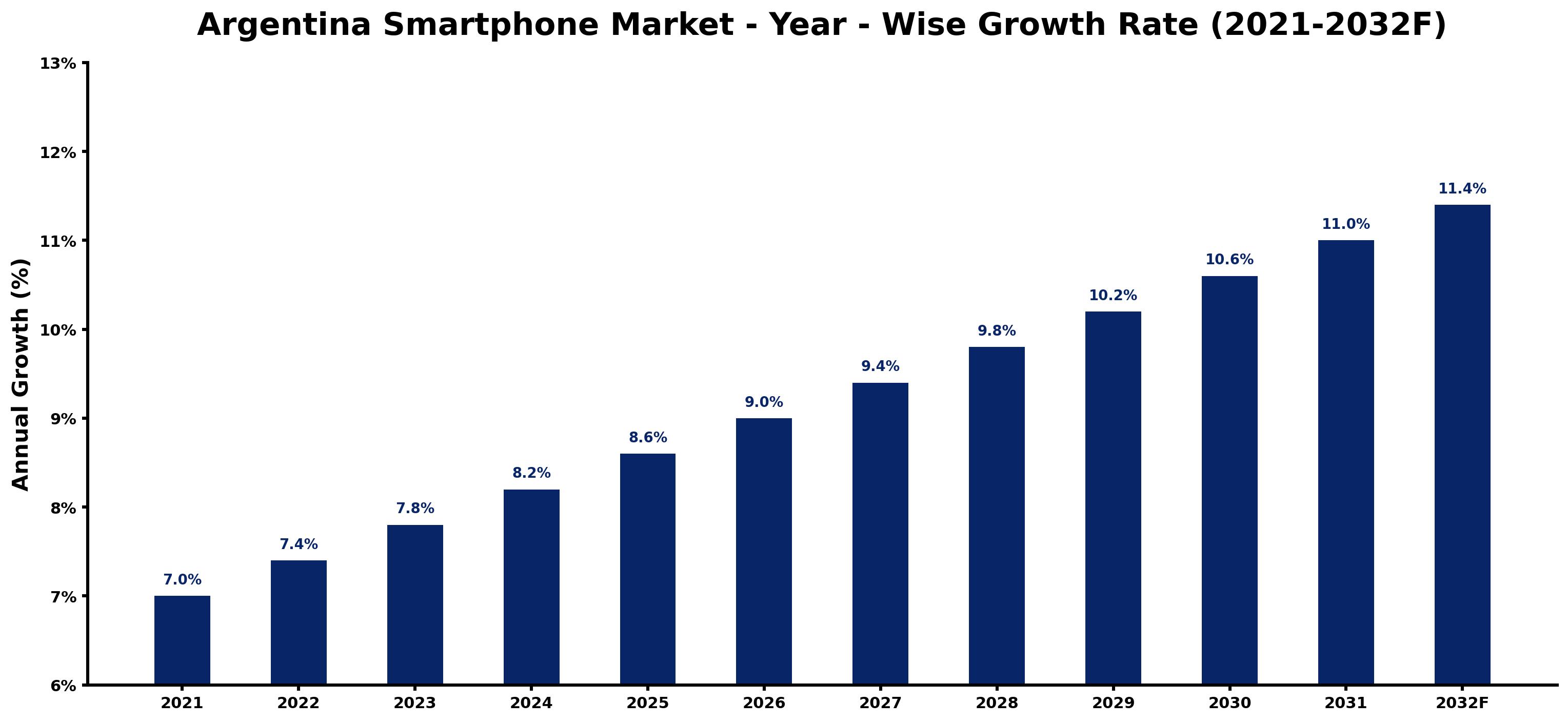
The table below presents the year wise growth rates along with the key drivers influencing the market
| Year | Growth Rate | Major Drivers |
| 2021 | 7.0% | Smartphone penetration in Argentina reached 85%, marking a significant consumer milestone. |
| 2022 | 7.4% | Mobile internet accessibility expanded in rural areas, boosting smartphone relevance and use. |
| 2023 | 7.8% | A vibrant app ecosystem emerged, meeting diverse needs from education to entertainment. |
| 2024 | 8.2% | Young demographics increasingly favor brands prioritizing sustainability and eco-friendly practices. |
| 2025 | 8.6% | Local manufacturers began enhancing production capacity, reducing dependence on foreign imports. |
| 2026 | 9.0% | 5G networks launched in major cities, enabling richer mobile experiences for users. |
| 2027 | 9.4% | E-commerce platforms integrated with mobile services, driving more online purchases via smartphones. |
| 2028 | 9.8% | Social media platforms leveraged mobile features, dramatically increasing user engagement statistics. |
| 2029 | 10.2% | Health apps gained popularity, reflecting a growing interest in digital wellness solutions. |
| 2030 | 10.6% | Consumer preferences shifted towards multifunctional devices, blending work and entertainment needs. |
| 2031 | 11.0% | Mobile payment adoption peaked, transforming traditional purchasing behaviors among consumers. |
| 2032 | 11.4% | Augmented reality applications became commonplace, enriching user experiences within various sectors. |
Note - Market size estimations and growth projections presented in this report are based on 6Wresearch's advanced forecasting approach, validated with industry datasets as of June 2026.
Argentina Smartphone Market Synopsis
The Argentina Smartphone Market is projected to reach 9.0% and witness significant growth during the forecast period (2026-2032). This positive trajectory is largely driven by a combination of factors, including rising disposable incomes, enhanced internet penetration, and a growing demand for high-end smartphones. These factors are further supported by the increasing levels of digitalization across various sectors of the economy. A crucial driver of this market is Argentina's youthful population, which demonstrates a strong affinity for technology and a heightened awareness of the latest advancements.
Argentina Smartphone Market Growth Drivers
The growth of the Argentina Smartphone Market can be attributed to several pivotal drivers:
- Increasing Disposable Income: The rise in household disposable income has facilitated consumer access to advanced smartphones, enabling greater market penetration.
- Growing Internet Penetration: With more people gaining access to the internet, the demand for smartphones that support high-speed connectivity has surged.
- Young Population: Argentina's demographic profile, characterized by a significant proportion of young individuals, is conducive to higher smartphone adoption rates.
- Technological Advancements: Continuous innovations in smartphone technology, such as enhanced camera features and improved processing power, are compelling consumers to upgrade their devices.
- Foreign Direct Investment: An increase in foreign investments within Argentina's telecommunications sector is expected to bolster market growth by improving infrastructure and availability.
Argentina Smartphone Market Trends and Opportunities
As the Argentina Smartphone Market evolves, several trends are emerging that present substantial opportunities for growth:
- Shift Towards Premium Devices: As consumer purchasing power increases, there is a noticeable shift towards high-end smartphones, which offer advanced features and superior performance.
- Focus on E-Commerce: The rising trend of e-commerce in Argentina is driving consumers to seek smartphones with better online shopping capabilities, thereby increasing demand.
- Digital Payment Solutions: With the proliferation of fintech solutions, consumers are increasingly utilizing smartphones for digital payments, further embedding these devices in daily life.
- Integration of AI and IoT: The growing integration of artificial intelligence and the Internet of Things into smartphones is creating a demand for devices that can seamlessly connect and interact with various technologies.
- Environmentally Sustainable Practices: There is a growing awareness and preference for environmentally friendly products, prompting manufacturers to explore sustainable materials and practices in smartphone production.
Argentina Smartphone Market Challenges and Restraints
Despite the positive outlook for the Argentina Smartphone Market, several challenges may impede growth:
- High Taxation Rates: Elevated taxation on imported smartphones can deter consumers from purchasing the latest models, affecting overall market dynamics.
- Economic Instability: Fluctuating economic conditions and inflation may cause uncertainty, leading consumers to delay purchasing decisions.
- Intense Competition: The presence of several regional players creates a highly competitive landscape, challenging domestic manufacturers to maintain market share.
- Supply Chain Disruptions: Global supply chain challenges could hinder the availability of components necessary for smartphone production, impacting overall market supply.
- Consumer Price Sensitivity: The economic environment may make consumers more cautious regarding spending, particularly on premium devices, thereby affecting sales volumes.
Argentina Smartphone Market Government Investment and Initiatives
The government of Argentina is actively promoting growth in the smartphone market through various initiatives and investment strategies. Key efforts include:
- Policy Reforms: The Argentine government is implementing policy reforms aimed at reducing barriers for foreign investment in the telecommunications sector, encouraging market growth.
- Public-Private Partnerships: Collaborative efforts between the government and private entities are being fostered to enhance telecommunications infrastructure, thereby supporting smartphone adoption.
- Digital Economy Initiatives: Strategic plans to promote the digital economy by investing in technology ecosystems are facilitating a conducive environment for smartphone proliferation.
- Incentives for Local Manufacturing: The government has introduced incentives to promote local manufacturing of smartphones, which aims to reduce import dependency and enhance domestic capabilities.
- Investment in Education: Initiatives aimed at enhancing digital literacy among the populace are essential for fostering a culture of technology adoption, thus driving the smartphone market forward.
Argentina Smartphone Market Latest Developments (May 2025 - June 2026)
The period from May 2025 to June 2026 has seen several noteworthy developments within the Argentina Smartphone Market. Increased governmental support for the digitalization process has been observed, with a focus on expanding internet accessibility in rural areas. This initiative aims to bridge the digital divide and expand smartphone usage among underrepresented populations. Additionally, there has been a consistent rise in consumer interest toward smartphones that integrate advanced features such as AI capabilities and enhanced security options. The competitive landscape has intensified as domestic manufacturers adapt to changing consumer preferences by introducing innovative designs and functionalities.
Argentina Smartphone Market - Key Attractiveness of the Report
- 10 Years of Market Numbers
- Historical Data Starting from 2022 to 2025
- Base Year: 2025
- Forecast Data until 2032
- Key Performance Indicators Impacting the Market
- Major Upcoming Developments and Projects
Key Highlights of the Report:
- Argentina Smartphone Market Outlook
- Market Size of Argentina Smartphone Market, 2025
- Forecast of Argentina Smartphone Market, 2032F
- Historical Data and Forecast of Argentina Smartphone Revenues & Volume for the Period 2022-2032F
- Argentina Smartphone Market Trend Evolution
- Argentina Smartphone Market Drivers and Challenges
- Argentina Smartphone Price Trends
- Argentina Smartphone Porter's Five Forces
- Argentina Smartphone Industry Life Cycle
- Historical Data and Forecast of Argentina Smartphone Market Revenues & Volume By Product Type for the Period 2022-2032F
- Historical Data and Forecast of Argentina Smartphone Market Revenues & Volume By Android for the Period 2022-2032F
- Historical Data and Forecast of Argentina Smartphone Market Revenues & Volume By iOS for the Period 2022-2032F
- Historical Data and Forecast of Argentina Smartphone Market Revenues & Volume By Windows for the Period 2022-2032F
- Historical Data and Forecast of Argentina Smartphone Market Revenues & Volume By Blackberry Operating System for the Period 2022-2032F
- Historical Data and Forecast of Argentina Smartphone Market Revenues & Volume By Other for the Period 2022-2032F
- Historical Data and Forecast of Argentina Smartphone Market Revenues & Volume By Distribution Channel for the Period 2022-2032F
- Historical Data and Forecast of Argentina Smartphone Market Revenues & Volume By OEM for the Period 2022-2032F
- Historical Data and Forecast of Argentina Smartphone Market Revenues & Volume By Retailer for the Period 2022-2032F
- Historical Data and Forecast of Argentina Smartphone Market Revenues & Volume By e-Commerce for the Period 2022-2032F
- Argentina Smartphone Import Export Trade Statistics
- Market Opportunity Assessment By Product Type
- Market Opportunity Assessment By Distribution Channel
- Argentina Smartphone Top Companies Market Share
- Argentina Smartphone Competitive Benchmarking By Technical and Operational Parameters
- Argentina Smartphone Company Profiles
- Argentina Smartphone Key Strategic Recommendations






































