Australia Artificial Intelligence (AI) Market Size & Growth Rate (2026-2032)
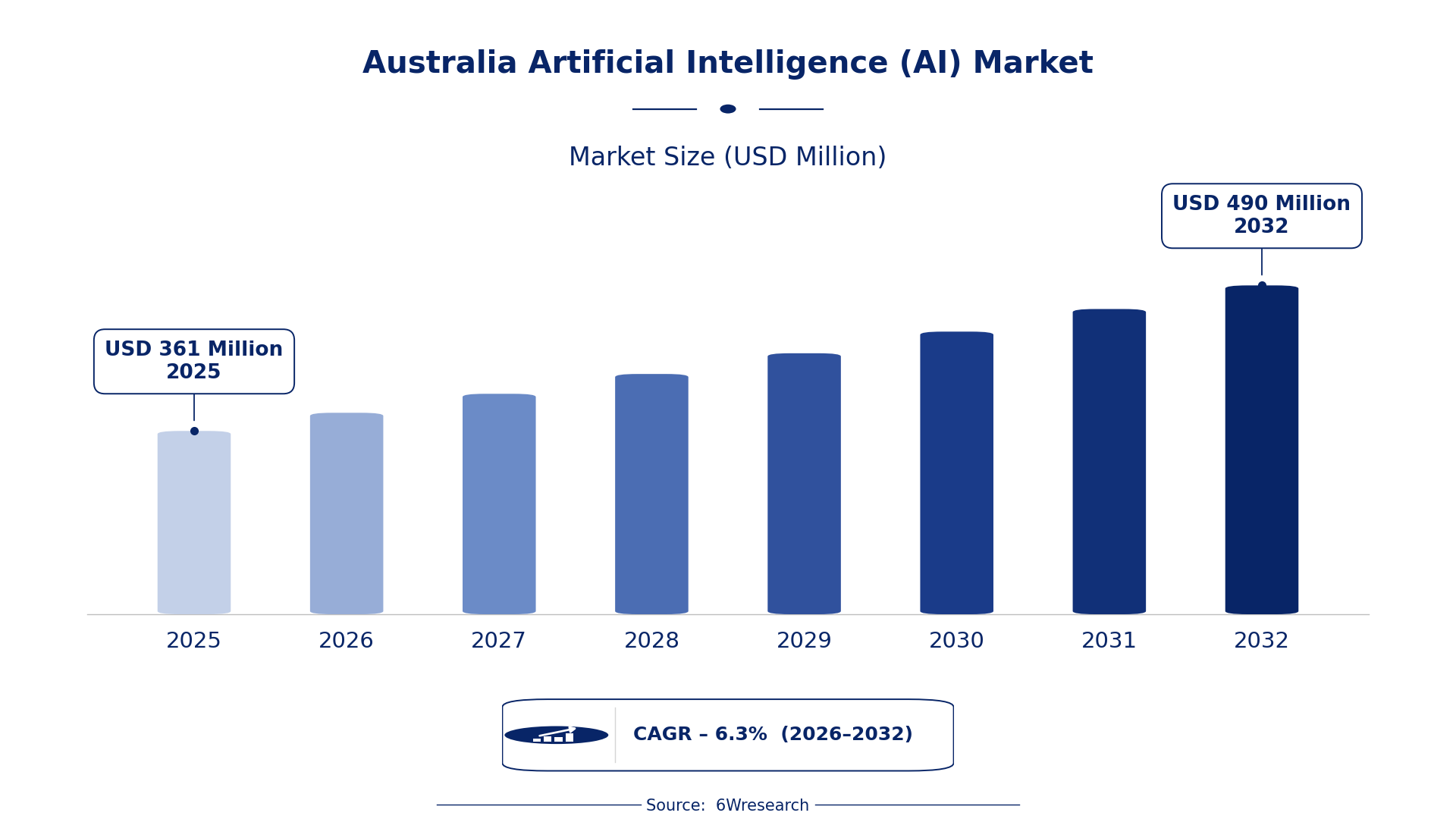
The Australia Artificial Intelligence (AI) Market was estimated at USD 361 Million in 2025 and is projected to reach USD 490 Million by 2032, growing at a CAGR of 6.3% from 2026 to 2032.
Australia Artificial Intelligence (AI) Market Synopsis
The Australia Artificial Intelligence (AI) Market is currently experiencing a surge in adoption, driven by advancements in technology and an increasing appetite for data-driven solutions. However, as we look ahead, the focus is shifting toward ethical AI practices and addressing regulatory frameworks that will shape the future of this market.
As sectors like healthcare, finance, and retail increasingly integrate AI technologies, the demand for innovative applications is on the rise. Companies are not just looking for automation; they are seeking smarter, more efficient systems that deliver measurable results. This creates a dynamic environment ripe for growth, albeit with challenges that must be addressed.
Australia Artificial Intelligence (AI) Market Year-wise Growth Rate and Key Drivers
This graph illustrates the annual growth rates of the Australia Artificial Intelligence (AI) Market from 2021 to 2032, highlighting a steady upward trajectory and projected expansion over the forecast period.
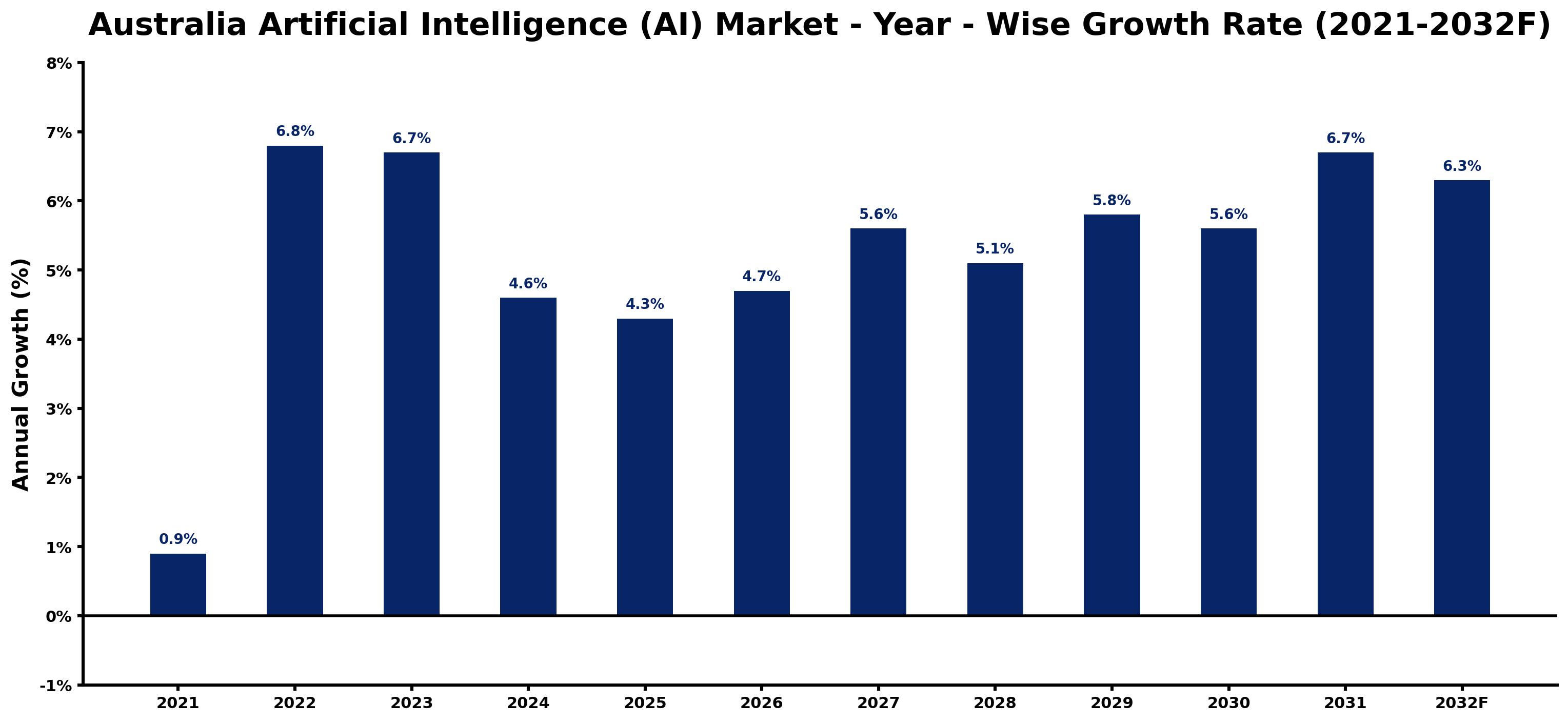
The table below presents the year‑wise growth rates along with the key drivers influencing the market
| Year | Growth Rate | Major Drivers |
| 2021 | 0.9% | AI Ethics Framework by Australian Government boosts adoption. |
| 2022 | 6.8% | Increased investment in AI startups via local venture funds. |
| 2023 | 6.7% | AI-driven agriculture solutions addressing labor shortages. |
| 2024 | 4.6% | Government funding for AI research in healthcare sector. |
| 2025 | 4.3% | Rise in AI applications for mining efficiency improvements. |
| 2026 | 4.7% | Public sector embrace of AI for service delivery. |
| 2027 | 5.6% | Integration of AI in educational tools for remote learning. |
| 2028 | 5.1% | Local enterprises adopting AI for customer experience enhancements. |
| 2029 | 5.8% | Partnerships between universities and tech firms drive innovation. |
| 2030 | 5.6% | Increased AI usage in predictive analytics for retail. |
| 2031 | 6.7% | Legislative support for AI in smart city initiatives. |
| 2032 | 6.3% | Focus on AI for sustainability in agriculture practices. |
Note: Market size estimations and growth projections presented in this report are based on 6Wresearch's proprietary forecasting methodology, utilizing the latest available industry data, government publications, and primary research inputs.
Australia Artificial Intelligence (AI) Market Key Takeaways
Below are some of the specific key takeaways from the market, including:
- Adoption of AI technologies is accelerating across multiple sectors, enhancing operational efficiency.
- Government initiatives are providing a structured framework to foster AI innovation and research.
- Ethical considerations and data privacy are becoming central to AI deployment strategies.
- Investment in AI solutions is being driven by the need for improved decision-making capabilities.
- Challenges remain, particularly regarding data security and regulatory compliance.
Evaluation of Restraints in Australia Artificial Intelligence (AI) Market
Despite the momentum in the Australia Artificial Intelligence (AI) Market, several restraints hinder its growth. Data privacy and security concerns are paramount, creating hesitancy among businesses when adopting AI solutions. on top of that, interoperability issues between existing systems and new AI technologies can lead to inefficiencies and increased costs. The skepticism surrounding outsourced AI capabilities also complicates the landscape, as companies grapple with demonstrating a clear return on investment while adhering to stringent regulatory standards.
Australia Artificial Intelligence (AI) Market Trends
Several trends are shaping the Australia Artificial Intelligence (AI) Market. Firstly, there is a significant push towards AI-powered data analytics, as organizations seek to derive actionable insights from vast data pools. The growing emphasis on ethical AI is also noteworthy, with companies prioritizing transparent algorithms and fairness in AI applications. on top of that, the rise of AI as a service (AIaaS) is making AI technologies more accessible to small and medium-sized enterprises, democratizing innovation.
Australia Artificial Intelligence (AI) Market Opportunities
Opportunities abound in the Australia Artificial Intelligence (AI) Market. The healthcare sector is particularly ripe for growth, with AI applications enhancing patient care and streamlining operations. Additionally, financial institutions are increasingly adopting AI for fraud detection and risk management, creating a demand for specialized solutions. As the government continues to invest in AI research and development, public-private partnerships are likely to emerge, providing further avenues for innovation and investment.
Government Initiatives in the Australia Artificial Intelligence (AI) Market
The Australian government recognizes the strategic significance of artificial intelligence and is actively implementing policies to bolster its development. Through various initiatives, the government aims to create a conducive environment for AI research and innovation, ensuring that ethical considerations are integrated into AI applications. This proactive stance is crucial for maintaining competitiveness on a global scale.
- A recent initiative includes the AI Action Plan launched in 2023, focusing on enhancing AI research capabilities across universities.
- A national digital infrastructure upgrade programme is currently underway, aimed at improving connectivity and accessibility for AI technologies.
- Planned for 2025 is a regulatory framework designed to ensure accountability and transparency in AI deployments across various sectors.
- The establishment of an AI advisory committee in 2024 will oversee the ethical implications of AI applications in public services.
- Investment in a national AI talent development programme is set to commence in 2026, aiming to upskill the workforce for future demands.
Future Insights of the Australia Artificial Intelligence (AI) Market
Looking ahead to 2026-2032, the Australia Artificial Intelligence (AI) Market is expected to witness robust growth driven by continuous advancements in technology and a deeper integration of AI across industries. Businesses will increasingly rely on AI for strategic decision-making, pushing the boundaries of innovation. As ethical AI practices become standard, organizations that prioritize responsible AI usage will likely gain a competitive advantage. put simply, the future holds significant promise for AI in Australia, contingent on addressing the challenges ahead.
Australia Artificial Intelligence (AI) Market Latest Developments
Over the past year, the Australia Artificial Intelligence (AI) Market has seen a flurry of activity, reflecting a strong commitment to innovation and ethical practices. Companies are not only enhancing their AI capabilities but also working closely with regulatory bodies to ensure compliance and accountability in their AI solutions.
- A major technology vendor announced a partnership in early 2025 to develop AI-driven healthcare solutions aimed at improving patient outcomes.
- An ongoing initiative, launched in Q3 2024, focuses on integrating AI technologies within public transportation systems to enhance efficiency and user experience.
- A rollout of AI-powered analytics tools is expected to begin in mid-2026, targeting the financial sector for improved fraud detection.
- In late 2025, a regional operator completed an upgrade of its AI infrastructure, enabling faster data processing capabilities.
- Upcoming in 2027 is a collaborative project between universities and industry leaders aimed at advancing AI research in sustainable technologies.
Australia Artificial Intelligence (AI) Market - Key Attractiveness of the Report
- 10 Years of Market Numbers
- Historical Data Starting from 2022 to 2025
- Base Year: 2025
- Forecast Data until 2032
- Key Performance Indicators Impacting the Market
- Major Upcoming Developments and Projects
Key Highlights of the Report:
- Australia Artificial Intelligence (AI) Market Outlook
- Market Size of Australia Artificial Intelligence (AI) Market, 2025
- Forecast of Australia Artificial Intelligence (AI) Market, 2032
- Historical Data and Forecast of Australia Artificial Intelligence (AI) Revenues & Volume for the Period 2022-2032F
- Australia Artificial Intelligence (AI) Market Trend Evolution
- Australia Artificial Intelligence (AI) Market Drivers and Challenges
- Australia Artificial Intelligence (AI) Price Trends
- Australia Artificial Intelligence (AI) Porter's Five Forces
- Australia Artificial Intelligence (AI) Industry Life Cycle
- Historical Data and Forecast of Australia Artificial Intelligence (AI) Market Revenues & Volume By Offering for the Period 2022-2032F
- Historical Data and Forecast of Australia Artificial Intelligence (AI) Market Revenues & Volume By Hardware for the Period 2022-2032F
- Historical Data and Forecast of Australia Artificial Intelligence (AI) Market Revenues & Volume By Software for the Period 2022-2032F
- Historical Data and Forecast of Australia Artificial Intelligence (AI) Market Revenues & Volume By Services for the Period 2022-2032F
- Historical Data and Forecast of Australia Artificial Intelligence (AI) Market Revenues & Volume By Technology for the Period 2022-2032F
- Historical Data and Forecast of Australia Artificial Intelligence (AI) Market Revenues & Volume By Machine Learning for the Period 2022-2032F
- Historical Data and Forecast of Australia Artificial Intelligence (AI) Market Revenues & Volume By Natural Language Processing for the Period 2022-2032F
- Historical Data and Forecast of Australia Artificial Intelligence (AI) Market Revenues & Volume By Context-Aware Computing for the Period 2022-2032F
- Historical Data and Forecast of Australia Artificial Intelligence (AI) Market Revenues & Volume By Computer Vision for the Period 2022-2032F
- Historical Data and Forecast of Australia Artificial Intelligence (AI) Market Revenues & Volume By Business Function for the Period 2022-2032F
- Historical Data and Forecast of Australia Artificial Intelligence (AI) Market Revenues & Volume By Finance for the Period 2022-2032F
- Historical Data and Forecast of Australia Artificial Intelligence (AI) Market Revenues & Volume By Security for the Period 2022-2032F
- Historical Data and Forecast of Australia Artificial Intelligence (AI) Market Revenues & Volume By Human Resources for the Period 2022-2032F
- Historical Data and Forecast of Australia Artificial Intelligence (AI) Market Revenues & Volume By Law for the Period 2022-2032F
- Historical Data and Forecast of Australia Artificial Intelligence (AI) Market Revenues & Volume By Marketing and Sales for the Period 2022-2032F
- Historical Data and Forecast of Australia Artificial Intelligence (AI) Market Revenues & Volume By Other Business Function (IT operations) for the Period 2022-2032F
- Historical Data and Forecast of Australia Artificial Intelligence (AI) Market Revenues & Volume By Deployment Mode for the Period 2022-2032F
- Historical Data and Forecast of Australia Artificial Intelligence (AI) Market Revenues & Volume By On-premises for the Period 2022-2032F
- Historical Data and Forecast of Australia Artificial Intelligence (AI) Market Revenues & Volume By Cloud for the Period 2022-2032F
- Historical Data and Forecast of Australia Artificial Intelligence (AI) Market Revenues & Volume By Organization Size for the Period 2022-2032F
- Historical Data and Forecast of Australia Artificial Intelligence (AI) Market Revenues & Volume By Large Enterprises for the Period 2022-2032F
- Historical Data and Forecast of Australia Artificial Intelligence (AI) Market Revenues & Volume By SMEs for the Period 2022-2032F
- Historical Data and Forecast of Australia Artificial Intelligence (AI) Market Revenues & Volume By Verticals for the Period 2022-2032F
- Historical Data and Forecast of Australia Artificial Intelligence (AI) Market Revenues & Volume By BFSI for the Period 2022-2032F
- Historical Data and Forecast of Australia Artificial Intelligence (AI) Market Revenues & Volume By IT/ ITES for the Period 2022-2032F
- Historical Data and Forecast of Australia Artificial Intelligence (AI) Market Revenues & Volume By Telecommunication for the Period 2022-2032F
- Historical Data and Forecast of Australia Artificial Intelligence (AI) Market Revenues & Volume By Government and Defense for the Period 2022-2032F
- Historical Data and Forecast of Australia Artificial Intelligence (AI) Market Revenues & Volume By Manufacturing for the Period 2022-2032F
- Historical Data and Forecast of Australia Artificial Intelligence (AI) Market Revenues & Volume By Healthcare and Lifesciences for the Period 2022-2032F
- Historical Data and Forecast of Australia Artificial Intelligence (AI) Market Revenues & Volume By Retail and Ecommerce for the Period 2022-2032F
- Historical Data and Forecast of Australia Artificial Intelligence (AI) Market Revenues & Volume By Automotive, Transportation & Logistics for the Period 2022-2032F
- Australia Artificial Intelligence (AI) Import Export Trade Statistics
- Market Opportunity Assessment By Offering
- Market Opportunity Assessment By Technology
- Market Opportunity Assessment By Business Function
- Market Opportunity Assessment By Deployment Mode
- Market Opportunity Assessment By Organization Size
- Market Opportunity Assessment By Verticals
- Australia Artificial Intelligence (AI) Top Companies Market Share
- Australia Artificial Intelligence (AI) Competitive Benchmarking By Technical and Operational Parameters
- Australia Artificial Intelligence (AI) Company Profiles
- Australia Artificial Intelligence (AI) Key Strategic Recommendations






































