Australia Cybersecurity Market Growth Rate
According to 6Wresearch internal databases and industry insights, Australia Cybersecurity Market is projected to grow at a steady compound annual growth rate (CAGR) of 7.4% during the forecast period 2026–2032.
Australia Cybersecurity Market Year-wise Growth Rate and Key Drivers (2022-2032)
This graph illustrates the annual growth rates of the Australia Cybersecurity Market from 2022 to 2032, highlighting a steady upward trajectory and projected market expansion over the forecast period.
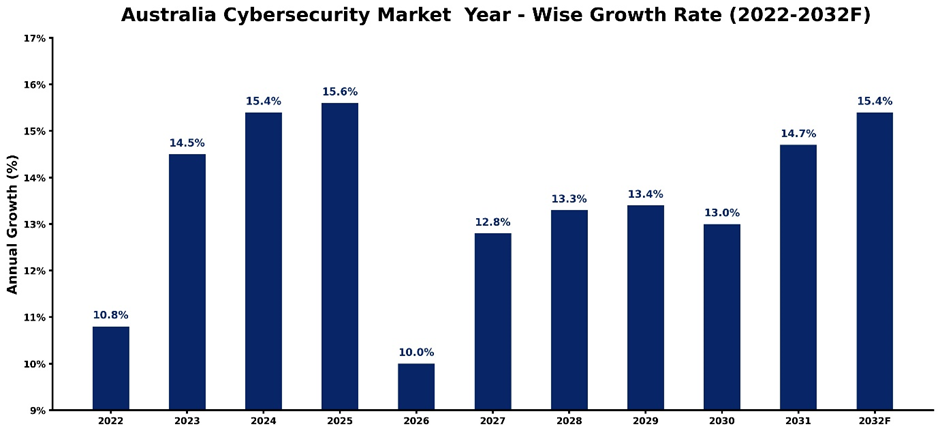 The following table summarizes the historical and forecasted growth rates of Australia Cybersecurity Market, along with the rationale behind each year’s performance.
| Year | Estimated Growth (%) | Market Rationale |
| 2022 | 10.8% | Growth driven by increased ransomware attacks and rising cybersecurity awareness among Australian businesses. |
| 2023 | 14.5% | Strong growth due to major cyber incidents and higher enterprise security investments. |
| 2024 | 15.4% | Expansion supported by demand for endpoint security and compliance solutions. |
| 2025 | 15.6% | Growth continues due to AI adoption and stronger cybersecurity regulations. |
| 2026 | 10% | Growth moderates but remains positive due to AI-driven threat detection and continued enterprise spending. |
| 2027 | 12.8% | Increasing adoption of cloud security and automated cybersecurity platforms drives market expansion. |
| 2028 | 13.3% | Growth supported by AI-powered cybersecurity tools and protection against AI-generated cyberattacks. |
| 2029 | 13.4% | Rising IoT adoption and stronger data protection requirements increase cybersecurity demand. |
| 2030 | 13.4% | Continued growth from cloud workload protection and enterprise cyber resilience programs. |
| 2031 | 14.7% | Market expands due to cyber insurance requirements and evolving threat landscapes. |
| 2032 | 15.4% | Long-term growth supported by continuous cyber threats and increasing cybersecurity investments. |
Topics Covered in the Australia Cybersecurity Market Report
The Australia Cybersecurity Market report thoroughly covers the market by security type, deployment and end-user. The report provides an unbiased and detailed analysis of ongoing market trends, emerging opportunities/high growth areas, and key market drivers, which would help stakeholders develop and align their cybersecurity strategies according to current and future market dynamics.
Australia Cybersecurity Market Highlights
| Report Name | Australia Cybersecurity Market |
| Forecast period | 2026-2032 |
| CAGR | 7.4% |
| Growing Sector | BFSI (Banking, Financial Services, and Insurance) |
Australia Cybersecurity Market Synopsis
Australia Cybersecurity Market will experience structural progress, supported by rising digital threats, rapid digital transformation, and increasing adoption of cloud-based services across enterprises. Due to regulatory reforms, enterprise security investments, and increasing requirement for advanced security solutions, Australia has emerged as one of the leading cybersecurity markets in the Asia-Pacific region. In addition, the growing adoption of artificial intelligence (AI) has accelerated cybersecurity spending across industries such as BFSI and critical infrastructure.
Evaluation of Growth Drivers in Australia Cybersecurity Market (2026–2032)
Below are the major drivers influencing market dynamics:
| Drivers | Primary Segment Affected | Why It Matters (Evidence) |
| Rising Cyber Threats & Ransomware Attacks | Endpoint Security, Managed Security Services | Increasing frequency of data breaches is pushing organizations to strengthen security infrastructure. |
| Cloud Adoption & Digital Transformation | Cloud Security, Identity Access Management (IAM), Data Security | Boost in demand for cloud-native security solutions, as enterprises are shifting workloads to cloud platforms. |
| AI-Powered Cybersecurity & Advanced Threat Detection | AI Security, Security Analytics, SOC Solutions | Adoption of machine learning-based threat detection need to enhance due to growing AI-driven cyberattacks. |
| Government Cybersecurity Initiatives & Regulations | Government, Critical Infrastructure, Enterprise Security | Organizations are encouraged to increase security investments by national cybersecurity strategies. |
| Growth of Managed Security Services (MSS) | SMEs, Large Enterprises, Cloud Security | Businesses outsource security monitoring and compliance activities, due to cybersecurity skill shortages. |
The Australia Cybersecurity Market is projected to rise at a CAGR of 7.4% during 2026–2032. Rising cyber risks, cloud adoption, AI-driven security solutions, and regulatory requirements are the primary factors for the market progress. Australia reported over 94,000 cybercrime reports, which questions the security management among organizations. The country’s digital economy, strong enterprise technology adoption, and growing investments in critical infrastructure protection are accelerating requirement for upgraded cybersecurity solutions.
Evaluation of Restraints in Australia Cybersecurity Market
Below are the major restraints influencing market dynamics:
| Restraints | Primary Segment Affected | What This Means (Evidence) |
| Cybersecurity Talent Shortage | Security Operations, Managed Services, Enterprise Security | Limited availability of skilled cybersecurity professionals increases operational costs. |
| High Cost of Advanced Security Solutions | SMEs & Mid-Sized Enterprises | Advanced AI security platforms and compliance solutions require significant investment. |
| Complex Regulatory Environment | Enterprises, Financial Services, Healthcare | Operational expenses surged due to changing cybersecurity regulations and compliance requirements. |
| Integration Challenges with Legacy Systems | Large Enterprises & Government Organizations | Modern security frameworks and zero-trust architectures implementing hindered by older IT infrastructure. |
| Budget Constraints During Economic Slowdowns | SMEs & Non-Critical Industries | Cybersecurity upgrades slow down, due to reduced IT spending during economic uncertainty. |
Australia Cybersecurity Market Challenges
The market restricted by various challenges which include a cybersecurity workforce gap of more than 30,000 professionals and increasing complexity of digital threats. Organizations keep on struggling with implementing advanced cybersecurity frameworks due to high costs, integration issues, and limited internal expertise, in spite of the Australia cybersecurity market growth momentum. Furthermore, the rapid adoption of AI increases the sophistication of cyberattacks, creating need for continuous security upgrades and advanced threat monitoring capabilities.
Australia Cybersecurity Market Trends
Key trends shaping the Australia cybersecurity market are outlined below:
- AI-Driven Cybersecurity Adoption: Organizations are increasingly deploying AI-powered security solutions for automated threat detection and faster incident response against sophisticated cyberattacks.
- Zero Trust Security Implementation: Enterprises are accepting zero-trust frameworks to enlarge identity verification, access control, and protection of sensitive business data across hybrid environments.
- Growth of Managed Security Services (MSS): Due to rising threats and shortages of skilled security professionals, businesses, especially SMEs, are actively outsourcing cybersecurity operations.
- Cloud Security Expansion: Need for cloud workload protection, identity management, and data security solutions increased due to rapid shift toward cloud platforms.
Investment Opportunities in Australia Cybersecurity Market
Potential investment opportunities in the Australia cybersecurity market include the following:
- Managed Security Service Providers (MSSPs): Cybersecurity service providers who offers monitoring, compliance, and incident response solutions will be in demand among SMEs and enterprises.
- Cloud Security Infrastructure: Funding required in cloud-native security platforms, identity management, and data protection technologies due to expansion of cloud adoption.
- Cybersecurity for Critical Infrastructure: Specialized cybersecurity solutions market needs funding due to government focus on protecting energy, healthcare, and defense.
- Cybersecurity Startups & Innovation Ecosystem: Investment potential lies in AI security, privacy technologies, and next-generation threat prevention platforms as Australia’s technology ecosystem grows.
Top Leading Players in Australia Cybersecurity Market
A comprehensive list of major companies operating in the Australia cybersecurity market is provided below:
| Company Name | CyberCX |
|---|---|
| Established Year | 2019 |
| Headquarters | Melbourne, Australia |
| Official Website | Click Here |
Australia’s largest homegrown pure-play cybersecurity provider, delivering enterprise security consulting, cloud security, managed security services.
2. Tesserent (Thales Group)
| Company Name | Tesserent (Thales Group) |
|---|---|
| Established Year | 1988 |
| Headquarters | Melbourne, Australia |
| Official Website | Click Here |
A leading Australian cybersecurity and managed security service provider, supporting government agencies, critical infrastructure operators, and large.
3. Palo Alto Networks
| Company Name | Palo Alto Networks |
|---|---|
| Established Year | 2005 |
| Headquarters | Santa Clara, California, USA |
| Official Website | Click Here |
A global cybersecurity leader providing AI-powered network security, zero-trust solutions, and next-generation firewall technologies widely adopted across Australian enterprises.
4. CrowdStrike
| Company Name | CrowdStrike |
|---|---|
| Established Year | 2011 |
| Headquarters | Austin, Texas, USA |
| Official Website | Click Here |
A leading cloud-native cybersecurity company offering the Falcon platform for endpoint protection, managed detection and response, and advanced incident response capabilities.
5. Microsoft
| Company Name | Microsoft |
|---|---|
| Established Year | 1975 |
| Headquarters | Redmond, Washington, USA |
| Official Website | Click Here |
A major cybersecurity provider offering integrated security solutions such as Microsoft Defender, Microsoft Sentinel, and Microsoft Purview, widely used by Australian enterprises.
Government Initiatives Introduced in the Australia Cybersecurity Market
According to the Australian government data, numerous programs are introduced to intensify the cybersecurity ecosystem, that holds, the 2023–2030 Australian Cyber Security Strategy, which aims to make Australia one of the most cyber-secure nations by 2030. The Australia Cybersecurity Market size will be extended by focusing on ransomware prevention, critical infrastructure protection, cyber resilience, and stronger partnership between government and industry. These initiatives are accelerating cybersecurity adoption across government, enterprises, and critical sectors.
Future Insights of the Australia Cybersecurity Market
The market is estimated to witness consistent progress during the forecast period, backed by rising digital threat, AI adoption, cloud expansion, and regulatory compliance requirements. To hike the Australia Cybersecurity Market revenue, future investments must focus on AI-powered threat detection, zero-trust architecture, managed security services, and critical infrastructure protection. Australia reported more than 94,000 cybercrime incidents in 2023, which highlights increasing need for upgraded security solutions. Government initiatives targeting cybersecurity resilience will further accelerate adoption across enterprises and public sectors.
Market Segmentation Analysis
This report presents a detailed analysis of the market segments along with their leading categories:
By Security Type - Cloud Led the Market and Identity Access Management (IAM) Set for Rapid Growth
According to Vasudha, Senior Research Analyst, 6Wresearch, by security type, in 2025, Cloud commanded the Australia Cybersecurity Market, accounting for 26% of market share, due to rapid cloud migration and hybrid infrastructure adoption. Conversely, by 2032, Identity Access Management (IAM) will lead with a CAGR of 15%, influenced by zero-trust security adoption and rising identity-based attacks.
By Deployment - Cloud Dominated the Market and Set for Rapid Expansion
By Deployment, with 65% of market share, and due to rapid cloud adoption and digital transformation initiatives, Cloud led the Australia Cybersecurity Market, in 2025. And Cloud will command with a CAGR of 15% during 2026-2032, supported by hybrid cloud expansion and AI workloads.
By End-User - Government and Defense Led the Market and BFSI (Banking, Financial Services, and Insurance) Set for Rapid Growth
By End-User, Government and Defense dominated the Australia Cybersecurity Market, accounting for 25% of market share in 2025, due to rising digital threats that targets national security, critical infrastructure protection requirements, and increased government cybersecurity investments,. However, during 2026-2032, BFSI (Banking, Financial Services, and Insurance) will lead the market with an CAGR of 15%, backed by rising financial fraud risks and digital banking acceptance.
Note: Market size estimations and growth projections presented in this report are based on 6Wresearch's proprietary forecasting methodology, utilizing the latest available industry data, government publications, and primary research inputs.
Key Attractiveness of the Report:
- 10 Years of Market Numbers
- Historical Data Starting from 2022 to 2025
- Base Year: 2025
- Forecast Data until 2032
- Key Performance Indicators Impacting the Market
- Major Upcoming Developments and Projects
Key Highlights of the Report:
- Australia Cybersecurity Market Outlook
- Market Size of Australia Cybersecurity Market, 2025
- Forecast of Australia Cybersecurity Market, 2032
- Historical Data and Forecast of Australia Cybersecurity Revenues & Volume for the Period 2022-2032
- Australia Cybersecurity Market Trend Evolution
- Australia Cybersecurity Market Drivers and Challenges
- Australia Cybersecurity Price Trends
- Australia Cybersecurity Porter's Five Forces
- Australia Cybersecurity Industry Life Cycle
- Historical Data and Forecast of Australia Cybersecurity Market Revenues & Volume By Security Type for the Period 2022-2032
- Historical Data and Forecast of Australia Cybersecurity Market Revenues & Volume By Cloud Security for the Period 2022-2032
- Historical Data and Forecast of Australia Cybersecurity Market Revenues & Volume By Data Security for the Period 2022-2032
- Historical Data and Forecast of Australia Cybersecurity Market Revenues & Volume By Identity Access Management for the Period 2022-2032
- Historical Data and Forecast of Australia Cybersecurity Market Revenues & Volume By Network Security for the Period 2022-2032
- Historical Data and Forecast of Australia Cybersecurity Market Revenues & Volume By Consumer Security for the Period 2022-2032
- Historical Data and Forecast of Australia Cybersecurity Market Revenues & Volume By Infrastructure Protection for the Period 2022-2032
- Historical Data and Forecast of Australia Cybersecurity Market Revenues & Volume By Others for the Period 2022-2032
- Historical Data and Forecast of Australia Cybersecurity Market Revenues & Volume By Deployment for the Period 2022-2032
- Historical Data and Forecast of Australia Cybersecurity Market Revenues & Volume By Cloud for the Period 2022-2032
- Historical Data and Forecast of Australia Cybersecurity Market Revenues & Volume By On-Premise for the Period 2022-2032
- Historical Data and Forecast of Australia Cybersecurity Market Revenues & Volume By End-User for the Period 2022-2032
- Historical Data and Forecast of Australia Cybersecurity Market Revenues & Volume By BFSI for the Period 2022-2032
- Historical Data and Forecast of Australia Cybersecurity Market Revenues & Volume By Healthcare for the Period 2022-2032
- Historical Data and Forecast of Australia Cybersecurity Market Revenues & Volume By Manufacturing for the Period 2022-2032
- Historical Data and Forecast of Australia Cybersecurity Market Revenues & Volume By Government and Defense for the Period 2022-2032
- Historical Data and Forecast of Australia Cybersecurity Market Revenues & Volume By IT and Telecommunication for the Period 2022-2032
- Historical Data and Forecast of Australia Cybersecurity Market Revenues & Volume By Others for the Period 2022-2032
- Australia Cybersecurity Import Export Trade Statistics
- Market Opportunity Assessment By Security Type
- Market Opportunity Assessment By Deployment
- Market Opportunity Assessment By End-User
- Australia Cybersecurity Top Companies Market Share
- Australia Cybersecurity Competitive Benchmarking By Technical and Operational Parameters
- Australia Cybersecurity Company Profiles
- Australia Cybersecurity Key Strategic Recommendations
Markets Covered
The Australia Cybersecurity Market report provides a detailed analysis of the following market segments:
By Security Type
- Cloud Security
- Data Security
- Identity Access Management
- Network Security
- Consumer Security
- Infrastructure Protection
- Others
By Deployment
- Cloud
- On-Premise
By End-User
- BFSI
- Healthcare
- Manufacturing
- Government and Defense
- IT and Telecommunication
- Others






































