Brazil Cybersecurity Market Growth Rate
According to 6Wresearch internal databases and industry analysis, the Brazil Cybersecurity Market is projected to expand at a steady compound annual growth rate (CAGR) of approximately 8.6% during the forecast period of 2026–2032.
Brazil Cybersecurity Market Year-wise Growth Rate and Key Drivers (2022–2032)
This graph illustrates the annual growth rates of the Brazil Cybersecurity Market from 2022 to 2032, highlighting a steady upward trajectory and projected market expansion over the forecast period.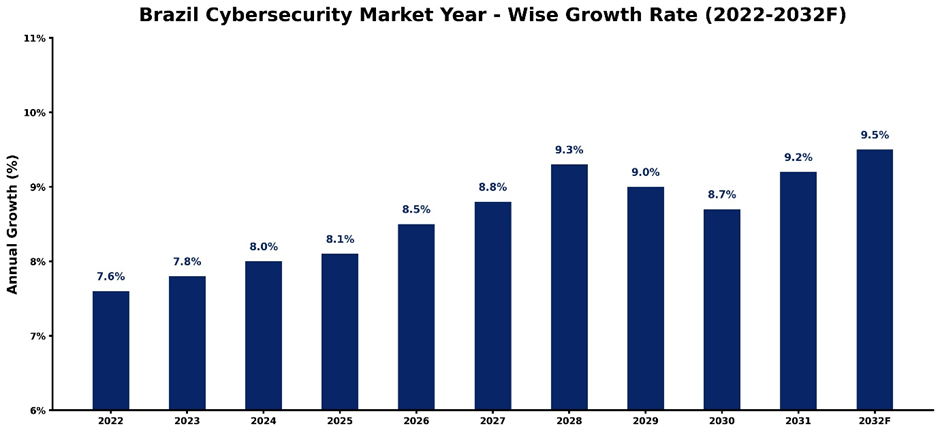
The following table summarizes the historical and forecasted growth rates of the Brazil Cybersecurity Market, along with the rationale behind each year’s performance.
| Year | Estimated Growth (%) | Market Rationale |
| 2022 | 7.6% | Rising ransomware incidents and increasing enterprise awareness accelerated cybersecurity spending. |
| 2023 | 7.8% | Implementation of LGPD compliance programs encouraged organizations to invest in data protection solutions. |
| 2024 | 8% | Growth in cloud adoption and digital transformation initiatives expanded cybersecurity requirements. |
| 2025 | 8.1% | Enterprises increased spending on endpoint protection, identity management, and security monitoring platforms. |
| 2026 | 8.5% | Demand for cloud security, AI-based threat intelligence, and managed security services supports market growth. |
| 2027 | 8.8% | Expansion of cybersecurity investments among SMEs and government agencies drives adoption. |
| 2028 | 9.3% | Increased deployment of zero-trust security frameworks and advanced analytics platforms boosts demand. |
| 2029 | 9% | Market growth stabilizes as cybersecurity maturity improves among large enterprises. |
| 2030 | 8.7% | Continued digital infrastructure expansion sustains cybersecurity investments. |
| 2031 | 9.2% | Greater automation and AI-driven cybersecurity solutions enhance market penetration. |
| 2032 | 9.5% | Mature adoption across industries maintains consistent cybersecurity spending growth. |
Topics Covered in the Brazil Cybersecurity Market Report
The Brazil Cybersecurity Industry Report provides a detailed assessment of market development by security type, deployment, and end-user. The report evaluates cybersecurity adoption trends, investment opportunities, regulatory developments, emerging technologies, and key growth areas influencing future market expansion.
Brazil Cybersecurity Market Highlights
| Report Name | Brazil Cybersecurity Market |
| Forecast period | 2026-2032 |
| CAGR | 8.6% |
| Growing Sector | Cloud Security |
Brazil Cybersecurity Market Synopsis
Brazil Cybersecurity Market is witnessing significant growth due to the increasing frequency of cyberattacks, rapid digital transformation, and rising adoption of cloud-based services across industries. Organizations in sectors such as banking, healthcare, government, retail, and telecommunications are strengthening their cybersecurity infrastructure to protect sensitive data and comply with evolving data protection regulations. The implementation of Brazil’s General Data Protection Law (LGPD) has further increased the demand for advanced cybersecurity solutions, including threat intelligence, identity and access management, endpoint security, and data protection technologies.
Evaluation of Growth Drivers in Brazil Cybersecurity Market (2026–2032)
Below are some major drivers influencing the Brazil Cybersecurity Market:
| Drivers | Primary Segment Affected | Why It Matters (Evidence) |
| Rising Cyberattacks and Ransomware Threats | Enterprises & Government Organizations | Frequent cyber incidents are forcing organizations to invest in advanced threat detection and response solutions. |
| Expansion of Cloud Computing | Cloud Security Providers | Shifting of workloads to cloud platforms increases demand for cloud-native security solutions. |
| LGPD Compliance Requirements | BFSI, Healthcare, Government | Data privacy regulations require companies to strengthen their encryption, monitoring, and governance systems. |
| Increasing Digital Banking Services | BFSI Sector | Increasing online transactions demand a strong identity verification and fraud prevention technology. |
| Cybersecurity Skill Development Programs | Research Institutions & Workforce Development | Training initiatives is addressing the issue of shortage of cybersecurity professionals in Brazil. |
The Brazil Cybersecurity Market is expected to grow at a CAGR of approximately 8.6% during the forecast period of 2026-2032, driven by increasing cybersecurity awareness among enterprises, regulatory pressures, and rapid digital transformation. Major organizations are focusing on security modernization, using zero-trust frameworks, security operation centres (SOCs), and artificial intelligence-based monitoring systems. On account of Brazil’s advanced digital payment ecosystem and high online banking penetration, the BFSI sector is expected to be one of the strongest contributors. Simultaneously, government agencies are increasing spending on cybersecurity, to protect critical infrastructure, public databases and digital services.
Evaluation of Restraints in Brazil Cybersecurity Market
Below are some major restraints and their influence on the market dynamics:
| Restraints | Primary Segment Affected | What This Means (Evidence) |
| Shortage of Skilled Cybersecurity Professionals | Workforce Development | Limited availability of trained experts tends to increase operational challenges. |
| High Implementation Costs | SMEs | Advanced cybersecurity platforms demand significant investment in technology and skilled resources. |
| Strict Regulatory Compliance Requirements | Enterprises | Companies face challenges in maintaining compliance across numerous digital platforms. |
| Limited Cybersecurity Awareness Among Small Businesses | SMEs & Local Enterprises | Small-scale organizations often lack adequate security budgets and expertise. |
| Integration Challenges with Legacy Systems | Manufacturing & Government | Old infrastructure creates challenges in implementing modern cybersecurity frameworks. |
Brazil Cybersecurity Market Challenges
The Brazil cybersecurity market growth faces several challenges, such as the lack of cybersecurity professionals, advanced cyber-attacks, and the lack of adoption by SMEs. Large companies and banks are investing in security, while smaller entities are unable to afford it, owing to financial limitations. The growing complexity of the cyber ecosystem is another market challenge, where organizations need to ensure that they secure their cloud platforms, IoT, remote employees, and other third-party networks simultaneously.
Brazil Cybersecurity Market Trends
Major trends in the Brazil cybersecurity market are summarized below:
- Cloud Security Solutions Adoption: Firms are rapidly adopting cloud security solutions to protect distributed workloads, and support hybrid working environments.
- Artificial Intelligence in Security: AI-enabled threat detection products have gained popularity, owing to their ability to identify abnormal behaviour and reduce response time.
- Zero-Trust Security Approach: There is an increasing adoption of identity-based security systems, in which all access attempts are authenticated throughout the process.
- Growth of Managed Security Services: Due to shortage of skilled cybersecurity professionals and complexity of cyber threats, businesses are moving towards managed security services.
Investment Opportunities in Brazil Cybersecurity Market
Growth-oriented investment opportunities in the Brazil Cybersecurity industry include the following:
- Cloud Security Platforms: There is an increasing adoption of cloud security in enterprises, which is a growing trend.
- Threat Intelligence using AI: Various resources are channelled towards automation of cybersecurity analytics.
- Managed Security Service Providers: There is a rising demand for advanced security skills, which is creating an opportunity for MSSP.
- Cybersecurity Problems Solutions of SMEs: There is a growing opportunity in this segment, due to an increasing awareness of ransomware and data security issues.
- Public Sector Cybersecurity Infrastructure Projects: Opportunities arise on account of the government schemes, to enhance the cybersecurity infrastructure.
Top 5 Leading Players in Brazil Cybersecurity Market
A comprehensive listing of prominent companies in the Brazil Cybersecurity Industry is provided below:
1. Cisco Systems
| Company Name | Cisco Systems |
|---|---|
| Established | 1984 |
| Headquarters | San Jose, California, USA |
| Official Website | Click Here |
Cisco is a major cybersecurity provider in Brazil, offering network security, cloud security, firewall solutions, endpoint protection, and security analytics platforms.
2. Palo Alto Networks
| Company Name | Palo Alto Networks |
|---|---|
| Established | 2005 |
| Headquarters | Santa Clara, California, USA |
| Official Website | Click Here |
Palo Alto Networks provides advanced cybersecurity solutions including next-generation firewalls, cloud security platforms, endpoint security, and AI-powered threat prevention systems.
3. Fortinet
| Company Name | Fortinet |
|---|---|
| Established | 2000 |
| Headquarters | Sunnyvale, California, USA |
| Official Website | Click Here |
Fortinet is one of the prominent cybersecurity vendors in Brazil, providing integrated network security, secure SD-WAN, endpoint protection, and security management solutions.
4. IBM
| Company Name | IBM |
|---|---|
| Established | 1911 |
| Headquarters | Armonk, New York, USA |
| Official Website | Click Here |
IBM offers cybersecurity solutions focused on security operations, identity management, data protection, and artificial intelligence-based threat detection.
5. Microsoft
| Company Name | Microsoft |
|---|---|
| Established | 1975 |
| Headquarters | Redmond, Washington, USA |
| Official Website | Click Here |
Microsoft plays a significant role in Brazil’s cybersecurity ecosystem through its cloud security, identity management, endpoint protection, and security monitoring solutions.
Government Initiatives Being Implemented in Brazil Cybersecurity Market
Several cybersecurity programs have been initiated by the Brazilian government, in order to enhance its digital resilience, and secure the critical information infrastructure of the nation. Which includes the National Cybersecurity Strategy (E-Ciber), developed by the Brazilian federal government, and it highlights improvements in the cybersecurity governance system, public and private sector collaboration, and the need to secure essential services. The LGPD law enacted in Brazil mandates all organizations operating in Brazil to implement necessary technical and administrative procedures for securing personal data.
Future Insights of the Brazil Cybersecurity Market
The Brazil Cybersecurity Market is estimated to witness steady expansion during the forecast period (2026-2032), as organizations continue to prioritize digital risk management. The growth of cyber complexity is expected to drive strong adoption of cloud security, identity and access management, and AI-powered cybersecurity solutions. The market is also projected to shift from perimeter-based security, to integrated cybersecurity ecosystems, based on zero-trust architecture, automation and ongoing surveillance. Financial services, healthcare, government and industrial sectors are likely to remain the key investment areas, due to high exposure to cyber risks.
Market Segmentation Analysis
This report presents a detailed analysis of the market segments along with their leading categories:
By Security Type: Cloud Security Dominates
According to Vasudha, Senior Research Analyst, 6Wresearch, Cloud Security is accounted for approximately 29% of the Brazil cybersecurity market share in 2025, and is projected to expand at a CAGR of around 11.2% during the forecast period (2026–2032). Cloud security will maintain its dominance in the Brazilian market, owing to an accelerated shift towards the cloud platform, rising adoption of hybrid IT infrastructure, and the need for secure remote access. Organizations in Brazil are utilizing cloud workload security solutions, cloud access security brokers (CASBs), and security posture management software for addressing challenges posed by cloud computing.
By Deployment: Cloud Deployment Dominates
The Cloud deployment model dominated the market share in 2025, with an estimated share of nearly 60%, and is expected to grow at a CAGR of approximately 10.5% during the forecast period (2026–2032). These solutions are gaining momentum, due to scalability, lesser infrastructure needs, faster deployment, and continuous security updates. Many companies are moving towards security-as-a-service model, to reduce operational complexity and improve protection against evolving cyber assaults.
Note: Market size estimations and growth projections presented in this report are based on 6Wresearch's proprietary forecasting methodology, utilizing the latest available industry data, government publications, and primary research inputs.
Key Attractiveness of the Report
- 10 Years of Market Numbers
- Historical Data Starting from 2022 to 2025
- Base Year: 2025
- Forecast Data Until 2032
- Key Performance Indicators Impacting the Market
- Major Upcoming Developments and Projects
Key Highlights of the Report:
- Brazil Cybersecurity Market Outlook
- Market Size of Brazil Cybersecurity Market, 2025
- Forecast of Brazil Cybersecurity Market, 2032
- Historical Data and Forecast of Brazil Cybersecurity Revenues & Volume for the Period 2022-2032
- Brazil Cybersecurity Market Trend Evolution
- Brazil Cybersecurity Market Drivers and Challenges
- Brazil Cybersecurity Price Trends
- Brazil Cybersecurity Porter's Five Forces
- Brazil Cybersecurity Industry Life Cycle
- Historical Data and Forecast of Brazil Cybersecurity Market Revenues & Volume By Security Type for the Period 2022-2032
- Historical Data and Forecast of Brazil Cybersecurity Market Revenues & Volume By Cloud Security for the Period 2022-2032
- Historical Data and Forecast of Brazil Cybersecurity Market Revenues & Volume By Data Security for the Period 2022-2032
- Historical Data and Forecast of Brazil Cybersecurity Market Revenues & Volume By Identity Access Management for the Period 2022-2032
- Historical Data and Forecast of Brazil Cybersecurity Market Revenues & Volume By Network Security for the Period 2022-2032
- Historical Data and Forecast of Brazil Cybersecurity Market Revenues & Volume By Consumer Security for the Period 2022-2032
- Historical Data and Forecast of Brazil Cybersecurity Market Revenues & Volume By Infrastructure Protection for the Period 2022-2032
- Historical Data and Forecast of Brazil Cybersecurity Market Revenues & Volume By Others for the Period 2022-2032
- Historical Data and Forecast of Brazil Cybersecurity Market Revenues & Volume By Deployment for the Period 2022-2032
- Historical Data and Forecast of Brazil Cybersecurity Market Revenues & Volume By Cloud for the Period 2022-2032
- Historical Data and Forecast of Brazil Cybersecurity Market Revenues & Volume By On-Premise for the Period 2022-2032
- Historical Data and Forecast of Brazil Cybersecurity Market Revenues & Volume By End-User for the Period 2022-2032
- Historical Data and Forecast of Brazil Cybersecurity Market Revenues & Volume By BFSI for the Period 2022-2032
- Historical Data and Forecast of Brazil Cybersecurity Market Revenues & Volume By Healthcare for the Period 2022-2032
- Historical Data and Forecast of Brazil Cybersecurity Market Revenues & Volume By Manufacturing for the Period 2022-2032
- Historical Data and Forecast of Brazil Cybersecurity Market Revenues & Volume By Government and Defense for the Period 2022-2032
- Historical Data and Forecast of Brazil Cybersecurity Market Revenues & Volume By IT and Telecommunication for the Period 2022-2032
- Historical Data and Forecast of Brazil Cybersecurity Market Revenues & Volume By Others for the Period 2022-2032
- Brazil Cybersecurity Import Export Trade Statistics
- Market Opportunity Assessment By Security Type
- Market Opportunity Assessment By Deployment
- Market Opportunity Assessment By End-User
- Brazil Cybersecurity Top Companies Market Share
- Brazil Cybersecurity Competitive Benchmarking By Technical and Operational Parameters
- Brazil Cybersecurity Company Profiles
- Brazil Cybersecurity Key Strategic Recommendations
Market Covered
The report offers an extensive study of the following market segments:
By Security Type
- Cloud Security
- Data Security
- Identity Access Management
- Network Security
- Consumer Security
- Infrastructure Protection
- Others
By Deployment
- Cloud
- On-Premise
By End User
- BFSI
- Healthcare
- Manufacturing
- Government and Defence
- IT and Telecommunication
- Others






































