Australia Data Center Market Growth Rate
According to 6Wresearch internal databases and industry insights, Australia Data Center Market is projected to grow at a steady compound annual growth rate (CAGR) of 2.7% during the forecast period 2026–2032.
Australia Data Center Market Year-wise Growth Rate and Key Drivers (2022-2032)
This graph illustrates the annual growth rates of the Australia Data Center Market from 2022 to 2032, highlighting a steady upward trajectory and projected market expansion over the forecast period.
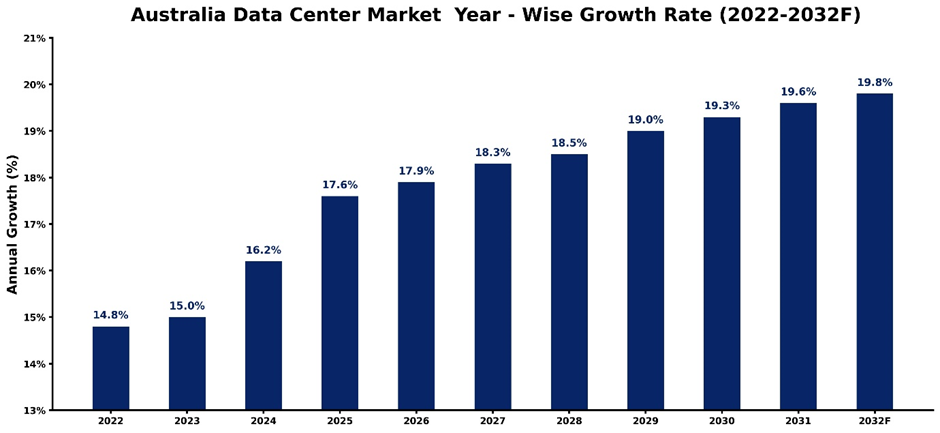 The following table summarizes the historical and forecasted growth rates of Australia Data Center Market, along with the rationale behind each year’s performance.
| Year | Estimated Growth (%) | Market Rationale |
| 2022 | 14.8% | Cloud adoption recovery and digital transformation growth |
| 2023 | 15% | Hyperscale expansion and rising colocation demand |
| 2024 | 16.2% | AI adoption and higher computing requirements |
| 2025 | 17.6% | Generative AI workloads and new data centre investments |
| 2026 | 17.9% | AI infrastructure, cloud growth, and data sovereignty needs |
| 2027 | 18.3% | Hyperscale projects and edge computing expansion |
| 2028 | 18.5% | AI inference, IoT, and digital service growth |
| 2029 | 19% | Increased investment in cloud and colocation facilities |
| 2030 | 19.3% | Large AI facilities and APAC hub development |
| 2031 | 19.6% | Advanced AI, automation, and sovereign cloud demand |
| 2032 | 19.8% | AI growth, edge networks, and digitalisation expansion |
Topics Covered in the Australia Data Center Market Report
The Australia Data Center Market report thoroughly covers the market by component and vertical. The market report provides an unbiased and detailed analysis of the ongoing market trends, opportunities/high growth areas, and market drivers which would help the stakeholders to devise and align their market strategies according to the current and future market dynamics.
Australia Data Center Market Highlights
| Report Name | Australia Data Center Market |
| Forecast period | 2026-2032 |
| CAGR | 2.7% |
| Growing Sector | IT & Telecom |
Australia Data Center Market Synopsis
The Australia data center market is experiencing significant growth, with projections indicating substantial expansion in the coming years. This growth is attributed to factors such as the increasing demand for cloud services, the rise of IoT and Big Data technologies, the adoption of renewable energy sources, enhanced connectivity through 5G deployments, and other key drivers. The Australian government's digital transformation strategy plays a crucial role in supporting this growth by encouraging cloud-based services adoption and fostering market expansion.
Evaluation of Growth Drivers in Australia Data Center Market (2026–2032)
Below are the major drivers influencing market dynamics:
| Drivers | Primary Segment Affected | Why It Matters (Evidence) |
| Rapid Cloud Adoption & Enterprise Digital Transformation | Cloud, Colocation, Hyperscale | Cloud migration is accelerated to improve scalability and digital capabilities. |
| Hyperscale Data Center Expansion by Global Cloud Providers | Hyperscale & Colocation | Australian infrastructure expanded due to rising demand for cloud services. |
| Artificial Intelligence (AI), Big Data & High-Performance Computing Growth | Hyperscale / AI Data Centers | High-density computing infrastructure needed by rising AI model training. |
| 5G Deployment, IoT & Edge Computing Growth | Edge & Distributed Infrastructure | Demand for edge data centers across Australian cities is driven by expansion of connected devices. |
| Renewable Energy Integration & Sustainable Data Centers | Hyperscale & Enterprise Data Centers | Operators encouraged to develop energy-efficient due to availability of renewable energy resources. |
The Australia Data Center market growth is projected to grow at a CAGR of 2.7% during 2026–2032. Increasing cloud adoption, AI infrastructure requirements, hyperscale investment, and enterprise digital transformation are the driving factors for the market progress. Boosting demand for AI-ready facilities and sustainable infrastructure is expected to remain a vital growth contributor throughout the forecast period. Australia has strong digital economy, stable regulatory environment, advanced telecommunications infrastructure, and strategic position in the Asia-Pacific region.
Evaluation of Restraints in Australia Data Center Market
Below are the major restraints influencing market dynamics:
| Restraints | Primary Segment Affected | What This Means (Evidence) |
| Power Availability Constraints & Grid Capacity Limitations | Hyperscale & AI Data Centers | High-density AI workloads require high electricity capacity, creating challenges in securing reliable power supply. |
| High Land & Real Estate Costs in Major Data Center Hubs | Colocation & Hyperscale | For new data center developments, cities will face increasing land costs and raising capital expenditure. |
| Energy Consumption & Sustainability Pressure | AI / High-Density Data Centers | Operators are actively adopting renewable energy due to increase operational costs by rising power requirements. |
| Complex Planning Approvals & Environmental Regulations | New Market Entrants | Project timelines can be extended due to development approvals, environmental assessments, and local regulations. |
| Limited Availability of Skilled Data Center Workforce | All Segments | Growing infrastructure demand creates pressure on availability of specialized data center professionals. |
Australia Data Center Market Challenges
The Australia data center market is restricted by various challenges, despite strong growth momentum. Enhancing AI adoption is creating additional challenges as high-performance computing facilities require significantly higher power density, advanced cooling technologies, and improved energy management systems. Limited land availability, electricity supply, and infrastructure capacity, due the market concentration around major hubs such as Sydney and Perth. Hyperscale operators are restricted by power grid limitations and rising electricity costs.
Australia Data Center Market Trends
Notable trends influencing the Australia data center industry are listed below:
- AI-Ready Data Center Development: To assist artificial intelligence, operators are investing in GPU-enabled infrastructure, high-density server environments, and advanced cooling technologies.
- Growth of Edge Data Centers: Low-latency applications such as IoT, autonomous systems, smart cities, and emerging digital services supported by distributed edge infrastructure.
- Green & Renewable Energy-Powered Data Centers: Sustainability has become a major focus, which lead operators to adopt renewable energy contracts and energy-efficient cooling systems.
- Liquid Cooling Adoption: Endorsement of liquid cooling enhanced due to increasing rack densities from AI workloads, while improving efficiency and reliability.
Investment Opportunities in Australia Data Center Market
Key areas of investment potential in the Australia data center market are outlined below:
- Hyperscale Infrastructure Development: Growing demand for cloud capacity creates opportunities for infrastructure investments, strategic collaborations, and partnerships with global technology companies.
- AI Data Center Infrastructure: Investment potential present in specialized AI facilities, GPU clusters, advanced cooling infrastructure, and next-generation digital processing capabilities.
- Renewable Energy-Powered Data Centers: Funding opportunities lies in sustainable data centers which is powered by solar, wind, and hybrid energy solutions while minimizing long-term operational costs.
- Regional & Edge Data Center Expansion: Increasing demand for low-latency digital services attract investment in regional edge facilities which can support Australia’s geographically distributed population.Top of Form
Top Leading Players in Australia Data Center Market
Below is an overview of key companies operating in the Australia data center industry:
1. AirTrunk
| Company Name | AirTrunk |
|---|---|
| Established Year | 2015 |
| Headquarters | Sydney, Australia |
| Official Website | Click Here |
AirTrunk is a leading hyperscale data center specialist in the Asia-Pacific region, AirTrunk develops and operates large-scale facilities designed for cloud providers and enterprise workloads.
2. Equinix
| Company Name | Equinix |
|---|---|
| Established Year | 1998 |
| Headquarters | Redwood City, California, USA |
| Official Website | Click Here |
A global leader in colocation and digital infrastructure, Equinix operates multiple International Business Exchange (IBX) data centers across Australia’s major business hubs.
3. NEXTDC
| Company Name | NEXTDC |
|---|---|
| Established Year | 2010 |
| Headquarters | Brisbane, Australia |
| Official Website | Click Here |
An ASX100-listed technology company and one of Australia’s largest data center operators, NEXTDC specializes in Tier IV certified, high-performance colocation facilities.
4. CDC Data Centres (Canberra Data Centres)
| Company Name | CDC Data Centres (Canberra Data Centres) |
|---|---|
| Established Year | 2007 |
| Headquarters | Canberra, Australia |
| Official Website | Click Here |
A leading sovereign data center operator focused on highly secure and government-grade infrastructure, it operates secure facilities across Canberra, Sydney, and Melbourne.
5. Digital Realty
| Company Name | Digital Realty |
|---|---|
| Established Year | 2001 |
| Headquarters | Austin, Texas, USA |
| Official Website | Click Here |
One of the world's largest data center real estate investment trusts (REITs), provides global-scale data center, colocation, and interconnection solutions.
Government Initiatives Introduced in the Australia Data Center Market
According to the Australian government data, several initiatives have introduced to assist data center progress, digital infrastructure development and sustainable technology adoption. To extend the Australia Data Center Market size, initiatives are focused on digital transformation, cloud adoption, data security, and artificial intelligence. These initiatives will push investment in local data infrastructure. Policies promoting data sovereignty and secure data storage are increasing demand for domestic facilities. Additionally, renewable energy targets are driving operators toward energy-efficient and sustainable data center development.
Future Insights of the Australia Data Center Market
The market is expected to witness expansion during the forecast period, influenced by AI adoption, cloud migration, and rising digital infrastructure demand. Data center capacity is estimated to increase, and expected to add more than 500 MW of additional capacity by 2032, results in hiking the Australia Data Center Market revenue. AI workloads are expected to drive higher rack densities, accelerating adoption of liquid cooling and advanced infrastructure. Hyperscale deployments and enterprise digital transformation will support market expansion across Australia.
Market Segmentation Analysis
This report presents a detailed analysis of the market segments along with their leading categories:
By Component - Electrical Led the Market and Set for Rapid Growth
According to Shubham Padhi, Senior Research Analyst, 6Wresearch, by component, in 2025, the Electrical dominated the Australia Data Center Market, accounting for 40% of the overall component share, influenced by increasing power requirements from hyperscale facilities and AI workloads. Also, by 2032, the Electrical keep on commanding the market, growing at a CAGR of 13%, owning to rising demand for power distribution systems and backup solutions.
By Vertical - IT & Telecom Dominated the Market and Set for Rapid Expansion
By Vertical, in 2025, the IT & Telecom commanded the Australia Data Center Market, accounting for 40% of the market share, driven by strong cloud adoption and telecom network expansion. And during 2026-2032, the IT & Telecom segment will maintain its leadership position, growing at a CAGR of 14%, backed by AI-driven computing demand and hyperscale cloud expansion.
Note: Market size estimations and growth projections presented in this report are based on 6Wresearch's proprietary forecasting methodology, utilizing the latest available industry data, government publications, and primary research inputs.
Key Attractiveness of the Report:
- 10 Years of Market Numbers
- Historical Data Starting from 2022 to 2025
- Base Year: 2025
- Forecast Data until 2032
- Key Performance Indicators Impacting the Market
- Major Upcoming Developments and Projects
Key Highlights of the Report:
- Australia Data Center Market Outlook
- Market Size of Australia Data Center Market, 2025
- Forecast of Australia Data Center Market, 2032
- Historical Data and Forecast of Australia Data Center Revenues & Volume for the Period 2022-2032
- Australia Data Center Market Trend Evolution
- Australia Data Center Market Drivers and Challenges
- Australia Data Center Price Trends
- Australia Data Center Porter's Five Forces
- Australia Data Center Industry Life Cycle
- Historical Data and Forecast of Australia Data Center Market Revenues & Volume By Component for the Period 2022-2032
- Historical Data and Forecast of Australia Data Center Market Revenues & Volume By Electrical for the Period 2022-2032
- Historical Data and Forecast of Australia Data Center Market Revenues & Volume By Mechanical for the Period 2022-2032
- Historical Data and Forecast of Australia Data Center Market Revenues & Volume By Networking for the Period 2022-2032
- Historical Data and Forecast of Australia Data Center Market Revenues & Volume By Racks for the Period 2022-2032
- Historical Data and Forecast of Australia Data Center Market Revenues & Volume By Security Systems for the Period 2022-2032
- Historical Data and Forecast of Australia Data Center Market Revenues & Volume By Fire Systems for the Period 2022-2032
- Historical Data and Forecast of Australia Data Center Market Revenues & Volume By Vertical for the Period 2022-2032
- Historical Data and Forecast of Australia Data Center Market Revenues & Volume By Banking Financial Services & Insurance (BFSI) for the Period 2022-2032
- Historical Data and Forecast of Australia Data Center Market Revenues & Volume By Government for the Period 2022-2032
- Historical Data and Forecast of Australia Data Center Market Revenues & Volume By IT & Telecom for the Period 2022-2032
- Historical Data and Forecast of Australia Data Center Market Revenues & Volume By Media for the Period 2022-2032
- Historical Data and Forecast of Australia Data Center Market Revenues & Volume By Retail for the Period 2022-2032
- Historical Data and Forecast of Australia Data Center Market Revenues & Volume By Manufacturing for the Period 2022-2032
- Historical Data and Forecast of Australia Data Center Market Revenues & Volume By Others for the Period 2022-2032
- Australia Data Center Import Export Trade Statistics
- Market Opportunity Assessment By Component
- Market Opportunity Assessment By Vertical
- Australia Data Center Top Companies Market Share
- Australia Data Center Competitive Benchmarking By Technical and Operational Parameters
- Australia Data Center Company Profiles
- Australia Data Center Key Strategic Recommendations
Market Covered
The report offers a comprehensive study of the subsequent market segments:
By Component
- Electrical
- Mechanical
- Networking
- Racks,
- Security Systems
- Fire Systems
By Vertical
- Banking Financial Services & Insurance (BFSI)
- Government
- IT & Telecom
- Media
- Retail
- Manufacturing
- Healthcare
- Others






































