Australia Electric Hair Clipper & Trimmer Market Size, Share & Growth Rate
The Australia Electric Hair Clipper & Trimmer Market was estimated at USD 250 Million in 2025 and is projected to reach USD 339 Million by 2032, growing at a CAGR of 4.4% from 2026 to 2032. This upward trajectory is propelled by an increasing emphasis on personal grooming, with consumers seeking innovative solutions that combine efficiency with style. Furthermore, advancements in battery technology and the rise of cordless models contribute significantly to expanding user convenience and overall market appeal.
Australia Electric Hair Clipper & Trimmer Market Year-wise Growth Rate and Key Drivers
This graph highlights how the Australia Electric Hair Clipper & Trimmer Market has steadily grown over the years, supported by major growth factors.
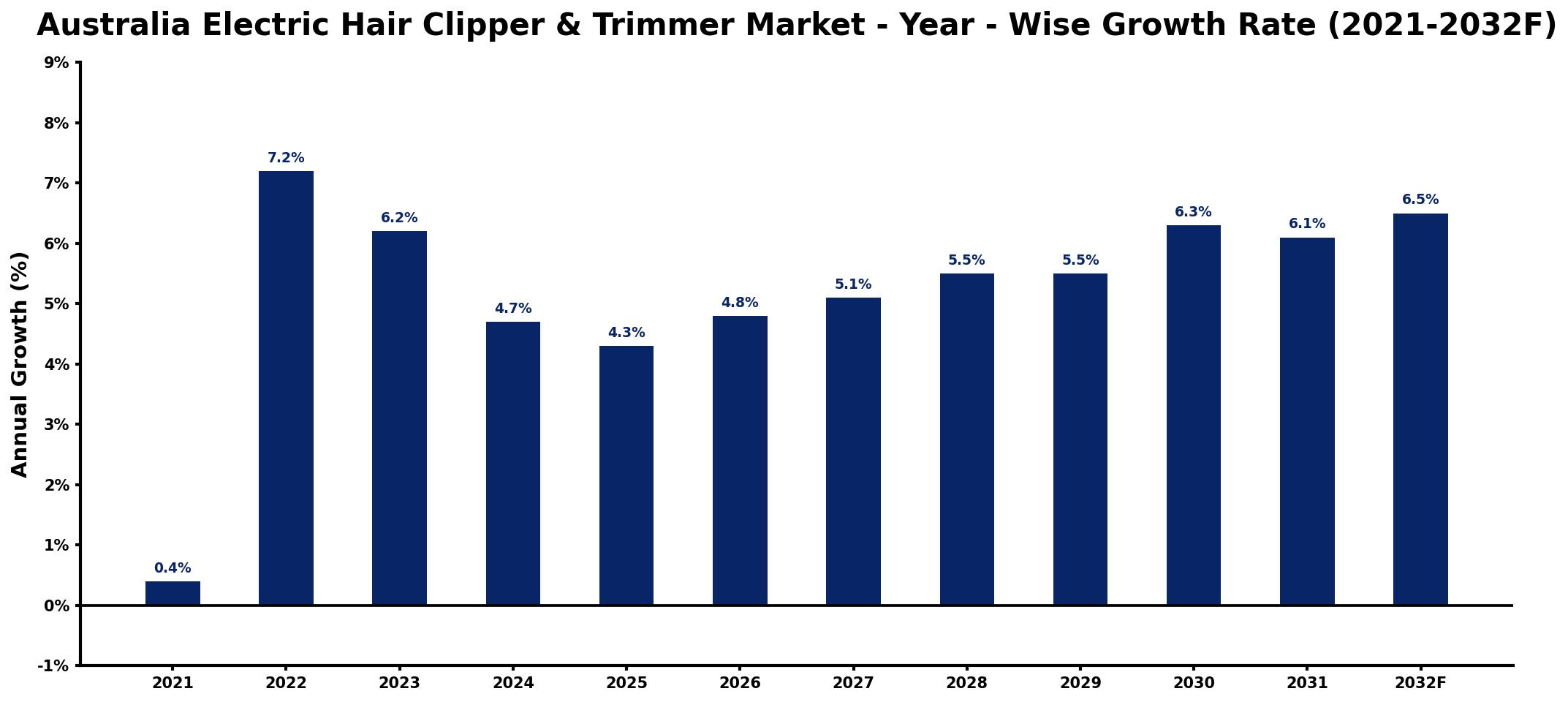
The table below presents the year‑wise growth rates along with the key drivers influencing the market
| Year | Growth Rate | Major Drivers |
| 2021 | 0.4% | Rising grooming awareness among consumers |
| 2022 | 7.2% | Expansion of online retail platforms |
| 2023 | 6.2% | Increasing disposable income trends |
| 2024 | 4.7% | Growth in men's grooming sector |
| 2025 | 4.3% | Emergence of innovative grooming technologies |
| 2026 | 4.8% | Popularity of personal grooming trends |
| 2027 | 5.1% | Investment in sustainable grooming solutions |
| 2028 | 5.5% | Rise of subscription grooming services |
| 2029 | 5.5% | Enhanced marketing strategies for brands |
| 2030 | 6.3% | Increase in lifestyle influencer promotions |
| 2031 | 6.1% | Demand for portable grooming devices |
| 2032 | 6.5% | Focus on premium grooming experiences |
Note: Market size estimations and growth projections presented in this report are based on 6Wresearch's proprietary forecasting methodology, utilizing the latest available industry data, government publications, and primary research inputs.
Australia Electric Hair Clipper & Trimmer Market Synopsis
The strongest force shaping the Australia Electric Hair Clipper & Trimmer Market currently is the growing consumer preference for versatile grooming tools. As fashion trends evolve and lifestyles become increasingly dynamic, the demand for high-quality, convenient hair grooming products continues to soar. This is evident in the rising popularity of electric clippers and trimmers that offer adjustable blades and ergonomic designs, catering to both professionals and home users alike.
In addition, the trend towards self-care and at-home grooming has accelerated significantly, particularly in the wake of recent global events. Australian consumers are increasingly prioritizing grooming as part of their daily routines, leading to higher sales volumes and fostering a competitive market landscape characterized by innovation and quality.
- The market is driven by the rising demand for convenient and efficient personal grooming solutions.
- Technological advancements, particularly in battery performance and cordless models, are reshaping product offerings.
- Shifting fashion trends and grooming habits are stimulating a robust demand for innovative grooming tools.
- Government regulations are playing a pivotal role in ensuring product safety and quality in the market.
- Consumer awareness around grooming and hygiene is contributing positively to market expansion.
While the market is poised for growth, it faces significant restraints primarily linked to battery life and performance standards. Consumers have high expectations for electric clippers and trimmers, specifically regarding their ability to deliver consistent cutting power without frequent recharging. As such, manufacturers must focus on developing advanced battery technologies that ensure longevity and reliability while adhering to safety protocols. Failure to meet these expectations could hamper consumer satisfaction and hinder market progress.
Several current and emerging trends are shaping the demand for electric hair clippers and trimmers. Notably, there is a marked shift towards eco-friendly products, with consumers showing increased interest in grooming tools made from sustainable materials. Additionally, the incorporation of smart technology, such as app connectivity for personalized grooming experiences, is gaining traction, appealing particularly to tech-savvy younger demographics.
Another significant trend is the rise of subscription services offering grooming kits, which not only provide convenience but also foster customer loyalty. This evolving landscape suggests that innovative marketing strategies and product diversification will be essential for success in the coming years.
The Australia Electric Hair Clipper & Trimmer Market is brimming with opportunities for growth and investment. One key area lies in developing new product lines that cater to specific consumer segments, such as professional hairstylists seeking high-performance tools or families looking for user-friendly options for home grooming. Additionally, expanding distribution channels to include e-commerce platforms could significantly broaden market reach and accessibility.
Furthermore, leveraging partnerships with influencers in the grooming and beauty space may enhance brand visibility and appeal, capturing the attention of potential customers eager to explore new grooming solutions.
Government policies in Australia are increasingly influencing the electric hair clipper trimmer market through stringent regulations aimed at product safety and consumer protection. Agencies such as the Australian Competition and Consumer Commission (ACCC) and the Therapeutic Goods Administration (TGA) enforce standards ensuring that products sold meet health and safety requirements. Additionally, government initiatives promoting public awareness around hygiene and product safety can positively impact consumer attitudes toward electric grooming products.
Looking ahead to 2026-2032, the Australia Electric Hair Clipper & Trimmer Market is expected to thrive, driven by continuous technological advancements and shifting consumer preferences towards personal grooming. As the industry adapts to incorporate smart technologies and eco-conscious materials, the competitive landscape will evolve, favoring innovative players. With the projected market size of USD 339 Million by 2032, there is ample scope for brands to capture growing demand through strategic product development and marketing initiatives.
Recent developments in the Australia Electric Hair Clipper & Trimmer Market indicate a strong focus on enhancing product features and user experience. Companies are increasingly introducing models with superior battery technologies, while others are expanding their product lines to include specialized grooming tools aimed at different demographics. Moreover, a notable trend is the rising popularity of online platforms for purchasing grooming products, reflecting changing consumer buying habits in an increasingly digital marketplace.
- 10 Years of Market Numbers
- Historical Data Starting from 2022 to 2025
- Base Year: 2025
- Forecast Data until 2032
- Key Performance Indicators Impacting the Market
- Major Upcoming Developments and Projects
Key Highlights of the Report:
- Australia Electric Hair Clipper & Trimmer Market Outlook
- Market Size of Australia Electric Hair Clipper & Trimmer Market, 2025
- Forecast of Australia Electric Hair Clipper & Trimmer Market, 2032
- Historical Data and Forecast of Australia Electric Hair Clipper & Trimmer Revenues & Volume for the Period 2022-2032F
- Australia Electric Hair Clipper & Trimmer Market Trend Evolution
- Australia Electric Hair Clipper & Trimmer Market Drivers and Challenges
- Australia Electric Hair Clipper & Trimmer Price Trends
- Australia Electric Hair Clipper & Trimmer Porter's Five Forces
- Australia Electric Hair Clipper & Trimmer Industry Life Cycle
- Historical Data and Forecast of Australia Electric Hair Clipper & Trimmer Market Revenues & Volume By Product for the Period 2022-2032F
- Historical Data and Forecast of Australia Electric Hair Clipper & Trimmer Market Revenues & Volume By Corded for the Period 2022-2032F
- Historical Data and Forecast of Australia Electric Hair Clipper & Trimmer Market Revenues & Volume By Cordless for the Period 2022-2032F
- Historical Data and Forecast of Australia Electric Hair Clipper & Trimmer Market Revenues & Volume By Distribution Channel for the Period 2022-2032F
- Historical Data and Forecast of Australia Electric Hair Clipper & Trimmer Market Revenues & Volume By Offline for the Period 2022-2032F
- Historical Data and Forecast of Australia Electric Hair Clipper & Trimmer Market Revenues & Volume By Online for the Period 2022-2032F
- Australia Electric Hair Clipper & Trimmer Import Export Trade Statistics
- Market Opportunity Assessment By Product
- Market Opportunity Assessment By Distribution Channel
- Australia Electric Hair Clipper & Trimmer Top Companies Market Share
- Australia Electric Hair Clipper & Trimmer Competitive Benchmarking By Technical and Operational Parameters
- Australia Electric Hair Clipper & Trimmer Company Profiles
- Australia Electric Hair Clipper & Trimmer Key Strategic Recommendations






































