Australia Fennel Seeds Market Size, Share & Growth Rate
The Australia Fennel Seeds Market was estimated at USD 240 Million in 2025 and is projected to reach USD 282 Million by 2032, growing at a CAGR of 2.3% from 2026 to 2032. This growth trajectory is primarily driven by the increasing demand for natural ingredients in culinary applications, as well as the rising popularity of herbal remedies and supplements. Furthermore, the expanding interest in plant-based diets among Australian consumers further fuels the consumption of fennel seeds, highlighting their versatility and health benefits.
Australia Fennel Seeds Market Year-wise Growth Rate and Key Drivers
This graph highlights how the Australia Fennel Seeds Market has steadily grown over the years, supported by major growth factors.
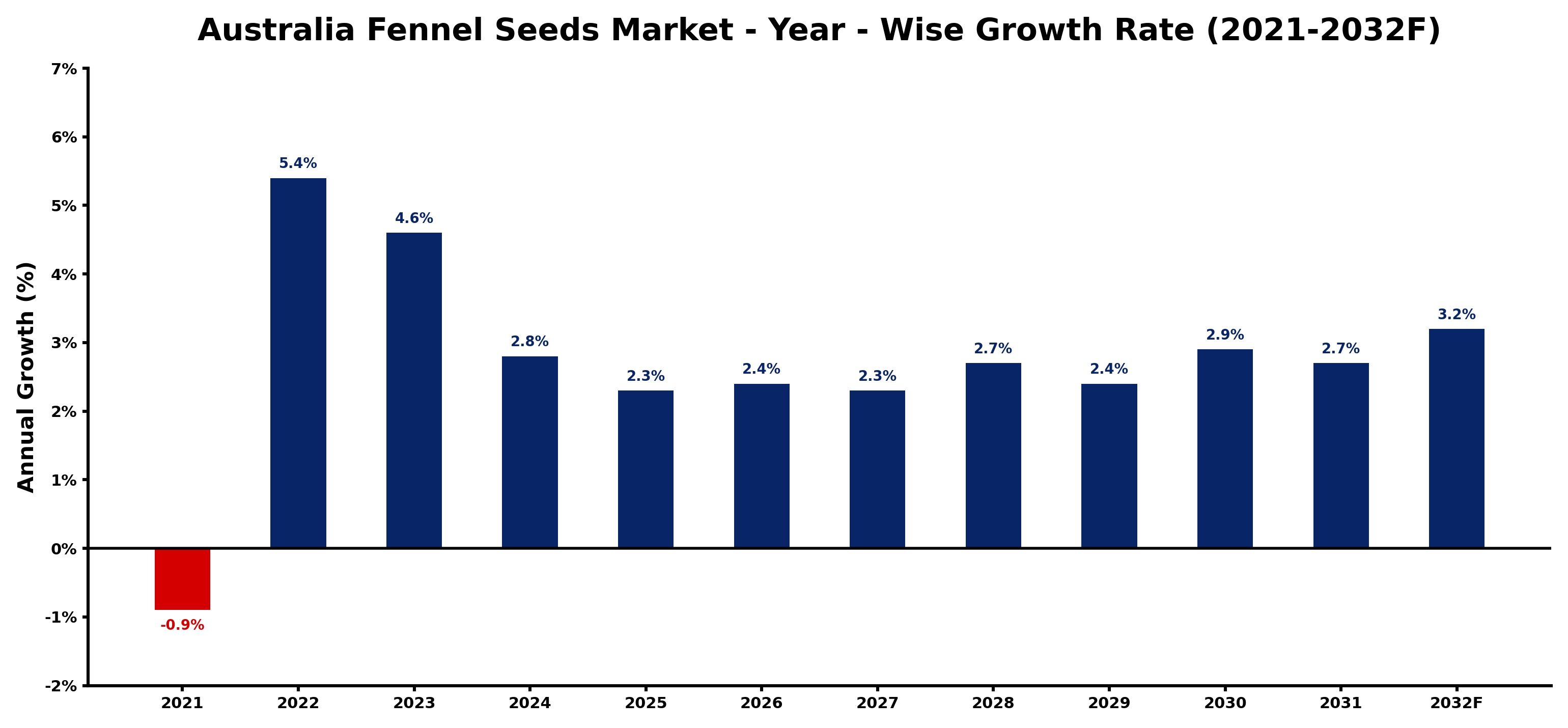
The table below presents the year‑wise growth rates along with the key drivers influencing the market
| Year | Growth Rate | Major Drivers |
| 2021 | -0.9% | Supply chain disruptions limited availability |
| 2022 | 5.4% | Health benefits awareness increased demand |
| 2023 | 4.6% | Culinary trends embraced fennel seeds |
| 2024 | 2.8% | Organic product offerings expanded market |
| 2025 | 2.3% | Consumer interest in natural remedies |
| 2026 | 2.4% | Ethnic cuisine popularity drove sales |
| 2027 | 2.3% | Sustainable farming practices gained traction |
| 2028 | 2.7% | E-commerce platforms enhanced accessibility |
| 2029 | 2.4% | Innovative product formulations attracted buyers |
| 2030 | 2.9% | Culinary education promoted ingredient usage |
| 2031 | 2.7% | Local sourcing initiatives strengthened supply |
| 2032 | 3.2% | Cross-industry collaborations expanded reach |
Note - Market size estimations and growth projections presented in this report are based on 6Wresearch’s advanced forecasting approach, validated with industry datasets as of June 2026.
Australia Fennel Seeds Market Synopsis
In recent years, the Australia fennel seeds market has gained momentum due to an increasing consumer shift towards natural and organic products. This has positioned fennel seeds not only as a staple in culinary practices but also as a valuable ingredient in health supplements. However, as demand stabilizes, market participants must navigate an environment marked by price volatility and saturation.
Looking ahead, the market is expected to evolve, with an emphasis on quality assurance and sustainable sourcing practices. As government policies begin to reflect a growing commitment to environmental sustainability, growers and suppliers are likely to adapt, further influencing market dynamics and consumer preferences.
Australia Fennel Seeds Market Key Takeaways
- The market is benefitting from a growing trend towards natural products across culinary and medicinal sectors.
- Local farmers play a crucial role in maintaining a steady supply chain that supports diverse industry demands.
- Consumer health consciousness is driving interest in fennel seeds as a dietary supplement.
- Ongoing government initiatives aim to promote sustainable farming practices within the sector.
- Fluctuations in pricing pose challenges for market stability, necessitating adaptability from stakeholders.
Evaluation of Restraints in Australia Fennel Seeds Market
The Australian fennel seeds market faces notable restraints that may inhibit its growth. Price fluctuations are a primary concern, as they can affect profitability for both growers and distributors. Additionally, market saturation presents a challenge, making it crucial for players to differentiate their offerings. Regulatory compliance regarding quality standards is another significant factor that can strain operational capacities, forcing companies to invest in quality assurance measures and sustainable practices, which can be resource-intensive.
Australia Fennel Seeds Market Trends
Current trends within the Australia fennel seeds market indicate a strong inclination towards herbal and organic products. As consumers increasingly seek out health-oriented alternatives, the role of fennel seeds in herbal teas and dietary supplements is on the rise. Moreover, digital marketing strategies are gaining traction, enabling suppliers to reach a wider audience. The integration of e-commerce platforms has also enhanced accessibility for consumers, encouraging higher consumption rates.
Australia Fennel Seeds Market Opportunities
Significant growth and investment opportunities lie in product innovation and the development of new applications for fennel seeds. The expanding herbal product market offers a fertile ground for diversification and specialization. Additionally, collaborations with health and wellness brands could enhance market penetration, positioning fennel seeds as a key ingredient in emerging health trends. Investments in sustainable agricultural practices also present avenues for long-term growth, catering to environmentally conscious consumers.
Government Initiatives in the Australia Fennel Seeds Market
Government initiatives in the Australia fennel seeds market focus on enhancing agricultural productivity and ensuring product quality. Policies supporting sustainable farming practices and crop diversification are increasingly prevalent. Additionally, there are measures in place to promote research and development, enabling advancements in cultivation techniques and pest management. Such initiatives not only aim to bolster the competitiveness of local farmers but also ensure that the market adheres to quality standards essential for consumer trust.
Future Insights of the Australia Fennel Seeds Market
Looking ahead to 2026-2032, the Australia fennel seeds market is poised for stable growth, primarily driven by consumer trends favoring natural and herbal products. This period may witness an increase in product innovation, particularly in health supplements and culinary applications. As awareness of health benefits associated with fennel seeds continues to expand, market players will likely explore new market segments and enhance distribution strategies to capitalize on these emerging consumer preferences.
Australia Fennel Seeds Market Latest Developments (May 2025 - June 2026)
Recent developments in the Australia fennel seeds market include a heightened focus on quality assurance and sustainability. Suppliers are increasingly investing in certifications that underline their commitment to organic farming. Additionally, there have been collaborative efforts among industry stakeholders to establish best practices for pest management and cultivation techniques. These initiatives are aimed at improving overall market stability and ensuring a reliable supply chain for various applications.
Australia Fennel Seeds Market - Key Attractiveness of the Report
- 10 Years of Market Numbers
- Historical Data Starting from 2022 to 2025
- Base Year: 2025
- Forecast Data until 2032
- Key Performance Indicators Impacting the Market
- Major Upcoming Developments and Projects
Key Highlights of the Report:
- Australia Fennel Seeds Market Outlook
- Market Size of Australia Fennel Seeds Market, 2025
- Forecast of Australia Fennel Seeds Market, 2032
- Historical Data and Forecast of Australia Fennel Seeds Revenues & Volume for the Period 2022-2032F
- Australia Fennel Seeds Market Trend Evolution
- Australia Fennel Seeds Market Drivers and Challenges
- Australia Fennel Seeds Price Trends
- Australia Fennel Seeds Porter's Five Forces
- Australia Fennel Seeds Industry Life Cycle
- Historical Data and Forecast of Australia Fennel Seeds Market Revenues & Volume By Types for the Period 2022-2032F
- Historical Data and Forecast of Australia Fennel Seeds Market Revenues & Volume By Organic for the Period 2022-2032F
- Historical Data and Forecast of Australia Fennel Seeds Market Revenues & Volume By Conventional for the Period 2022-2032F
- Historical Data and Forecast of Australia Fennel Seeds Market Revenues & Volume By Application for the Period 2022-2032F
- Historical Data and Forecast of Australia Fennel Seeds Market Revenues & Volume By Essential for the Period 2022-2032F
- Historical Data and Forecast of Australia Fennel Seeds Market Revenues & Volume By Flavors for the Period 2022-2032F
- Historical Data and Forecast of Australia Fennel Seeds Market Revenues & Volume By Seasoning Ingredient for the Period 2022-2032F
- Historical Data and Forecast of Australia Fennel Seeds Market Revenues & Volume By Beverages for the Period 2022-2032F
- Historical Data and Forecast of Australia Fennel Seeds Market Revenues & Volume By End-user for the Period 2022-2032F
- Historical Data and Forecast of Australia Fennel Seeds Market Revenues & Volume By Households for the Period 2022-2032F
- Historical Data and Forecast of Australia Fennel Seeds Market Revenues & Volume By Food Industry for the Period 2022-2032F
- Historical Data and Forecast of Australia Fennel Seeds Market Revenues & Volume By Personal Care Industry for the Period 2022-2032F
- Australia Fennel Seeds Import Export Trade Statistics
- Market Opportunity Assessment By Types
- Market Opportunity Assessment By Application
- Market Opportunity Assessment By End-user
- Australia Fennel Seeds Top Companies Market Share
- Australia Fennel Seeds Competitive Benchmarking By Technical and Operational Parameters
- Australia Fennel Seeds Company Profiles
- Australia Fennel Seeds Key Strategic Recommendations






































