Australia Foot Care Products Market Size, Share & Growth Rate
The Australia Foot Care Products Market was estimated at USD 234 Million in 2025 and is projected to reach USD 274 Million by 2032, growing at a CAGR of 2.3% from 2026 to 2032. This upward trajectory is largely fueled by an aging population increasingly concerned about foot health, as well as a growing awareness of preventive foot care practices across various age groups. Consumers are gravitating toward specialized solutions, including foot creams, orthotic inserts, and therapeutic products, to address common foot ailments and enhance overall foot comfort.
Australia Foot Care Products Market Year-wise Growth Rate and Key Drivers
This graph highlights how the Australia Foot Care Products Market has steadily grown over the years, supported by major growth factors.
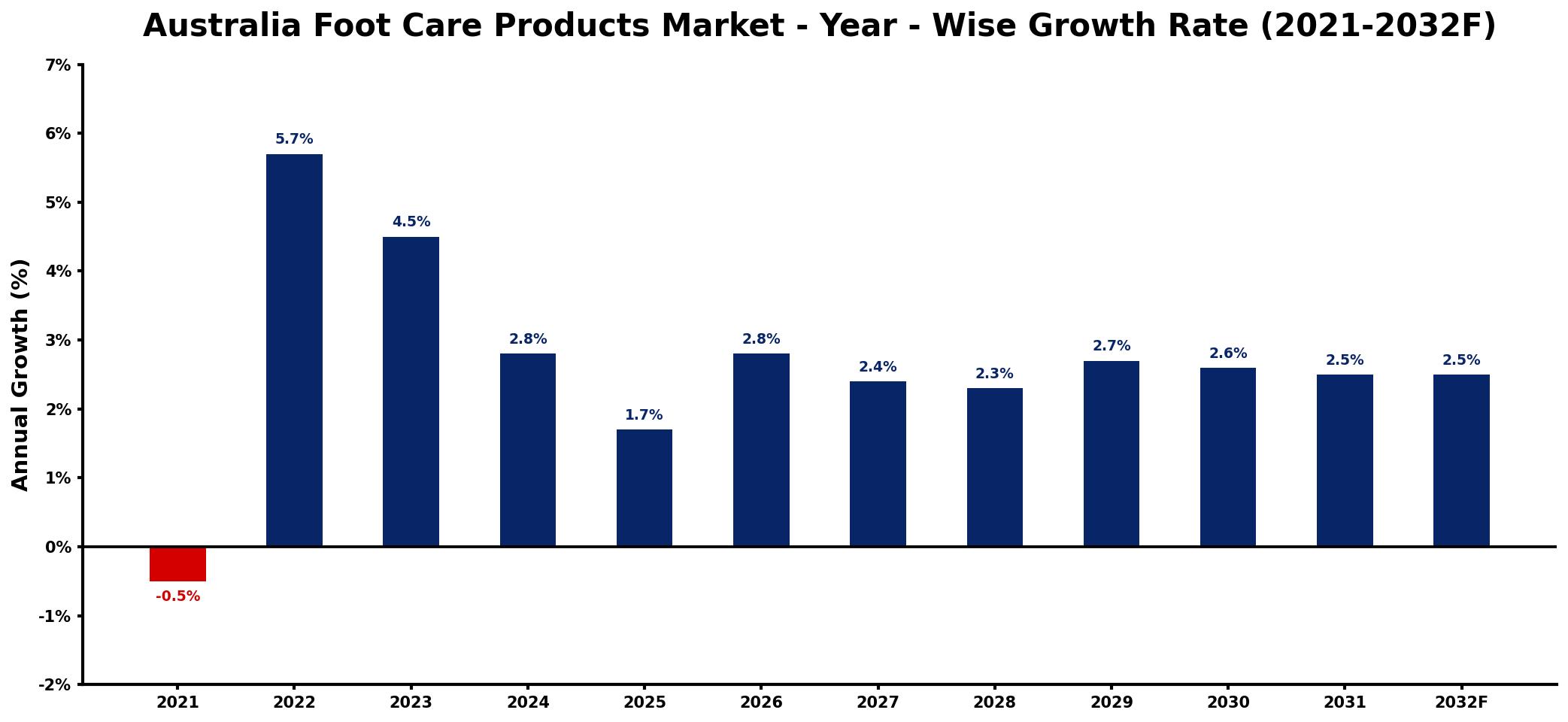
The table below presents the year‑wise growth rates along with the key drivers influencing the market
| Year | Growth Rate | Major Drivers |
| 2021 | -0.5% | decreased consumer spending on health |
| 2022 | 5.7% | growing interest in wellness trends |
| 2023 | 4.5% | rise in online shopping platforms |
| 2024 | 2.8% | increased focus on preventive health |
| 2025 | 1.7% | expansion of retail distribution channels |
| 2026 | 2.8% | growing popularity of eco-friendly options |
| 2027 | 2.4% | strengthening international trade flows |
| 2028 | 2.3% | emergence of innovative marketing strategies |
| 2029 | 2.7% | increased domestic production output |
| 2030 | 2.6% | growth in e-commerce sales channels |
| 2031 | 2.5% | increased investment in R&D initiatives |
| 2032 | 2.5% | enhanced consumer awareness campaigns |
Note: Market size estimations and growth projections presented in this report are based on 6Wresearch's proprietary forecasting methodology, utilizing the latest available industry data, government publications, and primary research inputs.
Australia Foot Care Products Market Synopsis
A marked demand for natural and effective formulations is shaping the foot care products sector in Australia. Manufacturers are responding by incorporating advanced technologies and natural ingredients into their offerings, thus catering to the diverse needs of Australian consumers.
Additionally, the rise in lifestyle-related foot health issues is compelling consumers to prioritize foot hygiene and comfort, translating into an increased uptake of foot care solutions. This proactive approach to foot health not only addresses existing problems but also serves as a preventive measure for future complications.
Australia Foot Care Products Market Key Takeaways
- The market is experiencing steady growth, driven by an aging population and increasing awareness of foot health.
- Specialized products targeting conditions such as fungal infections and calluses are gaining traction among consumers.
- Natural and advanced formulations are becoming key differentiators in product offerings.
- The expansion of distribution channels enhances accessibility and increases consumer adoption of foot care products.
- Regulatory frameworks ensure safety and efficacy, bolstering consumer confidence in available products.
Evaluation of Restraints in Australia Foot Care Products Market
Despite the growing market, certain constraints remain. The prevalence of complex foot conditions, like diabetic foot complications, necessitates highly targeted formulations and treatment solutions, which can prove challenging for manufacturers. Additionally, while awareness of foot care is on the rise, there is still a need for consumer education regarding proper foot hygiene and preventive measures. This education gap can limit the full potential of the market, underscoring the importance of targeted campaigns to inform consumers about their foot health.
Australia Foot Care Products Market Trends
An increasing trend toward organic and cruelty-free products is notably influencing consumer preferences within the Australia Foot Care Products Market. Many buyers are now actively seeking out products that align with their values regarding sustainability and animal welfare. Moreover, the integration of technology in product offerings, such as apps that remind consumers to maintain their foot care routines, is also becoming more prevalent. These innovations not only enhance user engagement but also drive brand loyalty.
Australia Foot Care Products Market Opportunities
Investing in R&D to create specialized products that cater to specific demographic segments—such as athletes or the elderly—represents a significant opportunity for market growth. Furthermore, as e-commerce continues to thrive, establishing a robust online presence can open new revenue streams for brands, allowing them to reach a wider audience. Finally, collaborations with health professionals to develop educational programs and promotional campaigns can serve as a catalyst for greater market penetration.
Government Initiatives in the Australia Foot Care Products Market
The Therapeutic Goods Administration (TGA) plays a crucial role in regulating foot care products in Australia, ensuring they meet stringent safety and quality standards. These regulations extend to product labeling and advertising, guaranteeing that consumers receive accurate information regarding efficacy and intended use. Government initiatives aimed at promoting public health also indirectly support the foot care products market by raising awareness about the importance of maintaining foot hygiene and overall health.
Future Insights of the Australia Foot Care Products Market
As we look toward the future, the Australia Foot Care Products Market is poised for steady growth, driven by continued demographic shifts and an unwavering focus on health and wellness. The integration of technology, combined with evolving consumer preferences for natural and ethical products, will further shape market dynamics. Additionally, ongoing education campaigns will be pivotal in informing consumers about proper foot care practices, potentially leading to increased demand for advanced and specialized foot care products.
Australia Foot Care Products Market Latest Developments (2025 - 2026)
Recent developments in the Australia Foot Care Products Market indicate a heightened focus on product innovation and sustainability. Companies are increasingly launching new formulations that incorporate organic ingredients, appealing to environmentally conscious consumers. The rise of online retail has led to strategic partnerships between brands and e-commerce platforms, enhancing product visibility and accessibility. Additionally, marketing campaigns emphasizing the importance of foot health are gaining momentum, aimed at educating consumers about the benefits of regular foot care.
Australia Foot Care Products Market - Key Attractiveness of the Report
- 10 Years of Market Numbers
- Historical Data Starting from 2022 to 2025
- Base Year: 2025
- Forecast Data until 2032
- Key Performance Indicators Impacting the Market
- Major Upcoming Developments and Projects
Key Highlights of the Report:
- Australia Foot Care Products Market Outlook
- Market Size of Australia Foot Care Products Market, 2025
- Forecast of Australia Foot Care Products Market, 2032
- Historical Data and Forecast of Australia Foot Care Products Revenues & Volume for the Period 2022-2032F
- Australia Foot Care Products Market Trend Evolution
- Australia Foot Care Products Market Drivers and Challenges
- Australia Foot Care Products Price Trends
- Australia Foot Care Products Porter's Five Forces
- Australia Foot Care Products Industry Life Cycle
- Historical Data and Forecast of Australia Foot Care Products Market Revenues & Volume By Application for the Period 2022-2032F
- Historical Data and Forecast of Australia Foot Care Products Market Revenues & Volume By Sports & Athletics for the Period 2022-2032F
- Historical Data and Forecast of Australia Foot Care Products Market Revenues & Volume By Medical for the Period 2022-2032F
- Historical Data and Forecast of Australia Foot Care Products Market Revenues & Volume By Personal Comfort for the Period 2022-2032F
- Historical Data and Forecast of Australia Foot Care Products Market Revenues & Volume By Distribution Channel for the Period 2022-2032F
- Historical Data and Forecast of Australia Foot Care Products Market Revenues & Volume By Drug Stores & Pharmacies for the Period 2022-2032F
- Historical Data and Forecast of Australia Foot Care Products Market Revenues & Volume By Hospitals & Specialty Clinics for the Period 2022-2032F
- Historical Data and Forecast of Australia Foot Care Products Market Revenues & Volume By Online Stores for the Period 2022-2032F
- Historical Data and Forecast of Australia Foot Care Products Market Revenues & Volume By Others for the Period 2022-2032F
- Australia Foot Care Products Import Export Trade Statistics
- Market Opportunity Assessment By Application
- Market Opportunity Assessment By Distribution Channel
- Australia Foot Care Products Top Companies Market Share
- Australia Foot Care Products Competitive Benchmarking By Technical and Operational Parameters
- Australia Foot Care Products Company Profiles
- Australia Foot Care Products Key Strategic Recommendations






































