Australia Meat, Poultry, Seafood Packaging Market Size, Share & Growth Rate
The Australia Meat, Poultry, Seafood Packaging Market was estimated at USD 208 Million in 2025 and is projected to reach USD 242 Million by 2032, growing at a CAGR of 2.2% from 2026 to 2032. This growth trajectory is primarily fueled by the increasing consumption of protein-rich foods among Australian consumers, alongside a surge in demand for convenient and hygienic packaging solutions. Additionally, advancements in packaging technologies are helping manufacturers create products that not only extend shelf life but also maintain the integrity and visual appeal of meat, poultry, and seafood items.
Australia Meat, Poultry, Seafood Packaging Market Year-wise Growth Rate and Key Drivers
This graph highlights how the Australia Meat, Poultry, Seafood Packaging Market has steadily grown over the years, supported by major growth factors.
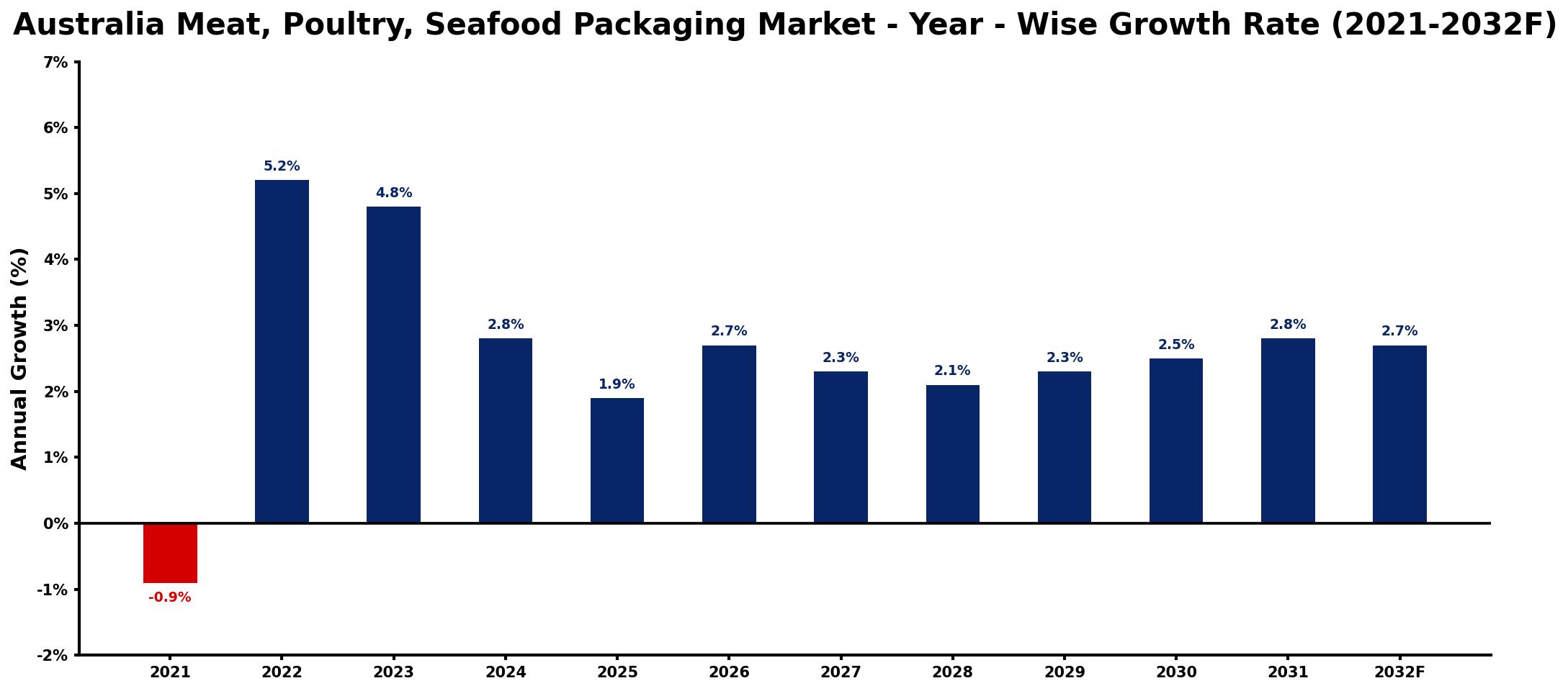
The table below presents the year‑wise growth rates along with the key drivers influencing the market
| Year | Growth Rate | Major Drivers |
| 2021 | -0.9% | Supply chain disruptions affect availability |
| 2022 | 5.2% | Rising consumer demand for convenience |
| 2023 | 4.8% | Sustainability trends drive innovation |
| 2024 | 2.8% | Increased investments in technology |
| 2025 | 1.9% | E-commerce growth enhances distribution |
| 2026 | 2.7% | Health consciousness influences purchasing |
| 2027 | 2.3% | Expansion of retail partnerships accelerates |
| 2028 | 2.1% | Emerging markets boost consumption levels |
| 2029 | 2.3% | Technological advancements improve efficiency |
| 2030 | 2.5% | Regulatory changes foster market growth |
| 2031 | 2.8% | Consumer preferences shift towards quality |
| 2032 | 2.7% | Global trade agreements enhance exports |
Note: Market size estimations and growth projections presented in this report are based on 6Wresearch's proprietary forecasting methodology, utilizing the latest available industry data, government publications, and primary research inputs.
Australia Meat, Poultry, Seafood Packaging Market Synopsis
The demand for sustainable packaging solutions is particularly pressing in the Australian market, driven by rising consumer awareness about environmental issues. This demand is prompting manufacturers to invest in eco-friendly materials and recycling initiatives, ensuring compliance with governmental regulations.
Furthermore, the growing trend of online grocery shopping is reshaping packaging requirements, as products need to be both visually appealing and secure for transportation. The diverse range of packaging options available, such as trays, pouches, and vacuum packs, is adapting to meet these evolving consumer preferences.
Australia Meat, Poultry, Seafood Packaging Market Key Takeaways
- The market is supported by an increasing consumer focus on protein-rich diets.
- Innovations in packaging technology are a significant driving force behind market growth.
- Sustainable packaging solutions are gaining traction due to regulatory and consumer pressures.
- Online shopping trends are influencing packaging design and functionality.
- Regulatory compliance remains a critical factor in packaging development.
Evaluation of Restraints in Australia Meat, Poultry, Seafood Packaging Market
While the Australia Meat, Poultry, Seafood Packaging Market shows promising growth, it faces restraints primarily related to food safety and regulatory compliance. Manufacturers must navigate stringent guidelines to ensure that packaging materials are safe for food contact and effectively prevent contamination. Additionally, the challenge of packaging waste management persists, as companies strive to balance consumer demands for convenience and sustainability with cost efficiency. This often results in complex decision-making processes that can hinder rapid innovation and adaptation in packaging solutions.
Australia Meat, Poultry, Seafood Packaging Market Trends
A noteworthy trend in the Australia Meat, Poultry, Seafood Packaging Market is the rise of active and intelligent packaging solutions. These innovations not only extend shelf life but also provide consumers with real-time information about product freshness. Furthermore, biodegradable and recyclable materials are becoming increasingly popular as consumers prioritize environmental responsibility. The integration of smart packaging technology is also fostering consumer engagement and enhancing the overall shopping experience.
Australia Meat, Poultry, Seafood Packaging Market Opportunities
The market presents several avenues for growth, particularly in the realm of sustainable packaging solutions. Companies that invest in research and development to create environmentally friendly materials stand to gain a competitive edge. Furthermore, partnerships with retailers focusing on e-commerce could yield significant opportunities, as effective packaging is crucial for protecting products during transit and ensuring customer satisfaction. Emerging markets in health and wellness are also fostering demand for specialized packaging that highlights product quality and nutritional benefits.
Government Initiatives in the Australia Meat, Poultry, Seafood Packaging Market
The Australian government plays a critical role in regulating packaging standards for the meat, poultry, and seafood industries. Organizations such as the Australia Packaging Covenant Organisation (APCO) and the Australia Meat Industry Council (AMIC) establish guidelines that ensure food safety and promote sustainable practices. Additionally, government initiatives are increasingly focused on fostering collaboration within the industry to tackle packaging waste and enhance recycling efforts, encouraging manufacturers to innovate responsibly.
Future Insights of the Australia Meat, Poultry, Seafood Packaging Market
Looking ahead to 2026-2032, the Australia Meat, Poultry, Seafood Packaging Market is expected to evolve with further advancements in packaging technologies. Companies are likely to invest more in intelligent packaging solutions that provide enhanced consumer engagement and product safety. Additionally, as sustainability becomes a non-negotiable expectation among consumers, there will be an increasing focus on eco-friendly materials and manufacturing processes. This evolution will not only enhance product appeal but also align with broader environmental goals.
Australia Meat, Poultry, Seafood Packaging Market Latest Developments (2025 - 2026)
In recent months, the industry has seen a notable shift towards smart packaging technologies, with several manufacturers exploring innovative solutions that offer real-time tracking and freshness indicators. This trend is being propelled by consumer demand for transparency and assurance of product quality. Furthermore, efforts to implement more comprehensive recycling programs are gaining momentum, with companies collaborating on initiatives to reduce packaging waste across the supply chain.
Australia Meat, Poultry, Seafood Packaging Market - Key Attractiveness of the Report
- 10 Years of Market Numbers
- Historical Data Starting from 2022 to 2025
- Base Year: 2025
- Forecast Data until 2032
- Key Performance Indicators Impacting the Market
- Major Upcoming Developments and Projects
Key Highlights of the Report:
- Australia Meat, Poultry, Seafood Packaging Market Outlook
- Market Size of Australia Meat, Poultry, Seafood Packaging Market, 2025
- Forecast of Australia Meat, Poultry, Seafood Packaging Market, 2032
- Historical Data and Forecast of Australia Meat, Poultry, Seafood Packaging Revenues & Volume for the Period 2022-2032F
- Australia Meat, Poultry, Seafood Packaging Market Trend Evolution
- Australia Meat, Poultry, Seafood Packaging Market Drivers and Challenges
- Australia Meat, Poultry, Seafood Packaging Price Trends
- Australia Meat, Poultry, Seafood Packaging Porter's Five Forces
- Australia Meat, Poultry, Seafood Packaging Industry Life Cycle
- Historical Data and Forecast of Australia Meat, Poultry, Seafood Packaging Market Revenues & Volume By Packaging Type for the Period 2022-2032F
- Historical Data and Forecast of Australia Meat, Poultry, Seafood Packaging Market Revenues & Volume By Rigid Packaging for the Period 2022-2032F
- Historical Data and Forecast of Australia Meat, Poultry, Seafood Packaging Market Revenues & Volume By Flexible Packaging for the Period 2022-2032F
- Historical Data and Forecast of Australia Meat, Poultry, Seafood Packaging Market Revenues & Volume By Product Type for the Period 2022-2032F
- Historical Data and Forecast of Australia Meat, Poultry, Seafood Packaging Market Revenues & Volume By Containers for the Period 2022-2032F
- Historical Data and Forecast of Australia Meat, Poultry, Seafood Packaging Market Revenues & Volume By Pre-made Bags for the Period 2022-2032F
- Historical Data and Forecast of Australia Meat, Poultry, Seafood Packaging Market Revenues & Volume By Food Cans for the Period 2022-2032F
- Historical Data and Forecast of Australia Meat, Poultry, Seafood Packaging Market Revenues & Volume By Coated Films for the Period 2022-2032F
- Historical Data and Forecast of Australia Meat, Poultry, Seafood Packaging Market Revenues & Volume By Others for the Period 2022-2032F
- Historical Data and Forecast of Australia Meat, Poultry, Seafood Packaging Market Revenues & Volume By Material Type for the Period 2022-2032F
- Historical Data and Forecast of Australia Meat, Poultry, Seafood Packaging Market Revenues & Volume By Polypropylene (PP) for the Period 2022-2032F
- Historical Data and Forecast of Australia Meat, Poultry, Seafood Packaging Market Revenues & Volume By Polystrene (PS) for the Period 2022-2032F
- Historical Data and Forecast of Australia Meat, Poultry, Seafood Packaging Market Revenues & Volume By Polyester (PET) for the Period 2022-2032F
- Historical Data and Forecast of Australia Meat, Poultry, Seafood Packaging Market Revenues & Volume By Thermoform for the Period 2022-2032F
- Historical Data and Forecast of Australia Meat, Poultry, Seafood Packaging Market Revenues & Volume By Aluminium for the Period 2022-2032F
- Historical Data and Forecast of Australia Meat, Poultry, Seafood Packaging Market Revenues & Volume By Others for the Period 2022-2032F
- Australia Meat, Poultry, Seafood Packaging Import Export Trade Statistics
- Market Opportunity Assessment By Packaging Type
- Market Opportunity Assessment By Product Type
- Market Opportunity Assessment By Material Type
- Australia Meat, Poultry, Seafood Packaging Top Companies Market Share
- Australia Meat, Poultry, Seafood Packaging Competitive Benchmarking By Technical and Operational Parameters
- Australia Meat, Poultry, Seafood Packaging Company Profiles
- Australia Meat, Poultry, Seafood Packaging Key Strategic Recommendations






































