Australia Printed Circuit Boards Market Summary
The australia printed circuit boards market was estimated at USD 167 Million in 2025 and is projected to reach USD 197 Million by 2032, growing at a CAGR of 2.7% from 2026 to 2032.
Australia Printed Circuit Boards Market Year-wise Growth Rate and Key Drivers
This graph highlights how the Australia Printed Circuit Boards Market has steadily grown over the past five years, supported by major growth factors.
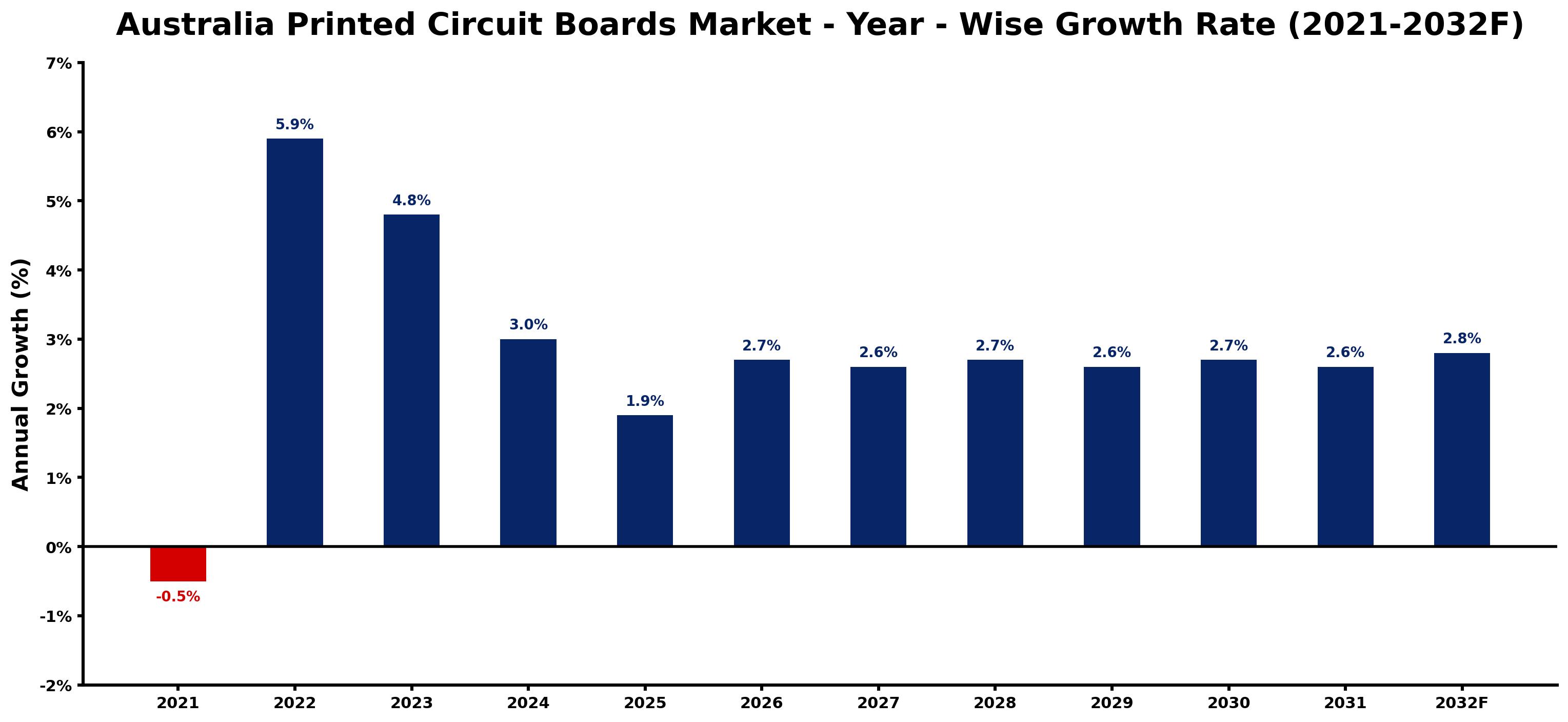
The table below presents the year wise growth rates along with the key drivers influencing the market
| Year | Growth Rate | Major Drivers |
| 2021 | -0.5% | Supply chain disruptions significantly delayed production timelines, adversely affecting market availability in the electronics sector. |
| 2022 | 5.9% | Local manufacturers are increasingly seeking advanced materials to enhance PCB quality and durability. |
| 2023 | 4.8% | Emerging technologies like IoT are creating new applications for printed circuit boards nationwide. |
| 2024 | 3.0% | Environmental concerns push manufacturers to adopt sustainable PCB production processes and materials. |
| 2025 | 1.9% | Increased collaboration between tech startups and PCB manufacturers is driving innovation in designs. |
| 2026 | 2.7% | The demand for electric vehicles is leading to heightened PCB requirements in automotive applications. |
| 2027 | 2.6% | Government incentives encourage local PCB production to reduce reliance on international suppliers. |
| 2028 | 2.7% | Post-pandemic recovery sees a surge in consumer electronics, boosting PCB market growth. |
| 2029 | 2.6% | Rising electric and hybrid vehicle production significantly elevates the need for complex PCBs. |
| 2030 | 2.7% | The integration of smart technology into everyday products is expanding PCB applications dramatically. |
| 2031 | 2.6% | Telecommunications infrastructure upgrades create heightened demand for high-frequency printed circuit boards. |
| 2032 | 2.8% | Australia's shift towards renewable energy sources increases demand for specialized PCB designs. |
Note - Market size estimations and growth projections presented in this report are based on 6Wresearch's advanced forecasting approach, validated with industry datasets as of June 2026.
Australia Printed Circuit Boards Market Synopsis
The Australia Printed Circuit Boards Market is projected to reach 2.7% and witness significant growth during the forecast period (2026-2032). This growth is primarily driven by the increasing adoption of electronics across various sectors, including industrial automation, telecommunications, and consumer electronics. The shift towards advanced PCBs, particularly flexible and multilayer designs, is gaining traction due to ongoing technological advancements. Furthermore, government support for domestic electronics manufacturing plays a crucial role in fostering market expansion, despite existing competition from international manufacturers and supply chain challenges that affect local production capabilities.
Australia Printed Circuit Boards Market Growth Drivers
Several key factors are propelling the growth of the Australia Printed Circuit Boards Market. Firstly, the rise of miniaturized electronic devices has increased the demand for sophisticated PCB designs that cater to compact and efficient performance. Secondly, the implementation of 5G technology and the expansion of Internet of Things (IoT) applications are significantly contributing to market growth by creating a higher demand for high-performance PCBs capable of supporting advanced connectivity and functionality.
- The automotive industry's evolution towards electric vehicles is increasing the need for specialized PCBs that can handle complex electronic systems while ensuring reliability and safety.
- Technological innovations in industrial automation are amplifying the need for efficient PCBs, as manufacturers seek to enhance productivity and minimize downtime through advanced electronic solutions.
- Consumer electronics, particularly in the realm of smart devices, are driving demand for PCBs that integrate advanced features and connectivity options.
- Local industries are showing a preference for domestically manufactured PCBs to mitigate supply chain risks and enhance quality control, fostering a favorable environment for local production.
- Government initiatives aimed at promoting local electronics manufacturing are likely to further stimulate demand for PCBs, as manufacturers are encouraged to invest in domestic capabilities.
Australia Printed Circuit Boards Market Challenges and Restraints
Despite the positive growth outlook, the Australia Printed Circuit Boards Market faces several challenges that could impede its progress. A significant reliance on imports for advanced materials and components limits local manufacturers' capability to innovate and compete effectively. Moreover, high production costs associated with domestic manufacturing often render local businesses less competitive compared to Asian markets that benefit from economies of scale.
- The increasing costs of raw materials and manufacturing processes can adversely affect profitability for local PCB manufacturers, necessitating strategic adaptations to maintain competitiveness.
- Limited domestic manufacturing capabilities hinder the ability to produce high-performance PCBs, leading to potential sessions of market share to international competitors.
- Supply chain disruptions, particularly in light of recent global events, pose risks to consistent production schedules and can lead to increased lead times for PCB delivery.
- Market volatility due to fluctuating demand in the electronics sector can create challenges in forecasting and inventory management for PCB manufacturers.
- The stringent regulations surrounding electronic waste management and compliance with safety standards add complexity to operational processes within the local PCB industry.
Australia Printed Circuit Boards Market Investment Opportunities
Investment opportunities within the Australia Printed Circuit Boards Market are emerging as the landscape evolves. The increasing adoption of PCBs in diverse applications, including defense and aerospace, presents avenues for growth, particularly in the realm of high-performance, specialized products. Innovations in flexible and high-density PCB designs are shaping market trends and attracting investments aimed at research and development.
- The defense sector's demand for advanced PCBs offers local manufacturers the opportunity to develop specialized solutions that meet rigorous standards and operational specifications.
- Growing interest in sustainable electronics provides avenues for innovations in eco-friendly PCB materials and manufacturing processes that align with environmental initiatives.
- Collaborations between industry stakeholders, academic institutions, and government entities can lead to the development of cutting-edge technologies that enhance PCB performance and reduce costs.
- The automotive industry's transition towards electric and autonomous vehicles is a significant growth driver, leading to increased investments in the development of bespoke PCB solutions.
- Investments in automation and smart manufacturing processes can enhance production efficiency, facilitating cost reductions and improved output quality for PCB manufacturers.
Australia Printed Circuit Boards Market Government Investment and Initiatives
The Australian government plays a vital role in shaping the landscape of the Printed Circuit Boards Market through various investments and initiatives aimed at bolstering domestic manufacturing capabilities. Regulations surrounding electronic waste management and import controls are designed to promote sustainable manufacturing practices and safeguard the environment.
- The Australian Communications and Media Authority (ACMA) enforces regulatory compliance regarding electromagnetic compatibility and radiofrequency emissions, ensuring that locally produced PCBs meet stringent standards.
- Research grants and financial incentives aimed at local PCB manufacturers encourage innovation and the development of advanced technologies, aiding in the reduction of import dependencies.
- Government policies are increasingly focused on enhancing skills within the workforce to ensure a competitive edge in the PCB manufacturing sector.
- Public investment in infrastructure is essential for supporting the growth of local PCB manufacturers and streamlining their operations.
- Environmental policies promote responsible recycling and management of hazardous materials, driving sustainability efforts within the PCB industry.
Australia Printed Circuit Boards Market Latest Developments (May 2025 - June 2026)
Recent developments within the Australia Printed Circuit Boards Market from May 2025 to June 2026 highlight a shift towards increased local manufacturing capabilities in response to global supply chain challenges. This period has seen heightened government interest in supporting domestic PCB production through various initiatives aimed at fostering innovation and creating a more resilient manufacturing landscape. Technological advancements in flexible PCB designs have gained traction, with growing interest from industries such as telecommunications and automotive. Additionally, sustainability practices are gaining importance, as manufacturers increasingly look to adopt eco-friendly materials and processes in their production operations.
Australia Printed Circuit Boards Market - Key Attractiveness of the Report
- 10 Years of Market Numbers
- Historical Data Starting from 2022 to 2025
- Base Year: 2025
- Forecast Data until 2032
- Key Performance Indicators Impacting the Market
- Major Upcoming Developments and Projects
Key Highlights of the Report:
- Australia Printed Circuit Boards Market Outlook
- Market Size of Australia Printed Circuit Boards Market, 2025
- Forecast of Australia Printed Circuit Boards Market, 2032
- Historical Data and Forecast of Australia Printed Circuit Boards Revenues & Volume for the Period 2022-2032F
- Australia Printed Circuit Boards Market Trend Evolution
- Australia Printed Circuit Boards Market Drivers and Challenges
- Australia Printed Circuit Boards Price Trends
- Australia Printed Circuit Boards Porter's Five Forces
- Australia Printed Circuit Boards Industry Life Cycle
- Historical Data and Forecast of Australia Printed Circuit Boards Market Revenues & Volume By Types for the Period 2022-2032F
- Historical Data and Forecast of Australia Printed Circuit Boards Market Revenues & Volume By Single Sided for the Period 2022-2032F
- Historical Data and Forecast of Australia Printed Circuit Boards Market Revenues & Volume By Double Sided for the Period 2022-2032F
- Historical Data and Forecast of Australia Printed Circuit Boards Market Revenues & Volume By Multi-Layer for the Period 2022-2032F
- Historical Data and Forecast of Australia Printed Circuit Boards Market Revenues & Volume By HDI for the Period 2022-2032F
- Historical Data and Forecast of Australia Printed Circuit Boards Market Revenues & Volume By Substrate for the Period 2022-2032F
- Historical Data and Forecast of Australia Printed Circuit Boards Market Revenues & Volume By Rigid for the Period 2022-2032F
- Historical Data and Forecast of Australia Printed Circuit Boards Market Revenues & Volume By Flexible for the Period 2022-2032F
- Historical Data and Forecast of Australia Printed Circuit Boards Market Revenues & Volume By Rigid-Flex for the Period 2022-2032F
- Historical Data and Forecast of Australia Printed Circuit Boards Market Revenues & Volume By End-users for the Period 2022-2032F
- Historical Data and Forecast of Australia Printed Circuit Boards Market Revenues & Volume By Industrial Electronics for the Period 2022-2032F
- Historical Data and Forecast of Australia Printed Circuit Boards Market Revenues & Volume By Healthcare for the Period 2022-2032F
- Historical Data and Forecast of Australia Printed Circuit Boards Market Revenues & Volume By Aerospace & Defense for the Period 2022-2032F
- Historical Data and Forecast of Australia Printed Circuit Boards Market Revenues & Volume By Automotive for the Period 2022-2032F
- Historical Data and Forecast of Australia Printed Circuit Boards Market Revenues & Volume By IT & Telecom for the Period 2022-2032F
- Historical Data and Forecast of Australia Printed Circuit Boards Market Revenues & Volume By Consumer Electronics for the Period 2022-2032F
- Historical Data and Forecast of Australia Printed Circuit Boards Market Revenues & Volume By Others for the Period 2022-2032F
- Australia Printed Circuit Boards Import Export Trade Statistics
- Market Opportunity Assessment By Types
- Market Opportunity Assessment By Substrate
- Market Opportunity Assessment By End-users
- Australia Printed Circuit Boards Top Companies Market Share
- Australia Printed Circuit Boards Competitive Benchmarking By Technical and Operational Parameters
- Australia Printed Circuit Boards Company Profiles
- Australia Printed Circuit Boards Key Strategic Recommendations






































