Australia Smart Cities Market Size & Growth Rate (2026-2032)
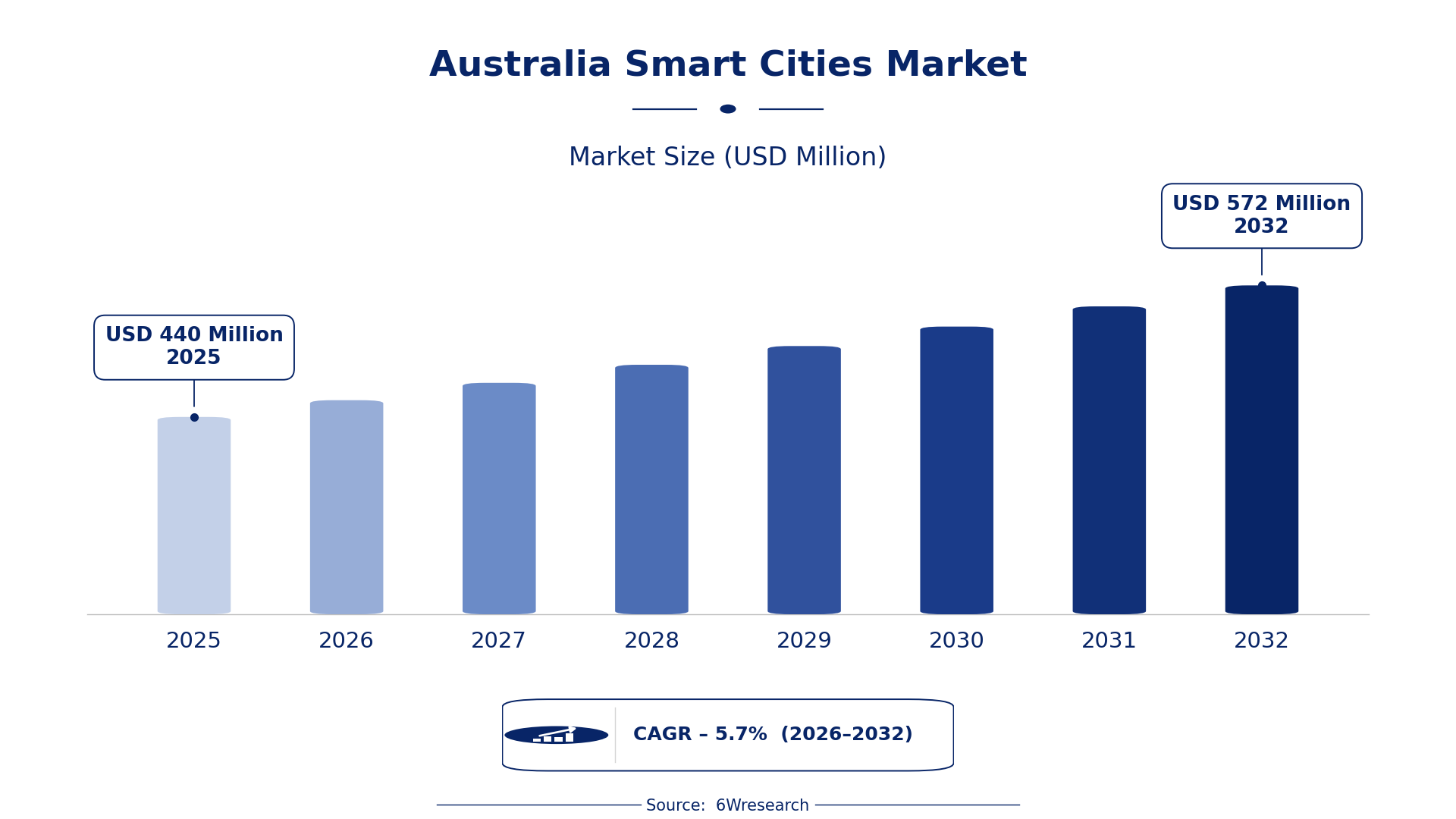
The Australia Smart Cities Market was estimated at USD 440 Million in 2025 and is projected to reach USD 572 Million by 2032, growing at a CAGR of 5.7% from 2026 to 2032.
Australia Smart Cities Market Synopsis
The transformation of urban areas into smart cities is no longer a futuristic concept in Australia; it’s happening now. Local governments and private sectors are integrating cutting-edge technologies, focusing on sustainability and enhanced living standards. This shift is evident in various sectors, including transportation, energy management, and public services.
As urbanization accelerates, the demand for innovative solutions is reshaping how cities operate. The emphasis on citizen engagement and efficient resource management is driving the momentum behind smart city initiatives. Australian cities are not just adopting technologies; they are reimagining urban life.
Australia Smart Cities Market Year-wise Growth Rate and Key Drivers
This graph illustrates the annual growth rates of the Australia Smart Cities Market from 2021 to 2032, highlighting a steady upward trajectory and projected expansion over the forecast period.
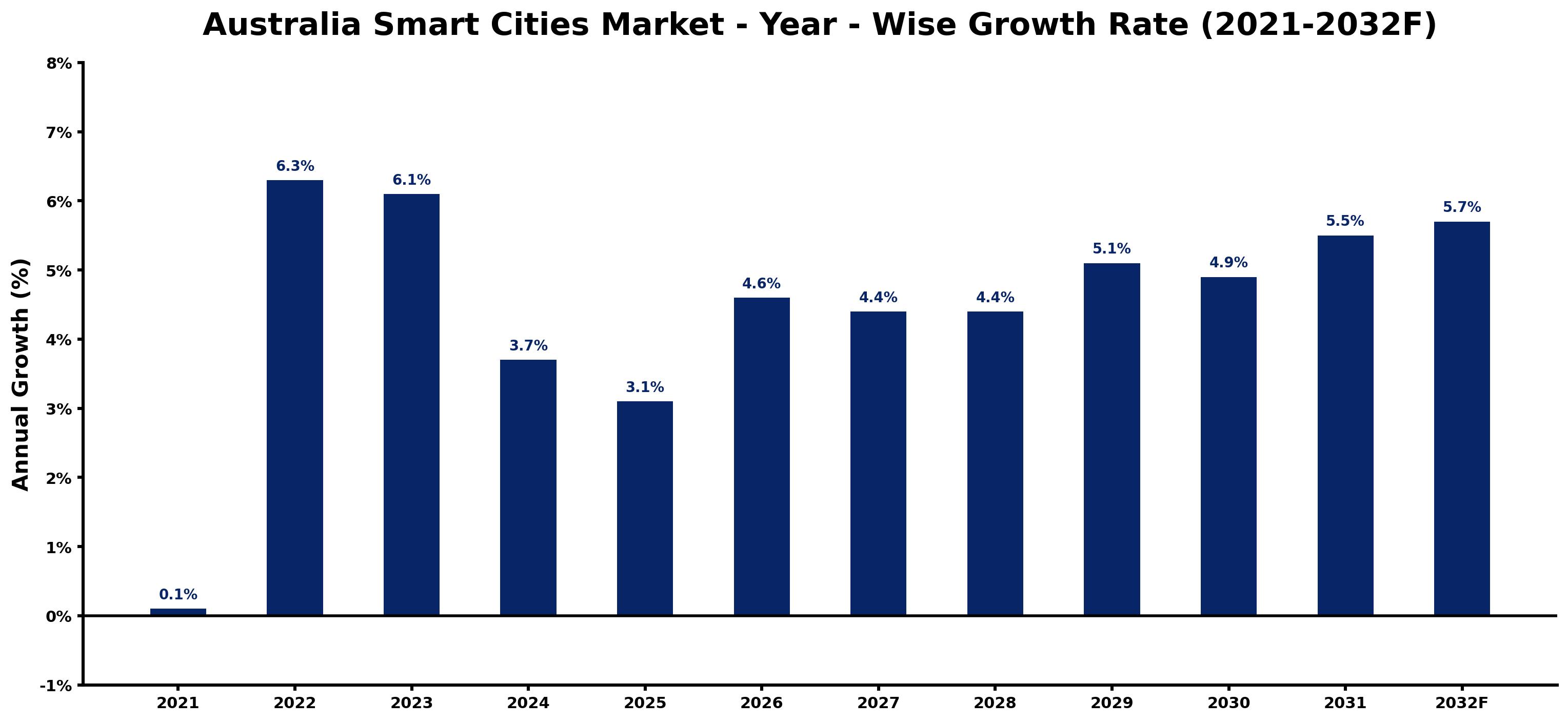
The table below presents the year‑wise growth rates along with the key drivers influencing the market
| Year | Growth Rate | Major Drivers |
| 2021 | 0.1% | Launch of Smart Cities Strategy by Australian Government |
| 2022 | 6.3% | Increased funding for urban mobility projects in cities |
| 2023 | 6.1% | Growing adoption of IoT for urban management applications |
| 2024 | 3.7% | Rise in community engagement through digital platforms |
| 2025 | 3.1% | Implementation of renewable energy solutions in public infrastructure |
| 2026 | 4.6% | Enhanced data analytics for urban planning processes |
| 2027 | 4.4% | Support for smart public transportation initiatives in cities |
| 2028 | 4.4% | Focus on sustainability in local city development policies |
| 2029 | 5.1% | Government incentives for clean technology adoption in urban areas |
| 2030 | 4.9% | Vibrant tech startup ecosystem driving smart solutions adoption |
| 2031 | 5.5% | Integration of AI in urban services offered to residents |
| 2032 | 5.7% | National support for smart waste management systems deployment |
Note: Market size estimations and growth projections presented in this report are based on 6Wresearch's proprietary forecasting methodology, utilizing the latest available industry data, government publications, and primary research inputs.
Australia Smart Cities Market Key Takeaways
Below are some of the specific key takeaways from the market, including:
- The market is increasingly driven by the integration of IoT, AI, and data analytics.
- Government policies are actively promoting sustainable urban development and technological innovation.
- Citizen engagement is a critical element in the success of smart city projects.
- Challenges remain in data privacy and security, impacting public trust and participation.
- Investment opportunities are emerging in infrastructure and technology solutions aimed at urban efficiency.
Evaluation of Restraints in Australia Smart Cities Market
The Australia Smart Cities Market faces notable restraints that could hinder its growth trajectory. One of the primary concerns is the complexity involved in coordinating various stakeholders, including government agencies, private companies, and the public. This coordination is essential for cohesive urban planning and implementation.
Additionally, the rising concerns surrounding data privacy and security present significant hurdles. Without addressing these issues, gaining public trust in smart city initiatives will remain a challenge. The need for standardized frameworks and regulations further complicates the landscape, requiring careful navigation to ensure effective deployment of smart technologies.
Australia Smart Cities Market Trends
Emerging trends in the Australia Smart Cities Market highlight a shift towards more integrated and intelligent urban solutions. The adoption of IoT devices is on the rise, leading to smarter traffic management and energy-efficient buildings. Data-driven decision-making is becoming standard, facilitating real-time responses to urban challenges.
on top of that, there is a growing emphasis on sustainability, with cities investing in renewable energy sources and waste management technologies. The trend towards enhancing citizen engagement through digital platforms is also gaining traction, ensuring that residents are active participants in the smart city ecosystem.
Australia Smart Cities Market Opportunities
The opportunities within the Australia Smart Cities Market are vast and multifaceted. Investment in smart infrastructure, such as advanced transportation systems and smart grids, presents a lucrative avenue for growth. Public-private partnerships are increasingly being explored to fund innovative projects that enhance urban living.
on top of that, the demand for integrated solutions that address climate change and urban challenges is pushing companies to innovate. Initiatives aimed at improving public services through technology, like smart waste management and enhanced public transport, are areas ripe for investment.
Government Initiatives in the Australia Smart Cities Market
The Australian government is laying a strong foundation for smart city development through a series of strategic initiatives. Public policy is heavily focused on sustainable urban growth, and regulations are being introduced to facilitate the integration of technology in city planning. These efforts are critical for fostering innovation and ensuring that urban environments meet the needs of their residents.
- A recently launched Smart Cities Plan outlines a comprehensive approach to leveraging technology for urban improvement.
- The Smart Cities and Suburbs Program is currently underway, promoting collaborative projects that enhance urban living through smart technologies.
- A national digital infrastructure upgrade program is planned, aiming to enhance connectivity across urban centers by 2028.
- Ongoing initiatives are focused on data-driven decision-making frameworks to better manage urban resources.
- A regulatory framework introduced in 2025 mandates transparency in data usage and collection within smart city projects.
Future Insights of the Australia Smart Cities Market
Looking ahead to 2026-2032, the Australia Smart Cities Market is expected to evolve significantly. The integration of AI and machine learning will likely enhance data analytics capabilities, enabling cities to respond more effectively to urban challenges. As public awareness of sustainability increases, smart city projects that emphasize eco-friendly solutions will gain traction.
Additionally, with ongoing government support and investment, the market is set to see a rise in innovative partnerships that drive technological advancements. Ultimately, smart cities will become more adaptive, resilient, and attuned to the needs of their inhabitants.
Australia Smart Cities Market Latest Developments
In the past year, the Australia Smart Cities Market has witnessed a flurry of activity as stakeholders respond to urbanization challenges. Significant developments include collaborations between local governments and technology firms to enhance urban infrastructure. There’s also a notable push for integrating green technologies into existing frameworks, reflecting a commitment to sustainability.
- A major technology vendor launched a new IoT platform in early 2025, aimed at improving city management and resource allocation.
- An initiative that began in mid-2025 is currently underway, focusing on smart public transportation systems to reduce congestion.
- A public-private partnership is expected to commence in Q3 2025, designed to upgrade digital infrastructure across major urban centers.
- A pilot project for smart waste management was completed in late 2025, showcasing improved recycling rates and reduced landfill waste.
- Plans for a comprehensive urban mobility strategy are expected to be unveiled by mid-2026, focusing on sustainable transit options.
Australia Smart Cities Market - Key Attractiveness of the Report
- 10 Years of Market Numbers
- Historical Data Starting from 2022 to 2025
- Base Year: 2025
- Forecast Data until 2032
- Key Performance Indicators Impacting the Market
- Major Upcoming Developments and Projects
Key Highlights of the Report:
- Australia Smart Cities Market Outlook
- Market Size of Australia Smart Cities Market, 2025
- Forecast of Australia Smart Cities Market, 2032
- Historical Data and Forecast of Australia Smart Cities Revenues & Volume for the Period 2022-2032F
- Australia Smart Cities Market Trend Evolution
- Australia Smart Cities Market Drivers and Challenges
- Australia Smart Cities Price Trends
- Australia Smart Cities Porter's Five Forces
- Australia Smart Cities Industry Life Cycle
- Historical Data and Forecast of Australia Smart Cities Market Revenues & Volume By Smart Citizen Services Type for the Period 2022-2032F
- Historical Data and Forecast of Australia Smart Cities Market Revenues & Volume By Public Safety for the Period 2022-2032F
- Historical Data and Forecast of Australia Smart Cities Market Revenues & Volume By Smart Healthcare for the Period 2022-2032F
- Historical Data and Forecast of Australia Smart Cities Market Revenues & Volume By Smart Education for the Period 2022-2032F
- Historical Data and Forecast of Australia Smart Cities Market Revenues & Volume By Smart Street Lighting for the Period 2022-2032F
- Historical Data and Forecast of Australia Smart Cities Market Revenues & Volume By E-Governance for the Period 2022-2032F
- Historical Data and Forecast of Australia Smart Cities Market Revenues & Volume By Focus Area for the Period 2022-2032F
- Historical Data and Forecast of Australia Smart Cities Market Revenues & Volume By Smart Transportation for the Period 2022-2032F
- Historical Data and Forecast of Australia Smart Cities Market Revenues & Volume By Smart Building for the Period 2022-2032F
- Historical Data and Forecast of Australia Smart Cities Market Revenues & Volume By Smart Utilities for the Period 2022-2032F
- Historical Data and Forecast of Australia Smart Cities Market Revenues & Volume By Smart Citizen Services for the Period 2022-2032F
- Historical Data and Forecast of Australia Smart Cities Market Revenues & Volume By Smart Buildings for the Period 2022-2032F
- Historical Data and Forecast of Australia Smart Cities Market Revenues & Volume By Component for the Period 2022-2032F
- Historical Data and Forecast of Australia Smart Cities Market Revenues & Volume By Type for the Period 2022-2032F
- Historical Data and Forecast of Australia Smart Cities Market Revenues & Volume By Smart Transportation for the Period 2022-2032F
- Historical Data and Forecast of Australia Smart Cities Market Revenues & Volume By Component for the Period 2022-2032F
- Historical Data and Forecast of Australia Smart Cities Market Revenues & Volume By Type for the Period 2022-2032F
- Historical Data and Forecast of Australia Smart Cities Market Revenues & Volume By Smart Utilities for the Period 2022-2032F
- Historical Data and Forecast of Australia Smart Cities Market Revenues & Volume By Component for the Period 2022-2032F
- Historical Data and Forecast of Australia Smart Cities Market Revenues & Volume By Type for the Period 2022-2032F
- Australia Smart Cities Import Export Trade Statistics
- Market Opportunity Assessment By Smart Citizen Services Type
- Market Opportunity Assessment By Focus Area
- Market Opportunity Assessment By Smart Buildings
- Market Opportunity Assessment By Smart Transportation
- Market Opportunity Assessment By Smart Utilities
- Australia Smart Cities Top Companies Market Share
- Australia Smart Cities Competitive Benchmarking By Technical and Operational Parameters
- Australia Smart Cities Company Profiles
- Australia Smart Cities Key Strategic Recommendations






































