Azerbaijan Art and Sculpture Market Size, Share & Growth Rate
The Azerbaijan Art and Sculpture Market was estimated at USD 1202 Million in 2025 and is projected to reach USD 2152 Million by 2032, growing at a CAGR of 8.7% from 2026 to 2032. This growth is driven by an increasing appreciation for both traditional and contemporary art forms, complemented by governmental support aimed at fostering local talent and promoting cultural heritage. The rise of art galleries, exhibitions, and public art projects has further catalyzed interest from both local collectors and international art enthusiasts.
Azerbaijan Art and Sculpture Market Year-wise Growth Rate and Key Drivers
This graph highlights how the Azerbaijan Art and Sculpture Market has steadily grown over the years, supported by major growth factors.
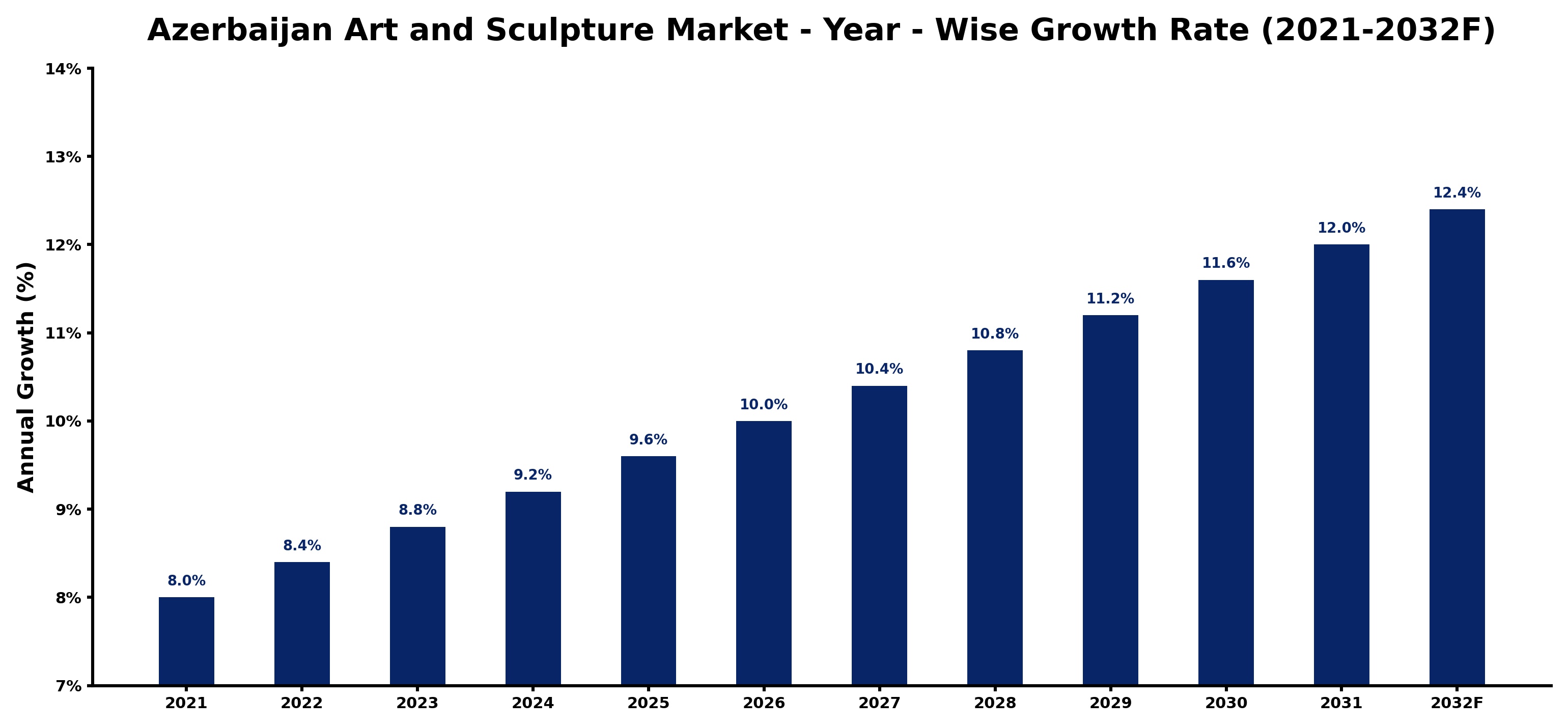
The table below presents the year‑wise growth rates along with the key drivers influencing the market
| Year | Growth Rate | Major Drivers |
| 2021 | 8.0% | Increasing adoption of advanced technologies |
| 2022 | 8.4% | Rising electricity demand across industries |
| 2023 | 8.8% | Rapid growth in telecom and data center sectors |
| 2024 | 9.2% | Growing renewable energy integration projects |
| 2025 | 9.6% | Increasing industrial automation investments |
| 2026 | 10.0% | Increasing industrial automation investments |
| 2027 | 10.4% | Expansion of manufacturing activities |
| 2028 | 10.8% | Expansion of commercial construction activities |
| 2029 | 11.2% | Government infrastructure modernization initiatives |
| 2030 | 11.6% | Growing renewable energy integration projects |
| 2031 | 12.0% | Government infrastructure modernization initiatives |
| 2032 | 12.4% | Growing urbanization and commercial development |
Note - Market size estimations and growth projections presented in this report are based on 6Wresearch's advanced forecasting approach, validated with industry datasets as of June 2026.
Azerbaijan Art and Sculpture Market Synopsis
The Azerbaijan art and sculpture market is thriving, with a notable resurgence in traditional art forms alongside modern artistic expressions. This dynamic sector is characterized by a blend of cultural heritage and contemporary creativity, making it an increasingly attractive landscape for both artists and collectors.
With government backing and a growing number of galleries and art spaces, the market is witnessing heightened activity and interest. Public art initiatives are enriching the urban environment, while emerging artists are gaining platforms to showcase their innovative works, reflecting the vibrancy and evolution of Azerbaijani art.
Azerbaijan Art and Sculpture Market Key Takeaways
- The Azerbaijan Art and Sculpture Market is projected to grow at a CAGR of 8.7% from 2026 to 2032.
- There is a significant push towards preserving traditional art while simultaneously embracing modern techniques.
- Government initiatives are aimed at enhancing the cultural sector, stimulating economic growth through tourism and art exports.
- Emerging artists are gaining prominence, supported by increasing public art projects and exhibitions.
- Investment in Azerbaijani art is becoming an attractive avenue for collectors seeking cultural significance and potential returns.
Evaluation of Restraints in Azerbaijan Art and Sculpture Market
Despite the encouraging growth, the Azerbaijan art and sculpture market grapples with several restraints that hinder its full potential. Limited government support for the arts is a primary concern, impacting the accessibility of funding for artists and organizations. The educational infrastructure for art remains underdeveloped, which can stifle creativity and professional growth among aspiring artists. Furthermore, the existing dominance of traditional art forms can overshadow contemporary expressions, leading to a smaller market for innovative art. A nascent collector base and inadequate international exposure further complicate the landscape, making it essential for stakeholders to address these issues for sustainable growth.
Azerbaijan Art and Sculpture Market Trends
The current trends within the Azerbaijan art and sculpture market highlight a growing fascination with both tradition and innovation. Artists are increasingly experimenting with new mediums, leading to unique interpretations that blend historical narratives with contemporary aesthetics. The rise of public art installations not only beautifies urban spaces but also fosters a sense of community, encouraging local engagement with the arts. Additionally, digital platforms are gaining traction, allowing artists to reach wider audiences and expanding the market's visibility beyond traditional confines.
Azerbaijan Art and Sculpture Market Opportunities
Investment opportunities abound within the Azerbaijan art and sculpture market, particularly for those looking to diversify their portfolios. As Azerbaijani artists gain international recognition, the potential for financial appreciation of artworks is significant. There is a palpable appetite among collectors for culturally resonant pieces, and supporting local artists can yield both monetary and community value. The expanding network of galleries, art fairs, and cultural exchanges further enhances the environment for investment, creating a promising outlook for potential buyers.
Government Initiatives in the Azerbaijan Art and Sculpture Market
The Azerbaijani government has taken proactive measures to bolster the art and sculpture market through various initiatives. Financial incentives and grants are being offered to artists and cultural organizations, facilitating the creation of new works. Art galleries and exhibition spaces are being established, along with art festivals and events designed to celebrate local talent. Furthermore, the government is actively working to protect cultural heritage sites and artworks, ensuring that the rich artistic traditions of Azerbaijan are preserved for future generations.
Future Insights of the Azerbaijan Art and Sculpture Market
Looking ahead to 2026-2032, the Azerbaijan art and sculpture market is positioned for significant expansion and innovation. The growing interest in cultural heritage, along with increasing governmental and institutional support, is expected to drive the market forward. Additionally, as online art platforms continue to evolve, they will likely broaden market access, attracting a diverse audience. This combination of factors suggests a robust future for Azerbaijani art, characterized by continued engagement from both local and international stakeholders.
Azerbaijan Art and Sculpture Market Latest Developments (May 2025 - June 2026)
Recent developments in the Azerbaijan art and sculpture market indicate a growing dynamism, with numerous exhibitions showcasing both emerging and established artists. Cultural festivals are increasingly highlighting the diversity of local artistic expressions, while collaborative projects between artists and galleries are fostering a vibrant creative community. There is also a noticeable trend towards integrating technology with art, paving the way for innovative presentations and audience interactions.
Azerbaijan Art and Sculpture Market - Key Attractiveness of the Report
- 10 Years of Market Numbers
- Historical Data Starting from 2022 to 2025
- Base Year: 2025
- Forecast Data until 2032
- Key Performance Indicators Impacting the Market
- Major Upcoming Developments and Projects
Key Highlights of the Report:
- Azerbaijan Art and Sculpture Market Outlook
- Market Size of Azerbaijan Art and Sculpture Market, 2025
- Forecast of Azerbaijan Art and Sculpture Market, 2032
- Historical Data and Forecast of Azerbaijan Art and Sculpture Revenues & Volume for the Period 2022-2032F
- Azerbaijan Art and Sculpture Market Trend Evolution
- Azerbaijan Art and Sculpture Market Drivers and Challenges
- Azerbaijan Art and Sculpture Price Trends
- Azerbaijan Art and Sculpture Porter's Five Forces
- Azerbaijan Art and Sculpture Industry Life Cycle
- Historical Data and Forecast of Azerbaijan Art and Sculpture Market Revenues & Volume By Types for the Period 2022-2032F
- Historical Data and Forecast of Azerbaijan Art and Sculpture Market Revenues & Volume By Artifacts for the Period 2022-2032F
- Historical Data and Forecast of Azerbaijan Art and Sculpture Market Revenues & Volume By Sculpture for the Period 2022-2032F
- Historical Data and Forecast of Azerbaijan Art and Sculpture Market Revenues & Volume By Sales Channel for the Period 2022-2032F
- Historical Data and Forecast of Azerbaijan Art and Sculpture Market Revenues & Volume By Auction Houses for the Period 2022-2032F
- Historical Data and Forecast of Azerbaijan Art and Sculpture Market Revenues & Volume By Dealers for the Period 2022-2032F
- Historical Data and Forecast of Azerbaijan Art and Sculpture Market Revenues & Volume By Galleries for the Period 2022-2032F
- Historical Data and Forecast of Azerbaijan Art and Sculpture Market Revenues & Volume By Art Fairs for the Period 2022-2032F
- Historical Data and Forecast of Azerbaijan Art and Sculpture Market Revenues & Volume By Online Sales for the Period 2022-2032F
- Historical Data and Forecast of Azerbaijan Art and Sculpture Market Revenues & Volume By Retail Outlets for the Period 2022-2032F
- Historical Data and Forecast of Azerbaijan Art and Sculpture Market Revenues & Volume By Artists Studios for the Period 2022-2032F
- Historical Data and Forecast of Azerbaijan Art and Sculpture Market Revenues & Volume By Others for the Period 2022-2032F
- Historical Data and Forecast of Azerbaijan Art and Sculpture Market Revenues & Volume By End-user for the Period 2022-2032F
- Historical Data and Forecast of Azerbaijan Art and Sculpture Market Revenues & Volume By Private Collectors for the Period 2022-2032F
- Historical Data and Forecast of Azerbaijan Art and Sculpture Market Revenues & Volume By Museums for the Period 2022-2032F
- Historical Data and Forecast of Azerbaijan Art and Sculpture Market Revenues & Volume By Real Estate Developers for the Period 2022-2032F
- Historical Data and Forecast of Azerbaijan Art and Sculpture Market Revenues & Volume By Interior Designers for the Period 2022-2032F
- Historical Data and Forecast of Azerbaijan Art and Sculpture Market Revenues & Volume By Residential Individual Buyers for the Period 2022-2032F
- Historical Data and Forecast of Azerbaijan Art and Sculpture Market Revenues & Volume By Other Professionals for the Period 2022-2032F
- Azerbaijan Art and Sculpture Import Export Trade Statistics
- Market Opportunity Assessment By Types
- Market Opportunity Assessment By Sales Channel
- Market Opportunity Assessment By End-user
- Azerbaijan Art and Sculpture Top Companies Market Share
- Azerbaijan Art and Sculpture Competitive Benchmarking By Technical and Operational Parameters
- Azerbaijan Art and Sculpture Company Profiles
- Azerbaijan Art and Sculpture Key Strategic Recommendations






































